Grass Roots 101: How Deep Do Lawn Roots Grow and Why It Matters
 James ThorntonLawn Equipment & Maintenance Expert | 20 Years
As an Amazon Associate we earn from qualifying purchases.
Brown patches by July. Footprints that stay flat. A sprinkler that never gets a day off. Same problem under all three: shallow roots. Two lawns can look identical in May and behave completely differently in August. The difference is below the blade.
The short answer: lawn grass roots can grow anywhere from under 8 inches to 5 feet deep, depending on the species, but most of the working roots sit in the top 4 to 6 inches of soil. UC Davis puts tall fescue, bermudagrass, and zoysiagrass in its deep class (18 to 60 inches of potential), and Kentucky bluegrass, ryegrass, red fescue, and St. Augustinegrass in the medium class (8 to 18 inches). NC State says most of a lawn's root system is often in the top 4 to 6 inches. Mowing, watering, and compaction decide how much of that potential your lawn actually uses.
Root depth drives three things you can see from the porch:
- How long the lawn stays green after the rain stops
- How well it holds up to kids, dogs, and mower tires
- How much of your fertilizer the grass actually catches
Most people treat all three as top-side problems. More water. More fertilizer. Lower cut to look tidy. All three push roots up. The fix runs the other way.
Most lawn grass roots work in the top 4 to 6 inches of soil, though deep-rooted grasses like tall fescue and bermudagrass can reach 5 to 6 feet in open, deep soil (UC Davis, Texas A&M). To check yours, cut a 6 to 8 inch deep slice of turf with a spade and see where the white roots stop.
Roots stuck in the top inch or two? Three settings fix most of it. Water to a depth of 6 to 8 inches, then wait for the grass to show a blue-gray cast before watering again (NC State, Clemson). Raise the deck and never cut more than a third of the blade (Kansas State). Aerate your lawn where the soil is compacted. Give it one growing season.
Grass root depth chart by grass type
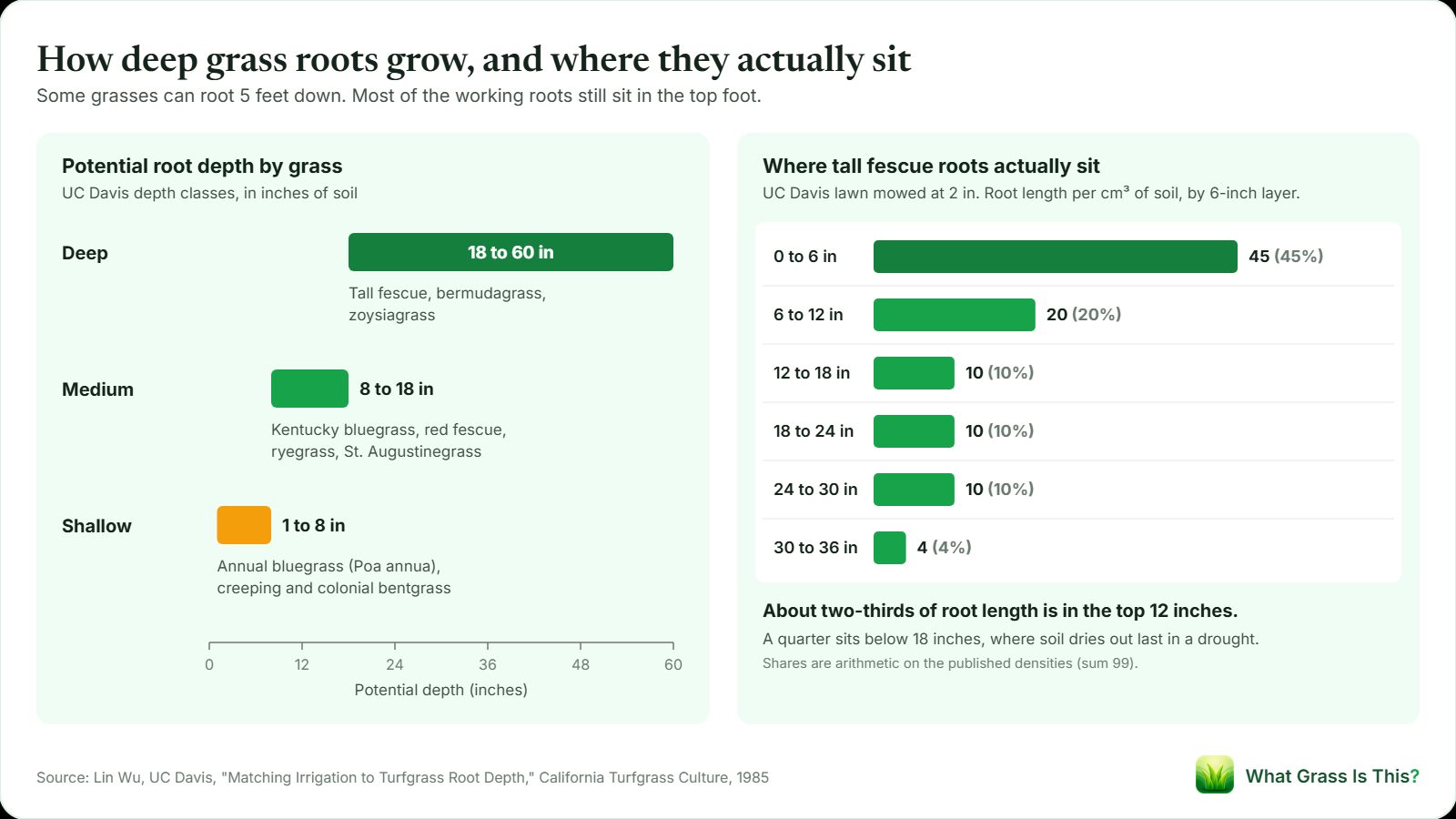
The question everybody types in: how deep do grass roots grow, by species. Two numbers matter. Potential depth, which is how far the species can go with no soil in the way. And where the working roots sit, which is where most of the water and fertilizer uptake happens. The chart below gives the potential class from UC Davis, plus what each extension source adds.
| Grass | Season | Potential depth (UC Davis class) | What the sources add |
|---|---|---|---|
| Tall fescue | Cool | Deep: 18 to 60 in | 60 in or more with no soil limit. Roots measured down to 36 in in a lawn mowed at 2 in (UC Davis) |
| Kentucky bluegrass | Cool | Medium: 8 to 18 in | About 8 in, per Nebraska Extension |
| Perennial ryegrass | Cool | Medium: 8 to 18 in | Same class as bluegrass |
| Red (fine) fescue | Cool | Medium: 8 to 18 in | Same class as bluegrass |
| Annual bluegrass, bentgrasses | Cool | Shallow: 1 to 8 in | The shallowest turf roots in the UC Davis table |
| Bermudagrass | Warm | Deep: 18 to 60 in | 6 feet or more, but 80% or more of the root system sits in the top 6 in (Texas A&M) |
| Zoysiagrass | Warm | Deep: 18 to 60 in | Once established, rarely needs irrigation to survive in North Carolina (NC State) |
| Buffalograss | Warm | Not in the UC Davis table | Three feet or more, against 8 in for bluegrass (Nebraska Extension) |
| Bahiagrass | Warm | Not in the UC Davis table | "Extensive, deep root system" (UF/IFAS) |
| St. Augustinegrass | Warm | Medium: 8 to 18 in | Majority of roots in roughly the top 8 in of Florida soil (UF/IFAS) |
| Centipedegrass | Warm | Not in the UC Davis table | "Inherently has a shallow root system" (Clemson) |
Look at bermudagrass. Six feet of potential, and 80% of it still lives in the top 6 inches. Tall fescue shows the same shape in the chart below. Deep roots are the reserve tank. The top half-foot does the daily work.
Grass roots 101: how the root system works
What are grass roots, really?
Yes, grass has roots. Every lawn grass does. They grow from the crown, the small whitish growing point right at the soil line. The crown sends leaves up and roots down. Protect it and the plant comes back from almost anything.
Some species also spread sideways on specialized stems:
- Stolons run above ground. St. Augustinegrass and centipedegrass spread this way.
- Rhizomes run below ground. Kentucky bluegrass and some zoysias use them to fill bare spots.
The roots themselves are fibrous. No taproot. Hundreds of fine strands instead of a few thick ones. That's why grass can soak up a light rain fast, and why it can rebuild roots after damage.
Roots don't grow all year at the same pace. Penn State says cool-season grasses grow the most roots at soil temperatures between 50°F and 65°F, mostly in spring and fall. Purdue says cool-season root growth declines through summer, "basically stopping once soil temperatures reach 70F." Warm-season grasses do their root building in the warm months, while they're green and growing. Check the current number for your ZIP on the soil temperature tracker before you plan any root work.
What do grass roots look like?
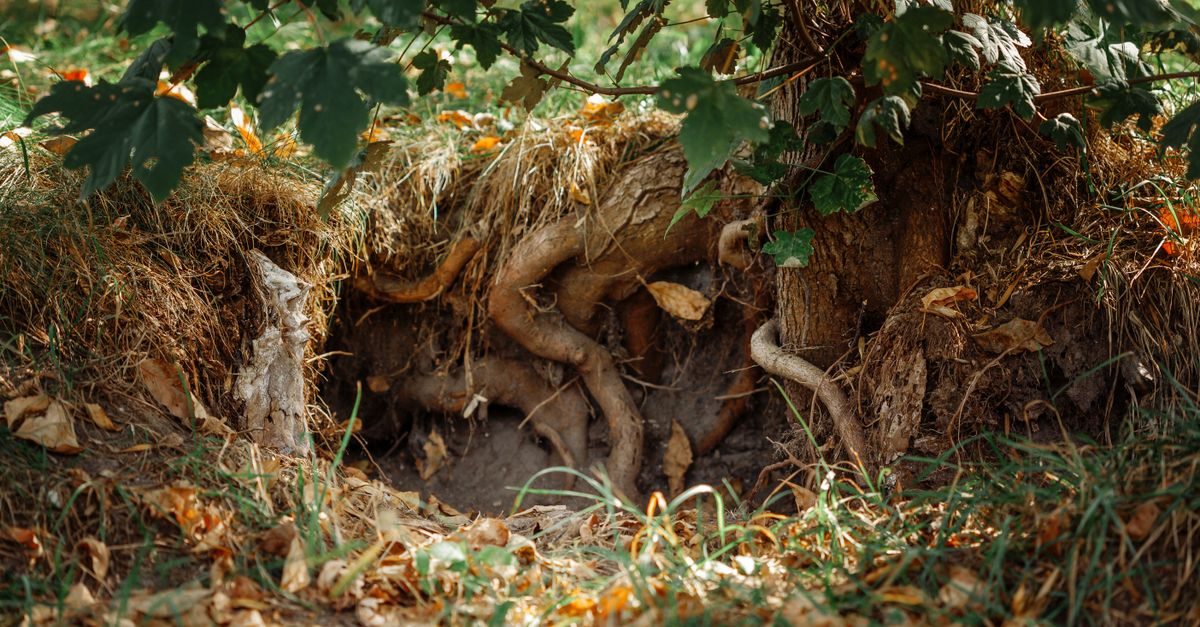
Slice into healthy turf and you'll see a dense, tangled mat of thin, thread-like strands running down from the crowns. New, active roots are bright white and firm. Older or stressed roots go tan, brown, or gray and snap easily. The top few inches often knit together so tight you can lift the sod like a flap. More white root below 4 inches means a stronger lawn.
Why root depth matters more than blade height
The blades are what you mow. The roots decide how those blades behave in August.
Soil dries from the top down. UC Davis watched it happen: after irrigation stopped, moisture was used up at the surface first, then layer by layer deeper. A lawn with roots only in the top 2 inches runs out of water first. A lawn with roots at 12 inches and below keeps drinking.
Turf people call the balance between leaves and roots the root-to-shoot ratio. Three habits wreck it:
- Cutting too low. Kansas State says removing more than a third of the blade at once "may cause root growth to cease while the leaves and shoots are regrowing."
- Heavy quick-release nitrogen. It pushes leaf growth the roots can't keep up with.
- Light daily watering. The plant finds water at the surface, so it keeps its roots there.
Flip all three and the lawn grows a bit slower on top and a lot stronger below. Dial in your deck with the mowing height calculator.
Does taller grass have deeper roots?
Yes, within the same species. Iowa State says raising the summer cut on bluegrass to 3 to 3½ inches "promotes deeper root growth." Kansas State puts it the other way around: "Turf cut too short usually has a shallow root system." Taller blades mean more leaf to make energy, and more energy goes down into roots. It won't change the species, though. A tall-mowed ryegrass lawn still won't root like tall fescue.
Does grass have deep roots?
Some grasses do. Tall fescue, bermudagrass, and zoysiagrass sit in the UC Davis deep class, 18 to 60 inches of potential. Buffalograss goes three feet or more, per Nebraska Extension. Annual bluegrass and the bentgrasses stay in the top 8 inches. Centipedegrass is shallow by nature, per Clemson. And any grass stays shallow if you scalp it and water it every day. Deep roots take two things: a species that can go deep, and management that makes it.
How deep should lawn roots be?
Use the extension numbers as the yardstick. Penn State says cool-season rooting depth "is usually between 2 and 6 inches." NC State says rooting can run from less than 4 inches to 6 to 12 inches, depending on soil and management. So here's how to read your own dig:
| Where the white roots stop | What it means | First fix |
|---|---|---|
| 1 to 2 inches | Below the extension range. Wilts fast, thins under traffic | Stop daily watering, raise the deck, check for compaction |
| 2 to 6 inches | Normal for a cool-season home lawn (Penn State) | Tune watering depth and fertilizer timing |
| 6 to 12 inches or more | The deep end of NC State's range | Keep doing what you're doing |
Four things move the number: soil type, species, climate, and management. You control the last one. Clay can hold dense roots in the top few inches and stop them there without aeration. Sand lets roots go deeper but dries out fast up top.
How deep lawn roots grow by grass type
Cool-season grasses
Cool-season grasses run the northern US and much of the transition zone. They build roots in spring and fall and lose them in summer heat. Purdue explains why: as soil warms, "root growth does not keep pace with root dieback, thus root systems naturally become shallower and lose density during the heat of summer." Plan around that. Roots you build in September carry the lawn through the next July.
Kentucky bluegrass
Dense, good-looking, spreads by rhizomes. UC Davis rates its potential depth medium, 8 to 18 inches. Nebraska Extension puts it at about 8 inches, against three feet for buffalograss. Penn State adds that bluegrass root growth is "greatly reduced" when the top inch of soil hits 90°F. The upside: rhizomes let it refill thin spots after a rough summer.
Perennial ryegrass
Germinates fast, which is why it's in so many seed mixes. Same medium class as bluegrass in the UC Davis table, and no deep-rooted reserve to fall back on. On an unwatered site, it's often the first to brown in a dry spell. Mow it high in summer, around the 3 to 3½ inches Iowa State gives for bluegrass, and water deep.
Tall fescue
The depth leader among cool-season grasses. UC Davis rates it deep, 18 to 60 inches, and notes roots "may reach a depth of 60 inches or more" with no soil limit. In a UC Davis lawn mowed at just 2 inches, researchers still found roots all the way down to 36 inches. It's a bunch grass, so it won't creep into bare spots. It makes up for that with drought staying power, which is why it's the default for transition zone lawns.
Fine fescues
Creeping red, chewings, and hard fescue. Fine texture, good shade tolerance, and happy on lean, sandy soil. UC Davis lists red fescue in the medium class, 8 to 18 inches. Heavy nitrogen and heavy watering work against them. Low input is the whole point.
Warm-season grasses
Warm-season grasses run the South and the Gulf Coast. Several of them are the deepest-rooted lawn grasses you can plant.
Bermudagrass
Texas A&M says bermudagrass roots "can grow to a depth of six feet or more depending on soil characteristics." Also Texas A&M: "the majority of the root system, 80% or more, is found in the top 6 inches of soil." Mow it at 1 to 2 inches, Texas A&M's home lawn range, and water it deep. Scalp it and water it daily and you're wasting the best root system in the yard.
Zoysiagrass
Dense, carpet-like, spreads by both stolons and rhizomes. UC Davis puts it in the deep class with bermuda and tall fescue. NC State says an established zoysia lawn "rarely needs irrigation to survive in North Carolina." It's slow to establish, so full depth takes time. Thick thatch in older zoysia lawns can hold roots near the surface. Aerate or dethatch when the thatch builds up.
St. Augustinegrass
Stolon-spreading, common in Florida and along the Gulf. UC Davis rates it medium. UF/IFAS says a ½ to ¾ inch watering reaches "roughly the top 8 inches of soil where the majority of the roots are." Mow standard varieties like Floratam at 3.5 to 4 inches, per UF. Water when it shows stress, then soak that top 8 inches.
Centipedegrass
The low-maintenance Southeast grass. Clemson says it "inherently has a shallow root system," so it shows drought stress sooner than bermuda. Clemson's settings: mow at 1½ to 2 inches, water only when stress shows, then water to a depth of 6 inches. Go light on fertilizer.
Bahiagrass
Coarse, tough, built for sandy soil and low inputs. UF/IFAS says it "forms an extensive, deep root system." In a long drought it goes dormant and browns, then comes back. UF's settings: mow at 3 to 4 inches, ½ to ¾ inch of water per application.
When roots grow: the soil temperature calendar
Time the root work to soil temperature:
- Cool-season, spring and fall (soil 50 to 65°F): peak root growth (Penn State). Aerate, overseed, and feed here.
- Cool-season, summer (soil 70°F and up): root growth "basically stopping" (Purdue). Mow high, go easy on nitrogen, water deep.
- Warm-season, late spring through summer: the growing season, and the root-building season. Aerate once the grass is fully green.
- Warm-season, fall: growth slows toward dormancy. Heavy nitrogen this late mostly feeds leaves.
Why deeper roots matter for everyday lawn care
Deep roots buy time. UC Davis measured how much. They shut off the water on a tall fescue lawn mowed at 2 inches and tracked how much green leaf was left as the soil dried deeper:
| Days without water | Soil dried down to | Green leaf area left |
|---|---|---|
| 15 | 6 to 12 inches | About 60% |
| 30 | 18 inches | 50% |
| Later | 24 inches | 30% |
| Later | 36 inches | 20% |
Water came back on after six weeks. The lawn recovered in three. That's what roots at 18 to 36 inches do. A lawn with 2 inch roots has nothing below the dry layer to draw on.
Water. NC State: "A healthy durable turf that withstands minor drought is achieved by irrigating thoroughly but as infrequently as possible." Fewer, bigger waterings. Less total water over a season, and less of the constantly damp surface that disease likes.
Fertilizer. Nitrogen that moves below a shallow root zone is gone. A deeper root system catches more of it. Timing matters too, more on that below.
Disease and stress recovery. Most leaf diseases hit the blades, but recovery comes from the crowns and roots. More roots, faster regrowth. Brown patch on tall fescue gets worse with heavy nitrogen and evening watering, the same habits that keep roots shallow.
Traffic and compaction. Heavy foot and tire traffic packs the top layer and holds roots up. Core aeration pulls plugs and opens channels for roots and water. On a compacted lawn, repeat aeration over one to three years turns a shallow root zone into a deeper one.
How to encourage deeper lawn roots: practical steps and timelines
You don't need to tear out the lawn to change root depth. You need to change five habits. Here's the short version:
| Practices that deepen roots | Practices that keep roots shallow |
|---|---|
| Mow tall and follow the one-third rule | Frequent low mowing or scalping |
| Deep, infrequent watering that lets soil dry between cycles | Light watering every day |
| Slow-release nitrogen applied in the right season | Heavy quick-release nitrogen at the wrong time |
| Annual core aeration to relieve compaction | Ignoring compaction and thatch buildup |
| Overseeding with deeper-rooted species where suited | Relying on shallow-rooted species through drought |
1. Adjust mowing height and frequency
Fastest lever you've got. Treat one-third like the redline on a tach: never cut more than a third of the blade in one pass (Texas A&M, Kansas State). Kansas State's example: bluegrass kept at 2 inches gets mowed when it hits 3.
Deck settings, with the source for each:
- Kentucky bluegrass in summer: 3 to 3½ inches. (Iowa State) Tall fescue and ryegrass do fine in the same range.
- Bermudagrass: 1 to 2 inches. (Texas A&M)
- Zoysiagrass: 1 to 1½ inches. (Kansas State)
- St. Augustinegrass, standard varieties: 3.5 to 4 inches. Dwarf varieties 2 to 2.5. (UF/IFAS)
- Centipedegrass: 1½ to 2 inches. (Clemson)
- Bahiagrass: 3 to 4 inches. (UF/IFAS)
Mowing short now? Raise the deck in steps so each cut still follows the one-third rule. Set it. Leave it.
2. Change watering patterns to favor depth
This is the big one. Soak the soil to the depth you want roots, then let the top dry before the next round. NC State's target: "Water established lawns to a depth of 6 to 8 inches to encourage deep rooting." Clemson's trigger for the next round: wait until the grass "takes on the slight blue-gray cast."
How much water reaches 6 inches depends on your soil:
| Soil | Water to wet the root zone | Source |
|---|---|---|
| Sandy | As little as ½ inch reaches 6 inches | Colorado State |
| Florida sand under St. Augustine | ½ to ¾ inch reaches roughly 8 inches | UF/IFAS |
| Clay | 1 to 1½ inches to reach 6 inches | Colorado State |
Loam falls between the two. Don't guess. Measure:
- Catch cups. Set a few straight-sided cans, tuna cans work, across the zone. Run the sprinkler 30 minutes and measure. Half an inch in 30 minutes means 1 inch takes an hour.
- Probe it. NC State says check the depth 6 to 8 hours after watering. UF says a screwdriver should push in 6 to 8 inches. Stops short? Run longer next time.
- Wait for the signal. Water again when the lawn turns blue-gray. A daily timer can't see that. Clemson's rule of thumb is about an inch a week total for most turfgrasses.
Soil dries top down, so each deep soak followed by a dry-down pulls roots after the water. Build the run times into a plan with the watering schedule tool. One morning with catch cups beats a season of guessing.
3. Use fertilization to support roots, not just top growth
Fertilizer timing matters as much as the rate. For cool-season lawns, Purdue's program puts the heaviest nitrogen in late summer and fall and none in summer for a lawn that isn't irrigated. Purdue's single-pass cap: "Do not apply more than 1.0 pound of actual water-soluble N per 1,000 square feet in any single application." Slow-release products let you feed steady without a flush of top growth.
Warm-season lawns get fed while they're green and growing, late spring through summer, and taper off as they head for dormancy. Nitrogen late in the season on warm-season turf feeds leaves the plant is about to shut down.
4. Relieve compaction and improve soil structure
Packed soil blocks roots and starves them of air. UC Davis lists compaction first among the things that "reduce turfgrass root growth." Core aeration is the fix. Aerate when the soil is moist and the grass is actively growing:
- Cool-season lawns: once a year in early fall. High-traffic lawns can take a second pass in spring.
- Warm-season lawns: once a year in late spring or early summer, once the grass is fully green.
Topdress with a thin layer of compost right after aerating and rake it into the holes. See how to aerate your lawn the right way for the machine settings.
5. Choose or overseed with deeper-rooted species where appropriate
Species sets the ceiling. Mowing and watering decide how close you get to it. If a transition zone lawn is mostly ryegrass and fries every July, overseeding with tall fescue raises the ceiling from medium to deep.
- Cool-season, sunny and dry: tall fescue.
- Shade or low input: fine fescues.
- Warm-season renovation: bermudagrass or zoysiagrass if drought and traffic are the problem. Buffalograss on the dry Plains.
Overseeding windows follow root season: late summer to early fall for cool-season grass, late spring to early summer for warm-season. See overseeding best practices for seeding rates and aftercare.
Recommended products

MySoil Soil Test Kit
A mail-in lab test that reports pH and 13 nutrients from one small soil sample.

The Andersons PGF Complete 16-4-8
A slow-release 16-4-8 with humic acid and small particles that feed roots without forcing a flush of top growth.
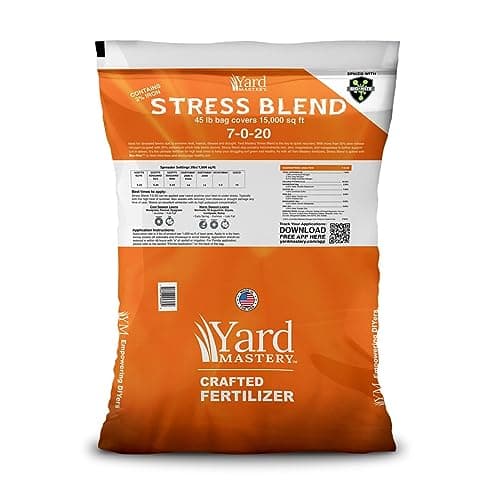
Yard Mastery Stress Blend 7-0-20
A high-potassium, low-nitrogen granular built for root and cell-wall strength rather than color.
Diagnosing your current root depth
Measure before you change anything. Colorado State's advice: "Use a soil probe or shovel to determine what the average rooting depth is in your lawn." A spade does the job.
- Grab a sturdy trowel, soil knife, or narrow spade.
- Cut a slice about 4 to 6 inches wide and 6 to 8 inches deep.
- Pry it back like a flap and look for where the white roots thin out.
Dig in three spots: a high-traffic path, an open sunny area, and a low-traffic corner. Compare them against the table in the root depth section above. Recheck in late spring or early fall for cool-season lawns and midsummer for warm-season lawns. Same spots, same spade. That's the tracking system.
What other guides get wrong about lawn roots
Most of the confusion comes from three beliefs.
"More water means deeper roots"
Backwards. Light daily watering keeps the surface wet, so roots stay at the surface. Clemson says plants that get "deep but infrequent irrigation are healthier. Their root systems extend deeper in the soil, looking for water."
"All grass roots grow about the same depth"
UC Davis's potential depths run from under 8 inches for bentgrass to 60 inches for tall fescue. Expecting ryegrass to ride out a drought like tall fescue sets you up for a bad August. Identify your grass type first, then set your expectations.

"Green on top means healthy roots"
A lawn fresh off a nitrogen feeding and daily watering can be bright green with roots in the top inch. That look lasts until the first heat wave or watering ban. Color tells you about the last few weeks. The spade tells you about the next few months.
Putting it all together: a root-first lawn plan
Going from shallow and needy to deep and tough takes one to three growing seasons. Match the work to root season:
| Season | Cool-season lawn | Warm-season lawn |
|---|---|---|
| Spring | Raise the deck. Light feeding only. Aerate compacted spots. | Set the deck for your species. Aerate once fully green. Start feeding as growth takes off. |
| Summer | Mow high. No nitrogen on unwatered lawns (Purdue). Water deep, early morning, only on the blue-gray signal. | Water deep to 6 to 8 inches. Mow on schedule, no scalping. Feed only if color and density need it. |
| Fall | Aerate and overseed thin areas. Heaviest feeding of the year, max 1 lb water-soluble N per pass (Purdue). | Taper nitrogen as growth slows. Keep watering deep until dormancy, then back off. |
The punch list:
- Dig a slice and measure where the white roots stop.
- Raise the deck to your species' range. One-third rule every cut.
- Run catch cups. Set run times to wet 6 to 8 inches.
- Water on the blue-gray signal. Skip the daily timer.
- Aerate compacted areas in your grass's root season.
- Put the heavy feeding where the roots are growing: fall for cool-season, summer for warm-season.
- Dig again next season. Same spots.
For the next steps, identify your grass if you haven't yet, then work through how to aerate your lawn the right way. Same job every season. Same weeks. That's the whole trick to it.

Top Picks
- Jonathan Green (10322) Black Beauty Ultra Grass Seed - Cool Season Lawn Seed (7 lb)Check price on Amazon
- Jacklin Seed by Barenbrug Heisman Kentucky Bluegrass Blend (5 lb)Check price on Amazon
- Pennington Full Season Lawn Fertilizer 32-0-5Check price on Amazon
As an Amazon Associate we earn from qualifying purchases.
Free Lawn Care Tools
Lawn grass roots can grow from under 8 inches to 5 feet deep depending on the species, but most of the working roots sit in the top 4 to 6 inches of soil. UC Davis rates tall fescue, bermudagrass, and zoysiagrass as deep-rooted (18 to 60 inches of potential) and Kentucky bluegrass, ryegrass, red fescue, and St. Augustinegrass as medium (8 to 18 inches). NC State says most of a lawn's root system is often in the top 4 to 6 inches. Tall mowing, deep infrequent watering, and aeration push roots deeper.
Bermudagrass roots can grow six feet deep or more, depending on the soil, according to Texas A&M. The same source says 80% or more of the root system is still in the top 6 inches of soil. Mow it at 1 to 2 inches and water deep and infrequently to use that depth. Scalping and light daily watering keep the roots near the surface.
Tall fescue is the deepest-rooted common cool-season grass, with a potential depth of 18 to 60 inches in the UC Davis classification. In a UC Davis lawn mowed at just 2 inches, tall fescue roots were measured down to 36 inches, though 45% of root length sat in the top 6 inches. Fine fescues such as creeping red fescue fall in the medium class, 8 to 18 inches. Mow high and water deep to keep fescue rooting toward the deep end.
Kentucky bluegrass roots typically reach about 8 inches deep, according to Nebraska Extension, and UC Davis rates its potential at 8 to 18 inches. Penn State says cool-season rooting depth is usually 2 to 6 inches in practice, and bluegrass root growth drops sharply when the top inch of soil hits 90°F. Mow it at 3 to 3½ inches in summer, per Iowa State, to keep roots growing. Its rhizomes help it refill thin spots after summer.
Some grasses have deep roots and some do not. Tall fescue, bermudagrass, and zoysiagrass are in the UC Davis deep class (18 to 60 inches), and Nebraska Extension says buffalograss roots three feet or more. Annual bluegrass and bentgrasses stay in the top 8 inches, and Clemson calls centipedegrass inherently shallow-rooted. Any grass stays shallow if it is mowed too low and watered lightly every day.
Healthy grass roots look like a dense mat of fine, white, thread-like strands running down from the crown at the soil line. New, active roots are bright white and firm, while older or stressed roots turn tan, brown, or gray and snap easily. There is no taproot. The more white root you find below 4 inches, the stronger the lawn.
Yes, within the same species, grass mowed taller grows deeper roots. Iowa State says raising the summer cut on bluegrass to 3 to 3½ inches promotes deeper root growth, and Kansas State says turf cut too short usually has a shallow root system. Taller mowing will not make a medium-rooted grass like ryegrass root as deep as tall fescue.
No, watering more often keeps roots shallow because the plant finds water at the surface. Clemson says lawns that get deep but infrequent irrigation grow roots deeper into the soil looking for water. NC State recommends watering established lawns to a depth of 6 to 8 inches, then waiting until the grass shows a slight blue-gray cast (Clemson) before watering again.
Mowing too low reduces root depth because the plant spends its energy replacing leaves instead of growing roots. Kansas State says removing more than one-third of the blade at once may cause root growth to stop while the leaves regrow. Follow the one-third rule and keep the deck in your species' range, such as 1 to 2 inches for bermudagrass (Texas A&M) and 3.5 to 4 inches for standard St. Augustinegrass (UF/IFAS).
A deep-rooted lawn stays green longer after watering stops, springs back from footprints, and recovers quickly from heat or light scalping. A shallow-rooted lawn wilts fast, holds footprints, and thins in traffic. The sure test is a spade: cut a 6 to 8 inch deep slice and see where the white roots stop. Penn State puts typical cool-season rooting at 2 to 6 inches, so roots stuck in the top inch or two need work.
Photos: Makrufin Muhammad / Pexels, Allan Mas / Pexels

Beat weeds and brown spots from your phone
Snap a photo, get the fix, and follow a plan timed to your soil and weather. Free on iPhone.