How to Get Thick Grass
 James ThorntonLawn Equipment & Maintenance Expert | 20 Years
As an Amazon Associate we earn from qualifying purchases.
Thick grass means a high density of healthy grass plants per square foot, not just tall or overgrown turf. When the lawn is truly dense, you see blades, not soil, even when you look straight down into the canopy.
A thick lawn matters because it naturally resists weeds, holds better color, feels softer underfoot, and handles drought and traffic far better than thin turf. Many homeowners search for how to get thick grass fast, but lasting thickness comes from improving conditions for roots and soil, then managing mowing, water, and nutrients correctly.
Several common misconceptions get in the way. Raising the mowing height helps, but it will not magically fix compacted soil or poor fertility. More fertilizer does not automatically mean thicker grass and can actually thin turf by burning roots or increasing disease. Overseeding once and walking away rarely works either if the soil, timing, and watering are off.
This guide walks through how to evaluate where your lawn stands today, create a practical step-by-step plan to thicken grass, understand seasonal timing, and avoid the common mistakes that waste time and money.
If you can see soil when you look down into the lawn or easily separate clumps of grass with your fingers, the issue is usually low plant density, not just mowing height. Confirm by checking several spots and counting stems in a 2 inch by 2 inch area, if you see mostly bare ground instead of stems and roots, you are dealing with a thin lawn that needs overseeding plus soil improvement.
The fix typically requires three parts, loosen compacted soil through core aeration, correct pH and nutrients with products based on a soil test, and overseed with a grass type suited to your region at the right season. Avoid the temptation to simply dump high nitrogen fertilizer on the lawn or seed at the wrong time, those approaches often cause flushes of top growth without lasting thickness.
For cool-season lawns, the best window to thicken grass is early fall, usually September to early October, when soil is warm but air is cooler. For warm-season lawns like Bermuda or Zoysia, late spring to early summer when soil temperatures are at least 65°F gives the fastest fill in. With correct timing, watering about 1 inch per week, and proper mowing height, you can see noticeably thicker turf in 4 to 8 weeks, with full results often taking a full growing season.
Know Your Lawn First: The Foundation of Thick Grass
Before you decide what to do, you need to know what you are working with. Grass type, current lawn condition, and soil health all change how to get thick grass efficiently. Skipping this diagnostic step is why many people repeat seeding or fertilizing with disappointing results.
Understand Your Grass Type (Cool-Season vs Warm-Season)
Cool-season grasses include Kentucky bluegrass, tall and fine fescues, and perennial ryegrass. They thrive in northern regions and transition zones, with growth peaks in spring and fall when air temperatures are roughly 60 to 75°F. These grasses tend to struggle in mid-summer heat, often going partially dormant or thinning if stressed.
Warm-season grasses such as Bermuda, Zoysia, St. Augustine, and Centipede prefer hotter climates in the South and parts of the lower transition zone. They grow most strongly in late spring through summer when soil temperatures are consistently above about 65°F, and they typically go brown and dormant in winter.
Grass type matters for thickening because it controls your best timing for overseeding, ideal mowing heights, and fertilizer schedule. For example, cool-season lawns are best overseeded in early fall, while warm-season lawns are usually thickened by encouraging lateral spread in late spring and early summer, sometimes with spot seeding of compatible varieties.
If you do not know your grass type, you can usually narrow it down by region and visual clues. Cool-season lawns generally dominate in the northern half of the US, while warm-season grasses dominate in the South. Cool-season grasses often have softer, finer blades, especially fescues, while warm-season types like Bermuda feel coarser and spread with visible runners (stolons) across the soil surface. Pull a small plug with a trowel, cool-season bunch grasses grow in clumps, while many warm-season grasses show rhizomes or stolons weaving horizontally through the soil and thatch.
Evaluate Current Lawn Health and Thickness
Next, assess how thin or thick your turf actually is. Stand in several spots and look straight down. If you can easily see soil between blades, or the canopy looks patchy, density is low. A quick hand test is to pinch a 2 inch by 2 inch area, if you can count only a few stems and see bare ground between them, the area is thin. Healthy dense turf often has so many stems that you cannot see soil without pushing the blades aside.
Note where thinness is worst. Shade often leads to thin grass because many species, especially Bermuda and Kentucky bluegrass, prefer full sun. High traffic areas such as paths, kids play zones, or dog areas often show compaction and wear. You may also see irregular dog spots, which appear as small dead or burned patches surrounded by dark green stimulated growth.
In some cases, a thickening strategy is not enough and a full renovation is more efficient. If more than about 50 percent of the lawn is weeds, the seed bank and competition are so high that trying to thicken the remaining turf is often frustrating. Large dead areas that do not green up with normal irrigation, or domination by invasive grasses like nutsedge or widespread crabgrass, are other signs that you may be better off doing a full kill and reseed or resod rather than piecemeal thickening.
Test Your Soil: The Hidden Key to Thick Grass
Soil ultimately controls how many grass plants can live in a given area. Poor pH, low nutrients, or compaction limit roots and keep grass from tillering (producing new shoots), which is what builds thickness. Without fixing soil issues, extra seed or fertilizer rarely results in durable density.
At minimum, use a home pH test kit to get a rough idea of whether your soil is acidic (below 6.0), neutral, or alkaline (above 7.5). For best results, send a sample to your local cooperative extension service or a reputable lab. A full soil test reports pH, phosphorus, potassium, and sometimes organic matter, and will include specific recommendations for lime or fertilizer.
Most cool-season grasses prefer a pH between about 6.0 and 7.0, while many warm-season grasses can tolerate slightly more acidic soils down to about 5.5. Organic matter in the 3 to 5 percent range supports good root growth and moisture retention, which directly improves lawn thickness. If the test reports very low phosphorus and you plan to overseed, that is especially important because phosphorus supports strong root and seedling establishment.
Once you have soil results, you can decide whether you need lime or sulfur to adjust pH, whether to choose a starter fertilizer with phosphorus for seeding, and whether to add compost or topdressing to improve organic matter. The guide on lawn soil testing and how to read your results explains this process in more detail.
Step 1: Fix the Soil So Grass Can Grow Thick
After diagnosis, the first real step in how to get thick grass is making sure your soil chemistry and structure support dense roots. Grass can only be as thick as the root system and soil allow.
Adjust Soil pH and Nutrients
Soil pH affects how available nutrients are to grass. If pH is too low (strongly acidic) or too high (strongly alkaline), nutrients like phosphorus, iron, and manganese get locked in forms the plant cannot use, even if you add fertilizer. This often shows up as yellowing, weak growth, and difficulty thickening despite feeding.
Use your soil test to guide pH correction. If pH is below the recommended range, apply lime at the rate and timing the report specifies. If pH is too high, elemental sulfur or acidifying fertilizers can gradually lower it. For many homeowners, one of the biggest gains in thickness comes from bringing pH into the 6.0 to 7.0 range rather than adding more nitrogen.
For nutrient balance, prioritize nitrogen, phosphorus, and potassium. Nitrogen drives green color and top growth, but excessively high nitrogen, especially in hot weather, can cause thatchy, weak turf that is more prone to disease and thinning. Phosphorus is critical for roots and new seedlings, so a starter fertilizer with a higher middle number is helpful when overseeding, where allowed by local regulations. Potassium boosts stress tolerance, which helps the lawn stay thick through heat, cold, and traffic.
Follow the recommended seasonal fertilizer schedule for your grass type. Cool-season lawns typically do best with 2 to 4 pounds of nitrogen per 1000 square feet per year, split into 2 to 4 applications in spring and especially fall. Warm-season lawns usually get similar total nitrogen, but heavily focused in late spring and summer when they are actively growing.
- Penn State Extension recommends 2 to 3 pounds of nitrogen per 1000 square feet per year for most home lawns, split across several applications, to support density without excessive growth.
Improve Soil Structure and Drainage
Even with perfect pH and nutrients, compacted or poorly structured soil limits root depth and plant count per square foot. If your lawn puddles after rain, feels hard underfoot, or fails the screwdriver test (you cannot push a screwdriver or soil probe 6 inches deep with moderate effort), compaction is likely restricting thickness.
Core aeration is one of the best tools for improving soil structure. A core aerator pulls small plugs, usually 2 to 3 inches deep, which reduces surface compaction and creates channels for air, water, and roots. Over time, the holes fill with loosened soil and organic matter, and grass roots expand into them, producing a denser, deeper root system.
Timing matters. Aerate cool-season lawns in early fall or early spring, with early fall generally preferred because recovery is faster. Aerate warm-season lawns in late spring through early summer, when they are growing vigorously. Avoid aerating during peak summer heat for cool-season grass or during winter dormancy for warm-season types.
Thatch is a layer of undecomposed stems and roots at the soil surface. A thin thatch layer up to about 0.5 inch is normal, but thicker layers can block water and nutrients and prevent seed from contacting soil. If your lawn feels spongy and a slice test shows more than about half an inch of thatch, mechanical dethatching before seeding can help. Many homeowners combine dethatching, core aeration, and overseeding into a single fall or spring project for cool-season grass.
Step 2: Use Mowing, Water, and Fertilizer to Build Thickness
Once soil conditions are improving, everyday lawn care practices either support or undermine thickness. Dialing in mowing, watering, and feeding is what maintains a thick lawn after you repair it.
Set the Right Mowing Height and Schedule
Mowing height has a direct impact on lawn density. Taller grass generally has deeper roots and shades the soil surface, which helps crowd out weeds and keep moisture for new tillers. However, there is an optimal range by grass type, not a single magic height.
Most cool-season lawns do best in the 3 to 4 inch range, while many warm-season grasses perform well around 1 to 2 inches, except St. Augustine which usually prefers 3 to 4 inches. Check recommendations for your species, then stay in the upper half of that recommended range if your goal is thickness.
Follow the one-third rule, never remove more than one-third of the blade at a single mowing. If the lawn has gotten tall, raise the mower and gradually bring it down over several cuts. Scalping, or cutting too low, stresses the grass, exposes soil, and quickly leads to thinning and weeds.
Water Deeply and Infrequently
Watering patterns shape root depth. Frequent light watering keeps roots shallow near the surface, which makes the lawn more vulnerable to heat and traffic and less able to fill in. Deep, infrequent watering encourages roots to explore deeper soil, supporting more plants per square foot.
Most lawns perform best with about 1 to 1.5 inches of water per week from rain or irrigation during the growing season. Instead of watering daily, aim to apply that amount in 1 or 2 deep soakings. Use a simple rain gauge or a tuna can under the sprinkler, when it fills to about 0.5 inch, that is your run time for that zone.
Water early in the morning, usually between 4 a.m. and 9 a.m., to reduce evaporation and disease risk. If you see signs of drought stress like bluish-gray color or footprints that remain visible, adjust your watering schedule rather than just fertilizing more.
Feed for Steady Growth, Not Spurts
To maintain thick grass, supply nutrients in moderate, well timed doses. Overfertilizing in spring, especially with high nitrogen products, pushes excessive top growth at the expense of roots, creating a cycle of needing more water and more mowing while the stand actually thins over time.
For cool-season lawns, prioritize feeding in early fall and late fall, for example, one application around Labor Day and one 4 to 6 weeks later. A lighter spring feeding around soil temperatures of 55°F to 60°F can help, but avoid heavy spring doses. For warm-season lawns, feed mainly from late spring through mid summer when the grass is solidly green and actively growing.
Use slow release fertilizers when possible, especially on cool-season lawns, to provide a steady supply of nitrogen without spikes. Follow labeled rates, commonly around 0.75 to 1 pound of nitrogen per 1000 square feet per application. More is not better for thickness, it is better to spread the recommended yearly total across the correct windows.
- NC State Extension notes that core aeration combined with fall fertilization in cool-season lawns significantly increases turf density within one growing season compared to fertilization alone.
Recommended products
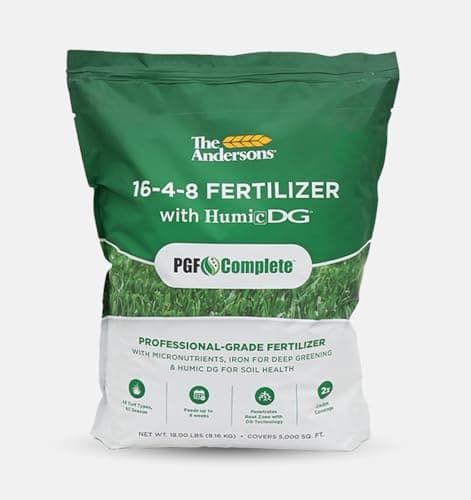
The Andersons PGF Complete 16-4-8
A slow release 16-4-8 granular that drives tillering without a growth surge.
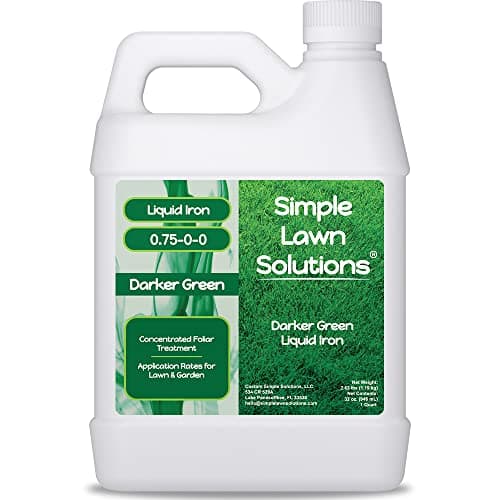
Simple Lawn Solutions Liquid Iron
A chelated iron and micronutrient blend that darkens color without pushing top growth.
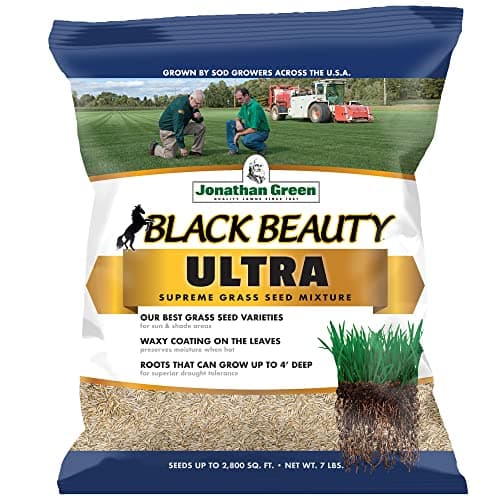
Jonathan Green Black Beauty Ultra Grass Seed
A deep rooting tall fescue blend for the overseeding step that adds actual plants.
Step 3: Overseeding and Renovation to Get Thick Grass
Overseeding is the direct way to add more plants to thin areas. However, it only works well when timing, seed-to-soil contact, and aftercare are correct. Otherwise, the new seed never establishes, and the lawn stays thin.
When and How to Overseed for Thickness
For cool-season lawns, early fall is the prime overseeding window, usually when daytime highs are in the 60s and 70s and soil is still warm. This timing gives seeds excellent germination and weeks of good growing conditions before winter. Spring overseeding can work, but competition from annual weeds and rising heat often reduce results.
For warm-season lawns, overseeding is used less for thickness and more for adding cool-season winter color. To thicken warm-season turf, most of the work happens through encouraging stolon and rhizome spread with proper fertilization and soil management. Where warm-season seed is available and used, sow in late spring to early summer once soil is consistently warm.
Before overseeding, mow the existing lawn lower than usual and bag the clippings. Then core aerate or lightly rake to open the surface. Apply your seed at the recommended overseeding rate for the species, commonly 3 to 5 pounds per 1000 square feet for tall fescue and 1 to 2 pounds for Kentucky bluegrass blends. Ensure good seed-to-soil contact by lightly raking or using a slit seeder. Keep the top 0.5 inch of soil consistently moist through light, frequent irrigation until germination, then gradually shift toward deeper, less frequent watering.
When to Consider a Full Renovation
If your evaluation showed more weeds than desirable grass, or if large areas are dead, you may get better long term results from a full renovation. That process typically means killing the existing vegetation with a non selective herbicide, waiting the labeled period, then preparing the seedbed or laying sod.
Full renovation is especially worth considering when an undesirable grass species dominates the lawn, such as a mixed patchwork of coarse grasses that never look uniform, or when chronic issues like severe compaction and standing water are widespread. While a renovation is more work up front, it gives you a clean slate to build a truly thick, healthy lawn with the right grass type and soil conditions.
What Other Guides Miss: Common Mistakes to Avoid
Many quick online guides on how to get thick grass skip critical diagnostic and timing steps, which is why homeowners see mixed results. Avoiding these common pitfalls will save you money and frustration.
First, do not seed at random times. Overseeding cool-season grass in mid summer heat or late into fall when frost is near almost guarantees low germination and weak seedlings that thin out. Confirm your timing window by checking average local temperatures and aim for at least 6 weeks of good growing weather after seeding.
Second, do not ignore soil testing. Guessing at fertilizer or pH adjustments can cause you to overapply phosphorus where it is already sufficient or miss a pH issue that is silently limiting thickness. A basic soil test every 2 to 3 years provides clear thresholds for action.
Third, do not try to fix thin grass solely with more fertilizer. If your lawn has visible compaction, high traffic, or shade, the issue is structural, not just nutritional. Confirm compaction with the screwdriver test, if you cannot push it 6 inches in multiple spots, schedule aeration within the next suitable seasonal window. For deep shade areas that never thicken despite good care, consider shade tolerant groundcovers or mulch instead of fighting a losing battle. Grass simply will not stay thick where it cannot get enough light, and working with the site always beats fighting it.
Top Picks
- Outsidepride Maya (Blackjack II) Bermuda Grass Seed (5 lb)Check price on Amazon
- Jacklin Seed by Barenbrug Heisman Kentucky Bluegrass Blend (5 lb)Check price on Amazon
- Ortho Weed B Gon Plus Crabgrass Control Ready-To-SprayCheck price on Amazon
As an Amazon Associate we earn from qualifying purchases.
Free Lawn Care Tools
Look straight down at the grass in several spots; if you can easily see soil between the blades, the lawn is thin. You can also pinch a 2 inch by 2 inch area—if you only feel a few stems and see bare ground between them, density is low and the lawn likely needs overseeding plus soil improvement.
The prime window for thickening cool-season lawns is early fall, usually September to early October. During this period, soil is still warm for quick germination, while cooler air temperatures reduce stress and help new seedlings establish a dense stand.
Warm-season grasses thicken best in late spring through early summer when soil temperatures are consistently at or above about 65°F. This is when they are in peak growth, so overseeding compatible varieties and encouraging lateral spread will fill in thin spots more quickly.
Raising mowing height helps overall lawn health, but it will not fix underlying problems like compacted soil or poor fertility. For real thickness, you still need to address soil issues, apply nutrients based on a soil test, and overseed or encourage spread at the right time.
Soil pH controls how available key nutrients are to grass roots, which directly impacts root growth and tillering (new shoot production). Most cool-season grasses do best between pH 6.0 and 7.0, while many warm-season types tolerate slightly more acidic conditions; outside these ranges, nutrients get locked up and density suffers.
If more than about 50 percent of the lawn is weeds, or large areas stay dead even with normal watering, spot thickening is usually frustrating. In cases dominated by invasive grasses like nutsedge or widespread crabgrass, a full kill and reseed or resod often gives better long-term results than piecemeal overseeding.

Beat weeds and brown spots from your phone
Snap a photo, get the fix, and follow a plan timed to your soil and weather. Free on iPhone.