Can Fungicide Help Your Lawn
 Marcus GreenTurf Management Pro | 18 Years
As an Amazon Associate we earn from qualifying purchases.
Brown patches, yellowing blades, or thin, weak turf usually mean one of two things: your grass is stressed, or it is under attack from something specific. When those symptoms show up in irregular patches, especially during warm, humid weather, lawn disease caused by fungus is a prime suspect.
This raises a critical question for homeowners: can fungicide help your lawn, or are you wasting money if the problem is not actually disease? Fungicide is a targeted tool, not an all-purpose fixer. It will not replace fertilizer, it will not kill weeds like an herbicide, and it will not control grubs or insects like an insecticide.
This guide explains when fungicide can help your lawn, when it will not help at all, how to use it safely and effectively, and the key mistakes most homeowners and even some guides overlook.
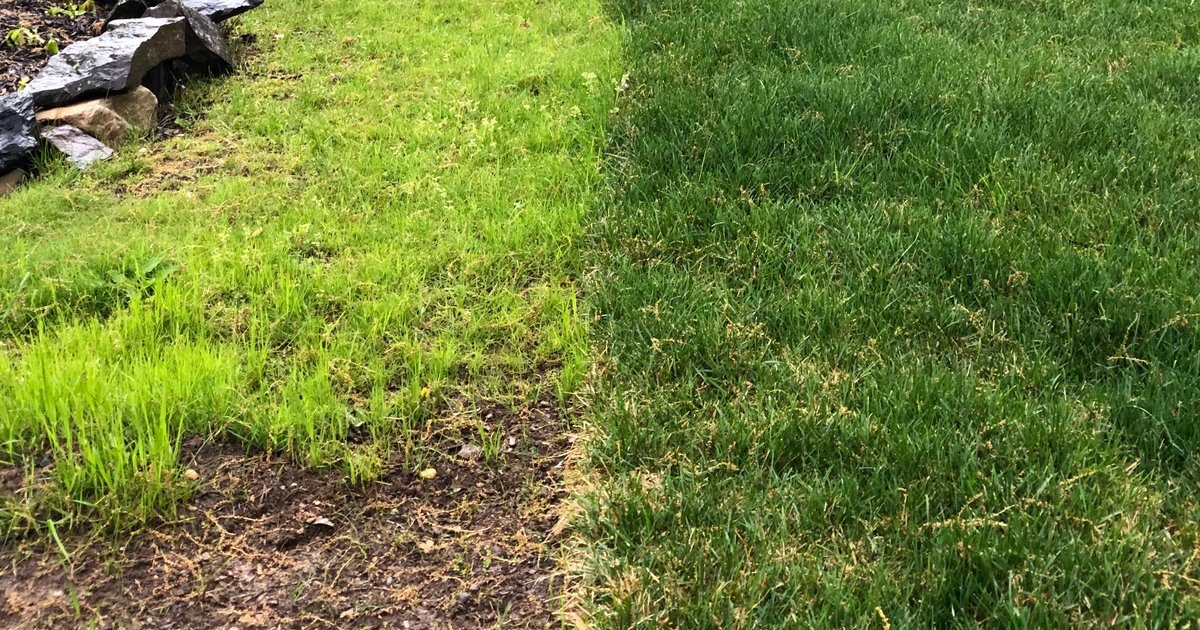
If you see irregular patches of yellow or brown grass that spread during warm, humid weather, especially when the soil is moist and you have been watering regularly, that often points to a fungal lawn disease rather than simple drought stress. Confirm by checking blades early in the morning for water-soaked, slimy, or moldy-looking growth, and look for circular or ring-shaped patches rather than uniform browning.
When disease is active, a lawn fungicide can help by stopping the spread, but it will not instantly green up dead patches. The correct move is to apply a fungicide labeled for your specific disease, correct watering and mowing issues, and then allow 7 to 14 days to see containment of the damage. Avoid repeatedly spraying fungicide "just in case," which wastes product and can harm beneficial organisms; instead, combine a properly timed application with better drainage, right fertilization, and overseeding to repair thin areas.
Understanding Lawn Fungus and Disease Basics
What Is Lawn Fungus?
Lawn fungus refers to a group of plant diseases caused by fungi that infect grass leaves, stems, or roots. Fungi are microscopic organisms that live in soil and thatch. They are present in almost every lawn, but they only become a problem when conditions strongly favor them over the grass.
Most fungi are actually neutral or beneficial. They help break down organic matter and drive soil biology. Disease fungi are the small subset that attack living grass tissue. When they become active, you can see distinct patterns:
- Circular or irregular brown patches that seem to expand over time
- Gray, white, or sometimes pink powdery or cottony growth on blades
- Grass that looks slimy, matted, or stuck together, especially after rain
- Yellowing or thinning turf in streaks or blotches instead of an even fade
If you notice those signs while the lawn is getting plenty of moisture, the issue usually is not drought or under-watering. It often points toward disease that might respond to fungicide if caught in time.
Common Lawn Diseases Fungicides Target
To answer "can fungicide help your lawn," you first need to know which diseases it can realistically manage. Different fungi respond to different active ingredients, which is why diagnosis matters.
In cool-season lawns like Kentucky bluegrass, perennial ryegrass, and fescue, these diseases are common:
- Brown patch - Circular brown or tan patches, often 6 to 24 inches across, that flare in warm, humid weather when night temperatures stay above about 65°F.
- Dollar spot - Small tan spots the size of a silver dollar that merge into larger patches, often with bleached centers and reddish borders on individual blades.
- Snow mold - Circular matted patches visible after snow melts, with gray or pink fungal growth in cool, wet spring conditions.
- Red thread - Patches of thin, pinkish turf where blades have reddish thread-like structures on the tips.
- Rust disease - Fine orange or rust colored powder on leaves that rubs off on shoes or mower wheels.
In warm-season lawns like Bermuda, zoysia, St. Augustine, and centipede, other diseases dominate:
- Large patch / zoysia patch - Large, irregular brown areas with an orange or yellow edge, usually in spring or fall when soil is cool but moist.
- Leaf spot and melting out - Purplish or brown spots on leaves that progress to thinning and "melted" turf during stress.
- Take-all root rot - General thinning, yellowing, and root decline in St. Augustine or Bermuda, worst in poorly drained or high pH soils.
Each of these responds best to specific active ingredients and timing. A separate resource like How to Identify Common Lawn Diseases can help with the detailed diagnosis before you buy fungicide.
Conditions That Encourage Lawn Fungus
Fungal spores are always present, but they only cause disease when environmental and management conditions favor them. In practice, lawn fungus flourishes when it is warm and leaves stay wet for long periods.
Key triggers include:
- Watering too frequently, or watering at night so leaves stay wet for 8 to 12 hours
- Poor drainage or low spots that stay soggy after rain
- High humidity combined with warm nights above about 60 to 65°F
- A thick thatch layer over 0.5 inch that traps moisture and harbors spores
- Dull mower blades that shred grass and create more entry points
- Heavy nitrogen fertilization right before hot, humid weather, especially on cool season grass
If you do not correct these conditions, fungicide might briefly suppress symptoms, but disease will likely return. Any serious plan to help your lawn with fungicide must include better watering, mowing, and soil management.
Can Fungicide Help Your Lawn? The Straight Answer
When Fungicide Absolutely Can Help Your Lawn
Fungicide can genuinely help your lawn in several clear scenarios, when used as part of a broader strategy rather than as a stand alone cure.
It is most effective when:
- You have a confirmed fungal disease with active symptoms. For example, circular brown patches that expand during humid weather, with visible fungal growth or characteristic leaf lesions.
- You experience repeated outbreaks at the same time each year. Brown patch that shows up every June, or snow mold every spring, is highly predictable and responds well to preventive fungicide applied just before the usual window.
- You are maintaining a high value lawn or sports turf where appearance and playability are critical. In those cases, a preventive fungicide program is often cheaper than repairing large dead areas later.
In these situations, a correctly selected product, applied at the label rate, can stop disease expansion within about 7 to 14 days and protect healthy turf from new infection. You still may need to overseed or allow time for stolons and rhizomes to fill in dead spots, but fungicide can protect what is still alive.
When Fungicide Will NOT Help Your Lawn
Fungicide is frequently misused on lawns that have problems unrelated to disease. In those cases, it provides no benefit and can actually disrupt beneficial microbes.
Fungicide will not fix:
- Grub or insect damage - If turf lifts easily like a carpet and you see white grubs or insect larvae underneath, the issue is insects, not fungus. A common threshold is around 8 to 10 grubs per square foot before treatment is warranted.
- Dog urine spots and salt damage - These create small, often circular dead patches with very green edges. The cause is salts and nitrogen, not disease.
- Drought stress or heat dormancy - Uniform browning across sunny areas in hot, dry periods usually indicates lack of water or natural dormancy. Confirm with a screwdriver test: if you struggle to push it 3 to 4 inches into the soil, you likely have dry or compacted soil, not fungus.
- Fertilizer burn - Sharp edged, bright yellow or brown streaks that follow spreader paths are classic overfertilization, not disease.
- Compaction and poor soil - Thin, weak turf in high traffic areas or heavy clay cannot be fixed with fungicide. It needs aeration, organic matter, and better cultural practices.
Using fungicide when disease is not present wastes money and can contribute to resistance in disease fungi. It may also suppress some beneficial soil fungi that help with nutrient cycling and root health.
Curative vs Preventive: Setting the Right Expectation
To understand how fungicide can help your lawn, it helps to separate curative and preventive use.
Curative fungicide is applied after you see symptoms. In this mode, the realistic best case is that it stops the disease from getting worse. It rarely reverses damage that has already killed tissue. After a curative treatment, expect:
- Active lesions and patch expansion to slow within 7 to 10 days
- Color improvement mostly from new growth, not from old damaged leaves healing
- Some areas that still need overseeding or time to regrow
Preventive fungicide is applied before conditions favor the disease. This is often the most efficient way to protect a problem lawn. For example, in cool season turf with a history of brown patch, a preventive application when night temps begin staying above about 60 to 65°F can keep lesions from forming at all. In snow mold prone lawns, applying a labeled fungicide in late fall before permanent snow cover can prevent spring damage.
Homeowners with chronic disease issues sometimes follow a fungicide program: a sequence of 2 to 4 applications spaced 14 to 28 days apart during high risk periods. This is most useful when other cultural changes have not fully solved the problem. Always rotate fungicide modes of action to reduce resistance risk.
Types of Fungicides for Lawns (Beginner-Friendly Overview)
Contact vs Systemic Fungicides
Fungicides are usually grouped as contact or systemic, based on how they move or do not move in the plant.
Contact fungicides stay on the surface of leaves and stems. They create a protective barrier that prevents spores from infecting the tissue they coat. They:
- Are mainly preventive, since they do not move into existing lesions
- Require good coverage and may wash off with heavy rain or irrigation
- Often need more frequent reapplication, such as every 7 to 14 days in high pressure periods
Systemic fungicides are absorbed into the plant and move in the xylem. They can protect new growth from inside and sometimes have limited curative action on early infections. They:
- Provide longer protection intervals, often 14 to 28 days
- Can be more effective on root or crown diseases like take-all root rot
- Must still be used according to label rotation to avoid resistance
For home lawns, a combination product or alternating between contact and systemic actives during a season often provides better, more sustainable control than relying on a single chemistry.
Granular vs Liquid Fungicides
Lawn fungicides are available as granular products that you spread, and liquid concentrates or ready to spray bottles that you apply with a sprayer or hose end.
Granular fungicides are small pellets applied with a broadcast spreader. They are convenient for large lawns and easy for beginners to apply at a consistent rate. They are best suited for:
- Root and crown diseases where the product should reach the soil
- Situations where you can water in the product with 0.25 to 0.5 inch of irrigation right after application
Liquid fungicides allow more precise coverage of foliage. When properly mixed and sprayed, liquids are often more effective against leaf diseases like dollar spot and leaf spots because they coat the blades evenly. They:
- Require a calibrated sprayer and more careful handling
- May need a drying period of 2 to 4 hours with no rain or irrigation
- Are often chosen for spot treating problem areas instead of full lawn coverage
Both granular and liquid forms can help your lawn when matched to the disease and applied correctly. The product label will specify whether to water in or allow it to dry on the foliage, which is crucial for performance.
How to Use Fungicide Safely and Effectively
Step-by-Step Application Basics
To get real benefit when you ask "can fungicide help your lawn," follow a consistent process rather than guessing.
- Confirm likelihood of disease. If patches appear during moist, humid weather and grass blades show spots, mold, or water soaked lesions, disease is likely. If turf pulls up easily with damaged roots and visible grubs, you need insect control, not fungicide.
- Identify your grass type. Cool season vs warm season grasses get different diseases and have different recommended products. If you are unsure, see a resource like Identifying Your Grass Type.
- Match product to disease group. Read labels for mentions of brown patch, dollar spot, large patch, or your suspected issue. If you cannot identify disease precisely, choose a broad spectrum lawn fungicide that covers multiple common diseases for your grass type.
- Measure your lawn area. Most products list a coverage rate, such as "treats 5,000 sq ft." Measure length times width of sections to avoid under or over application.
- Apply at label rate and timing. Never exceed the maximum rate per 1,000 sq ft or shorten the labeled interval, typically 14 to 28 days between applications.
- Follow water instructions exactly. If the label says "water in," irrigate immediately with about 0.25 to 0.5 inch of water. If it says "do not water for 24 hours," avoid irrigation and rain if possible.
Most homeowners who see poor results from fungicide either misdiagnosed the problem, used the wrong product, or missed the water in / no water window on the label.
Integrating Cultural Practices
No fungicide can overcome chronically poor conditions. Combine treatment with better lawn care to prevent recurring disease.

Key practices include:
- Watering deeply and infrequently - Aim for about 1 to 1.5 inches of total water per week from rain plus irrigation, delivered in 1 or 2 deep soakings rather than daily light sprinkling. Water early in the morning so leaves dry quickly.
- Mowing at the correct height with sharp blades - Most cool season lawns do best at 3 to 4 inches, while many warm season lawns prefer 1 to 2.5 inches depending on species. Sharp blades reduce wounding and entry points for fungi.
- Managing thatch and compaction - If thatch exceeds 0.5 inch, plan core aeration and possibly dethatching in appropriate seasons. Better air movement and less thatch reduce disease pressure.
- Balanced fertilization - Use slow release nitrogen and avoid heavy applications right before hot, humid stretches that favor brown patch in cool season grass.
When you correct these issues, you may find that you need less fungicide in future years, or can switch from a season long program to an occasional spot treatment.
- NC State Extension recommends limiting cool season grass nitrogen to about 0.75 to 1 pound of N per 1,000 sq ft per application during active growth, and avoiding high rates in late spring in brown patch prone areas.
What Other Guides Miss: Common Mistakes to Avoid
Many quick online answers to "can fungicide help your lawn" skip some key details that determine whether you get results or frustration.
Skipping a Simple Confirmation Test
One common oversight is not confirming the cause before applying fungicide. If you see brown patches, lightly tug on the turf in the center of a damaged area. If it comes up easily and you see grub activity, your threshold is about 8 to 10 grubs per square foot before treatment is justified. In that case, insecticide is the correct tool, and fungicide will not help at all.
If the turf is firmly rooted and blades show spotting or mold, that points more strongly toward disease, and fungicide can be part of the solution. Taking 5 minutes for this check can prevent weeks of wrong treatment.
Bad Timing Around Weather and Watering
Another frequent mistake is applying fungicide just before heavy rain or ignoring the water instructions. If a label indicates that a product needs to dry on the leaves and you irrigate within 2 hours, you may wash off much of its effectiveness. Conversely, if a granular product is meant to be watered in and you leave it dry, it may sit on the surface and never reach the target zone.
Check the label for its rainfast window and watering directions before you apply, and glance at the forecast for the next 24 to 48 hours. A few minutes of planning around weather is often the difference between a fungicide that works and one that washes away.
Top Picks
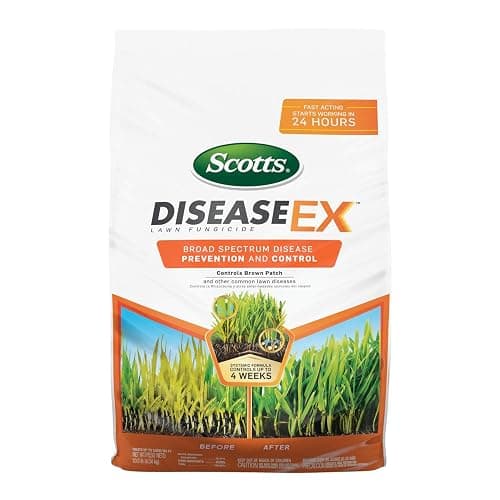
 Scotts DiseaseEx Lawn FungicideCheck price on Amazon
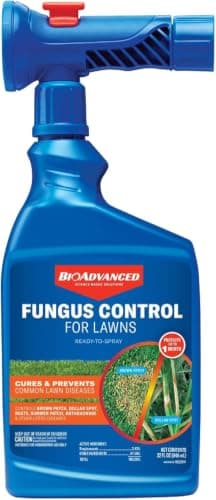
 BioAdvanced Fungus Control for Lawns - 32 fl oz BottleCheck price on Amazon
As an Amazon Associate we earn from qualifying purchases.
Free Lawn Care Tools
Lawn fungus refers to a group of plant diseases caused by fungi that infect grass leaves, stems, or roots. Fungi are microscopic organisms that live in soil and thatch. They are present in almost every lawn, but they only become a problem when conditions strongly favor them over the grass.
Look at the pattern and timing of the damage. Fungal diseases usually show up as irregular or circular patches that spread during warm, humid weather when the lawn is getting plenty of moisture, while drought stress tends to cause more uniform browning. Early in the morning, check blades for slimy, water-soaked, or moldy-looking growth and ring-shaped patches. Those signs point toward a fungal problem that may benefit from fungicide rather than simple lack of water.
Fungicide does not instantly green up damaged turf; it works by stopping the disease from spreading. With the correct product and timing, you can usually expect disease activity to be contained within about 7 to 14 days. After that, living grass can begin to recover, and thin or dead areas may need overseeding or time to fill in.
Fungicide cannot revive grass that is already dead. Its job is to protect living turf and stop the disease from expanding into healthy areas. Dead or severely thinned spots typically need overseeding, or they will slowly fill in over time from surrounding stolons and rhizomes if the grass type spreads.
Watering too often or at night, poor drainage, and thick thatch all keep grass blades wet long enough to encourage disease. Dull mower blades that shred grass, heavy nitrogen right before hot, humid weather, and ignoring low, soggy spots also increase fungal problems. If those issues are not corrected, fungicide may give only temporary relief and the disease is likely to return.
Preventive fungicide makes sense when you see the same fungal disease at the same time every year, such as brown patch every June or snow mold after winter. It is also common on high-value lawns or sports turf where appearance and playability are critical, because preventing outbreaks is cheaper than repairing large dead areas later. In those cases, applying a labeled product just before the usual disease window can protect the grass before symptoms appear.
Photos: Greta Hoffman / Pexels, Karola G / Pexels, Juan Pablo Amador DÃaz / Pexels

Beat weeds and brown spots from your phone
Snap a photo, get the fix, and follow a plan timed to your soil and weather. Free on iPhone.