How to Sharpen Lawn Mower Blades
Sharpen mower blades like a pro. Improve lawn health, reduce mower strain, and get a clean, even cut with this expert, step-by-step sharpening and maintenance guide.
Brown-tipped grass, a ragged overall appearance, and a mower that seems to struggle all signal the same underlying issue: the blade is dull and no longer cutting cleanly. Turfgrass science is clear that sharp mower blades are one of the simplest ways to improve lawn health and appearance while reducing mowing time and equipment strain.
This guide explains exactly how to sharpen mower blades at home with basic tools, how often to sharpen, and how to decide when replacement is safer than sharpening. It also builds a practical maintenance schedule so mower blade maintenance becomes routine instead of an emergency repair.
Homeowners reading this typically fall into two groups: those ready to sharpen mower blades themselves and those trying to decide whether sharpening or replacing is the better option. Both questions are addressed directly, with step-by-step instructions and diagnostic criteria drawn from university extension guidance.
For a complete lawn care system, mower blade sharpness sits alongside other core decisions such as mower choice (see Best Lawn Mowers in 2025), automation options (see Robotic Lawn Mowers: Are They Worth It?), tool selection (see Essential Lawn Care Tools Every Homeowner Needs), irrigation control (see Smart Irrigation Systems: Are They Worth It?), and avoiding Common Lawn Care Mistakes Beginners Make. Blade care is one of the highest leverage tasks within that system, and it is straightforward once you see it broken down.
A sharp mower blade cuts each grass blade cleanly with a scissor-like action. A dull blade impacts grass more like a club, ripping and bruising tissue instead of slicing it. That difference in cut quality affects disease pressure, moisture loss, and turf density.
According to Purdue University Extension, clean cuts reduce the number of open, shredded tissue surfaces where fungal spores can establish. Frayed leaf tips have more exposed cells, which increases susceptibility to diseases such as leaf spot and dollar spot, especially during warm, humid weather. A sharp blade, by contrast, leaves a smooth cut that closes more quickly.
Clean cuts also limit water loss. The University of Nebraska-Lincoln Extension notes that torn grass tips lose more moisture through increased surface area, which accelerates leaf desiccation. During summer heat, this additional stress reduces turf vigor. Keeping blades sharp minimizes that unnecessary water loss and helps the lawn withstand short dry periods more effectively.
From a growth standpoint, grass plants that experience clean, minimal injury put more energy into root development and lateral spread instead of constant repair. This encourages thicker, more uniform turf. Over several months, lawns mowed with sharp blades show noticeably better density compared to lawns regularly cut with dull blades, even when fertilizer and irrigation are similar.
Appearance improves as well. Cleanly cut tips maintain a solid, deep green color. When the entire lawn is cut cleanly at a consistent height, visual striping from the mower becomes sharper and more professional looking. Those light and dark stripes that many homeowners admire depend on uniform bending of the grass blades. Torn tips disrupt that uniformity and cause stripes to appear fuzzy or uneven.
Dull blades create predictable symptoms on the lawn and in mower behavior. Recognizing these signals allows you to schedule sharpening before damage accumulates.
On the turf surface, three indicators stand out:
Under the mower deck, dull blades produce more clumping and clogging. Instead of ejecting fine clippings, they tear and mash the grass into wet clumps that stick under the deck and leave piles on the lawn. Those clumps can smother turf, and they require extra raking or a second mowing pass to disperse.
On the equipment side, dull blades increase load on the mower. The University of Florida IFAS Extension notes that dull blades force engines to work significantly harder to achieve the same cut because the blade is beating its way through grass instead of slicing. The consequences are straightforward:
Over a season, that added strain reduces engine and battery life and increases maintenance costs. Sharpening blades restores cutting efficiency and reduces mechanical wear.
Sharpening is effective as long as the blade metal is intact and the blade remains structurally sound. Replacement is required whenever the blade shows damage that cannot be removed while preserving safe thickness and balance.
Sharpen the blade if you see:
Replace the blade if you see any of the following:
According to guidance from North Carolina State University Extension, mower blades function as high speed rotating components, with tip speeds often around 150 to 200 miles per hour. Any structural defect at those speeds creates a safety hazard. When in doubt, replacement is the safer and typically inexpensive choice, especially for residential walk behind mowers.
Most homeowners ask how frequently they should sharpen mower blades. The answer depends on hours of use, mowing conditions, and turf height, but there are clear starting benchmarks.
A practical rule of thumb is to sharpen the blade every 20 to 25 hours of mowing. For a typical suburban lawn of 8,000 to 10,000 square feet, that equates to roughly:
Several additional guidelines help refine that schedule:
Several factors shorten intervals between sharpenings:
To keep this simple, create a basic mower blade maintenance calendar based on yard size and climate:
For example, a 30 minute weekly mow from April through October totals about 13 hours of runtime. In that case, sharpening at spring startup and again mid summer keeps the blade in good condition.
Sharpening mower blades involves lifting equipment, handling sharp metal, and potentially using power grinding tools. Rushing this process or skipping safety steps introduces avoidable injury risk. A structured safety checklist ensures each sharpening session remains controlled and predictable.
Before touching the mower or blade, secure the machine so it cannot start and the blade cannot move unexpectedly:
Always wait until the mower blade is fully stopped and the engine has cooled before beginning. For gas mowers, allow at least 10 to 15 minutes after mowing so engine surfaces and mufflers are cool to the touch.
Personal protective equipment (PPE) is essential:
For gas mowers, manage fuel safely. Keep the mower level while disconnecting the spark plug, then tip it according to manufacturer guidance. Most manufacturers recommend tipping the mower so the air filter and carburetor face upward, which prevents fuel and oil leakage into those components.
A well set up workspace makes sharpening more accurate, safer, and faster. The best locations include a garage, driveway, or sturdy outdoor workbench with good lighting and ventilation.

Key workspace considerations include:
Place a magnetized tray or a small container nearby for nuts, bolts, and washers removed from the mower. This prevents hardware loss during the process.
Managing metal filings is straightforward if planned in advance. Place a piece of cardboard, a tray, or an old towel below the sharpening area to catch filings. After sharpening, fold and dispose of single use materials, or carefully shake filings into a trash container if reusing the surface covering.
For fuel powered equipment, store gasoline containers and other flammables away from the sharpening area, especially when using an angle grinder or bench grinder that produces sparks. Maintain clear separation between grinding activities and any potential ignition sources, including water heaters or open flames.
Sharpening lawn mower blades at home does not require specialized equipment. A simple hand file and basic mechanic tools deliver excellent results for most homeowners. More advanced power tools can speed up the process, but they are not essential.
The core tool set includes:
According to Michigan State University Extension, hand filing with a flat mill file is sufficient for most residential mower blades and reduces risk of overheating the blade edge compared to aggressive power grinding. Overheating can change metal temper and reduce edge durability, which is avoided when sharpening by hand with moderate strokes.
For homeowners who sharpen multiple mowers or prefer powered tools, an angle grinder with a medium grit grinding wheel (around 60 to 80 grit) or a bench grinder can significantly speed material removal. However, these tools require more control and safety precautions. For this guide, the primary focus is on the beginner friendly hand file method, with notes for power tool use where relevant.
A typical sharpening session for a single walk behind mower blade takes 30 to 60 minutes from start to finish, including removal, cleaning, sharpening, balancing, and reinstallation. For riding mowers with two or three blades, plan 60 to 90 minutes total.
Use this simple action timeline:
Building this 1 hour block into your seasonal maintenance plan ensures sharpening becomes routine rather than a rushed reaction when cut quality deteriorates sharply.
After following the safety steps (disconnect spark plug, remove battery, or unplug cord), position the mower for blade removal. For most walk behind mowers, tilting the mower back so the handle rests on the ground and the front wheels point upward provides clear access to the blade without spilling fuel. If tipping to the side, ensure the air filter faces up according to the owner manual.
Use a block of wood or a heavy glove to wedge between the blade and mower deck. This keeps the blade from turning while you loosen the center bolt or nut. Place the correct size socket or wrench on the fastener and turn counterclockwise to loosen. Some bolts are very tight from factory installation, so controlled force with a longer handle ratchet sometimes helps.
Before removing the blade completely, note its orientation. The cutting edge should face the direction of rotation, and the side stamped with "bottom" or with more curvature typically faces downward toward the grass. If you are unsure, take a quick photo on your phone, which serves as a reference for correct reinstallation.
Once the bolt and any washers are removed, carefully slide the blade off the spindle shaft. Set the hardware aside in your parts tray.
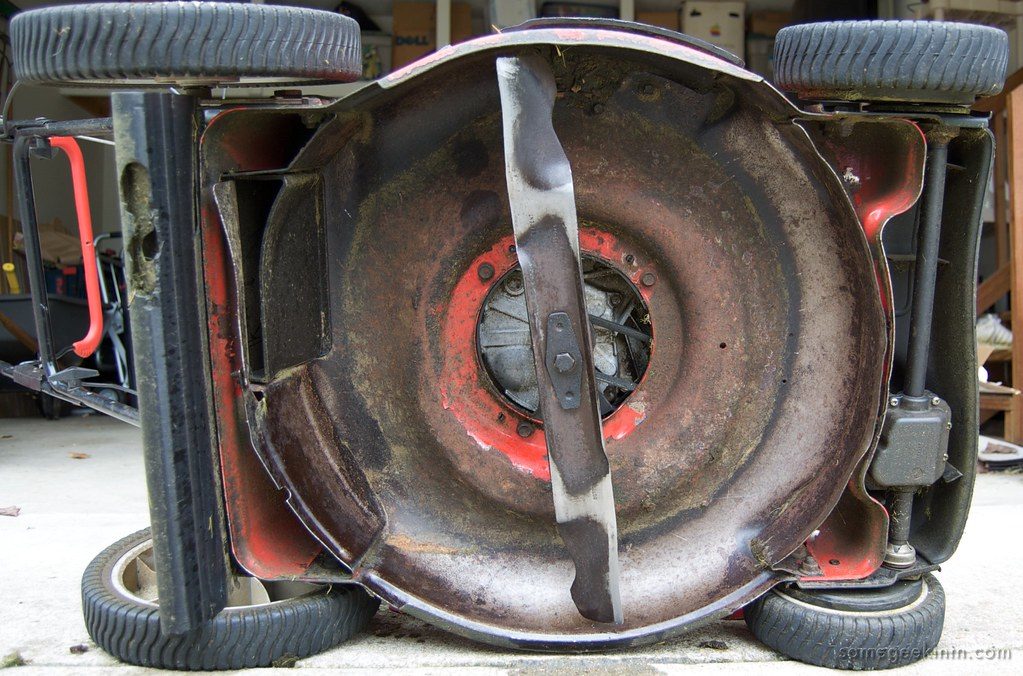
Clamp the blade securely in a bench vise or between clamps on a sturdy work surface. Use a wire brush or scraper to remove dried grass, mud, and rust flakes from the blade, particularly along the cutting edges and lift wings (the curved sections that create airflow and lift clippings).
After cleaning, inspect the blade under good lighting. Look for:
If the blade shows structural issues described earlier (cracks, major gouges, severe thinning, or warping), set it aside for recycling and install a new blade instead of sharpening.
Every mower blade is manufactured with a specific bevel angle along the cutting edge, typically between 30 and 40 degrees. Your goal is to maintain that angle while restoring sharpness, not to create a razor thin edge that dulls quickly or chips easily.
Visually follow the existing bevel from the cutting edge back into the thicker body of the blade. Place the file against this beveled surface so it lies flat and fully contacts the bevel. This establishes the proper sharpening angle. Maintaining this original angle ensures consistent performance and durability.
With the blade clamped and the first cutting edge accessible, put on your gloves and safety glasses. Hold the file by the handle with your dominant hand and support the front of the file with your other hand for control.
Align the file with the bevel angle and push the file in one direction, from the inside of the blade (near the center hole) toward the tip. Use long, smooth strokes that cover the full bevel length. Apply firm, steady pressure on the push stroke, then lift the file slightly on the return stroke to avoid dulling the file and creating irregular scratches.
Count strokes to keep both edges consistent. For a moderately dull blade, 20 to 30 strokes on the first side often restore a clean edge. For heavily dulled blades, additional strokes are sometimes required. Periodically wipe metal filings from the edge so you can see progress clearly.
The sharpening goal is a clean, uniform, bright metal bevel with no visible nicks and a clearly defined edge transition. The edge should feel sharp to the touch when very lightly brushed perpendicular to the edge, but it does not need to be knife sharp. A slightly blunt edge is actually more durable under mowing conditions.
Once the first edge is sharpened, loosen the clamp or vise, rotate the blade, and secure the opposite edge. Follow the same procedure, matching the stroke count to maintain similar material removal on both sides. This preserves balance and weight distribution.
Again, file only in the push direction, maintain the original bevel angle, and inspect frequently. Remove any burrs or rough spots that develop on the back side of the edge as you sharpen.
If you notice deep nicks or small chips that require more material removal, concentrate initial strokes on those areas, then blend the bevel along the whole edge to restore a smooth, continuous cutting line.
Sharpening often creates a thin burr of metal on the backside of the cutting edge. This burr appears as a slight roughness when you run a finger carefully (and lightly) from the back of the blade toward the edge. Leaving this burr in place reduces cut quality and can break off in use.
To remove it, flip the blade in the vise so the backside of the edge faces you. Hold the file nearly flat against this backside and make a few light strokes along the length of the edge. The goal is not to create a second bevel, but simply to knock off the burr and smooth the transition.
After sharpening both edges, checking balance is essential. An unbalanced blade vibrates during operation, which stresses mower bearings and can lead to premature failure of spindles and engine mounts.
Place the blade on a commercial cone style blade balancer, which centers the blade on a pointed cone. If the blade remains level, it is balanced. If one end drops consistently, that side is heavier.
If you do not have a commercial balancer, drive a large nail horizontally into a wall stud or wooden post and hang the blade through its center hole on the nail. Again, observe which side drops. A balanced blade will hang nearly level, while an unbalanced one will tip strongly to the heavier side.
To correct imbalance, do not grind the lighter side. Instead, remove a small amount of additional metal from the heavier side by filing along the bevel. Take 3 to 5 extra strokes, then recheck balance. Repeat as needed until the blade hangs level or nearly level. Small variations are acceptable, but any strong tipping should be corrected before reinstalling.
Once the blade is sharp and balanced, clean any debris from the underside of the mower deck. A putty knife, scraper, or stiff brush works well. Removing built up grass improves airflow and mowing performance.
Orient the blade correctly, using your earlier photo or notes. The cutting edges must face the direction of rotation, and the lift wings should curve upward toward the deck, not downward toward the grass. Installing a blade upside down results in poor cut quality and heavy clumping.
Slide the blade onto the spindle shaft, align any positioning tabs, and reinstall the washers and bolt or nut. Hand tighten first, then use your socket or wrench while blocking the blade with a wood block or gloved hand to prevent spinning.
Manufacturers specify torque values for blade bolts, often in the 40 to 60 foot pound range for walk behind mowers and higher for riding mower blades. If you have a torque wrench, tighten to the recommended specification from your owner manual. Proper torque ensures the blade remains secure without overtightening threads.
Once installed, reconnect the spark plug wire, reinsert the battery, or plug the mower back in. Mow a small test area and inspect the grass tips within a few hours. Clean, sharp cuts confirm that sharpening is complete and effective.
For homeowners with multiple mowers or those who prefer faster sharpening, an angle grinder or bench grinder offers a time saving alternative. The basic principles remain the same: maintain the original bevel angle, avoid overheating, and preserve balance.
When using an angle grinder:
Check the edge frequently and dip the blade tip in water if it begins to feel hot. Overheating to a blue color along the edge softens the metal and reduces edge life. Light, controlled passes are better than aggressive grinding.
On a bench grinder, adjust the tool rest to support the blade at the correct angle. Move the blade smoothly across the wheel, again avoiding prolonged contact in one spot. Always wear eye and hearing protection and avoid loose clothing near rotating wheels.
Regardless of tool, finish by deburring and balancing the blade as described in the hand file method.
Integrating sharpening into a broader mower maintenance plan simplifies lawn care and improves long term turf quality. A structured schedule incorporates pre season, in season, and post season tasks.
Here is a practical seasonal framework:
According to Ohio State University Extension, aligning mower maintenance with the first spring mowing ensures equipment operates efficiently at the exact time turf resumes active growth. A sharp blade at this stage prevents early season stress that can slow green up.
In regions with long growing seasons or heavy use, mid season sharpening might be done twice, roughly every 6 to 8 weeks.
Documenting dates and tasks in a simple notebook or digital note helps maintain consistency year after year, similar to tracking irrigation or fertilization schedules. Pairing this mower schedule with knowledge from guides like Common Lawn Care Mistakes Beginners Make and Smart Irrigation Systems: Are They Worth It? creates a holistic approach to turf management.
From a cost perspective, sharpening mower blades is highly economical. A quality new blade for a residential walk behind mower often costs between 15 and 30 dollars. A hand file costs a similar amount but will service many blades across several seasons.
Sharpening at home costs primarily time, while replacing frequently without sharpening increases hardware expenses and environmental waste. Extension recommendations from multiple universities, including Penn State Extension, consistently emphasize maintaining sharp blades through regular sharpening as a core best practice for both lawn health and mower efficiency.
However, replacement is appropriate when:
Keeping two blade sets is particularly effective for busy homeowners. When you notice cut quality declining, you swap in the sharp set in 10 to 15 minutes, then sharpen the dull set later. This approach prevents mowing with dull blades simply because you did not have time to sharpen immediately.

Several recurring errors reduce sharpening effectiveness or create new issues. Addressing them directly ensures your sharpening work translates into real improvements.
A brief post sharpening inspection of the first mow, looking closely at leaf tips, confirms that these mistakes have been avoided. If tips still appear torn, recheck blade orientation, sharpness, and mower speed.
Blade sharpness does not operate in isolation. Its benefits compound with correct mowing height, mowing frequency, and equipment selection.
For example, a sharp blade cutting tall fescue at 3 to 4 inches weekly encourages deep rooting and improved drought tolerance, as documented by Kansas State University Extension. A dull blade cutting the same turf too short at 2 inches weakens the lawn, even if fertilization is adequate. The mechanical quality of the cut interacts directly with plant physiology.
Mower choice also matters. Guides like Best Lawn Mowers in 2025 and Robotic Lawn Mowers: Are They Worth It? evaluate cutting systems and blade design. Many robotic mowers use small razor blades that require frequent replacement rather than sharpening, while commercial grade zero turn mowers often use thick blades designed for repeated sharpening. Understanding your mower's blade type informs your maintenance approach.
Tool selection from Essential Lawn Care Tools Every Homeowner Needs also ties in. Owning a basic socket set, bench vise, and hand file simplifies blade sharpening and reduces reliance on shop services. Integrating sharpening with scheduled irrigation adjustments, such as those discussed in Smart Irrigation Systems: Are They Worth It?, creates a cohesive, planned maintenance rhythm.
Ragged leaf tips, brownish haze after mowing, and a struggling mower all signal one straightforward issue: it is time to sharpen the mower blade. Turfgrass and extension research from universities such as Purdue, Nebraska, and Ohio State consistently shows that sharp blades improve lawn health, reduce disease entry points, cut water loss, and create a more uniform, professional appearance.
With basic tools like a socket wrench, bench vise, and flat mill file, homeowners can sharpen mower blades safely in under an hour. The process involves proper safety preparation, blade removal, cleaning, hand filing along the original bevel, balancing, and correct reinstallation. A simple schedule of sharpening every 20 to 25 mowing hours, tied to early spring, mid season, and late season checks, keeps blades consistently sharp.
From here, consider setting up a full lawn care calendar that pairs blade maintenance with correct mowing heights, irrigation adjustments, and seasonal fertilization. For related guidance on equipment and broader lawn strategy, explore Best Lawn Mowers in 2025, Robotic Lawn Mowers: Are They Worth It?, Essential Lawn Care Tools Every Homeowner Needs, Smart Irrigation Systems: Are They Worth It?, and Common Lawn Care Mistakes Beginners Make. With a sharp blade and a structured plan, your lawn responds with denser growth, better color, and more efficient maintenance all season.
Brown-tipped grass, a ragged overall appearance, and a mower that seems to struggle all signal the same underlying issue: the blade is dull and no longer cutting cleanly. Turfgrass science is clear that sharp mower blades are one of the simplest ways to improve lawn health and appearance while reducing mowing time and equipment strain.
This guide explains exactly how to sharpen mower blades at home with basic tools, how often to sharpen, and how to decide when replacement is safer than sharpening. It also builds a practical maintenance schedule so mower blade maintenance becomes routine instead of an emergency repair.
Homeowners reading this typically fall into two groups: those ready to sharpen mower blades themselves and those trying to decide whether sharpening or replacing is the better option. Both questions are addressed directly, with step-by-step instructions and diagnostic criteria drawn from university extension guidance.
For a complete lawn care system, mower blade sharpness sits alongside other core decisions such as mower choice (see Best Lawn Mowers in 2025), automation options (see Robotic Lawn Mowers: Are They Worth It?), tool selection (see Essential Lawn Care Tools Every Homeowner Needs), irrigation control (see Smart Irrigation Systems: Are They Worth It?), and avoiding Common Lawn Care Mistakes Beginners Make. Blade care is one of the highest leverage tasks within that system, and it is straightforward once you see it broken down.
A sharp mower blade cuts each grass blade cleanly with a scissor-like action. A dull blade impacts grass more like a club, ripping and bruising tissue instead of slicing it. That difference in cut quality affects disease pressure, moisture loss, and turf density.
According to Purdue University Extension, clean cuts reduce the number of open, shredded tissue surfaces where fungal spores can establish. Frayed leaf tips have more exposed cells, which increases susceptibility to diseases such as leaf spot and dollar spot, especially during warm, humid weather. A sharp blade, by contrast, leaves a smooth cut that closes more quickly.
Clean cuts also limit water loss. The University of Nebraska-Lincoln Extension notes that torn grass tips lose more moisture through increased surface area, which accelerates leaf desiccation. During summer heat, this additional stress reduces turf vigor. Keeping blades sharp minimizes that unnecessary water loss and helps the lawn withstand short dry periods more effectively.
From a growth standpoint, grass plants that experience clean, minimal injury put more energy into root development and lateral spread instead of constant repair. This encourages thicker, more uniform turf. Over several months, lawns mowed with sharp blades show noticeably better density compared to lawns regularly cut with dull blades, even when fertilizer and irrigation are similar.
Appearance improves as well. Cleanly cut tips maintain a solid, deep green color. When the entire lawn is cut cleanly at a consistent height, visual striping from the mower becomes sharper and more professional looking. Those light and dark stripes that many homeowners admire depend on uniform bending of the grass blades. Torn tips disrupt that uniformity and cause stripes to appear fuzzy or uneven.
Dull blades create predictable symptoms on the lawn and in mower behavior. Recognizing these signals allows you to schedule sharpening before damage accumulates.
On the turf surface, three indicators stand out:
Under the mower deck, dull blades produce more clumping and clogging. Instead of ejecting fine clippings, they tear and mash the grass into wet clumps that stick under the deck and leave piles on the lawn. Those clumps can smother turf, and they require extra raking or a second mowing pass to disperse.
On the equipment side, dull blades increase load on the mower. The University of Florida IFAS Extension notes that dull blades force engines to work significantly harder to achieve the same cut because the blade is beating its way through grass instead of slicing. The consequences are straightforward:
Over a season, that added strain reduces engine and battery life and increases maintenance costs. Sharpening blades restores cutting efficiency and reduces mechanical wear.
Sharpening is effective as long as the blade metal is intact and the blade remains structurally sound. Replacement is required whenever the blade shows damage that cannot be removed while preserving safe thickness and balance.
Sharpen the blade if you see:
Replace the blade if you see any of the following:
According to guidance from North Carolina State University Extension, mower blades function as high speed rotating components, with tip speeds often around 150 to 200 miles per hour. Any structural defect at those speeds creates a safety hazard. When in doubt, replacement is the safer and typically inexpensive choice, especially for residential walk behind mowers.
Most homeowners ask how frequently they should sharpen mower blades. The answer depends on hours of use, mowing conditions, and turf height, but there are clear starting benchmarks.
A practical rule of thumb is to sharpen the blade every 20 to 25 hours of mowing. For a typical suburban lawn of 8,000 to 10,000 square feet, that equates to roughly:
Several additional guidelines help refine that schedule:
Several factors shorten intervals between sharpenings:
To keep this simple, create a basic mower blade maintenance calendar based on yard size and climate:
For example, a 30 minute weekly mow from April through October totals about 13 hours of runtime. In that case, sharpening at spring startup and again mid summer keeps the blade in good condition.
Sharpening mower blades involves lifting equipment, handling sharp metal, and potentially using power grinding tools. Rushing this process or skipping safety steps introduces avoidable injury risk. A structured safety checklist ensures each sharpening session remains controlled and predictable.
Before touching the mower or blade, secure the machine so it cannot start and the blade cannot move unexpectedly:
Always wait until the mower blade is fully stopped and the engine has cooled before beginning. For gas mowers, allow at least 10 to 15 minutes after mowing so engine surfaces and mufflers are cool to the touch.
Personal protective equipment (PPE) is essential:
For gas mowers, manage fuel safely. Keep the mower level while disconnecting the spark plug, then tip it according to manufacturer guidance. Most manufacturers recommend tipping the mower so the air filter and carburetor face upward, which prevents fuel and oil leakage into those components.
A well set up workspace makes sharpening more accurate, safer, and faster. The best locations include a garage, driveway, or sturdy outdoor workbench with good lighting and ventilation.

Key workspace considerations include:
Place a magnetized tray or a small container nearby for nuts, bolts, and washers removed from the mower. This prevents hardware loss during the process.
Managing metal filings is straightforward if planned in advance. Place a piece of cardboard, a tray, or an old towel below the sharpening area to catch filings. After sharpening, fold and dispose of single use materials, or carefully shake filings into a trash container if reusing the surface covering.
For fuel powered equipment, store gasoline containers and other flammables away from the sharpening area, especially when using an angle grinder or bench grinder that produces sparks. Maintain clear separation between grinding activities and any potential ignition sources, including water heaters or open flames.
Sharpening lawn mower blades at home does not require specialized equipment. A simple hand file and basic mechanic tools deliver excellent results for most homeowners. More advanced power tools can speed up the process, but they are not essential.
The core tool set includes:
According to Michigan State University Extension, hand filing with a flat mill file is sufficient for most residential mower blades and reduces risk of overheating the blade edge compared to aggressive power grinding. Overheating can change metal temper and reduce edge durability, which is avoided when sharpening by hand with moderate strokes.
For homeowners who sharpen multiple mowers or prefer powered tools, an angle grinder with a medium grit grinding wheel (around 60 to 80 grit) or a bench grinder can significantly speed material removal. However, these tools require more control and safety precautions. For this guide, the primary focus is on the beginner friendly hand file method, with notes for power tool use where relevant.
A typical sharpening session for a single walk behind mower blade takes 30 to 60 minutes from start to finish, including removal, cleaning, sharpening, balancing, and reinstallation. For riding mowers with two or three blades, plan 60 to 90 minutes total.
Use this simple action timeline:
Building this 1 hour block into your seasonal maintenance plan ensures sharpening becomes routine rather than a rushed reaction when cut quality deteriorates sharply.
After following the safety steps (disconnect spark plug, remove battery, or unplug cord), position the mower for blade removal. For most walk behind mowers, tilting the mower back so the handle rests on the ground and the front wheels point upward provides clear access to the blade without spilling fuel. If tipping to the side, ensure the air filter faces up according to the owner manual.
Use a block of wood or a heavy glove to wedge between the blade and mower deck. This keeps the blade from turning while you loosen the center bolt or nut. Place the correct size socket or wrench on the fastener and turn counterclockwise to loosen. Some bolts are very tight from factory installation, so controlled force with a longer handle ratchet sometimes helps.
Before removing the blade completely, note its orientation. The cutting edge should face the direction of rotation, and the side stamped with "bottom" or with more curvature typically faces downward toward the grass. If you are unsure, take a quick photo on your phone, which serves as a reference for correct reinstallation.
Once the bolt and any washers are removed, carefully slide the blade off the spindle shaft. Set the hardware aside in your parts tray.
Clamp the blade securely in a bench vise or between clamps on a sturdy work surface. Use a wire brush or scraper to remove dried grass, mud, and rust flakes from the blade, particularly along the cutting edges and lift wings (the curved sections that create airflow and lift clippings).
After cleaning, inspect the blade under good lighting. Look for:
If the blade shows structural issues described earlier (cracks, major gouges, severe thinning, or warping), set it aside for recycling and install a new blade instead of sharpening.
Every mower blade is manufactured with a specific bevel angle along the cutting edge, typically between 30 and 40 degrees. Your goal is to maintain that angle while restoring sharpness, not to create a razor thin edge that dulls quickly or chips easily.
Visually follow the existing bevel from the cutting edge back into the thicker body of the blade. Place the file against this beveled surface so it lies flat and fully contacts the bevel. This establishes the proper sharpening angle. Maintaining this original angle ensures consistent performance and durability.
With the blade clamped and the first cutting edge accessible, put on your gloves and safety glasses. Hold the file by the handle with your dominant hand and support the front of the file with your other hand for control.
Align the file with the bevel angle and push the file in one direction, from the inside of the blade (near the center hole) toward the tip. Use long, smooth strokes that cover the full bevel length. Apply firm, steady pressure on the push stroke, then lift the file slightly on the return stroke to avoid dulling the file and creating irregular scratches.
Count strokes to keep both edges consistent. For a moderately dull blade, 20 to 30 strokes on the first side often restore a clean edge. For heavily dulled blades, additional strokes are sometimes required. Periodically wipe metal filings from the edge so you can see progress clearly.
The sharpening goal is a clean, uniform, bright metal bevel with no visible nicks and a clearly defined edge transition. The edge should feel sharp to the touch when very lightly brushed perpendicular to the edge, but it does not need to be knife sharp. A slightly blunt edge is actually more durable under mowing conditions.
Once the first edge is sharpened, loosen the clamp or vise, rotate the blade, and secure the opposite edge. Follow the same procedure, matching the stroke count to maintain similar material removal on both sides. This preserves balance and weight distribution.
Again, file only in the push direction, maintain the original bevel angle, and inspect frequently. Remove any burrs or rough spots that develop on the back side of the edge as you sharpen.
If you notice deep nicks or small chips that require more material removal, concentrate initial strokes on those areas, then blend the bevel along the whole edge to restore a smooth, continuous cutting line.
Sharpening often creates a thin burr of metal on the backside of the cutting edge. This burr appears as a slight roughness when you run a finger carefully (and lightly) from the back of the blade toward the edge. Leaving this burr in place reduces cut quality and can break off in use.
To remove it, flip the blade in the vise so the backside of the edge faces you. Hold the file nearly flat against this backside and make a few light strokes along the length of the edge. The goal is not to create a second bevel, but simply to knock off the burr and smooth the transition.
After sharpening both edges, checking balance is essential. An unbalanced blade vibrates during operation, which stresses mower bearings and can lead to premature failure of spindles and engine mounts.
Place the blade on a commercial cone style blade balancer, which centers the blade on a pointed cone. If the blade remains level, it is balanced. If one end drops consistently, that side is heavier.
If you do not have a commercial balancer, drive a large nail horizontally into a wall stud or wooden post and hang the blade through its center hole on the nail. Again, observe which side drops. A balanced blade will hang nearly level, while an unbalanced one will tip strongly to the heavier side.
To correct imbalance, do not grind the lighter side. Instead, remove a small amount of additional metal from the heavier side by filing along the bevel. Take 3 to 5 extra strokes, then recheck balance. Repeat as needed until the blade hangs level or nearly level. Small variations are acceptable, but any strong tipping should be corrected before reinstalling.
Once the blade is sharp and balanced, clean any debris from the underside of the mower deck. A putty knife, scraper, or stiff brush works well. Removing built up grass improves airflow and mowing performance.
Orient the blade correctly, using your earlier photo or notes. The cutting edges must face the direction of rotation, and the lift wings should curve upward toward the deck, not downward toward the grass. Installing a blade upside down results in poor cut quality and heavy clumping.
Slide the blade onto the spindle shaft, align any positioning tabs, and reinstall the washers and bolt or nut. Hand tighten first, then use your socket or wrench while blocking the blade with a wood block or gloved hand to prevent spinning.
Manufacturers specify torque values for blade bolts, often in the 40 to 60 foot pound range for walk behind mowers and higher for riding mower blades. If you have a torque wrench, tighten to the recommended specification from your owner manual. Proper torque ensures the blade remains secure without overtightening threads.
Once installed, reconnect the spark plug wire, reinsert the battery, or plug the mower back in. Mow a small test area and inspect the grass tips within a few hours. Clean, sharp cuts confirm that sharpening is complete and effective.
For homeowners with multiple mowers or those who prefer faster sharpening, an angle grinder or bench grinder offers a time saving alternative. The basic principles remain the same: maintain the original bevel angle, avoid overheating, and preserve balance.
When using an angle grinder:
Check the edge frequently and dip the blade tip in water if it begins to feel hot. Overheating to a blue color along the edge softens the metal and reduces edge life. Light, controlled passes are better than aggressive grinding.
On a bench grinder, adjust the tool rest to support the blade at the correct angle. Move the blade smoothly across the wheel, again avoiding prolonged contact in one spot. Always wear eye and hearing protection and avoid loose clothing near rotating wheels.
Regardless of tool, finish by deburring and balancing the blade as described in the hand file method.
Integrating sharpening into a broader mower maintenance plan simplifies lawn care and improves long term turf quality. A structured schedule incorporates pre season, in season, and post season tasks.
Here is a practical seasonal framework:
According to Ohio State University Extension, aligning mower maintenance with the first spring mowing ensures equipment operates efficiently at the exact time turf resumes active growth. A sharp blade at this stage prevents early season stress that can slow green up.
In regions with long growing seasons or heavy use, mid season sharpening might be done twice, roughly every 6 to 8 weeks.
Documenting dates and tasks in a simple notebook or digital note helps maintain consistency year after year, similar to tracking irrigation or fertilization schedules. Pairing this mower schedule with knowledge from guides like Common Lawn Care Mistakes Beginners Make and Smart Irrigation Systems: Are They Worth It? creates a holistic approach to turf management.
From a cost perspective, sharpening mower blades is highly economical. A quality new blade for a residential walk behind mower often costs between 15 and 30 dollars. A hand file costs a similar amount but will service many blades across several seasons.
Sharpening at home costs primarily time, while replacing frequently without sharpening increases hardware expenses and environmental waste. Extension recommendations from multiple universities, including Penn State Extension, consistently emphasize maintaining sharp blades through regular sharpening as a core best practice for both lawn health and mower efficiency.
However, replacement is appropriate when:
Keeping two blade sets is particularly effective for busy homeowners. When you notice cut quality declining, you swap in the sharp set in 10 to 15 minutes, then sharpen the dull set later. This approach prevents mowing with dull blades simply because you did not have time to sharpen immediately.

Several recurring errors reduce sharpening effectiveness or create new issues. Addressing them directly ensures your sharpening work translates into real improvements.
A brief post sharpening inspection of the first mow, looking closely at leaf tips, confirms that these mistakes have been avoided. If tips still appear torn, recheck blade orientation, sharpness, and mower speed.
Blade sharpness does not operate in isolation. Its benefits compound with correct mowing height, mowing frequency, and equipment selection.
For example, a sharp blade cutting tall fescue at 3 to 4 inches weekly encourages deep rooting and improved drought tolerance, as documented by Kansas State University Extension. A dull blade cutting the same turf too short at 2 inches weakens the lawn, even if fertilization is adequate. The mechanical quality of the cut interacts directly with plant physiology.
Mower choice also matters. Guides like Best Lawn Mowers in 2025 and Robotic Lawn Mowers: Are They Worth It? evaluate cutting systems and blade design. Many robotic mowers use small razor blades that require frequent replacement rather than sharpening, while commercial grade zero turn mowers often use thick blades designed for repeated sharpening. Understanding your mower's blade type informs your maintenance approach.
Tool selection from Essential Lawn Care Tools Every Homeowner Needs also ties in. Owning a basic socket set, bench vise, and hand file simplifies blade sharpening and reduces reliance on shop services. Integrating sharpening with scheduled irrigation adjustments, such as those discussed in Smart Irrigation Systems: Are They Worth It?, creates a cohesive, planned maintenance rhythm.
Ragged leaf tips, brownish haze after mowing, and a struggling mower all signal one straightforward issue: it is time to sharpen the mower blade. Turfgrass and extension research from universities such as Purdue, Nebraska, and Ohio State consistently shows that sharp blades improve lawn health, reduce disease entry points, cut water loss, and create a more uniform, professional appearance.
With basic tools like a socket wrench, bench vise, and flat mill file, homeowners can sharpen mower blades safely in under an hour. The process involves proper safety preparation, blade removal, cleaning, hand filing along the original bevel, balancing, and correct reinstallation. A simple schedule of sharpening every 20 to 25 mowing hours, tied to early spring, mid season, and late season checks, keeps blades consistently sharp.
From here, consider setting up a full lawn care calendar that pairs blade maintenance with correct mowing heights, irrigation adjustments, and seasonal fertilization. For related guidance on equipment and broader lawn strategy, explore Best Lawn Mowers in 2025, Robotic Lawn Mowers: Are They Worth It?, Essential Lawn Care Tools Every Homeowner Needs, Smart Irrigation Systems: Are They Worth It?, and Common Lawn Care Mistakes Beginners Make. With a sharp blade and a structured plan, your lawn responds with denser growth, better color, and more efficient maintenance all season.
Common questions about this topic
Most homeowners ask how frequently they should sharpen mower blades. The answer depends on hours of use, mowing conditions, and turf height, but there are clear starting benchmarks.
After mowing, look closely at the grass tips; if they appear white, torn, shredded, or broom-like instead of clean and smooth, the blade is dull. A dull blade also leaves the lawn with a brown or tan haze within a day or two, creates uneven cutting heights, and can cause scalped patches where too much leaf tissue is removed.
A sharp blade cuts grass cleanly, which reduces disease risk, limits water loss, and helps the lawn maintain better overall vigor. Grass plants can put more energy into root growth and thickening the turf instead of constantly repairing torn tissue, leading to a denser, more uniform, deep green lawn with sharper-looking stripes.
Dull blades force the engine to work harder because they tear and beat through grass instead of slicing it cleanly. This increases fuel use on gas mowers, reduces runtime on battery mowers, and often means more passes or slower mowing, which over time shortens engine and battery life and raises maintenance costs.
Replacement is the safest choice if the blade has cracks, large chunks missing from the cutting edge, or is excessively thinned or visibly warped from past sharpening. At mowing speeds of 150–200 miles per hour at the blade tip, any structural defect becomes a serious safety hazard, and a new blade is usually inexpensive protection.
Clean, sharp blades cut tips smoothly so grass blades bend uniformly, which makes the light and dark mowing stripes look crisp and professional. Torn tips from dull blades disrupt that uniform bending, causing stripes to look fuzzy, uneven, and less defined across the lawn.
Subscribe for monthly lawn care tips and expert advice
Loading product recommendations...