Best Grass Types for Full Sun
 Marcus GreenTurf Management Pro | 18 Years
As an Amazon Associate we earn from qualifying purchases.
Quick answer: for southern lawns in full sun, bermuda grass is the top pick. It thrives on 6 or more hours of direct light, shrugs off heat, and recovers fast from wear, with zoysia a close second. For northern lawns, Kentucky bluegrass delivers the classic dense look with regular irrigation, while turf-type tall fescue is the more drought-tough choice thanks to roots that can reach 2 to 3 feet deep. Match the grass to your region first and every other decision gets easier.
Every golf course has a stretch of fairway that faces south with nothing to shade it, and by August you can pick it out from the clubhouse by its color. The crew waters it the same as the rest. It still goes off color first, because the grass on it was never built for that much light and heat. Full sun is a gift to the right grass and a slow drought for the wrong one. Want to identify what kind of grass you have first? It takes one photo.
In lawn care, “full sun” means an area that receives at least 6 to 8 hours of direct sunlight every day. Many front yards, open backyards, and new construction lots fall into this category. If your grass is not genetically suited to that level of light and heat, no amount of fertilizer will keep it looking lush for long.
That is why choosing a truly sun tolerant grass is so important. Some species evolved for bright, hot, exposed sites. Others are naturally better in dappled light under trees. On top of that, cool-season and warm-season grasses behave very differently, especially when soil temperatures climb.
What you'll find below:
- The difference between sun tolerant grass and shade tolerant grass and why it matters.
- How cool-season vs warm-season grasses handle full sun in different climates.
- The best grass for full sun in northern, transition, and southern regions.
- Seed rates, germination times, and planting windows for every full-sun grass, from extension data.
- How to plant and care for grass in full sun so it holds color through August.
If you are not sure what is already growing in your yard, read How to Identify Your Grass Type by Look & Feel for a quick field guide. For deeper background on specific species, see the cool-season grass types guide and the warm-season grass types guide.
Bermuda is the best grass for full sun in the South, and turf-type tall fescue is the best in the North and transition zone. Clemson Extension rates bermuda excellent for both sun and drought, and Oregon State notes tall fescue grows the deepest roots of any cool-season grass, commonly 2 to 3 feet on deep soils.
Your region changes the answer. Zoysia works across the South and transition zone, St. Augustine along the Gulf, bahia on sandy low-input sites, buffalograss in the dry Plains and West, and Kentucky bluegrass up north where you can irrigate. Pick for your climate first. The sun question answers itself after that.
Understanding Full Sun, Heat, and Your Lawn’s Needs
What “Full Sun” Really Means for Grass
Sun exposure is usually divided into three simple categories. Full sun means 6 to 8 or more hours of direct sunlight per day. Partial sun (or partial shade) means about 3 to 6 hours of direct light, often with shade for the rest of the day. Full shade means less than 3 hours of direct sun, usually filtered through trees or blocked by buildings.
Full sun areas can be brutal on grass. Soil temperatures rise more quickly, which can stress roots. Moisture evaporates faster from both the soil surface and the leaves, so drought stress sets in sooner. In hot climates or during heat waves, the wrong grass may show leaf burn, brown patches, or a thin, thatchy look even if you water.
Clemson's Home & Garden Information Center puts it plainly: all turfgrasses grow best in full sun, and some, including St. Augustine, zoysia, and tall fescue, can get by on as little as 4 to 6 hours of direct sun a day. Bermuda and bahia are not in that group. Clemson rates bermuda very poor in shade, and UF/IFAS does not recommend either one for shady yards.
A true sun tolerant grass is bred or selected to handle these stresses better than shade lovers. It still needs proper watering, mowing, and fertilizing, but it will maintain color and density in bright, exposed locations where other grasses fail.
Climate First: Cool-Season vs Warm-Season Grasses in Full Sun
Before picking a grass for full sun, you need to match your climate. Cool-season grasses, like Kentucky bluegrass and tall fescue, thrive in northern regions with cold winters and moderate summers. They grow most actively in spring and fall and can stress in prolonged summer heat.
Warm-season grasses, like Bermuda and Zoysia, are built for hot summers and mild winters. They love full sun and peak in growth during the warmest months. In cold climates they go fully dormant and brown in winter, which some homeowners do not prefer.
This climate difference changes what “best grass for full sun” means. In cooler climates, your best bet is often a heat tolerant grass among the cool-season types. In warm and humid or arid southern climates, warm-season species almost always outperform cool-season grasses in full sun, especially on south-facing slopes or open yards.
To see where your lawn fits, you may want to review the Complete Guide to Cool-Season Grass Types and the Complete Guide to Warm-Season Grass Types. Together, they help you match grass species to your temperature range, then you can narrow down to the most sun tolerant options.
Best Grass Seed for Sunny Areas (North vs South)
Shopping for seed instead of sod? The best grass seed for sunny areas splits cleanly by region. In the North and transition zone, look for turf-type tall fescue or a Kentucky bluegrass and perennial ryegrass blend labeled for full sun. In the South, hulled common bermuda or an improved bermuda seed blend gives the fastest full-sun coverage, while zoysia and bahia seed are solid lower-water alternatives. One footnote: St. Augustine handles full sun well but is rarely grown from seed, so plan on sod or plugs for that one.
Here is how the major full-sun grasses compare at a glance:
| Grass type | Season | Sun tolerance | Drought tolerance | Best region |
|---|---|---|---|---|
| Bermuda | Warm | Excellent (wants 6-8+ hrs) | Excellent | South, warm transition zone |
| Zoysia | Warm | Excellent | Very good | South, transition zone |
| St. Augustine | Warm | Very good (also takes some shade) | Moderate | Gulf Coast, Florida, coastal South |
| Bahia | Warm | Excellent | Excellent | Southeast, sandy soils |
| Buffalograss | Warm | Excellent (needs 6-8 hrs) | Excellent (very low water) | Great Plains, West |
| Tall fescue | Cool | Very good | Best of the cool-season grasses (deep roots) | North, transition zone |
| Kentucky bluegrass | Cool | Excellent with irrigation | Fair (shallow roots) | North |
| Perennial ryegrass | Cool | Good | Fair | North, cool summers |
Seed Rates, Germination Times, and Planting Windows
Every spring somebody seeds a bluegrass and ryegrass mix, watches the rye come up inside a week, and decides the bluegrass failed because the gaps are still bare at day 14. Nothing failed. Purdue Extension puts Kentucky bluegrass at 18 to 28 days to germinate once the soil reaches 55°F, while UC IPM clocks perennial ryegrass at 3 to 5 days in mild weather. Give bluegrass four weeks before you reseed anything. The numbers below come from university extension publications, so you can buy the right amount of seed and put it down in the right window.
| Grass | Plant from | Seed per 1,000 sq ft | Days to germinate | When to seed | Drought tolerance | Shade tolerance |
|---|---|---|---|---|---|---|
| Bermudagrass (common) | Seed, sod, sprigs | 0.5 to 1 lb PLS | 7 to 10 | Mid-spring on, once soil at 3 inches holds in the upper 60s °F | High | Low |
| Zoysiagrass | Mostly sod or plugs; seed for a few cultivars such as Zenith | 1 to 2 lb (Zenith) | Slow; Clemson calls seeding "difficult and time consuming" | Late spring to early summer | High | Moderate to high |
| St. Augustinegrass | Sod or plugs only | No seed sold | n/a | Sod in the warm months | Moderate | High |
| Bahiagrass | Seed or sod | 5 to 10 lb | Not published in these sources | Spring and summer | Goes dormant in drought, then recovers | Not recommended for shade |
| Buffalograss | Seed, sod, plugs | 3 to 5 lb | 7 to 21 | Spring to late July, after soil passes 55°F | High | Low |
| Tall fescue | Seed or sod | 6 to 8 lb | 14 to 21 | Early fall (Sept. 1 to Oct. 1 in the NC Piedmont) | Moderate | Moderate |
| Kentucky bluegrass | Seed or sod | 2 lb | 18 to 28 | Early fall, or spring once soil reaches 55°F | Low | Moderate |
| Perennial ryegrass | Seed or sod | 6 to 9 lb | 3 to 5 | Fall | Low | Low |
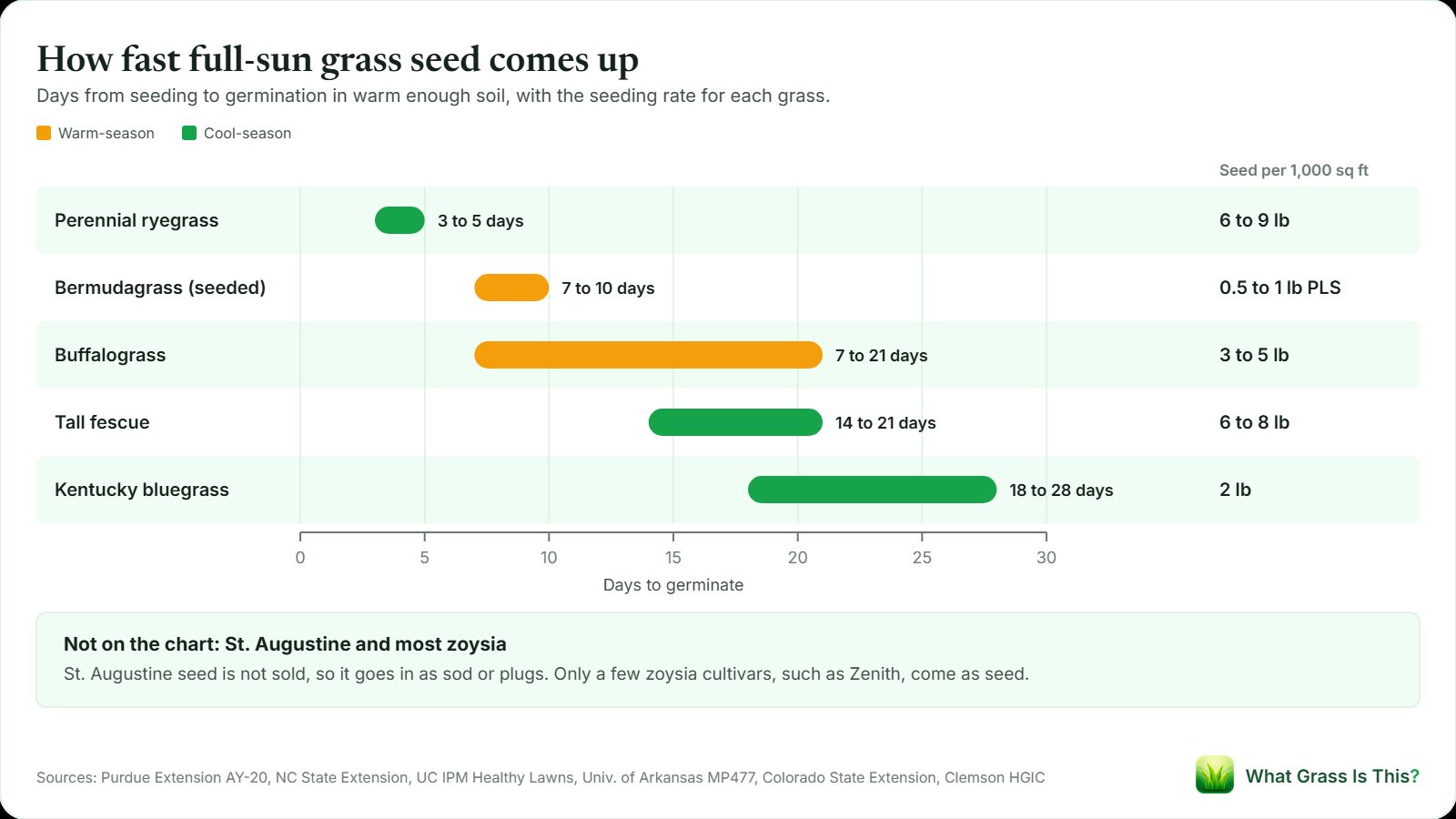
Seed rates come from Purdue Extension AY-20, NC State's Carolina Lawns, UC IPM's Guide to Healthy Lawns, University of Arkansas MP477, Clemson HGIC, UF/IFAS, and Colorado State Extension. Drought and shade ratings come from UC IPM's turf tolerance tables, with bahia from UF/IFAS, and the fescue window from NC State. Tall fescue rates run 6 pounds at NC State and 8 at Purdue. Stay inside that range and follow the bag label, which sets the rate for that blend.
Bermuda seed needs one more check at the store. The University of Arkansas works out that a pound of pure live seed (PLS, the share of the bag that is actually viable seed) takes about 1.09 pounds of uncoated bermuda seed, or about 2.32 pounds of coated seed. Buy by the PLS number and let the seeding calculator handle the square footage.
Got shade instead of sun? This whole decision flips. See Best Grass Types for Shade for the species that actually tolerate 3 to 6 hours of light.
Recommended products
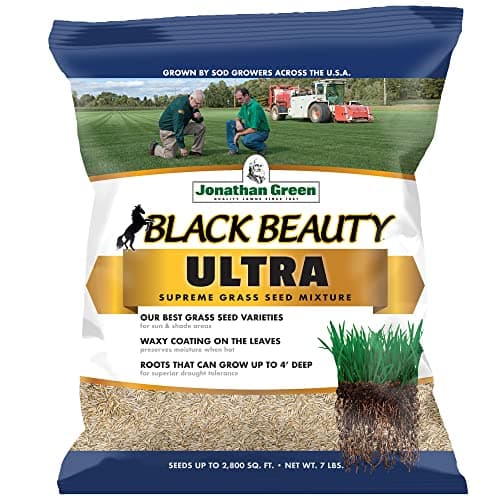
Jonathan Green Black Beauty Ultra Grass Seed
A deep rooting tall fescue, bluegrass and ryegrass blend for northern lawns in full sun.

Outsidepride Maya Bermuda Grass Seed
A Blackjack II bermuda seed blend built for full sun southern lawns.

The Andersons PGF Complete 16-4-8
A slow release 16-4-8 granular with humic acid that suits any grass type.
Best Cool-Season Grass Types for Full Sun (Northern & Transition Zones)
Kentucky Bluegrass: Classic Full-Sun Lawn for Cooler Climates
Kentucky bluegrass is the picture-perfect cool-season lawn for many northern homeowners. It has a rich, dark green color, fine to medium texture, and the ability to form a dense “carpet” that crowds out many weeds. In cooler regions with real winters, it is one of the top choices for full sun lawns.
In full sun, Kentucky bluegrass uses the extra light efficiently and fills in to create a thick turf. Its strong rhizomes help it spread and recover from damage, such as kids’ play, pets, or snow mold patches. However, it has relatively shallow roots compared to tall fescue, so long, hot, dry summers can be challenging without consistent irrigation.
Expect Kentucky bluegrass to go partially dormant or lose color if soil dries out deeply during extended heat. In northern states with average summers, irrigated Kentucky bluegrass lawns stay lush and resilient in bright sun.
Use Kentucky bluegrass for:
- Full-sun front lawns in cold or cool summer climates.
- High-visibility areas where color and uniformity matter.
- Blend mixes with perennial ryegrass for faster establishment.
For best results, mow Kentucky bluegrass at about 2.5 to 3.5 inches. Higher mowing in summer protects the crown and shades the soil. Water deeply but infrequently, applying roughly 1 to 1.5 inches per week during dry spells. Overseed every 2 to 3 years in early fall to maintain density and repair thin spots.
Perennial Ryegrass: Fast-Germinating Grass for Sunny Spots
Perennial ryegrass is the sprinter of cool-season turf. It germinates quickly, 3 to 5 days in mild weather by UC IPM's count, and establishes much faster than Kentucky bluegrass. It has a fine to medium blade, a bright to medium green color, and very good wear tolerance, which is why it is common on sports fields.
In full sun, perennial ryegrass grows aggressively and can handle plenty of foot traffic. It is well suited for cool climates where summer heat is moderate. Like other cool-season types, it can struggle if temperatures repeatedly exceed 85 to 90 degrees and rainfall or irrigation is limited.
Many homeowners use perennial ryegrass to get quick cover on bare sunny spots or new lawns. It is also often mixed with Kentucky bluegrass seed so the ryegrass covers fast while the bluegrass fills in over time, creating a more resilient blend.
Mow perennial ryegrass at 2 to 3 inches. It responds well to regular nitrogen, but avoid over-fertilizing in hot weather. Because individual plants do not spread much, overseed high wear or thinning areas every 1 to 2 years, ideally in early fall.
Tall Fescue: Best Heat Tolerant Grass Among Cool-Season Types
Tall fescue is the workhorse cool-season grass for full sun and heat. Oregon State's turf program says it produces the deepest roots of all cool-season turfgrasses, commonly 2 to 3 feet on deep soils. That deep rooting gives tall fescue excellent drought and heat tolerance compared to Kentucky bluegrass or perennial ryegrass.
Traditional tall fescue had a relatively coarse texture, but newer “turf-type” tall fescues and rhizomatous tall fescues (RTF) have finer blades and a more lawn-like appearance. These improved types are now the go-to choice in many transition zone areas where summers are hot but winters are still cold enough to rule out some warm-season grasses.
In full sun, tall fescue stays greener longer into summer with less water. It handles heat waves better than most cool-season grasses and is notably resistant to wear from kids and pets. It is often considered the best heat tolerant grass among cool-season types.
Ideal uses for tall fescue include:
- Sunny backyards in the transition zone (mid-Atlantic, upper South, lower Midwest).
- Full-sun front lawns that experience summer drought or water restrictions.
- Mixed-use areas where durability matters more than ultra-fine texture.
Mow tall fescue on the higher side, usually 3 to 4 inches. The higher canopy protects the soil from direct sun and reduces evaporation. Water deeply and less frequently to encourage deep root growth; 1 to 1.25 inches per week is typical in summer if rainfall is low. Since tall fescue forms bunches and spreads slowly, overseeding every 1 to 2 years in fall helps maintain a dense, weed-resistant turf.
Best Warm-Season Grass Types for Full Sun (Southern & Hot Regions)
Bermuda Grass: Sun-Loving Powerhouse for Heat and Traffic
If you ask lawn pros in hot southern climates for the best grass for full sun, Bermuda grass is usually at the top of the list. It thrives in intense light and heat, tolerates drought once established, and recovers very quickly from wear. That is why you see Bermuda on many sports fields and golf course fairways throughout the South.
Bermuda grass spreads aggressively via stolons and rhizomes, forming a dense, low-growing turf. In full sun, it becomes a thick mat that resists weeds and handles heavy use. It is truly a sun loving grass; most cultivars thin out or get patchy in moderate to heavy shade.
Bermuda’s heat tolerance is excellent. It maintains strong growth in temperatures that would send cool-season grasses into full dormancy. However, Bermuda does go dormant and turn brown in winter in much of the South and transition zone, then greens up again in late spring when soil warms.
Bermuda is a strong choice for:
- Full-sun yards in the Deep South, coastal regions, and hot inland areas.
- High-traffic lawns with kids, pets, or sports.
- Sunny slopes that are hard to irrigate evenly.
Mow Bermuda at 1 to 2 inches for a tight, carpet-like look. Because it grows so vigorously in summer, it will need frequent mowing in full sun. Water about 0.75 to 1 inch per week during peak heat, more on sandy soils. Fertilize according to soil test recommendations, usually from late spring through mid-summer only.
Zoysia Grass: Dense, Drought Tough, and Great for Full Sun
Zoysia grass is another warm-season favorite for sunny yards, especially where homeowners want a dense, soft-feeling turf that uses less water. Zoysia forms a thick, cushiony lawn with fine to medium blades and excellent wear resistance once fully established. It is generally more drought tolerant than cool-season grasses and can rival Bermuda in sun tolerance. Clemson's zoysia fact sheet is candid about the trade, though: compared with bermuda, zoysia is slower to cover, less drought-tolerant, and more shade tolerant. Pick zoysia for density and a little shade. Pick bermuda for the hottest, driest spot on the lot.
One of Zoysia’s biggest strengths in full sun is its ability to form an extremely dense turf that naturally suppresses weeds. That same density also improves heat and drought resistance, since the soil surface is shaded by the thick canopy. Zoysia can handle moderate foot traffic and recovers well, although not usually as quickly as Bermuda.
Different Zoysia species and cultivars can be adapted to slightly cooler or warmer regions. In general, Zoysia loves full sun and will thin out in heavy shade. In the transition zone, it is popular for homeowners who want a warm-season lawn but prefer a finer texture than Bermuda.
Use Zoysia grass for:
- Full-sun southern lawns where water efficiency is a priority.
- Sunny front yards where a dense, manicured look is desired.
- Lawns that can tolerate slower establishment in exchange for long-term toughness.
Mow Zoysia at about 1 to 2.5 inches depending on the cultivar. It grows more slowly than Bermuda, so mowing frequency is lower once fully established. Water about 0.5 to 1 inch per week in dry periods. Be patient early on, since Zoysia can take a full growing season or more to fill in completely from plugs or sprigs.
St. Augustine and Bahia: Tough Options for Coastal and Low-Maintenance Lawns
In coastal and Gulf regions, St. Augustine grass is a common choice for sunny lawns. It has broad blades, a coarse texture, and a lush, tropical appearance. St. Augustine thrives in warm, humid climates with mild winters, and it handles full sun very well. It also tolerates more shade than Bermuda or Zoysia, making it versatile on properties that have a mix of sun and trees.
St. Augustine spreads by stolons and forms a thick turf that competes well with weeds when healthy. It prefers regular moisture and does not love prolonged drought, but with irrigation it can maintain color and density in intense sun and heat.
Bahia grass is another warm-season option, often used in low-maintenance or rural settings. It is extremely drought and heat tolerant, and it handles sandy, infertile soils better than many other turfgrasses. Bahia is very sun tolerant, and UF/IFAS lists it with bermuda as a grass it does not recommend for shady landscapes. It is often used along roadsides, pastures, and large open properties where durability is more important than golf course looks.
Consider St. Augustine if you want:
- A lush, full-sun lawn in warm, humid coastal or Gulf climates.
- Grass that can handle some shade along with bright areas.
Consider Bahia if you want:
- A rugged, low-input grass for full sun, especially on sandy soils.
- Functional cover more than a manicured lawn appearance.
Mow St. Augustine relatively high, 3 to 4 inches, to protect stems and maintain thickness. It benefits from regular watering and moderate fertilization in the growing season. Bahia can be mowed at 2.5 to 4 inches and usually needs less fertilization, but it will go off-color in drought and then green up again with rain.
Key Traits of the Best Grass Types for Full Sun
While each species has its own quirks, most of the best sun tolerant grass types share a few key traits. Understanding these helps you evaluate new varieties or blends that claim to be “built for full sun.”
Look for grass types with:
- Deep or efficient root systems - Deeper roots give grasses access to cooler, moister soil. Tall fescue and many warm-season grasses excel here.
- Good heat tolerance - Some species maintain cell function and photosynthesis at higher temperatures. Bermuda, Zoysia, and turf-type tall fescues are standouts.
- Drought response - Drought tolerant grass either keeps growing with less water or goes dormant then recovers quickly when moisture returns.
- Dense growth habit - Thick turf shades the soil, reducing evaporation and weed invasion. Kentucky bluegrass, Zoysia, and healthy Bermuda are examples.
- Recovery ability - Rhizomes and stolons allow grasses like Bermuda and Kentucky bluegrass to repair damaged or thin areas over time.
When comparing seed tags or sod descriptions, look for terms like “heat tolerant grass,” “sun tolerant grass,” “drought tolerant,” “deep rooting,” and “traffic tolerant.” These usually indicate traits that play well in full sun environments.
Grass for Hot, Sunny Areas That Won't Burn Out
Some yards bake: south-facing slopes, open lots with no tree cover, reflective heat off driveways and siding. For those hot, sunny areas, prioritize the grasses that keep growing at high temperatures. In the South, that is bermuda first and zoysia second. Both keep growing through heat that pushes every cool-season grass into dormancy, and both bounce back quickly after dry spells once water returns.
For low-water lawns in the Great Plains and West, buffalograss deserves a serious look. It needs 6 to 8 hours of direct sun, and Colorado State Extension says a buffalograss lawn can stay green on 50 to 75 percent less irrigation than Kentucky bluegrass, needing one to two inches of rain or irrigation every two to four weeks in summer. In extreme drought it goes dormant, then greens back up with rain. The trade-off is a thinner, prairie-style look and slower recovery from wear than bermuda.
In the North and transition zone, turf-type tall fescue is the grass least likely to burn out in a hot, sunny spot. Oregon State puts its roots at 2 to 3 feet on deep soils, pulling moisture from below the dry surface layer while shallow-rooted Kentucky bluegrass browns out. One caution: in a heat wave with limited moisture, fescue tips can look scorched or rusty in direct sun. Read that as a call to water deeper, and do it that week.
How to Plant Grass in Full Sun So It Thrives
Even the most sun tolerant grass will struggle if it is planted poorly or into compacted, nutrient-poor soil. A little extra preparation at the beginning sets your lawn up to handle years of bright light and summer heat.
Use this basic step-by-step approach for seeding or sodding a full-sun area:
- Test and prepare your soil
Get a soil test to check pH and nutrient levels. Loosen compacted soil to at least 4 to 6 inches deep, then rake smooth and remove debris. Incorporate compost if the soil is very sandy or very heavy. - Choose climate-appropriate, sun tolerant grass
In northern or transition zones, pick improved Kentucky bluegrass, tall fescue, or perennial ryegrass blends labeled for sun. In southern regions, select Bermuda, Zoysia, St. Augustine, or Bahia varieties suited to your state. - Seed or lay sod at the right time
Cool-season grasses establish best in late summer to early fall; Purdue times germination from the day soil reaches 55°F. Warm-season grasses establish best in late spring to early summer, and LSU AgCenter says to seed bermuda when soil at 3 inches holds in the upper 60s °F. Check the soil temperature before you buy the seed. - Water correctly during establishment
Keep the top 0.5 to 1 inch of soil consistently moist while seeds germinate or sod roots. In full sun this may mean light, frequent watering at first, then deeper, less frequent watering as roots grow. - Ease into regular mowing
Start mowing when new grass reaches one third taller than your target mowing height. Use a sharp blade and remove only the top third of growth each time.
If you want help choosing fast coverage options for a new full-sun lawn, you can also look at Fastest Growing Grass Varieties: 5 Picks That Sprout in 3-7 Days for ideas on quick-germinating mixes and blends.
Ongoing Care Tips for Lawns in Full Sun
Once your sun tolerant grass is established, ongoing care is what keeps it thick, green, and healthy year after year. Full sun magnifies both good and bad habits, so a few smart practices can make a big difference in long-term performance.
Mowing, Watering, and Fertilizing for Full-Sun Success
Mowing height and frequency play a major role in how well your lawn handles heat. As a general rule, higher mowing heights help lawns in full sun tolerate stress better. Taller blades shade the soil, cool the crown of the plant, and encourage deeper roots.
Good targets for mowing height are:
- Kentucky bluegrass and perennial ryegrass: 2.5 to 3.5 inches
- Tall fescue: 3 to 4 inches
- Bermuda: 1 to 2 inches
- Zoysia: 1 to 2.5 inches
- St. Augustine: 3 to 4 inches
- Bahia: 2.5 to 4 inches
For watering, deep and infrequent is usually best once grass is established. Aim for about 1 inch of water per week for most lawns, adjusting for rainfall and soil type. Sandy soils may need smaller, more frequent applications; heavy clay can handle deeper, less frequent watering. In full sun, try to water early in the morning so leaf surfaces dry quickly.
Fertilize based on your grass type and soil test results. Cool-season grasses usually receive most of their nitrogen in fall and late spring. Warm-season grasses are fertilized from late spring through summer and left alone while dormant. Over-fertilizing in high heat can trigger disease, so stay moderate during stressful times.
Preventing Heat Stress and Burn in Full Sun
Even with a sun tolerant grass, extreme heat or drought can cause stress. Watch for early signs like wilting, bluish-gray color, or footprints that remain visible after walking across the lawn.
To reduce heat stress in full sun:
- Raise your mowing height during heat waves to give more shade to the soil and crowns.
- Avoid heavy nitrogen fertilization during the hottest periods.
- Water deeply before, not during, extreme heat if possible so roots have moisture available.
- Keep mower blades sharp to reduce leaf tearing and water loss.
If you see localized dry spots or browning on south-facing slopes, check soil depth and compaction. These areas may need aeration or extra organic matter to improve water holding capacity.
For yards where trees or buildings create a patchwork of sun and shade, you may also want to read Best Grass Types for Shade. In some cases, using different blends for sunny and shady zones produces a more consistent look and healthier turf overall.
Conclusion: Matching Grass to Sun and Climate for Your Best Lawn Yet
Getting a durable lawn in full sun starts with the grass you plant. When you choose a grass type that is naturally sun tolerant and matched to your climate, everything else becomes easier. Heat tolerant grass with deep roots, dense growth, and strong recovery will always outperform a shade lover struggling in the same bright, hot yard.
In cooler regions, Kentucky bluegrass, perennial ryegrass, and especially tall fescue can create beautiful full-sun lawns when managed correctly. In southern and hot climates, warm-season champions like Bermuda, Zoysia, St. Augustine, and Bahia shine brightest under intense sunlight.
Combine the right species with smart mowing heights, deep watering, and appropriate fertilization, and your full-sun yard can stay thick and green even through summer. If you want to fine-tune your plan further, explore the Complete Guide to Cool-Season Grass Types, the Complete Guide to Warm-Season Grass Types, Fastest Growing Grass Varieties, and Best Grass Types for Shade to round out your lawn care toolkit.
With the right grass for full sun and a bit of consistent care, that hot, exposed yard can become one of the most attractive parts of your property.
Top Picks
- Outsidepride Maya (Blackjack II) Bermuda Grass Seed (5 lb)Check price on Amazon
- Pennington Full Season Lawn Fertilizer 32-0-5Check price on Amazon
- Pennington Smart Seed Sun and Shade MixCheck price on Amazon
As an Amazon Associate we earn from qualifying purchases.
Free Lawn Care Tools
The best grass for full sun depends on your climate. In the South, bermuda grass is the top performer: it thrives on 6 to 8 or more hours of direct light, tolerates drought once established, and recovers quickly from wear. In the North, Kentucky bluegrass excels in full sun with regular irrigation, while turf-type tall fescue is the better pick where summers run hot and dry thanks to roots that can reach 2 to 3 feet deep. In the transition zone, tall fescue and zoysia are the most reliable full-sun choices.
Bermuda grass grows best in full hot sun. It keeps growing in temperatures that push other grasses into dormancy, tolerates drought once established, and recovers quickly from heat and foot traffic. Zoysia is a close second with a denser, softer feel, and buffalograss is the low-water champion for hot, dry lawns in the Great Plains and West. In cooler climates with hot summers, turf-type tall fescue handles hot sun better than any other cool-season grass.
For lawn care, “full sun” means an area that gets at least 6 to 8 hours of direct sunlight every day. Partial sun is about 3 to 6 hours, and full shade is less than 3 hours. Full sun spots heat up faster, dry out more quickly, and put more stress on grass than shaded or partially shaded areas. Only grass types that are truly sun tolerant, like bermuda or zoysia in the South or tall fescue in the North, will stay thick and green in these conditions.
Cool-season grasses like Kentucky bluegrass and tall fescue grow best in spring and fall and can struggle during prolonged summer heat, even in full sun. Warm-season grasses like Bermuda and Zoysia peak in growth during hot weather and usually love full sun, especially in southern climates. In colder regions, warm-season grasses will go dormant and turn brown in winter, which affects how your lawn looks year-round.
In full sun, grass does best with deep, infrequent watering rather than light, frequent sprinkling. Applying about 1 to 1.5 inches of water per week during dry spells helps roots grow deeper and better handle heat and drought. This approach reduces stress from fast evaporation on hot, sunny days.
The best grass for direct sunlight depends on where you live. In cooler northern states, turf-type tall fescue handles full sun exposure better than most cool-season grasses thanks to roots that commonly reach 2 to 3 feet on deep soils (Oregon State), giving it strong drought and heat tolerance. Kentucky bluegrass also does well in full sun with consistent irrigation. In the South and transition zone, bermuda and zoysia are the top picks for direct sunlight because they are built for intense heat and high light levels. All of these need 6 or more hours of sun to thrive and will thin out in shade.
For sunny yards in the North, choose tall fescue for durability and drought tolerance, Kentucky bluegrass for a classic fine-textured look, or a blend of the two with perennial ryegrass for fast establishment. For sunny areas in the South, bermuda is best if you want toughness and fast recovery, zoysia if you prefer a dense cushioned feel with lower water needs, and St. Augustine if you live along the Gulf or coast. Match the grass to your climate zone first, then fine-tune based on how much mowing and watering you want to do.
The best sod for full sun depends on your climate. In southern regions with hot summers, bermuda sod (Tifway 419 or TifTuf) is the top performer for full sun, with zoysia (Empire or Zeon) as a close second offering a denser, softer surface. St. Augustine sod (Floratam variety) handles full sun along the Gulf and Florida coast specifically. In northern regions, sod is typically Kentucky bluegrass or a Kentucky bluegrass and perennial ryegrass blend, and both perform well in full sun with consistent watering. In the transition zone, turf-type tall fescue sod (often labeled RTF) is the most common full-sun choice because its deep roots tolerate heat better than bluegrass. Pick the sod that matches your climate first, then look at install timing and maintenance fit.
Staying green all summer in full sun comes down to matching grass type to climate. Warm-season grasses like bermuda, zoysia, and St. Augustine peak in summer heat and stay green right through July and August in southern lawns. In cooler climates where heat is shorter but still real, turf-type tall fescue is the most reliable cool-season grass for staying green all summer thanks to roots that commonly reach 2 to 3 feet on deep soils (Oregon State), helping it pull moisture from below the dry surface zone. Kentucky bluegrass tends to brown out or go dormant during prolonged heat unless watered weekly. To keep any cool-season lawn green through summer, water deeply (about 1.5 inches per week), mow tall (3 to 4 inches), and avoid fertilizing during peak heat.
For fast establishment in direct sunlight, perennial ryegrass germinates in 3 to 5 days in mild weather (UC IPM) and is the quickest cool-season grass to fill a sunny seed bed. It is often blended with Kentucky bluegrass (which takes 18 to 28 days once soil reaches 55°F, per Purdue) to give you both speed and long-term self-repair. In warm climates, common bermuda grass seed germinates in 7 to 10 days under good conditions (University of Arkansas) and establishes aggressively in full sun. For the fastest possible coverage in either climate, sod gives you an instant lawn (about 2 weeks for roots to anchor) but costs significantly more than seed. Soil temperature is the key variable: cool-season grasses establish best in early fall when soils are 50 to 65°F, and warm-season grasses need soil at 65°F or higher.
Tall fescue is the best cool-season grass for full sun. Its deep root system, commonly 2 to 3 feet on deep soils per Oregon State, gives it the strongest heat and drought tolerance of the cool-season grasses, so it stays green longer through summer with less water than Kentucky bluegrass or perennial ryegrass. Choose a turf-type tall fescue for a finer, more lawn-like look. Kentucky bluegrass is a close second in cooler northern climates with reliable irrigation.
In hot southern climates, bermuda and zoysia are the most drought-tolerant grasses for full sun. Both go semi-dormant in dry spells and bounce back quickly when water returns. In northern and transition zones, tall fescue is the most drought-tolerant cool-season option thanks to its deep roots. Bahia is the toughest choice for sandy, low-water sites where survival matters more than appearance.
Bermuda is the best grass for a high-traffic, full-sun lawn. It spreads aggressively by stolons and rhizomes and recovers from wear faster than any other common turf, which is why it is used on sports fields and golf fairways across the South. In cooler climates, a tall fescue and Kentucky bluegrass blend gives the best mix of sun tolerance and traffic recovery.

Beat weeds and brown spots from your phone
Snap a photo, get the fix, and follow a plan timed to your soil and weather. Free on iPhone.