How to Mow a Lawn With a Riding Mower: Expert Tips
 James ThorntonLawn Equipment & Maintenance Expert | 20 Years
As an Amazon Associate we earn from qualifying purchases.
Scalped humps. Ruts at the turns. A deck that cuts one side short. Most people blame the mower. Usually it's the setup. Dull blades, a deck out of level, the wrong height, too much speed. Fix those and the same machine cuts clean. Shopping for a new one instead? The riding mower and zero-turn buying guide covers terrain, deck size, and slope safety.
Below: how to mow with a rider, step by step. Then the settings, the service schedule, the slope limits, and the fixes for a bad cut. Numbers come from the CPSC, OSHA, extension services, and the engine makers' own schedules.
To mow a lawn with a riding mower, clear the yard of sticks and rocks, set the deck so you remove less than one-third of the grass blade (NC State's rule), engage the blades on the grass, and mow straight overlapping passes, going up and down any slope and never across it, as the CPSC directs.
Uneven stripes or scalping? Check tire pressure, level the deck, then sharpen the blades. John Deere's spec: blade tips within 1/8 inch side to side, front of the deck 1/8 to 1/4 inch lower than the rear. Most cool-season lawns want about 3 inches or more in summer, per Penn State. Bermuda and zoysia run lower. Slow down in thick or wet grass. Skip slopes over 15 degrees unless your manual allows more.
How to mow a lawn with a riding mower
Same order every time. Takes a few minutes before the engine turns over. Saves a blade, a sprinkler head, or worse.
- Walk the lawn. Pick up rocks, wire, sticks, and toys. The CPSC's ride-on rules list them by name because the blade throws them.
- Gear up. Eye protection every time (CPSC). Hearing protection too: the CDC puts a lawn mower at 80 to 100 dB, loud enough to cost you some hearing. Closed-toe shoes, per the American Academy of Pediatrics (AAP).
- Clear the yard of kids and pets. The CPSC says keep small children out of the mowing area, watched by an adult other than the operator. Never carry passengers. The AAP's minimum age to drive a rider is 16.
- Check the machine. Oil level (Briggs & Stratton says daily or every 8 hours). Tire pressure at your manual's number, never over the sidewall maximum (Troy-Bilt). Fuel you bought within the last 30 days.
- Set the deck. Pick a height that removes less than one-third of the blade. Grass got away from you? Raise the deck for this cut and step down over the next few mows.
- Start with blades off. Parking brake on, transmission in neutral. Drive onto the grass. Throttle to full, then engage the blades. John Deere's manual says full throttle first, or the engine can stall. Blades off before you cross gravel (CPSC) or the driveway.
- Lap the edges first. Two or three passes around the border. That strip becomes your turning lane.
- Mow straight passes. Overlap each pass slightly so no strip gets missed. Slow down before every turn (CPSC). Wide three-point turns tear less turf than a pivot.
- Take slopes up and down. Never across. Low, steady speed. No stopping, starting, or turning on the hill. Details in the slope section below.
- Don't mow in reverse. Only when you have to, and look down and behind first (CPSC).
- Park it right. Blades off, parking brake set, engine off, key out, before you step off (CPSC).
Next mow, run the stripes the other direction. Done.
Understanding riding lawn mowers: which type fits your lawn
Match the machine to the ground. A small rider on rough acreage struggles. A zero-turn on a steep side-hill slides. Buying bigger rarely fixes either one.
Riding vs. walk-behind vs. zero-turn: which is right for your lawn?
Small, tight yard? Walk-behind. Skip the rider unless the push mower is eating your weekend. Time one mow and decide. A rider saves time with a wider deck and a seat, and a small lot has no room to use either.
Zero-turns pivot on their rear wheels. The CPSC describes a zero-turn radius mower as one that can rotate 180 degrees and head back out the path it came in on. That's the whole appeal around trees and beds. The trade: lap-bar steering takes practice, and on a side-hill the machine can lose traction. Flat lawn with a lot of obstacles? Buy it. Hills? Steering wheel.
How often you mow matters as much as what you ride. The mowing calculator sets height and frequency for your grass type. A smaller rider on the right schedule beats a big one run late.
Main types of riding lawn mowers
Four types. Buy the one that fits the ground.
| Type | Buy it if | Skip it if |
|---|---|---|
| Lawn tractor (front engine, steering wheel) | You mow a typical residential lawn and tow a cart, spreader, or sweeper | You need tilling, plowing, or other ground-engaging work |
| Garden tractor (heavier frame and axles) | You'll run ground-engaging attachments, a snow blade, or a big aerator | It only ever mows a flat suburban lot |
| Zero-turn (lap bars, rear-wheel steering) | The lawn is fairly flat and full of trees, beds, and fence lines | You mow side-hills or rough ground |
| Rear-engine or compact rider | Storage is tight, gates are narrow, and the lot is small and flat | You tow heavy loads or mow dense, fast-growing turf |
Deck sizes, horsepower, and prices by acreage live in the buying guide linked above. Here, the job is running what you already own.
Key features that actually matter
Most spec sheets are marketing. A few features change the cut and the ride.
- Hydrostatic transmission. A pedal instead of gears. Smooth speed changes. Worth it if more than one person drives the mower.
- Fabricated deck. Welded plate steel. Heavier and tougher than a stamped deck. Worth it for rough ground or heavy use. Skip it on a small smooth lawn.
- Safety standard label. The CPSC points shoppers to machines certified to ANSI B71.1. That standard brought operator presence control (blades stop if you leave the seat), a seatback at least 4 1/2 inches high, and blades that stop when you back up, with a temporary override allowed. Zero-turns and front-mount mowers are exempt from that reverse rule.
- Attachments. Buy for jobs you'll actually do in the next two or three years. A bagger for leaf-heavy yards. A mulching kit. A tow-behind spreader. Leave the rest on the shelf.
Pre-mowing preparation: set up yourself and your riding mower
Most bad mows start before the key turns. A scalped hump, a broken sprinkler head, a thrown rock. Five minutes of prep prevents all three.
Site assessment: know your lawn before you ride
Walk it once properly. Then scan it before every mow. Look for:
- Slopes, and which way you'll have to mow them.
- Low, wet spots that rut or trap a tire.
- Hidden hazards: shallow sprinkler heads, raised roots, stumps, tie-out stakes.
Flag the hidden ones with stakes. Hit something twice, mark it for good. Too tight or too steep for the rider at a crawl? Trimmer or push mower there. The rider does the open ground.
Grass type sets the pace. Cool-season lawns (bluegrass, fescue, ryegrass) grow fastest in spring and fall. Warm-season lawns (Bermuda, zoysia, St. Augustine) grow fastest in summer. Mow more often in each one's peak so the one-third rule holds.
Safety first: pre-ride checks
Riders are heavy and the blades are fast. The CPSC estimates 35,000 riding mower injuries treated in emergency rooms each year (2012 to 2014), and an average of about 90 riding mower deaths a year (2008 to 2010). Rollovers, falls, and run-overs make up the fatal patterns.
Before each mow:
- Sturdy closed-toe shoes. No sandals, no sneakers (AAP).
- Snug clothes. Nothing loose near belts.
- Eye protection and hearing protection. Keep a pair of earmuffs next to the mower. That's the CDC's own tip.
- Kids and pets inside. No riders on your lap. Ever.
Then the ground:
- Wet grass? Wait. The CPSC says tires may lose traction on it. It also clumps and ruts.
- Slopes inside your manual's limit? If the manual doesn't list one, OSHA's fallback is 15 degrees.
Then the machine, engine off:
- Tires inflated and not cracked.
- Seat switch, blade engagement, and parking brake all working.
- Discharge guard or bagger installed. The CPSC says never run without it.
- Fuel and oil topped up. No leaks under the frame.
- The CPSC's ride-on rules say to clear the area of bystanders before operating, stop the machine if anyone enters the area, and never tamper with safety devices. Check their operation regularly.
Something feels off mid-mow? Vibration, loose steering, a new noise. Stop and look. Set it right before the next pass.
Mowing strategy: patterns, height, speed and grass health
Four settings decide the cut: height, pattern, speed, and what happens to the clippings. Get them right and the lawn looks striped instead of stressed.
Choosing efficient mowing patterns
Outline first. Two or three laps around each area give you room to turn. Then straight passes.
Rectangular lawn? Back and forth stripes. Switch direction every mow: north to south this week, east to west the next. Same wheel tracks every week pack the soil and leave tramlines.
Curved beds? Follow the edge and echo it inward. Less trimming later. In tight corners, a three-point turn beats a pivot, especially on a heavy zero-turn.
Setting the correct mowing height
Height is the biggest lever you have. The rule: remove less than one-third of the leaf surface per cut. NC State's words. Treat one-third like the redline on a tach.
Scalping weakens roots and invites weeds. Penn State says raise mowing heights to three inches or more as summer begins, and that studies show taller mowing alone cuts weed pressure significantly.
| Grass | Mowing height | Source |
|---|---|---|
| Cool-season lawns in summer | 3 inches or more | Penn State Extension |
| Tall fescue | 2.5 to 3.5 inches | NC State Extension |
| Bermudagrass (common, rotary mower) | 1 to 2 inches | NC State Extension |
| Zoysiagrass | 0.75 to 2 inches | NC State Extension |
| Centipedegrass | 1 to 1.5 inches | NC State Extension |
| St. Augustine (Floratam and other standard types) | 3.5 to 4 inches | UF/IFAS |
| St. Augustine (dwarf types) | 2 to 2.5 inches | UF/IFAS |
Don't trust the number on the height lever. Measure it:
- Park on a flat floor. Garage or driveway.
- Measure from the floor to the blade tip at the outer edge, both sides.
- Adjust until the reading matches your target. Level side to side. Front slightly lower than the rear (spec in the maintenance section).
Scalped spots only on the humps? Uneven ground or an unlevel deck. Scalping everywhere? The deck is too low for how tall the grass got.
Peak growth may mean mowing every week or more often. UF/IFAS says St. Augustine typically needs weekly mowing in the growing season. Missed a week? Raise the deck one notch for that cut, then step back down.
Finding the right ground speed
Top speed is for getting across the yard. Cutting speed is slower. You're going too fast if you see:
- Uncut or bent blades in the middle of the pass.
- Clumps instead of an even spread.
- The engine lugging in thick patches.
Full throttle for blade speed. Pedal or gear for ground speed. Slow down one step in tall, wet, or dense grass until the cut comes out clean. Cruise control only on open, flat, even ground.
Managing clippings: bag, mulch, or side discharge?
Mulch or side-discharge by default. Bag for cleanup.
Clippings are free fertilizer. NC State says returning them lets you cut fertilizer use by 20 to 30 percent. Penn State found Kentucky bluegrass clippings held 46 to 59 percent of the nitrogen applied as fertilizer over three years. Penn State also says clippings don't cause thatch. They're leaf tissue, and they break down fast.
- Mulching recuts clippings fine and drops them into the turf. Works on dry grass under the one-third rule. Clumps mean wet grass, too much height off, or too much speed.
- Side discharge is fastest in tall grass. Overlap passes to break up windrows. Point the chute away from people, cars, and windows. The CPSC also says don't discharge against a wall. It ricochets.
- Bagging: buy the bagger if you have heavy leaf drop or need a clean surface for an event. Every bag you haul off is nitrogen you'll buy back later.
Recommended products

The Andersons PGF Complete 16-4-8
A slow-release 16-4-8 with humic acid and a fine particle size for even coverage.
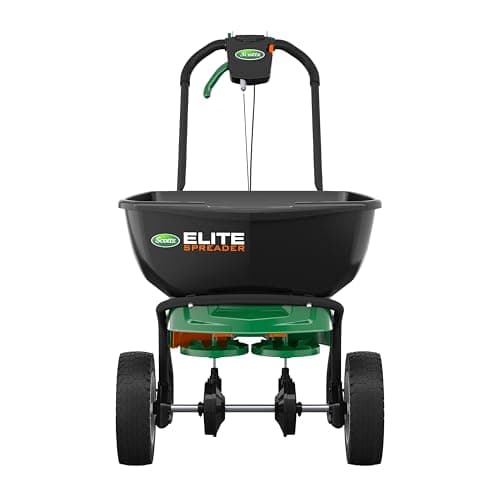
Scotts Elite Spreader
A broadcast spreader with a dual rotor and large pneumatic tires for rough ground.

MySoil Soil Test Kit
A mail-in soil test that keeps you from fertilizing a large lawn blind.
Maintenance and tuning: keep your riding mower cutting like new
Ragged cuts, one-sided scalping, and vibration usually trace back to four things. Dull or bent blades. Uneven tires. A deck out of level. A tired engine. All four are on a schedule.
Treat it like a small tractor. Service on the hour meter, not on a feeling.
Core maintenance schedule
The engine maker and the mower maker both publish intervals. Here's where they land.
| Job | Interval | Source |
|---|---|---|
| First oil change on a new engine | After the first 5 hours | Briggs & Stratton |
| Check oil level | Every 8 hours or daily | Briggs & Stratton |
| Clean battery terminals | Every 10 hours | Cub Cadet |
| Clean air filter and pre-cleaner | Every 25 hours or yearly | Briggs & Stratton (Cub Cadet: pre-cleaner every 25 hours) |
| Check, sharpen, or replace blades | Every 25 hours | Cub Cadet |
| Change oil (and filter, if fitted) | Every 50 hours or yearly | Briggs & Stratton; Cub Cadet (50 hours) |
| Replace air filter | Yearly, or every 100 hours | Briggs & Stratton (yearly); Cub Cadet (100 hours) |
| Spark plug | Replace yearly; check every 100 hours | Briggs & Stratton; Cub Cadet |
| Fuel filter | Yearly, or every 100 hours | Briggs & Stratton; Cub Cadet |
| Fuel | Buy only what you'll burn in 30 days | Briggs & Stratton |
Heavy use or dusty ground? Briggs & Stratton says service more often. Your operator's manual wins over both columns.
Shop math: mowing an hour a week for a 30-week season puts about 30 hours on the meter. That's one blade sharpening past the 25-hour mark, and the yearly oil change comes before the 50-hour one. Two hours a week puts you at 60 hours: sharpenings at 25 and 50, and the 50-hour oil change late in the season.
Blade sharpening and deck leveling
A dull blade tears grass the way a dull chisel tears wood. The tips fray, then turn white or brown. The whole lawn looks faded.
Sharpen on the schedule above. Keeping a spare set on the shelf means you swap in five minutes and sharpen the dull set whenever. To pull and sharpen safely:
- Pull the spark plug wire and the key.
- Raise the mower on ramps or a jack rated for its weight, or drop the deck.
- Wear gloves or wrap the blade. The CPSC calls this out.
- Mark which side faces down before you remove it.
- File or grind to the original angle. Then balance it on a blade balancer or a nail. An unbalanced blade shakes the spindle bearings apart.
Not a bench person? A small-engine shop sharpens blades fast and cheap. Full technique in How to Sharpen Lawn Mower Blades.
Then level the deck. One side low means a scalped band on that side of every pass. John Deere's lawn tractor manual gives the numbers:
- Tire pressure set first. Equal side to side, at the pressure in your manual. Never over the sidewall maximum (Troy-Bilt).
- Park on a flat, level floor. Engine off, key out, plug wire off.
- Turn the blades sideways. Measure the outside tips to the floor. They must be within 1/8 inch of each other.
- Turn a blade front to back. The front tip sits 1/8 to 1/4 inch lower than the rear.
Set it. Leave it. Recheck after you hit something hard.
Engine, fuel, and drive system care
- Fuel: Briggs & Stratton says gas can start to deteriorate in as little as 30 days. Buy small cans. Use stabilizer for anything that sits. E10 is fine. Skip E15. Briggs says it isn't approved for small engines. Minimum 87 octane.
- Oil: first change at 5 hours on a new engine. Then every 50 hours or yearly.
- Air filter: clean it at 25 hours. A choked filter means a rich mixture, a fouled plug, and lost power.
- Spark plug: replace it yearly.
Hydrostatic transmissions on home riders are mostly sealed. Some have a serviceable filter or reservoir. If yours does, follow the manual's interval. Slipping or whining under load points to a worn drive belt, low fluid, or worn parts. Get it looked at before it quits in the back forty.
Check tire pressure monthly in the season and any time the cut changes for no reason. A soft tire tilts the whole deck.
- Your engine's operator's manual lists the exact intervals for your model. Briggs & Stratton notes that heavy use and dusty or dirty conditions call for more frequent service.
Safety and operation skills: ride your mower like a pro
Slopes cause the worst accidents. The CPSC calls them a major factor in loss of control and tip-overs. Treat the rider like a small tractor. Because it is one.
Hill and slope techniques
Know your limit before you're on the hill. Your manual's number comes first. No number in the manual? OSHA says avoid mowing slopes over 15 degrees. OSHA's slope bands, and what those angles look like on real ground:
| Slope | Grade | Rise over 10 feet | OSHA equipment band |
|---|---|---|---|
| 5° | 9% | 0.9 ft | Riding mowers or tractor mowers |
| 10° | 18% | 1.8 ft | Riding mowers or tractor mowers |
| 15° | 27% | 2.7 ft | Top of the riding mower band |
| 22° | 40% | 4.0 ft | Top of the tractor mower band (15 to 22°) |
| Over 22° | Over 40% | Over 4.0 ft | String trimmers, push mowers, or specialized slope mowers |
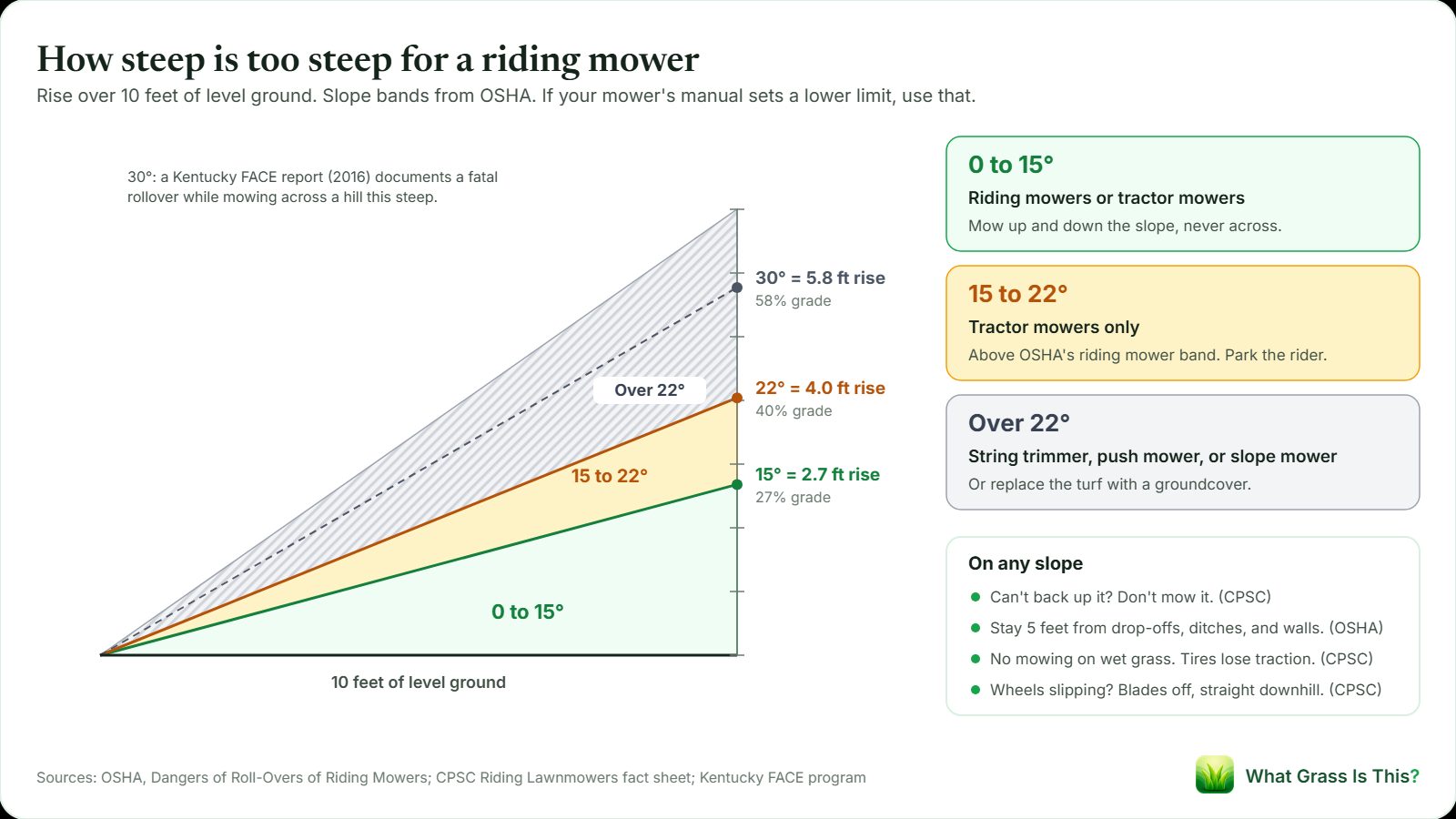
Grade and rise are plain trigonometry: rise equals 10 feet times the tangent of the angle. OSHA suggests a slope indicator, also called an inclinometer. Phone apps work. So does a printable one from a mower maker's site.
On any slope:
- Lawn tractors and riders: mow up and down. Never across. The CPSC and OSHA say the same thing.
- Can't back up the slope, or you feel uneasy on it? The CPSC says don't mow it.
- Pick a low ground speed so you never stop or shift on the hill. Keep it in gear going down. No coasting in neutral (CPSC).
- Wheels start to slide? Disengage the blades and go slowly straight down (CPSC).
- Stay off the edges. OSHA says keep drive wheels at least 5 feet from drop-offs, retaining walls, ditches, and embankments.
- Baggers and tow-behinds change the balance. The CPSC says take extra care with them, and keep them off steep slopes.
Mowing across is how people get hurt. A Kentucky FACE fatality report (2016) documents a 22-year-old operator killed when his mower slid and rolled while he mowed horizontally across a 30 degree hill. That slope is twice OSHA's riding mower limit.
A slope that feels marginal every week? Trade the grass for groundcover, mulch, or shrubs. Or cut it with a walk-behind.
Starting, stopping, and turning without damaging turf
Start and stop the way the step list says: brake set and neutral to start, full throttle before the blades go in, blades off before gravel, brake set before you step off. The turf damage comes from the turns.
Tight pivots on a heavy machine tear turf, worst on wet or soft ground. Use wide three-point turns at the row ends. On a zero-turn, ease off speed before the turn and don't spin one wheel in place. Arc-shaped torn patches in the lawn come from turning. Slow the turns and they stop showing up.
Protecting people, pets, and property
The blade throws whatever it finds. The AAP counts more than 5,000 children treated in emergency departments each year for power mower injuries.
- Clear the area of people and pets before you start. Stop the mower if anyone walks in (CPSC).
- Never point discharge at roads, sidewalks, cars, or windows.
- Before and while backing, look behind and down for small children (CPSC).
- Never give kids rides, even with the blades off. The CPSC says kids who got rides before may run back out for another one.
- No alcohol, no drugs, no mowing drowsy. Daylight or good artificial light only (CPSC).
Hauling the mower? Strap it down on the trailer. The CPSC says take extra care loading and unloading, and watch for traffic near roads. Driving a rider on a public street? Check your local rules first.
Troubleshooting common riding mower problems
Match the pattern, then run the check. Most fixes happen in the garage.
Uneven or poor quality cut
Stripes of different heights, scalping on one side, or ragged tips. Check in this order:
- Tire pressure. Gauge every tire. One soft tire tilts the deck.
- Deck level. Blade tips within 1/8 inch side to side, per John Deere's spec.
- Blades. Rounded, nicked, or blunt edges get sharpened or replaced.
- Speed. If the cut cleans up when you slow down, speed was it.
Cheapest check first. Most cuts clean up in one session.
Mower stalling, bogging, or not starting
Two kinds of trouble. Won't start. Or starts and bogs under load.
Won't start or hard to start:
- Old fuel. Briggs & Stratton says gas can start to deteriorate in as little as 30 days. Unstabilized gas from last season? Drain it and refill.
- Choke and throttle. Follow the start procedure in your manual.
- Safety switches. Seat, brake, and blade lever in the right positions. A bad seat switch keeps it from starting.
- Spark plug. Pull it. Fouled or worn? Replace it. It's a yearly part anyway.
Starts, then bogs or stalls with the blades engaged:
- Dull blades pulling extra power.
- A clogged air filter.
- A partly clogged fuel filter.
- Grass too tall or too wet. One-third rule broken.
Test it: mow a short, dry patch with the deck raised. Runs fine there? It's load, and the engine is healthy. Sharpen and raise the deck first. Then filters.
Excessive vibration or noise
Vibration means something is bent, unbalanced, or loose. Usual causes:
- A bent blade from a rock or root.
- An unbalanced blade after sharpening.
- Packed debris under the deck or wrapped on a spindle.
- Worn spindle bearings.
Engine off, key out, plug wire off. Look under the deck. A blade that doesn't match its twin gets replaced. Shaking started right after sharpening? Rebalance. Spin each blade by hand and feel the spindle. Grinding or roughness means the bearing is done. The CPSC's rule: hit something, stop and inspect before you restart.
What other guides get wrong
Most riding mower articles stop at buying tips and a safety checklist. The expensive mistakes live in between.
They jump straight to "sharpen the blades." Stripes of high and low grass usually start with tire pressure or deck level. Check both first. They're free.
They let the mower pick the height. A deck that drops to 1 or 1.5 inches doesn't mean your grass wants it there. Species and season set the height. Use the table above or your extension office's range.
- Penn State Extension says mowing heights should be raised to three inches or more as summer begins, and that studies show increased mowing height alone reduces weed pressure significantly, even without pre-emergent herbicides.
They sell zero-turn speed without the slope warning. The fine print on every rider is the same: the manual's slope limit, and OSHA's 15 degrees when there isn't one. Feel the machine slide even a little? That's the limit. Don't power through it.
They blame the carburetor for spring no-starts. Usually it's last year's gas. Stabilizer, a clean deck, and a dry spot in the shed fix most of it before spring.
Putting it all together: a simple seasonal plan
Same jobs every year. Same order.
Early spring, before the first mow
- Full service: oil, filters, spark plug, blades, deck level, tire pressure.
- Walk the yard. Pick up winter branches and rocks.
- Start the deck at the high end of your grass's range.
Late spring to early summer
- Mow often enough to hold the one-third rule. Cool-season grass grows fastest now.
- Switch stripe direction every mow.
- Clumps or ragged tips? Check the blades and slow down.
Mid to late summer
- Cool-season lawns up to 3 inches or more (Penn State).
- Mulch the clippings. Free nitrogen.
- Footprints that stay visible or grass turning bluish-gray means drought stress. Mow less, and skip the heat of the day.
Fall
- Keep mowing until growth stops. Don't let leaves mat down on the turf.
- Bag or mulch the leaves. A couple of passes with the deck up shreds them fine.
- Past 25 hours on the blades? Sharpen.
Late fall storage
- Final oil change, clean the deck, check belts and blades.
- Stabilize the fuel. Briggs & Stratton says stabilized fuel lets you store the machine up to 24 months without draining it.
- Store it dry. Battery maintained or disconnected, per the manual.
Comparing machines, or thinking about skipping the seat entirely? See Best Lawn Mowers in 2026 and Robotic Lawn Mowers: Are They Worth It?.

The riding mower punch list
A rider is part of the lawn program. Set it up right and it does most of the work for you.
- Match the machine to the ground. Steering wheel for hills, zero-turn for obstacles on flat ground.
- Clear the yard, gear up, kids inside. Every time.
- Deck height from your grass type. Under one-third off per cut.
- Straight, overlapping passes. Alternate direction. Slow before turns.
- Slopes up and down, under your manual's limit or 15 degrees.
- Service on the hour meter: blades at 25, oil at 50, plug and filters yearly.
- Bad cut? Tires, deck level, blades, speed. In that order.
Blade technique lives in How to Sharpen Lawn Mower Blades. Machine picks by category live in Best Lawn Mowers in 2026. Set it. Leave it. Check it again in the spring.
Top Picks
- EGO POWER+ Self-Propelled Cordless Lawn Mower (Select Cut, LM2135SP)Check price on Amazon
- American Lawn Mower Company 1204-14 14-Inch 4-Blade Push Reel Lawn MowerCheck price on Amazon
- Segway Navimow i210 AWD Robot Lawn MowerCheck price on Amazon
As an Amazon Associate we earn from qualifying purchases.
Free Lawn Care Tools
Clear the lawn of sticks and rocks, set the deck so you remove less than one-third of the grass blade, engage the blades once you are on the grass, and mow straight passes that overlap slightly. The CPSC says to slow down before turning, mow slopes up and down rather than across them, and disengage the blades, set the parking brake, and remove the key before you step off. Switch stripe direction every mow.
A riding mower is worth it when a walk-behind mower takes up a real chunk of your weekend and the lawn has open ground for a wider deck. No published acreage cutoff fits every yard, so time one full mow with your push mower and decide from that. Small, tight lots with lots of beds usually stay faster with a walk-behind.
Set the height by grass type and remove less than one-third of the blade per mow. Penn State says to raise cool-season lawns to three inches or more as summer begins; NC State lists 2.5 to 3.5 inches for tall fescue and 1 to 2 inches for common Bermuda; UF/IFAS lists 3.5 to 4 inches for Floratam St. Augustine. Scalping only on high spots means an unlevel deck or bumpy ground.
Check tire pressure first, then deck level, then blade sharpness, then ground speed. John Deere's lawn tractor spec is blade tips within 1/8 inch side to side and the front of the deck 1/8 to 1/4 inch lower than the rear. Most uneven cuts clean up after those four checks.
Follow the slope limit in your mower's manual, and if it lists none, OSHA says to avoid mowing slopes over 15 degrees. A 15 degree slope rises about 2.7 feet over 10 feet of level ground, a 27 percent grade. Mow up and down, never across, and the CPSC says not to mow any slope you cannot back up or feel uneasy on.
Zero-turns work best on fairly flat ground with lots of obstacles and are a poor pick for side-hills, where they can lose traction. Use your manual's slope limit, or OSHA's 15 degree fallback, and keep speed low with no sudden turns on a grade. If the wheels slide, the CPSC says to disengage the blades and go slowly straight down the slope.
Briggs & Stratton says to change the oil after the first 5 hours on a new engine, then every 50 hours or yearly, and to clean the air filter every 25 hours. Cub Cadet lists checking and sharpening blades every 25 hours. Replace the spark plug, air filter, and fuel filter yearly, and buy only as much gas as you will burn in 30 days.

Beat weeds and brown spots from your phone
Snap a photo, get the fix, and follow a plan timed to your soil and weather. Free on iPhone.