Tenacity Herbicide (Mesotrione) Application Guide for Cool-Season Lawns
 Sarah MitchellLawn Diagnostics Specialist | 12 Years
As an Amazon Associate we earn from qualifying purchases.
Short on time? The Tenacity label works out to 0.5 teaspoon of Tenacity per gallon of water to spot spray about 1,000 square feet, and you need to add a non-ionic surfactant (about 1.5 to 2 teaspoons per gallon) or the spray beads up and rolls right off the weed. That is the answer most people came here for. Everything below covers the why, the broadcast rates, the temperature windows, and the mistakes that make people swear Tenacity does not work.
If you have spent more than a season researching cool-season weed control, you have run into Tenacity. It is the herbicide pro turf managers and serious DIYers reach for when the standard 3-way is not enough, when nimblewill is creeping into the fescue, or when fall overseeding needs to happen on a lawn that is already half creeping charlie. The active ingredient, mesotrione, does something no other homeowner-accessible herbicide does well: it kills weeds and tolerates new grass seedlings. Deciding between actives? See Tenacity vs Quinclorac for which weed killer fits your job.
It also has a reputation. Half the threads online are people panicking that their lawn turned white, the other half are people who applied it wrong and got no weed control at all. Both problems trace back to the same root cause, which is treating Tenacity like every other bottle of weed killer instead of reading the actual label.
This is the guide I wish existed when I started using mesotrione on my own bluegrass-fescue mix. We will cover what it actually is, when it works (and when it does not), the exact mix rate per gallon, the surfactant requirement that 80% of homeowners skip, and a few honest alternatives for the things Tenacity will not do well.
Mix Tenacity at 0.5 teaspoon per gallon of water to spot spray about 1,000 square feet, and add a non-ionic surfactant or the spray beads up and rolls off the weed. Susceptible weeds bleach white in 5 to 7 days, so if nothing turns white, the application failed.
Surfactant goes in at roughly 1.5 to 2 teaspoons per gallon. A full-lawn pass runs 1 teaspoon per gallon, and the label caps you at two post-emergent applications and 16 fluid ounces per acre per year. Spray when soil is near 60°F, and do not water in for at least 6 hours.
How Much Tenacity Per Gallon of Water?
Mix Tenacity at 0.5 teaspoon (about 2.5 milliliters) per gallon of water for spot spraying, or 1 teaspoon per gallon when treating a full lawn at the top of the label's 4 to 8 fluid ounces per acre range. Add a non-ionic surfactant at the label's 0.25 percent by volume, roughly 1.5 to 2 teaspoons per gallon of mix, to break the leaf cuticle and improve uptake. For most homeowner sprayers, that means 0.5 tsp Tenacity plus about 2 tsp surfactant per gallon. Use a fine-spray nozzle, soak the weed canopy until just before runoff, and do not water in for at least 6 hours. Tenacity works post-emergent on actively growing weeds and pre-emergent for roughly 3 weeks after application, and the same mix rate applies in both cases.
What Is Tenacity Herbicide? (Mesotrione Explained)
Before we go deeper on rates, it helps to know exactly what you are spraying. Tenacity herbicide is a selective pre- and post-emergent weed killer for cool-season lawns, and everything it does traces back to one active ingredient: mesotrione. Mesotrione is the molecule doing the work, and Tenacity is simply the brand name on the bottle. It controls a long list of broadleaf and grassy weeds both before they sprout and after they are up, without harming the labeled cool-season turf types covered below.
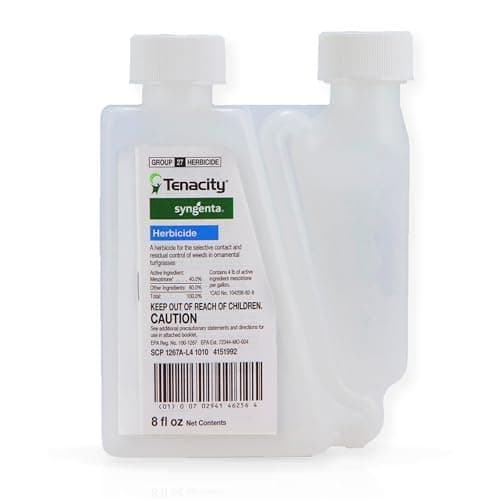
Tenacity is Syngenta's brand name for a 4SC formulation of mesotrione, a selective herbicide originally derived from a compound that the bottlebrush plant uses to suppress competing vegetation around it. The "4SC" means four pounds of active ingredient per gallon of suspension concentrate, which translates to roughly 40% mesotrione by weight. Generic mesotrione products you will find online (Liquid Harvest, Atticus Torocity, several others) use the same 4SC concentration and are functionally identical at the label rate.
The mode of action is what makes Tenacity special. It is an HPPD inhibitor, which is a fancy way of saying it blocks an enzyme weeds need to produce carotenoids. Carotenoids are the protective pigments that shield chlorophyll from sunlight damage. Strip those out and the plant's chlorophyll oxidizes the moment the sun hits it. That is why treated weeds turn ghostly white before they die. The bleaching is the kill signal, not a side effect.
For homeowner use, three things flow from that mode of action and matter every time you apply it:
- The white-out is normal. Susceptible weeds bleach in 5 to 7 days, then collapse over the next 2 to 3 weeks. If they do not bleach, your application failed. Either you skipped the surfactant, you sprayed in cold weather, or the weed is on the resistant list.
- It has real residual activity. Mesotrione binds in the top inch of soil and gives roughly 21 days of pre-emergent suppression on germinating broadleaves and some grassy weeds. That is why it is the only herbicide rated safe to apply at the time of seeding for most cool-season grasses.
- It is selective, but not universally. Tenacity is safe on Kentucky bluegrass, tall fescue, fine fescue, perennial ryegrass (with some bleaching), centipede, and buffalograss. It will damage actively growing bermudagrass, and the label does not recommend it on zoysiagrass, seashore paspalum, or kikuyugrass. It is flat-out not labeled for St. Augustine home lawns. If you have a southern lawn, this guide is probably not for you.
One more thing on the brand question. Real Syngenta-branded Tenacity is sold through SiteOne Landscape Supply and a handful of professional ag outlets, not Amazon. The generic mesotrione 4SC products on Amazon are the same active ingredient at the same concentration and follow the same label rates. There is no quality penalty for going generic, just verify the bottle says "4SC" or "40% mesotrione" before you buy.
Tenacity Application Rate (Spot Spray vs Broadcast)
The Tenacity label lists a broadcast rate of 4 to 8 fluid ounces per acre depending on the target weed, with a hard ceiling of 16 fluid ounces per acre per year across all applications. Almost nobody sprays by the acre at home, so here is the same label math converted to sprayer-friendly rates.
| Use case | Tenacity per gallon | Non-ionic surfactant | Coverage |
|---|---|---|---|
| Spot spraying weeds (standard) | 0.5 tsp (about 2.5 ml) | 1.5 to 2 tsp | About 1,000 sq ft |
| Full-lawn pass at the max single rate | 1 tsp | 1.5 to 2 tsp | 1,000 sq ft per gallon |
| Pre-emergent at overseeding | 0.5 tsp | Skip on bare soil; use NIS if weeds are up | About 1,000 sq ft |
| Broadcast, calibrated sprayer | 4 to 8 fl oz per acre | 0.25% of spray volume | 1 acre |
Two more label numbers worth committing to memory: maximum two post-emergent applications per year on the same area, spaced at least 2 to 3 weeks apart, and never more than 16 fluid ounces per acre per year total. If a first pass underwhelmed, the fix is the surfactant and the timing, not a heavier pour.
Tenacity and Surfactant Ratio
The label calls for a non-ionic surfactant (NIS) at 0.25 percent by volume for post-emergent applications. That works out to about 0.32 fluid ounces per gallon of finished spray, which is roughly 1.5 to 2 teaspoons of surfactant per gallon. So the working ratio for a 1-gallon batch is 0.5 teaspoon Tenacity to about 2 teaspoons NIS. It feels backwards that you add more surfactant than herbicide, but that is exactly what the label intends: the surfactant is the delivery system, and skipping it is the number one reason applications fail. More on why in Step 2 below.
When to apply Tenacity
Tenacity has a wider application window than almost any other selective herbicide on the market, which is part of why it is so useful and also why people get confused about timing. Use this as your decision tree.
Tenacity Application Temperature (Soil and Air Anchors)
The label itself does not print a hard temperature range, but the chemistry and university extension guidance point the same direction: mesotrione works best when both weeds and turf are actively growing. The practical floor is around 60°F soil temperature and daytime highs in the 60s to 80s. Below that, weed metabolism slows, less product translocates, and you get incomplete kills. Above 90°F daytime highs, you risk turf injury, especially on perennial ryegrass. Spring and early fall are the sweet spots. If you are not sure where your soil temp sits, our herbicide timing tool will give you a regional readout.
Pre-emergent vs post-emergent
Tenacity does both, but it is far more useful as a post-emergent on established weeds plus a short-window pre-emergent during seeding. As a pure pre-emergent for an established lawn, it is mediocre. 21 days of residual is nothing compared to prodiamine's 6+ months. Do not use it as your spring crabgrass pre-emergent if you have other options.
The killer use case: weed control while overseeding
This is where Tenacity earns its keep. Per the Syngenta label, you can apply it up to and during seeding on most cool-season grasses (Kentucky bluegrass, tall fescue, fine fescue, perennial ryegrass, though ryegrass shows some bleaching). You get roughly three weeks of pre-emergent suppression on germinating broadleaves and crabgrass while your new seed establishes. No other herbicide on the homeowner shelf can do this.
The catch: after your new grass germinates, you cannot spray again until the new turf has been mowed two times, or 4 weeks after emergence, whichever comes later, per the label. That gives the seedlings time to develop a wax cuticle thick enough to tolerate a second pass. If you spray too early, you will fry the baby grass.
What Does Tenacity Kill?
Tenacity is labeled for over 40 weeds. The ones that matter for most cool-season homeowners:
- Strong control: creeping charlie (ground ivy), wild violet, clover, chickweed, henbit, dandelion (young), yellow nutsedge (suppression), young crabgrass, goosegrass, foxtail, barnyardgrass, nimblewill (with repeat applications), creeping bentgrass (in cool-season turf).
- Weak or unreliable: mature crabgrass past the 4-tiller stage, oxalis, mature dandelions with deep taproots, spurge, nutsedge in heavy infestations.
- Will not control: bermudagrass, dallisgrass, kyllinga, woody perennials, and existing Poa annua (annual bluegrass). The label offers pre-emergent suppression of Poa annua only; Tenacity will not kill plants that are already up.
For mature crabgrass, you want quinclorac (Drive XLR8) either as a follow-up or tank-mixed. For tough broadleaves like spurge or oxalis, a 2,4-D ester or a 3-way amine fills the gap.
Does Tenacity kill creeping charlie?
Yes, and it is one of the better homeowner options for it. Creeping charlie (ground ivy) sits on the strong-control side of the Tenacity label, and mesotrione does something the standard 3-way herbicides struggle with: it actually translocates through ground ivy's creeping stems instead of just burning the leaves it touches. Expect the classic sequence, bleaching within about a week, then collapse over the following 2 to 3 weeks.
Set honest expectations, though. One application almost never finishes the job on an established patch. Ground ivy roots at every node, so plan on two applications spaced 2 to 3 weeks apart from the start, always with the non-ionic surfactant in the tank. Heavy, years-old infestations may still push back the following season, in which case a fall follow-up when the plant is moving energy to its roots tends to be the knockout punch. If a patch survives two proper passes, thicken the turf in that spot too, since thin, shaded, damp areas are exactly where creeping charlie re-invades.
How to apply Tenacity step-by-step
This is where most homeowners go wrong, and it is almost always one of three mistakes: wrong mix rate, no surfactant, or wrong sprayer setup. The label is short and specific. Follow it.
Step 1: Mix rate
For spot spraying with a hand-pump or backpack sprayer:
- 0.5 tsp Tenacity (or generic mesotrione 4SC) per 1 gallon of water covers up to 1,000 sq ft.
- Add 1.5 to 2 tsp non-ionic surfactant per gallon (this is the label's 0.25% v/v of final spray volume).
- Maximum two applications per year, at least 2 to 3 weeks apart, and no more than 16 fl oz per acre per year total.
For broadcast applications across a full lawn, the per-acre rate is 4 to 8 fl oz of Tenacity per acre. Most homeowners will not need to think in acre rates, but if you have a large property and a calibrated sprayer, that is the math.
Step 2: The surfactant is not optional
This is the single most common reason Tenacity "does not work" for first-time users. Mesotrione is a contact-and-systemic herbicide that has to penetrate the waxy leaf cuticle of the weed. Water alone beads up and rolls off. A non-ionic surfactant (NIS) breaks the surface tension so the spray spreads and sticks. Without it, you might get 30% of the control you are paying for.
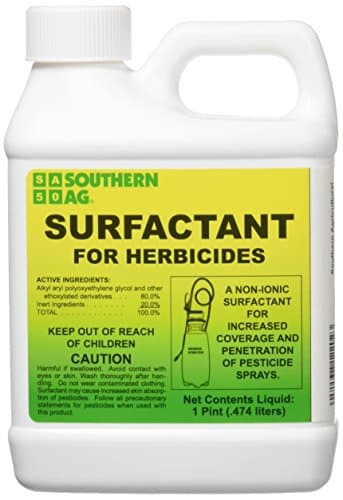
Methylated seed oil (MSO) works too and is sometimes preferred in cool weather, but it can increase turf sensitivity. For most homeowner applications, plain NIS at 0.25% v/v is the safer call. Southern Ag's non-ionic surfactant is the standard inexpensive option and one bottle lasts most homeowners several seasons.
Step 3: Sprayer setup
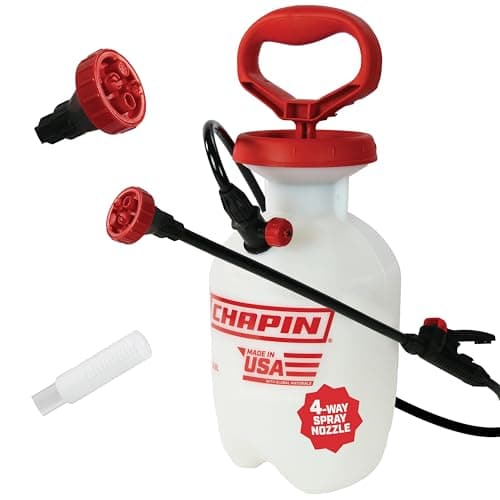
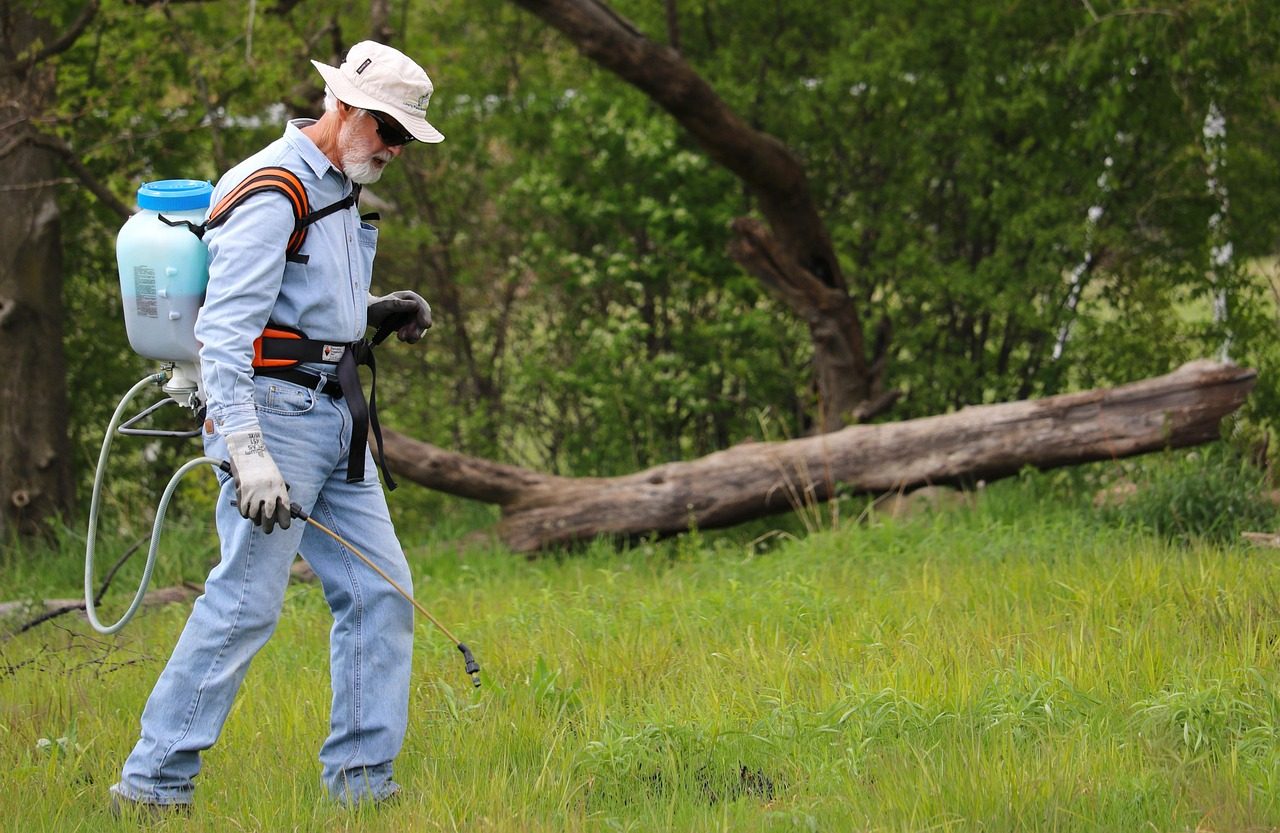
Use a hand-pump pressure sprayer or backpack with a flat-fan nozzle that produces medium droplets. Avoid hose-end sprayers and avoid fine-mist nozzles, since drift onto sensitive plants (tomatoes, ornamentals) will bleach them too. Calibrate by spraying a measured amount of clean water across a known area first so you know your gallon truly covers your 1,000 sq ft, not 600 or 1,500.
Step 4: Application
Spray uniformly to wet the leaf surface but stop short of runoff. Walk a steady pace, slight overlap on each pass, and shake the sprayer every couple minutes since mesotrione is a suspension and will settle. Apply when:
- No rain or irrigation for at least 6 hours (Syngenta says Tenacity is rainfast in about an hour, but the label guidance is to hold water for 6; 24 hours is safer).
- Wind is under 10 mph to avoid drift.
- Daytime temperatures are between 60°F and 85°F.
- The lawn has not been mowed for 2 to 3 days, and you can wait 2 to 3 days after spraying before mowing again.
Step 5: Repeat application
Most weeds need a second pass 2 to 3 weeks after the first. Mesotrione is slow by design. Resist the urge to spray sooner just because you do not see results in 4 days. Bleaching shows up at day 5 to 7, peak whitening at day 10, full collapse by day 21. The second application catches survivors and any seedlings that emerged under the residual window.
Best Tenacity alternatives and pro-grade companion products
The reality of cool-season weed control is that no single herbicide does everything. Tenacity handles the post-emergent broadleaf and grassy weed work that a 3-way cannot, and it is the only option for spraying at seeding, but it has gaps, and the smart move is to keep two or three products on the shelf and pick the right one for each job.
Here is how the Amazon-available stand-ins and companion products stack up.
| Product | Active ingredient | Best for | Surfactant needed? |
|---|---|---|---|
| Liquid Harvest Mesotrione - 8oz - Mesotrione Concentrate (Compare to Tenacity) - Pre and Post-Emergent Weed Killer for Lawn and Turf Grasses | Mesotrione 4SC (40%) | Direct generic substitute for Tenacity. Spraying at overseeding, creeping charlie, wild violet, clover, nimblewill. | Yes, NIS |
| Southern Ag Surfactant for Herbicides Non-Ionic, 16oz, 1 Pint | 80% non-ionic surfactant | Required tank partner for any mesotrione application. Also pairs with quinclorac, 2,4-D, and 3-ways. | N/A (it is the surfactant) |
| BASF Drive XLR8 Crabgrass Killer for Lawn & Turf, Post Emergent Grassy & Broadleaf Weed Control, Active Ingredient Quinclorac, 30 Day Residual, Herbicide, Concentrate 64 Ounce | Quinclorac 18.92% | Mature crabgrass, foxtail, signal grass. The standard tank partner with mesotrione for a complete grassy + broadleaf burndown. | Yes, MSO preferred |
If you want the actual Syngenta-branded Tenacity rather than a generic, you can buy it through SiteOne Landscape Supply if there is one near you. Same with Lesco-branded turf products, which are SiteOne-exclusive. Neither are sold on Amazon, and neither are available through us as affiliate links, but the active ingredient is what matters, and the generics use the exact same molecule at the exact same concentration.
For most homeowner programs, the right combo is a generic mesotrione (your "do everything" cool-season tool), a non-ionic surfactant (always in the cabinet), and quinclorac for the crabgrass problem you cannot prevent every spring. That three-product kit handles 90% of cool-season weed pressure. If you want a deeper read on how to sequence these through the season, our cool-season weed control schedule walks through the full calendar.
Common mistakes and Tenacity FAQ
After thousands of forum threads and probably a hundred spray sessions of my own, the same handful of mistakes show up over and over. Avoid these and you will hit the 80/20 of Tenacity success.
Mistake 1: Doubling the rate because "it didn't work"
If your first application didn't kill anything, the problem was almost certainly the surfactant (or lack of one), not the rate. Doubling the rate doubles the chance of bleaching your own lawn without improving weed control. Stick to 0.5 tsp per gallon per 1,000 sq ft, add the NIS, and wait the full 14 to 21 days before judging results.
Mistake 2: Spraying in cold weather
Mesotrione translocation slows dramatically below 60°F. Spraying during a March warm spell when soil temps are still 45°F gives you weak control and disappointing kills. Wait for soil temps to climb past 55 to 60°F. The herbicide timing tool gives you a regional read on when that window opens.
Mistake 3: Not knowing your grass type
This is the one that destroys lawns. Tenacity on actively growing bermudagrass will bleach it badly. On St. Augustine home lawns, it is not labeled at all. If you are not 100% sure what grass you have, identify it first. Our grass identification tool can confirm before you spray something you cannot undo.
Mistake 4: Stacking applications too close together
The label is two applications per year, minimum 2 to 3 weeks apart. People who spray every weekend "to be sure" end up with persistent turf bleaching and stunted growth. Mesotrione has residual activity. Trust the chemistry and wait.
Mistake 5: Skipping the second application
The flip side of mistake 4. One application typically gets you 60 to 70% control on tough weeds like creeping charlie or nimblewill. The second pass at 14 to 21 days catches survivors and seedlings emerging under the residual. Plan on two applications from the start, not "I'll see if I need another one."
Mistake 6: Spraying right before or after mowing
Both are bad. Spraying right before mowing means you cut off the treated leaf tissue before mesotrione translocates. Spraying right after mowing means weeds have minimal leaf surface to absorb the spray. Aim for 2 to 3 days of growth before spraying and 2 to 3 days of waiting after.
Mistake 7: Using a hose-end sprayer
Hose-end sprayers cannot deliver the precise per-1,000-sq-ft rate Tenacity needs. They also produce coarse, uneven coverage. Use a hand-pump pressure sprayer for under 5,000 sq ft, a 4-gallon backpack for anything larger.
Mesotrione is one of the most effective tools in cool-season lawn care, and it rewards homeowners who treat it as a precision instrument rather than a "spray and hope" product. Get the rate right, always include the surfactant, mind the soil temperature, and pair it with quinclorac when you need to crush mature crabgrass. The white grass scare goes away once you understand the bleaching is the kill signal, and the lawn that comes back is cleaner than anything a 3-way alone can deliver.
Free Lawn Care Tools
That is mesotrione working as designed. Tenacity is an HPPD inhibitor that blocks carotenoid production, so any plant absorbing it loses its ability to protect chlorophyll from sunlight and bleaches white. Sensitive turf species (especially perennial ryegrass) can show some bleaching too. The white tissue is gone in 2 to 3 weeks as new green growth pushes through. If your whole lawn whitened, you applied at too high a rate. If only weeds and a few stray turf blades whitened, you nailed it.
Not on labeled cool-season grasses applied at label rate. It is selective and safe on Kentucky bluegrass, tall fescue, fine fescue, perennial ryegrass, centipedegrass, and buffalograss. It is NOT safe on actively growing bermudagrass or St. Augustine home lawns, where it will cause severe injury, and the label does not recommend it on zoysiagrass. Always confirm your grass type before spraying.
The Syngenta label states the treated area can be re-entered once spray has dried, typically within 1 to 2 hours in warm weather. Mesotrione has a low acute toxicity profile compared to most synthetic herbicides, but no herbicide is "food safe." Keep kids and pets off until fully dry, ideally until after the next rain or irrigation event.
Two days minimum, ideally 3 to 5. Mowing too soon removes treated leaf tissue before mesotrione translocates into the weed. For the same reason, do not mow for at least 2 days before spraying so weeds have full leaf surface to absorb spray. On newly seeded areas, the label says to wait until the new grass has been mowed two times (or 4 weeks after emergence, whichever is longer) before spraying again.
For spot spraying, mix about 0.08 fluid ounces (roughly 0.5 teaspoon, or 2.5 milliliters) of Tenacity per gallon of water. For a full lawn application at the maximum single rate of 8 fluid ounces per acre, that works out to about 0.18 fluid ounces (roughly 1 teaspoon) per gallon when calibrated for a typical pump sprayer at 1 gallon per 1,000 square feet. Always add a non-ionic surfactant at 0.25 percent by volume, about 1.5 to 2 teaspoons per gallon, to break the leaf cuticle and improve uptake. The label caps total use at 16 fluid ounces per acre per year across all applications.
Spray when air temperatures are between 55 and 85 degrees F and weeds are actively growing. Below about 50 degrees, plant metabolism slows and mesotrione works poorly, while spraying above 85 degrees on stressed turf increases the odds of visible bleaching on your good grass. Mild, sunny stretches in spring and early fall are the sweet spots.
The label calls for a non-ionic surfactant at 0.25 percent by volume, which works out to roughly 1.5 to 2 teaspoons of surfactant per gallon of spray mix alongside your 0.5 teaspoon of Tenacity. Yes, you add more surfactant than herbicide. The surfactant breaks the waxy leaf cuticle so mesotrione actually gets into the weed, and skipping it is the most common reason a Tenacity application appears to do nothing.
Properly capped, kept out of direct sunlight, and not allowed to freeze, mesotrione 4SC is generally good for 3 to 5 years; the label does not print an expiration date. Shake well before each use, since the suspension concentrate settles between seasons. If you see crystallization or separation that will not redissolve with shaking, replace the bottle.
You will see the first white bleaching on susceptible weeds in about 5 to 7 days, peak whitening around day 10, and full collapse by 2 to 3 weeks. The bleaching is the kill signal, so do not judge the application before the 3-week mark, and do not re-spray early. If nothing has whitened after a week of warm, sunny weather, the usual culprits are a skipped surfactant, cold temperatures, or a weed that is not on the label.
Yes, this is common practice. Tenacity plus a 3-way (2,4-D, dicamba, MCPP) is a classic combo for broadleaf cleanup. Tenacity plus quinclorac is the standard for nuking crabgrass plus broadleaves in one pass. Do a jar test first, and always include a non-ionic surfactant when Tenacity is in the mix.
For all practical purposes, yes. Mesotrione is the active ingredient, and Tenacity is Syngenta's brand name for its 4SC formulation, which works out to roughly 40% mesotrione by weight. Generic mesotrione 4SC products sold online use the same active ingredient at the same concentration and follow the same label rates, so there is no quality penalty for going generic. Just verify the bottle says "4SC" or "40% mesotrione" before you buy.
Tenacity is labeled for over 40 weeds. The headliners for cool-season lawns are creeping charlie (ground ivy), wild violet, clover, chickweed, henbit, young dandelions, young crabgrass, goosegrass, foxtail, barnyardgrass, nimblewill (with repeat applications), and creeping bentgrass in cool-season turf, plus suppression of yellow nutsedge. It is weak on mature crabgrass past the 4-tiller stage, oxalis, spurge, and deep-rooted mature dandelions, and it will not control bermudagrass, dallisgrass, kyllinga, or Poa annua that is already up. Pair it with quinclorac for mature crabgrass and a 3-way for the tougher broadleaves.

Your lawn plan, in your pocket all season
Grass ID, a season plan, soil-timed reminders, and a lawn journal that remembers what you did. Free on iPhone.