
Diagnose before you spray
Most failed weed control comes from spraying the wrong product at the wrong time. Pre-emergents stop seeds from germinating. They do nothing to weeds that already have leaves above the soil. Post-emergents kill growing weeds. They do nothing to ungerminated seeds. If you spray a pre-emergent on a yard full of crabgrass, you've just bought a 90-day delay before you can re-seed and watched the existing crabgrass laugh at you.
So step one is always: identify what's there. Annual grassy weeds (crabgrass, Poa annua, goosegrass, foxtail) need a pre-emergent strategy. Broadleaf perennials (dandelion, clover, plantain, ground ivy, violet) need a post-emergent and a thicker lawn next year. Sedges (yellow and purple nutsedge) need their own product class entirely (halosulfuron or sulfentrazone), since standard broadleaf sprays do almost nothing to them.
If you can't ID the weed by sight, the Penn State Extension weed management library has photo keys for the most common turf weeds in the U.S.
Common lawn weeds: a quick ID guide
Annual grassy weeds
Crabgrass is the headline annual: light green, low-growing, spreads in star-shaped tufts that radiate from a center crown by midsummer. Goosegrass looks similar but the center crown is bright white and flatter. Both die at first frost but drop seed first, which is why pre-emergent timing matters every year. Annual bluegrass (Poa annua) flips the calendar: it germinates in fall, looks like a finer, lighter version of Kentucky bluegrass through winter, and seeds out in spring before dying in early summer heat. Foxtail rounds out the group, standing more upright than crabgrass with a fuzzy bottlebrush seed head by late summer.
Broadleaf perennials
Dandelion, white clover, broadleaf plantain, ground ivy (creeping charlie), and wild violet are the five that show up on most homeowner lists. Dandelion and plantain are easy kills with a 3-way (2,4-D + dicamba + MCPP). Ground ivy and violet are stubborn and usually need triclopyr or a fall application of a 4-way to actually finish the job. Cool-season winter annuals like henbit and common chickweed, plus the mat-forming summer annual spotted spurge, follow the same broadleaf playbook.
Sedges
Yellow nutsedge stands out because it grows about 50% faster than the surrounding lawn. A few days after mowing, you'll see lighter, glossy spikes sticking up an inch above the canopy. Roll a stem between your fingers: sedges have triangular stems, grasses are round or flat. Sedges thrive in soggy spots, so a drainage fix often does as much as the herbicide.
Pre-emergent timing by soil temperature
Crabgrass germinates when soil temperature at the upper 1 to 2 inches holds at 55°F for several consecutive days. Michigan State University Extension recommends applying when soil temps consistently reach 50 to 55°F at the 0 to 2 inch depth, so the chemical barrier is in place before the first germination flush. University of Maryland Extension uses the same 53 to 55°F threshold for 5 consecutive days as the trigger.
That's why pre-emergents go down in early spring before the first cut, not by calendar. Penn State Extension publishes regional windows: southeastern PA runs March 15 to April 15, central PA April 1 to May 1, and northern or high-altitude areas April 20 to May 10. In the deep south the same logic puts the window in late February. ZIP-code-driven timing matters more than rule-of-thumb dates, and our herbicide timing calculator uses your ZIP plus current soil temps to set the window.
Forsythia bloom is the old folk indicator and it's still useful as a "start watching soil temps" reminder, but it's not reliable on its own. Forsythia responds to air temperature and day length while crabgrass responds to soil temperature, so a warm February air mass can pop the blooms while soils stay in the mid-40s.
For Poa annua, the window flips: apply in late summer or early fall, before fall germination begins (target soil temps falling through 70°F at the 2-inch depth, usually mid-August through September depending on latitude). Two spring crabgrass applications won't touch Poa, since it has already germinated and put down roots months earlier.
Most pre-emergents need 0.5 inch of irrigation or rainfall within 2 to 3 days of application to activate the soil barrier. Without that water-in step, the active ingredient sits on the canopy and breaks down in UV. A second, lower-rate application 6 to 8 weeks later extends the barrier through summer for late-germinating species like goosegrass.
Post-emergent strategy
Spot-treat where you can. Blanket spraying a whole lawn for three dandelions wastes product and stresses the turf. A pump sprayer with a 3-way (2,4-D + dicamba + MCPP or MCPA) handles 90% of homeowner broadleaf problems at a fraction of the cost of a hose-end blanket application.
Spray when daytime highs are 60 to 85°F, weeds are actively growing, and there's no rain in the forecast for at least 24 hours. Hot summer applications above 90°F burn the lawn alongside the weeds and volatilize 2,4-D and dicamba into vapor that can drift onto neighbors' tomatoes and ornamentals. Fall applications (late September through early November in most of the country) are the single most effective broadleaf treatment of the year, because perennial weeds are pulling carbohydrates down into roots and the herbicide goes with them.
Wait 2 to 3 days after mowing before you spray (you need leaf area to absorb the herbicide), and wait another 2 to 3 days after spraying before mowing again (so the systemic herbicide can translocate). Don't water for 24 hours after a foliar broadleaf application unless the label says otherwise.
Selective broadleaf herbicides leave most lawn grasses alone but kill many broadleaf weeds. Read the label for grass safety: St. Augustine and Centipede are sensitive to several common active ingredients (high rates of 2,4-D burn St. Augustine; dicamba can damage Centipede). For warm-season lawns, atrazine and metsulfuron are common label-safe alternatives, with their own restrictions.
Recommended Products
- 1Check price
 Top pick
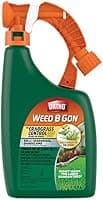
Ortho Weed B Gon Plus Crabgrass Control (Ready-to-Spray)
Hose-end quinclorac formula for spot-treating crabgrass and broadleaf weeds without mixing a separate sprayer, matching the spot-treat approach here.
- 2Check price
 Best value
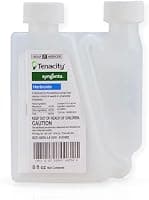
Syngenta Tenacity Turf Herbicide
Mesotrione concentrate for the tough and newly-seeded-lawn cases where standard 3-way broadleaf killers can't be used; a little goes a long way in a pump sprayer.
As an Amazon Associate we earn from qualifying purchases.
Herbicide modes of action, in plain English
Every herbicide label includes a WSSA group number (or HRAC letter). The number tells you how the chemical kills the plant, which matters for two reasons: rotating modes of action prevents resistance, and you can swap brand names if a product is out of stock as long as the group number matches. The full WSSA herbicide mode-of-action chart is the canonical reference.
The handful that matter for home lawns:
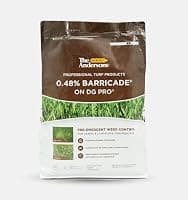
- Group 3 (mitosis inhibitors): prodiamine (Barricade), pendimethalin (Pendulum), benefin. Pre-emergents that stop root cell division in germinating seeds. Long residual, 3 to 5 months.
- Group 4 (synthetic auxins): 2,4-D, dicamba, MCPP, MCPA, triclopyr. The classic broadleaf killers. Cause uncontrolled growth that the plant can't sustain. Kills most broadleaf weeds, safe on most grasses at label rate.
- Group 5 (PSII inhibitors): atrazine, simazine. Pre and post-emergent for warm-season lawns; not safe on cool-season turf.
- Group 9 (EPSP synthase inhibitor): glyphosate (Roundup). Non-selective; kills everything green. Use only for spot kills, edging, or full renovations.
- Group 14 (PPO inhibitors): sulfentrazone (Dismiss), carfentrazone. Fast-acting contact herbicides for sedges and tough broadleaves.
- Group 27 (HPPD inhibitors): mesotrione (Tenacity). Bleaches new weed growth white. Safe at seeding, which is rare among post-emergents.
If a 3-way isn't finishing off ground ivy after two applications, swap to a different group (Group 4 triclopyr or Group 27 mesotrione) instead of just spraying more of the same.
Selective vs non-selective, spot vs broadcast
Selective herbicides kill some plants and leave others. Most lawn herbicides are selective for broadleaf weeds in grass turf. Non-selective herbicides (glyphosate is the main one) kill anything green, so they belong in driveway cracks, fence lines, and full lawn renovations, not on a healthy lawn.
Spot-spraying with a pump sprayer treats individual weeds. It uses 90% less product, costs less per season, and avoids the off-target stress of blanket coverage. Broadcast spraying (hose-end or spreader-applied granules) covers the entire lawn at a uniform rate. It makes sense when more than about 30% of the lawn is weeds, since spot-spraying that many targets gets impractical and you'll miss seedlings.
For a typical 5,000 sq ft suburban lawn with scattered dandelions and clover, a 1-gallon pump sprayer of mixed 3-way handles a full pass in under 30 minutes. Reserve granular weed-and-feed or hose-end blanket products for heavily infested or newly bought lawns where the cost-benefit flips.
Weed-and-feed: when it actually makes sense
Combination weed-and-feed products solve a marketing problem (one trip to the store, one trip across the lawn) and create an agronomic one. The fertilizer in the bag wants to go down when grass is actively growing and pulling nitrogen, which is mid-spring through early fall in cool-season regions. The herbicide wants to go down when weeds are emerged or about to germinate, which doesn't always overlap.
Illinois Extension and UF/IFAS Extension both flag the timing mismatch as the core issue: a spring crabgrass pre-emergent should ideally go down in early March in central Illinois, but the lawn isn't ready for nitrogen until mid-May. In north Florida the gap is even wider (March 1 vs April 15). Putting fertilizer down on dormant turf wastes most of it to runoff and groundwater.
Weed-and-feed makes the most sense in a narrow window: late spring or early fall, on a lawn with actively growing broadleaf weeds (dandelion, clover) and grass that's pulling nitrogen, applied to a wet canopy so the granules stick. For pre-emergent crabgrass control, separating the two products (a standalone prodiamine pre-emergent in early spring, then fertilizer 4 to 8 weeks later) gives both inputs better timing and usually costs less per square foot.
If you do use a weed-and-feed: mow 1 to 2 days before, apply to wet leaves so granules adhere, don't water in for 24 to 48 hours (broadleaf herbicide needs leaf contact time), avoid rain for 24 hours, and skip the next mow for 2 to 3 days. Most products take 7 to 14 days to show full weed yellowing and 3 to 4 weeks for complete kill.
Sedges need their own playbook
If you sprayed a 3-way and the lighter, glossy, fast-growing spikes are still there, you have nutsedge, not grass. Standard broadleaf herbicides don't touch sedges. The two effective active ingredients for homeowner use are halosulfuron (Sedgehammer, ProSedge) and sulfentrazone (Dismiss).
Per Michigan State Extension and Purdue Turfgrass, sulfentrazone shows injury within a few days; halosulfuron takes about 2 weeks but goes deeper into the tubers. Sequential halosulfuron applications 3 weeks apart give greater than 95% control. Treat early summer when the plant is young and actively growing but before tubers form, since established tuber chains can survive a single spray.
Halosulfuron needs a non-ionic surfactant added to the tank to stick to the waxy sedge leaf. Sulfentrazone does not (the label specifically says don't add surfactant; it can burn turf). Always read the label.
The long-term fix is drainage. Nutsedge thrives in soggy ground, so a section that grows nutsedge year after year usually has an irrigation leak, a low spot, or compacted soil that won't drain.
Organic and mechanical options
Hand-pulling works for scattered dandelions, plantain, and young crabgrass, especially when the soil is moist after rain or watering. Use a fishtail weeder or dandelion fork to get the full taproot. Pulling adult crabgrass after it has dropped seed in late summer is mostly cosmetic, since the seedbank is already set for next year.
Corn gluten meal is the organic pre-emergent option. It works as a germination inhibitor at 20 lbs per 1,000 sq ft, but the suppression rate is roughly 50 to 60% in the first year and only climbs after 3 or 4 consecutive years of use. It also adds about 10% nitrogen by weight, which can be a problem if you don't want to fertilize that early. For most homeowners, prodiamine or pendimethalin gives much better first-year control.
Iron-based broadleaf herbicides (chelated iron HEDTA, sold as Fiesta) burn broadleaf weeds on contact while leaving grass alone. They work on small dandelion and clover and need a follow-up in 10 to 14 days. They're a fit for homeowners avoiding 2,4-D but cost more per application and don't translocate, so they don't kill stubborn perennials.
Mechanical de-thatching, core aeration, and overseeding bare patches in fall do more for long-term weed pressure than any herbicide. Thick turf shades the soil and prevents weed seeds from getting the light they need to germinate. The single best weed-control investment is a fall overseed.
Reading the label and applying safely
The label is a legal document and "the label is the law" is the EPA's literal phrasing. Three numbers on every herbicide label decide whether you're using it correctly:
- Application rate: usually expressed as fluid oz per 1,000 sq ft or per gallon of water. Doubling the rate doesn't double the kill, it just doubles the chance of turf damage and groundwater contamination.
- Re-entry interval (REI): how long before kids and pets can walk on the treated area. For most lawn broadleaf products it's "until the spray has dried" (about 1 to 2 hours).
- Grass tolerance list: which species the product is labeled safe on. If your grass isn't on the list, don't spray it. St. Augustine and Centipede are missing from a lot of common labels.
Wear long sleeves, long pants, closed shoes, and chemical-resistant gloves (nitrile, not latex). Mix outdoors in a ventilated spot, never in the kitchen sink. Triple-rinse the empty container and pour the rinse water into the sprayer, not down the drain. The EPA pesticide label guide walks through the exact label sections.
Volatility and drift matter most for 2,4-D ester formulations and dicamba. Use the amine formulation when temps are above 80°F to reduce vapor drift onto sensitive plants (tomatoes, grapes, redbuds). Spray with a coarse droplet nozzle and wind under 10 mph.