Best Fertilizers for a Green Lawn This July
 Sarah MitchellLawn Diagnostics Specialist | 12 Years
As an Amazon Associate we earn from qualifying purchases.
It is mid-summer, the kids and pets are pounding the yard, and suddenly your grass looks tired, yellow, or thin even though it was lush in May. The challenge now is getting a thick green lawn for the rest of summer without cooking it with the wrong fertilizer.
July is one of the trickiest months to feed grass. Heat, drought stress, heavier foot traffic, and long days push your lawn hard, while the wrong product or rate can cause fertilizer burn. The best fertilizers for a green lawn this July are not always the same ones you used in spring or will use in fall.
This guide walks beginners through exactly which fertilizers make sense in July, how to match them to your grass type and climate, how to read N-P-K labels, and how to apply them safely. You will also see organic vs synthetic options, step-by-step July schedules, and common mistakes most guides skip.
If your lawn is pale green to yellow in July with fairly even color, and you do not see obvious spots or rings, the problem usually points to summer stress plus mild nitrogen or potassium deficiency. Confirm by checking your watering depth with a screwdriver (it should slide 6 inches down after irrigation) and looking for uniform fading rather than circular disease patches. If blades are thin, color is dull, and soil is hard, your lawn is hungry and stressed, not simply diseased.
The safest fix in July is a light feeding with a slow-release fertilizer that has moderate nitrogen and higher potassium, watered in with about 0.5 inch of irrigation right after application. Avoid heavy quick-release nitrogen, especially on cool-season grasses, and do not fertilize during a heat wave when highs are consistently above 90°F. Expect mild color improvement in 3 to 7 days with liquids and 7 to 14 days with granulars, with full results over 3 to 4 weeks as stress eases and roots recover.
Understanding Your Lawn’s Needs in July
Why July Is Different From Spring and Fall
Spring and fall are the natural comfort zones for most lawn grasses. Soil is cool to mild, rainfall is more regular, and grass can safely use higher nitrogen without as much stress. July changes that equation, especially in hot-summer regions.
In July, several factors stack up at once: soil and air temperatures climb, rains may become spotty, and evaporation rates spike. Cool-season grasses slow down or even go dormant, while warm-season types hit peak growth. Because the plant is already under heat and drought pressure, the definition of the "best" fertilizers shifts from maximum growth to stress protection and safe color improvement.
Heavy nitrogen in July can push lush, tender growth at precisely the wrong time. That soft tissue uses more water and is more vulnerable to disease and burn. This is why many university lawn programs recommend lower summer nitrogen rates for cool-season lawns and slightly more, but still moderate, for warm-season lawns. Compared to spring and fall fertilizer plans, July is about gentle feeding, higher potassium, and tightening up your watering and mowing habits rather than forcing rapid growth.
Know Your Grass Type First (Cool-Season vs Warm-Season)
The best fertilizers for a green lawn this July depend first on whether you have cool-season or warm-season grass. If you are not sure, identifying your grass type is your starting point before choosing any product.
Cool-season grasses include Kentucky bluegrass, perennial ryegrass, tall fescue, and fine fescue. They prefer soil temperatures in roughly the 50 to 70°F range and are common in the northern half of the United States and cooler regions. In July, these grasses are in survival or maintenance mode. They naturally slow growth and may go tan or light brown in prolonged drought. For them, heavy nitrogen applications above about 0.75 pound of nitrogen per 1,000 square feet in a single summer dose typically increase stress rather than help.
Warm-season grasses include Bermuda, Zoysia, St. Augustine, and Centipede, common in the South, coastal regions, and warm transition zones. These grasses hit their stride in summer when soil temperatures are 70°F and above. In July, they can safely use a bit more nitrogen, usually up to about 1 pound of nitrogen per 1,000 square feet per month if water is adequate. They respond with dense, spreading growth that can outcompete weeds and fill in thin areas.
If you are unsure what you have, use quick visual cues. Cool-season lawns often look finer textured, bright to medium green, and grow more upright. Kentucky bluegrass has soft blades and subtle boat-shaped tips. Tall fescue has wider blades with distinct veins and clumps. Bermuda and Zoysia form dense, carpet-like mats with finer blades, while St. Augustine has very wide, coarse blades and a thick, stolon-forming habit. If your lawn is fully dormant and brown in January but emerald in July, it is likely warm-season. For more depth, see topics like Best Fertilizers for Lawns or summer lawn care for cool-season grass and summer lawn care for warm-season grass.
Understanding N-P-K and Summer-Friendly Nutrients
Every fertilizer bag lists three main numbers, for example 20-0-10. These are N-P-K: nitrogen, phosphorus, and potassium. Nitrogen drives leaf and blade growth and is also the main color driver. Phosphorus supports root development, especially important when seeding, but is often restricted or banned in many areas due to water quality concerns. Potassium is the stress manager. It supports disease resistance, drought tolerance, and overall plant resilience, which makes it crucial in July.
The best fertilizers for a green lawn this July usually share a similar pattern: moderate nitrogen, little or no phosphorus unless a soil test shows deficiency, and relatively higher potassium. A product like 15-0-15, 20-0-10, or 10-0-20 can be an excellent July choice, depending on your soil test. Micronutrients such as iron, manganese, and magnesium also help deepen color without forcing heavy growth. Many summer fertilizers or "lawn supplements" include iron to green up grass in 3 to 7 days without overloading nitrogen.
Another key concept is slow-release versus quick-release nitrogen. Slow-release forms (such as polymer-coated urea, sulfur-coated urea, or organic nitrogen in meals and biosolids) release over several weeks, which lowers burn risk and provides steadier feeding. Quick-release forms like urea or ammonium sulfate act within days but can scorch grass in heat if applied too heavily or not watered in. In July, slow-release nitrogen is usually safer for both cool- and warm-season lawns, especially when daytime highs regularly exceed 85°F.
- Rutgers Extension recommends limiting summer nitrogen on cool-season lawns to about 0.5 pound N per 1,000 sq ft per application to reduce stress and disease risk.
Types of Fertilizers to Consider for a Green Lawn This July
Granular vs Liquid Fertilizers
Most homeowners will pick between granular and liquid products when looking for the best fertilizers for a green lawn this July. Each format has advantages and tradeoffs in summer conditions.
Granular fertilizers are dry pellets you spread with a broadcast or drop spreader. They are often easier for beginners to apply evenly because you can see where you have already gone, and settings on the spreader help control the rate. Granulars are usually formulated with a mix of quick and slow-release nitrogen, so they feed for 4 to 8 weeks depending on the product. The downside in July is that they require watering in with about 0.25 to 0.5 inch of irrigation immediately after spreading to dissolve and move nutrients into the soil. Color improvement tends to show in 7 to 14 days as the product breaks down.
Liquid fertilizers are mixed with water and sprayed onto the lawn with a hose-end sprayer or backpack sprayer. Liquids act faster because nutrients are available immediately and can be absorbed through leaves and roots. This makes them ideal for "spoon-feeding" low doses of nitrogen and micronutrients every 2 to 4 weeks in summer. The tradeoff is that they are much easier to misapply, especially if you move too slowly or overlap spray patterns, which can cause striping or burn. They also require more frequent applications to maintain color.
Choose granular if your goal in July is steady feeding with minimal fuss and you are willing to water right after application. Choose liquid if you want a quick cosmetic green up, especially with iron-based products, or if you plan to spoon-feed small nitrogen doses, such as 0.1 to 0.25 pound N per 1,000 square feet every 2 to 3 weeks on a high-maintenance warm-season lawn.
Organic vs Synthetic Fertilizers
Another decision is organic versus synthetic fertilizers. This choice affects burn risk, speed of results, soil health, and cost per unit of nitrogen. Both can work well in July if you understand their behavior.
Organic fertilizers include compost, manure-based products, feather meal, bone meal, biosolids, and plant-based organics like alfalfa or soybean meal. They release nitrogen slowly as soil microbes break them down, which makes them inherently "slow release." In July, that slow, steady feeding lowers burn risk and supports soil structure and biology. An organically fed lawn often handles drought and heat better over time because organic matter increases water holding capacity and root depth.
The downside of organics in midsummer is speed and cost. Visible color change can take 2 to 4 weeks, sometimes longer, especially if soil is dry and microbial activity is slower. You may also pay more per pound of nitrogen compared to synthetics. However, if you are focused on long-term soil health, kid and pet exposure, and reducing fertilizer burn, organic fertilizers are strong candidates as some of the best fertilizers for a green lawn this July.
Synthetic fertilizers are manufactured products with specific N-P-K formulations such as 24-0-6, 29-0-4, or 20-0-10. They deliver predictable, measurable amounts of nitrogen quickly, which is helpful when you need relatively fast results. Many quality summer synthetics include controlled-release nitrogen plus added potassium and iron. The risk in July is that high analysis synthetics can burn turf when applied above label rate or left on dry grass in high heat without proper watering in.
For homeowners who want a hybrid approach, a low to moderate rate of synthetic slow-release nitrogen in early July, followed by light organic topdressing or composting for a healthier lawn later in the month, can combine the benefits of both worlds. If you are unsure, the article Organic vs Synthetic Fertilizers goes deeper into pros and cons.
Step-by-Step July Fertilizer Strategy
Step 1: Diagnose Your Lawn’s Stress Level
Before applying anything, assess what your lawn is telling you. If you see uniform light green color with slower growth but no distinct patches, rings, or slimey spots, the issue is usually mild nutrient deficiency and heat stress. If you see sharply defined brown or darkened circles, or blades that look water soaked or moldy, disease is more likely, and fertilizer alone will not fix it.
Use two quick tests to confirm stress versus deeper problems. First, the screwdriver test: try pushing a screwdriver 6 inches into the soil. If you need significant force or cannot reach 3 to 4 inches, the soil is dry or compacted. Second, measure watering. Lawns typically need about 1 to 1.5 inches of water per week in total from rain plus irrigation in summer. Place a few tuna cans around the yard and run sprinklers, then time how long it takes to reach 0.5 inch. Use that to plan your watering after fertilizing.
Step 2: Match Fertilizer to Grass Type
Once you have confirmed the lawn is stressed but still mostly healthy, choose your July fertilizer based on grass type and how much stress you are seeing.
For cool-season lawns in July (Kentucky bluegrass, rye, fescues), a good target is about 0.25 to 0.5 pound of nitrogen per 1,000 square feet in any single midsummer application, or skip nitrogen entirely if the lawn is already on the edge of dormancy. Look for products with higher potassium, such as 15-0-15 or 10-0-20, and consider iron-enhanced fertilizers or separate iron supplements for color. Avoid high nitrogen products like 32-0-4 at full label rates during hot, dry stretches.
For warm-season lawns (Bermuda, Zoysia, St. Augustine, Centipede), July can be a prime feeding time if water is adequate. These grasses can typically handle 0.5 to 1 pound of nitrogen per 1,000 square feet in July, applied once or split into smaller feedings every 3 to 4 weeks. Again, favor formulas with potassium and some slow-release nitrogen. For high-maintenance Bermuda, a schedule of 0.5 pound N every 3 to 4 weeks in June, July, and early August is common, as long as temperatures and moisture are managed.
- Texas A&M Extension notes that warm-season grasses like Bermuda often perform best with 3 to 4 pounds of nitrogen per 1,000 sq ft spread across late spring through summer, while cool-season lawns in hot regions should receive little or no nitrogen during peak heat.
Step 3: Read the Label and Calculate the Right Rate
To avoid burn, you must translate the bag numbers into actual nitrogen applied. Take a 20-0-10 fertilizer as an example. That bag is 20 percent nitrogen by weight. If the bag weighs 40 pounds, it contains 8 pounds of nitrogen total.
If your target is 0.5 pound of nitrogen per 1,000 square feet for a cool-season lawn in July, you would apply 2.5 pounds of that product per 1,000 square feet. The math is: 0.5 divided by 0.20 equals 2.5. Most bags also list a coverage area at a specific rate. If the label says "covers 10,000 square feet" and your lawn is 5,000 square feet, you will use half the bag to match the recommended rate.
Stick within the label rate range. If a product lists 2.5 to 3.5 pounds per 1,000 square feet, choose the lower end for cool-season lawns in July and no higher than the mid range for warm-season turf unless instructed otherwise by a soil test and extension recommendations.
Step 4: Ideal July Application Schedule
Timing matters as much as rate. For most regions, an early to mid July application works best, after the first real heat waves show how your lawn is handling summer but before late summer stress peaks.
A practical schedule looks like this for cool-season lawns:
- Early July: Optional light feeding of 0.25 to 0.5 pound N per 1,000 square feet with higher potassium if the lawn is still green and actively growing.
- Late July to August: Focus on watering, mowing, and spot seeding damaged areas rather than additional nitrogen.
- Early September: Resume stronger fertilization as temperatures moderate.
For warm-season lawns:
- Late June to early July: Full summer feeding of 0.5 to 1 pound N per 1,000 square feet with a balanced or high K product.
- Late July to early August: Another similar or slightly lighter feeding if growth and color are good and watering is consistent.
- Late August to September: Gradually reduce nitrogen so the lawn can prepare for fall and winter.
Always apply granular fertilizer on a dry lawn, then water in with 0.25 to 0.5 inch of irrigation within 24 hours, ideally right away. For liquids, apply during cooler parts of the day, such as morning or early evening, and follow the label about whether to irrigate after or leave on the leaves for foliar uptake.
What Other Guides Miss: Common Mistakes to Avoid
Many articles about the best fertilizers for a green lawn this July focus only on brand names or N-P-K numbers and skip the context that keeps you out of trouble. Three problem areas come up repeatedly for homeowners.
The first is fertilizing into drought dormancy. If your cool-season lawn is already tan and crispy across large areas, with blades folding and crunching underfoot, it is likely dormant from heat and lack of water. In this state, applying nitrogen without restoring at least 1 inch of water per week can push the plant toward real death instead of dormancy. Confirm dormancy by watering 1 inch per week for 2 weeks and watching for any green response before fertilizing.
The second is ignoring soil pH and underlying deficiencies. If you repeatedly fertilize and still see poor color or growth, the issue could be soil pH outside the 6.0 to 7.0 range, or deficiencies beyond nitrogen and potassium. In that case, the best move is to follow the steps in How to Test Your Lawn's Soil, then correct with lime or sulfur as needed using guidance from How to Improve Soil pH for Grass. Potassium or micronutrient deficiencies may also emerge in soil test results and should be addressed with targeted products instead of more blanket N fertilization.
The third is overcorrecting with too many products at once. Homeowners often stack a high nitrogen fertilizer, an iron supplement, and a herbicide during one hot weekend. This cocktail can stress or burn turf even if each product alone is safe. Limit July interventions to one major fertilizer application at a time, separate weed control by at least 10 to 14 days, and keep rates at or below label recommendations.
Bringing It All Together
For mid-summer success, think of fertilizer as a support tool, not a magic paint. The best fertilizers for a green lawn this July supply moderate nitrogen, robust potassium, and helpful micronutrients in a slow, controlled way that matches your grass type and watering habits. Cool-season lawns benefit from light feeding or even a pause on nitrogen, while warm-season lawns can still use regular, but measured, feeding.
If your lawn still struggles despite following these July fertilizer guidelines, step back and look at the bigger picture: soil testing, pH correction, organic matter additions, and proper mowing heights. A thin, compacted, or acidic soil needs more than fertilizer alone. For long term improvement, explore Composting for a Healthier Lawn and How to Test Your Lawn's Soil so each future July application works smarter, not harder.

When you shop, look for products that clearly list slow-release nitrogen percentage, higher potassium content, and, ideally, added iron. Those features are strong signs you are choosing one of the best fertilizers for a green lawn this July instead of a spring-only growth booster. Check out our guide on Best Fertilizers for Lawns next to dial in specific product types and seasonal programs.
Top Picks
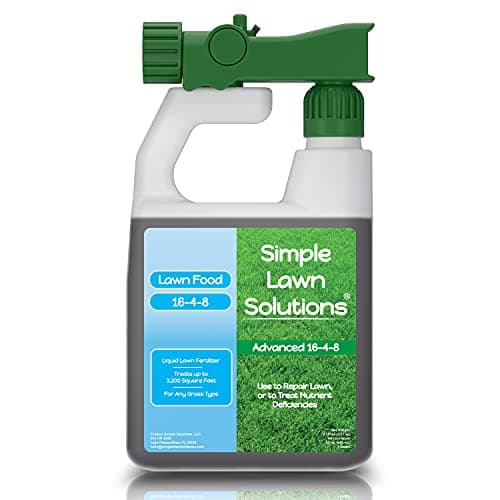
 Simple Lawn Solutions Advanced 16-4-8 Liquid FertilizerCheck price on Amazon
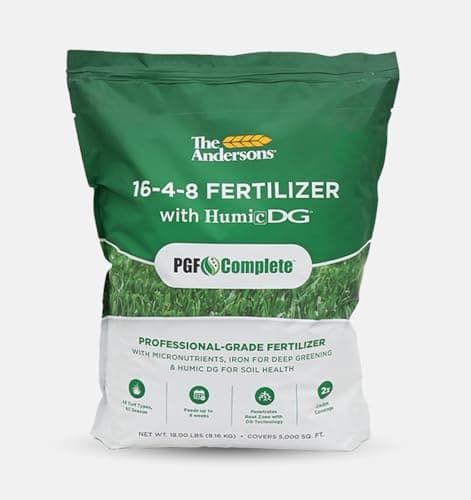
 The Andersons Professional PGF Complete 16-4-8 FertilizerCheck price on Amazon
As an Amazon Associate we earn from qualifying purchases.
Free Lawn Care Tools
In July, the best choice is a fertilizer with moderate nitrogen, little or no phosphorus, and relatively higher potassium, such as 15-0-15, 20-0-10, or 10-0-20 when it matches your soil test. This balance helps maintain color while boosting stress tolerance instead of forcing soft, water-hungry growth. Slow-release nitrogen is especially helpful in summer because it feeds steadily and reduces burn risk.
When the lawn is uniformly pale green to yellow with thin blades and dull color, and the soil feels hard, it usually signals mild nutrient deficiency plus summer stress. Check watering by pushing a screwdriver into the soil after irrigation; it should slide about 6 inches down. If the fading is uniform rather than in circular spots or rings, the grass is more likely hungry and stressed than diseased.
Fertilizing in July is safe if you avoid heat waves and heavy quick-release nitrogen. Do not fertilize when daytime highs are consistently above 90°F, and use lighter summer rates, especially on cool-season grasses. A gentle, slow-release product applied during a moderate stretch of weather and watered in right away is the safest approach.
For cool-season grasses like Kentucky bluegrass, ryegrass, and fescue, summer applications are usually kept at or below about 0.5 to 0.75 pound of nitrogen per 1,000 square feet in a single dose. Warm-season grasses such as Bermuda, Zoysia, and St. Augustine can handle up to about 1 pound of nitrogen per 1,000 square feet per month if they are well watered. Staying within these ranges reduces stress and fertilizer burn during hot weather.
Both can work, but granular products are often easier for beginners to spread evenly because you can see the pellets and control the rate with a spreader. Granular fertilizers usually combine quick and slow-release nitrogen for 4 to 8 weeks of feeding but must be watered in with about 0.25 to 0.5 inch of irrigation right after application. Liquids tend to green up the lawn faster, in about 3 to 7 days, but they require more precise mixing and spraying.
With liquid fertilizers or supplements that include nutrients like iron, mild color improvement often appears within 3 to 7 days. Granular fertilizers typically take 7 to 14 days to show visible greening, with full results developing over 3 to 4 weeks as stress eases and roots recover. Consistent watering and proper mowing during that period help the lawn respond more fully.
Photos: iantmcfarland / Openverse, Macleay Grass Man / Openverse

Beat weeds and brown spots from your phone
Snap a photo, get the fix, and follow a plan timed to your soil and weather. Free on iPhone.