Fertilizer Numbers Explained: What 29-0-10, 10-10-10 and Other NPK Ratios Mean
 Sarah MitchellLawn Diagnostics Specialist | 12 Years
As an Amazon Associate we earn from qualifying purchases.
What the fertilizer numbers mean: The three numbers on a fertilizer bag are the N-P-K analysis, the percentage by weight of nitrogen, phosphorus, and potassium. A 29-0-10 bag is 29% nitrogen, 0% phosphorus, and 10% potassium. Nitrogen drives green growth, phosphorus builds roots, and potassium builds stress tolerance.
Loading Fertilizer Calculator...
Brown or weak lawns often trace back to one thing: the wrong fertilizer numbers for your soil and grass. The lawn fertilizer numbers meaning is simpler than the bag makes it look: the three numbers are always N-P-K, the percentage by weight of nitrogen (green growth), phosphorus (roots), and potassium (stress tolerance). So a 29-0-10 is 29 percent nitrogen, no phosphorus, and 10 percent potassium. Once you can read fertilizer numbers correctly, you can control growth, color, and recovery instead of guessing with every bag you buy.
This guide explains how to read fertilizer numbers, what N-P-K really means, and how to match those numbers to your lawn or garden. We will cover what the three fertilizer numbers mean, how to choose the right analysis for your situation, and how much and how often to apply it without wasting money or burning the turf. If you are also comparing product types, see related topics like Best Fertilizers for Lawns, Organic vs Synthetic Fertilizers, How to Test Your Lawn's Soil, How to Improve Soil pH for Grass, and Composting for a Healthier Lawn.
Fertilizer numbers are always listed as N-P-K, which means nitrogen, phosphorus, and potassium. A bag labeled 24-0-6 contains 24 percent nitrogen for green growth, 0 percent phosphorus for roots, and 6 percent potassium for stress tolerance. If the first number is much higher than the others, the product is focused on leaf and blade growth, which is ideal for established lawns but not for new seed.
To confirm a fertilizer fits your needs, compare the numbers to your goal: for thick green turf, look for a higher first number such as 20-0-5; for new lawns or seeding, choose something with a higher middle number such as 18-24-12; for winter hardiness, favor a stronger third number like 22-0-14. Avoid applying more than 1 pound of nitrogen per 1,000 square feet in a single application, and wait at least 6 to 8 weeks between full-strength feedings. Most lawns show noticeable color improvement within 7 to 10 days with quick-release nitrogen and within 2 to 3 weeks with slow-release products.
What Do the Numbers on Fertilizer Mean?
Fertilizer numbers are the three bold figures on the front of every bag, and they always mean the same thing: the percentage by weight of nitrogen, phosphate (P₂O₅), and potash (K₂O), in that order. Most people just call them N, P, and K, and that shorthand works fine in conversation. A 29-0-10, for example, is 29 percent nitrogen, no phosphate, and 10 percent potash, with the rest of the bag made up of carrier material and any listed extras.
Lawn fertilizer numbers follow this same N-P-K convention whether the bag is a turf builder, a starter blend, or a winterizer, so once you can read one label you can read them all. Here is how the pieces fit together.
When you pick up a fertilizer bag and see something like 24-0-6 or 10-10-10 on the front, those three numbers are the fertilizer analysis. In simple terms, they tell you which nutrients are in the product and how strong they are. Learning to read these fertilizer numbers lets you predict how the product will act on your lawn or plants before you ever spread it.
By law, every fertilizer sold in the United States must include a guaranteed analysis. You usually find it on the front of the bag or bottle as three bold numbers separated by dashes, and again in more detail in a box on the back or side label. This guarantee is your roadmap for nutrient content and is the key to comparing products accurately instead of just trusting brand names or marketing terms like “green-up” or “winterizer.”
The N-P-K Ratio: Nitrogen, Phosphorus, and Potassium
The three fertilizer numbers always appear in the same order: N-P-K.
Nitrogen (N) - first number supports leaf and blade growth, deep green color, and overall lawn density. High nitrogen fertilizers push top growth, thicken turf, and improve visual appeal. If your lawn looks pale, yellowish, or thin, a lack of nitrogen is often the primary issue.
Phosphorus (P) - second number supports root development, seedling establishment, and, for some plants, flowering. New lawns from seed or sod, as well as recently transplanted shrubs and perennials, respond well to a moderate bump in phosphorus when soil tests indicate it is low.
Potassium (K) - third number is critical for stress tolerance, disease resistance, and cold and drought hardiness. Potassium is like the immune support system of the plant. Lawns going into summer heat or winter cold often benefit from adequate potassium so they can handle stress without thinning out.
A helpful analogy is to think of N-P-K as the protein, vitamins, and minerals for your lawn. Nitrogen is the main fuel for visible growth, phosphorus is the rooting and establishment support, and potassium keeps the whole system tough and resilient.
Percent by Weight: What the Fertilizer Numbers Represent
Each fertilizer number is the percentage by weight of that nutrient in the product. That means a 24-0-6 fertilizer is 24 percent nitrogen, 0 percent phosphorus, and 6 percent potassium by weight. The rest of the bag is filler, carrier materials, and sometimes secondary or micronutrients.
On the detailed label, phosphorus and potassium are listed in oxide forms, written as P₂O₅ for phosphate and K₂O for potash. This is a historical labeling convention used for regulation. You do not need to convert these for normal lawn care. Just understand that the second and third numbers refer to these oxide forms, and they are consistent from product to product, which lets you compare them safely.
Here is a quick example: In a 50 pound bag of 24-0-6 fertilizer:
- 24 percent nitrogen means 0.24 × 50 = 12 pounds of actual nitrogen
- 0 percent phosphorus means 0 pounds of P₂O₅
- 6 percent potassium means 0.06 × 50 = 3 pounds of K₂O
That 50 pound bag physically contains 12 pounds of nitrogen and 3 pounds of potash that will be spread across the lawn. Understanding this helps you calculate application rates, like not exceeding 1 pound of nitrogen per 1,000 square feet at one time.
Primary vs Secondary and Micronutrients
The N-P-K numbers cover the primary macronutrients, the three elements lawns and plants use in the greatest amounts. There are also secondary nutrients and micronutrients that matter, especially if your lawn has chronic color or growth problems.
Secondary nutrients include calcium, magnesium, and sulfur. These often appear in the guaranteed analysis box below the N-P-K line. Calcium affects soil structure and root health, magnesium is part of chlorophyll and affects color, and sulfur can acidify soil slightly and help with greening.
Micronutrients include iron, manganese, zinc, copper, boron, and others. Lawns with iron deficiency, for example, often look yellow-green even when nitrogen is adequate. Some “iron plus” or “micro-nutrient blend” fertilizers add small amounts of these elements to fine tune color and performance, especially on high pH soils.
When you read fertilizer numbers, start with N-P-K, then scan the secondary and micronutrient section if you are trying to correct a specific issue such as iron chlorosis or a known magnesium deficiency from a soil test.
How to Read Fertilizer Numbers Step-by-Step
Instead of treating each bag like a mystery, you can use a simple three step process to read any fertilizer numbers and decide if the product fits your lawn or garden goals. This process works for granular bags and liquid concentrates.
Step 1: Locate the N-P-K Numbers on the Label
On granular lawn fertilizers, the N-P-K numbers are almost always printed on the front in large type, for example 29-0-4 or 32-0-10. On the back or side panel, you will see a “Guaranteed Analysis” box that repeats those three numbers and often expands with secondary nutrients.
On liquid fertilizers, look near the product name on the front or top section of the label. It might read 12-4-8 or 10-0-0. Below that, a table or box will specify nutrient percentages and sometimes whether they are quick release or slow release forms of nitrogen.
One rule is fixed: the order is always N - P - K. If you see three numbers, no matter the product type, they represent nitrogen, then phosphorus, then potassium. Once you can spot that pattern quickly, you are ready to decode what the ratio tells you.
Step 2: Decode What the Ratio Tells You About the Product
The shape of the N-P-K ratio tells you how the fertilizer will behave.

If the first number is highest, such as 24-0-6 or 30-0-4, the product is nitrogen heavy and designed to push leafy growth and green color. This is ideal for established lawns and foliage plants where you are not trying to encourage blooms or establish new roots.
If the middle number is relatively high, such as 18-24-12 or 10-20-10, the product emphasizes phosphorus for root growth, seeding, and establishment. Starter fertilizers for new lawns almost always have a higher middle number, assuming local regulations allow phosphorus use.
If the last number is high, such as 0-0-60 or 22-0-14, the product is high in potassium, often marketed as “winterizer” or “stress blend.” These are used where soil tests or turf performance indicate a need for stronger stress tolerance as the lawn enters summer or winter.
Common examples and uses include:
- 20-0-5 or 24-0-6 - typical lawn maintenance fertilizers for established grass, focused on color and density.
- 10-10-10 - balanced, general purpose garden fertilizer suitable for many vegetables and ornamentals when soil tests do not show a specific deficiency.
- 18-24-12 - starter fertilizer used at seeding or sodding to boost roots in new turf.
- 0-0-60 - high potassium supplement used sparingly when soil tests show very low K levels.
By comparing these ratios, you can see whether a product is aggressive on top growth, root-building, or stress protection.
Step 3: Match Fertilizer Numbers to Your Lawn or Plant Needs
Next, connect what the numbers say to what your lawn or garden actually needs. This depends on grass type, soil test results, season, and whether you are working with an established lawn, a new seeding, or ornamental beds.
If your established lawn is thin and pale but otherwise healthy, a nitrogen forward fertilizer such as 24-0-6 applied at 0.5 to 1.0 pound of nitrogen per 1,000 square feet is often appropriate. For a typical 50 pound bag at 24 percent nitrogen, that bag will cover roughly 12,000 to 24,000 square feet depending on the rate you choose.
If you are seeding a new lawn, look for a starter formula like 18-24-12, but only use phosphorus where it is legal and your soil test indicates need. Many states restrict phosphorus on established turf unless a soil test shows low levels. If phosphorus is restricted, choose a starter with low or zero middle number and focus on proper watering and soil preparation instead.
If your area has hot summers or cold winters and your soil test shows low potassium, you might use a product such as 22-0-14 in late summer or early fall. This supports stress tolerance as the grass prepares for seasonal extremes.
For flowers and vegetables, a more balanced ratio like 10-10-10 or a plant specific analysis (for example, tomato blends with slightly higher potassium) is common. Always cross-check with a soil test when possible to avoid building up excess nutrients, especially phosphorus.
Common Fertilizer Numbers and What They Mean
Most people who look up a fertilizer label are really asking one thing: "what does this specific number mean for my lawn?" The table below decodes the most common lawn and garden N-P-K ratios, what each one is built for, and when to reach for it. Match the shape of the numbers, not the brand on the bag.
| N-P-K numbers | What it is | Best use |
|---|---|---|
| 10-10-10 | Balanced, general-purpose blend | Vegetable gardens and ornamentals when no soil deficiency is known. See our 10-10-10 fertilizer guide. |
| 16-4-8 | Nitrogen-forward with light P and K | All-around lawn feeding through the growing season. See our guide to applying a 16-4-8 fertilizer. |
| 12-4-8 | Balanced-lean liquid or granular blend | Lawns, trees, and shrubs needing steady, moderate growth. |
| 18-24-6 / 18-24-12 | Starter fertilizer (high phosphorus) | New seed or sod, where phosphorus is legal and a soil test shows it is low. |
| 20-0-6 / 24-0-6 | Nitrogen-heavy, zero phosphorus | Established lawns, for green-up and density without adding P. |
| 22-0-4 / 24-0-11 | High nitrogen, low-to-moderate potassium | Maintenance feeding; the higher K versions add stress tolerance. |
| 29-0-3 / 29-0-4 / 29-0-10 | High-nitrogen turf builders (zero P) | Peak-season lawn feeding; the 29-0-10 leans on potassium for heat and drought hardiness. |
| 30-0-4 / 32-0-4 / 32-0-10 | Very high nitrogen, zero phosphorus | Fast spring or summer green-up on established turf; easy to over-apply, so watch the rate. |
| 15-0-15 | Balanced nitrogen and potassium, no P | Warm-season lawns (St. Augustine, palms) needing color plus stress tolerance. |
| 0-0-60 | Muriate of potash (potassium only) | Spot-correcting a low-potassium soil test; use sparingly. |
Want to turn any of these numbers into an exact bag amount for your yard? Run them through our fertilizer calculator to get pounds of product per 1,000 square feet.
What Does 29-0-10 Fertilizer Mean?
29-0-10 means 29 percent nitrogen, 0 percent phosphorus, and 10 percent potassium by weight. It is a high-nitrogen turf builder with no phosphorus and a solid dose of potassium, so it pushes deep green growth while also helping the lawn handle summer heat and drought. It suits established lawns in peak season, not new seedings, since there is no phosphorus for root establishment. The closest widely available match on the shelf is Scotts Turf Builder Southern Lawn Food 32-0-10, which carries the same potassium level in a warm-season blend.
What Does 29-0-4 Fertilizer Mean?
29-0-4 is 29 percent nitrogen, 0 percent phosphorus, and 4 percent potassium. It is a classic nitrogen-forward lawn maintenance analysis: strong on color and density, with just enough potassium for general resilience and no phosphorus. Use it on an established lawn that is actively growing, kept at or below 1 pound of nitrogen per 1,000 square feet per application.
What Does 18-24-6 Fertilizer Mean? (Classic Starter Fertilizer Numbers)
18-24-6 is 18 percent nitrogen, 24 percent phosphorus, and 6 percent potassium. The high middle number marks it as a starter fertilizer aimed at root development and seedling establishment, which is why it is sold for new lawns from seed or sod. Only use a high-phosphorus product where local rules allow it and a soil test shows phosphorus is low.
What Does 30-0-4 Fertilizer Mean?
30-0-4 means 30 percent nitrogen, 0 percent phosphorus, and 4 percent potassium. It is a very high-nitrogen, zero-phosphorus blend built for fast green-up on established turf. Because the first number is so high, it is easy to over-apply and burn the lawn, so divide the bag rate carefully and keep each feeding at or under 1 pound of nitrogen per 1,000 square feet.
What Does 12-4-8 Fertilizer Mean?
12-4-8 is 12 percent nitrogen, 4 percent phosphorus, and 8 percent potassium. It follows a balanced 3-1-2 style ratio, with moderate nitrogen for steady growth, a little phosphorus, and higher potassium for durability. It is a common all-purpose analysis for lawns, trees, and shrubs that want consistent feeding rather than an aggressive nitrogen spike. If you want a granular version of that same balanced shape, The Andersons PGF Complete 16-4-8 is the one we keep recommending.
What Does 20-0-0 Fertilizer Mean?
A 20-0-0 fertilizer is 20 percent nitrogen and nothing else: no phosphorus, no potassium. It is a pure nitrogen feed, often sold as ammonium sulfate, and it shines when a soil test shows your phosphorus and potassium are already adequate. It greens a lawn up fast, but with no slow-release component in most versions, apply it lightly and water it in to avoid burn. If you would rather spray it than spread it, Simple Lawn Solutions Maximum Green 28-0-0 is the closest widely available match in liquid form.
What Does 24-0-6 Fertilizer Mean?
A 24-0-6 fertilizer is 24 percent nitrogen, 0 percent phosphorus, and 6 percent potassium. This is one of the most common lawn maintenance ratios on the shelf: strong nitrogen for growth and color, no phosphorus (which established lawns rarely need and many states restrict), and a modest potassium dose for stress tolerance. It is a sensible default for feeding a healthy, established lawn in season. For the closest widely available match, Scotts Turf Builder Lawn Food 32-0-4 does the same job with a bit more nitrogen per pound.
What Common Fertilizer Numbers Mean (Quick Decoder)
Standing in the aisle and just want to know what the numbers on the bag mean? This is the recognition-friendly version. If you searched something like "29-0-10 fertilizer meaning", "18-24-6 fertilizer meaning", or "20-0-5 fertilizer meaning", find your ratio in the table below to see what kind of product it is and what it is best for. The shape of the numbers tells you the job: a high first number is built for green growth, a high middle number is built for roots and new grass, and a high third number is built for stress tolerance.
| Numbers | What it is | Best for |
|---|---|---|
| 29-0-10 | High nitrogen, no phosphorus, moderate potassium | Routine green-up on established lawns, with extra potassium for summer heat and drought |
| 29-0-3 | High nitrogen, no phosphorus, low potassium | Peak-season color and density on established turf that does not need added P |
| 26-0-3 | High nitrogen, no phosphorus, low potassium | General maintenance feeding on established lawns; very close in behavior to 29-0-3 |
| 20-0-5 | Nitrogen-forward, no phosphorus, light potassium | Everyday lawn feeding for color and thickness without adding phosphorus |
| 20-0-0 | Straight nitrogen (often ammonium sulfate) | Fast green-up when a soil test shows phosphorus and potassium are already adequate |
| 18-24-6 | Starter fertilizer, high in phosphorus | New seed or sod, where the middle number feeds root and seedling establishment |
| 18-24-12 | Starter fertilizer with the highest middle number of the common starters | New seed or sod where phosphorus is legal and a soil test shows it is low |
| 16-4-8 | Nitrogen-forward with light P and K (a 4-1-2 style ratio) | Balanced, all-around lawn feeding through the growing season |
| 12-4-8 | Moderate nitrogen, light phosphorus, higher potassium (a 3-1-2 ratio) | Steady feeding for lawns, trees, and shrubs that want growth plus durability |
| 24-8-16 | Water-soluble 3-1-2 ratio blend | All-purpose feeding for lawns and gardens through a hose-end or watering can; dilute per the label |
| 10-10-10 | Balanced, general-purpose blend | Vegetable gardens and ornamentals with no known soil deficiency. See our 10-10-10 fertilizer guide. |
| 13-13-13 | Balanced, general-purpose blend (a slightly stronger 10-10-10) | All-purpose feeding for gardens, new plantings, and pastures when nothing is specifically low |
| 10-0-0 | Low-concentration straight nitrogen, common in organic blends like blood meal | Gentle green-up on an established lawn that needs nothing but nitrogen |
| 6-4-0 | Low nitrogen with some phosphorus and no potassium, typical of manure-based organic blends | Slow, mild feeding for garden beds and new plantings rather than turf |
| 5-10-5 | Low-analysis blend weighted toward phosphorus | Flower beds, bulbs, and transplants, not established lawns |
| 0-10-10 | No nitrogen, equal phosphorus and potassium | Fall root and hardiness feeding in gardens, where phosphorus is still allowed |
| 0-0-7 | Potassium only, at a low rate | Late-season stress feeding on warm-season lawns that should not get nitrogen before frost |
What the Third Number (Potassium) Does
The third number is potassium, listed on the label as K2O (potash), and it is the one people understand least. Potassium does not drive the lush green flush that nitrogen does, so a bag like 29-0-10 or 12-4-8 leans on it for a different reason: it builds stress tolerance. Adequate potassium helps grass handle summer heat, drought, cold, foot traffic, and disease pressure, which is why "winterizer" and summer "stress" blends carry a meaningful third number. That is the difference between a 29-0-3 and a 29-0-10, for instance: both green the lawn up, but the higher third number gives the turf more of a buffer going into a tough season. As always, match the rate to the label and your local extension rather than guessing, since too much potassium offers no extra benefit once your soil test reads adequate.
Fall Fertilizer Numbers: What to Look For in September and October
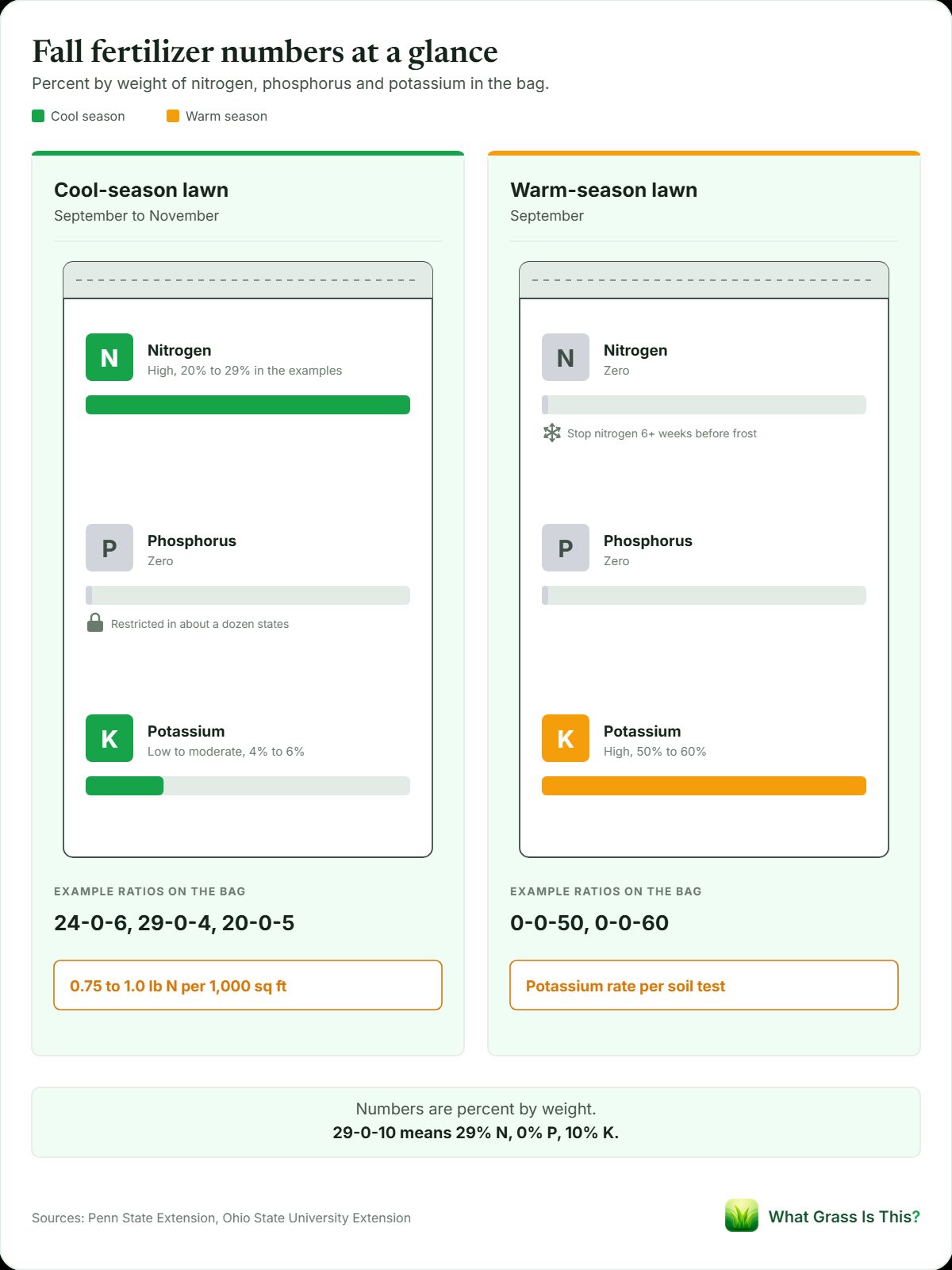
In fall the numbers you want depend on which half of the country you are feeding. Cool-season lawns like Kentucky bluegrass, tall fescue, and ryegrass do their best growing right now, so fall is their main nitrogen window. Look for a high first number and a low or zero middle number, like 24-0-6, 29-0-4, or 20-0-5, and apply 0.75 to 1.0 pound of actual nitrogen per 1,000 square feet, two or three times between early September and early November.
Warm-season lawns are the opposite. Bermuda, zoysia, centipede, and St. Augustine are winding down, and nitrogen now pushes tender growth straight into the first frost. Drop the first number to zero and lean on potassium instead, something like 0-0-50 or 0-0-60, applied in mid to late September and at least six weeks before your average first frost date.
The middle number is the one to check twice. Roughly a dozen states restrict phosphorus on established lawns, so a fall starter blend may not be legal where you live unless a soil test shows a deficiency or you are seeding new turf.
Here is the fall N-P-K shape to look for, by what you are feeding.
| Grass type | Fall N-P-K shape | Example ratios | Rate per application | Window |
|---|---|---|---|---|
| Cool season (Kentucky bluegrass, tall fescue, ryegrass) | High N, zero or low P, low to moderate K | 24-0-6, 29-0-4, 20-0-5 | 0.75 to 1.0 lb N per 1,000 sq ft | Early September to early November, 2 to 3 applications, 6 to 8 weeks apart |
| Cool season, where P is allowed and a soil test shows low P | A 3-1-2 or 4-1-2 ratio | 21-7-14, 12-4-8 | 0.75 to 1.0 lb N per 1,000 sq ft | Same window |
| Warm season (bermuda, zoysia, St. Augustine, centipede) | Zero N, potassium only | 0-0-50, 0-0-60, 0-0-7 | Per soil test | Mid to late September, at least 6 weeks before first frost. See our bermuda grass NPK guide. |
| New seed or overseed, fall | High P starter, where legal | 18-24-6, 18-24-12 | 0.5 to 1.0 lb N per 1,000 sq ft | At seeding |
Before you buy anything with a middle number in fall, check whether your state restricts phosphorus on established turf.
| Where | What is restricted | Common exemption |
|---|---|---|
| About a dozen states, including Illinois, Maine, Maryland, Michigan, Minnesota, New Jersey, New York, Vermont, Virginia, Washington, and Wisconsin | Phosphorus lawn fertilizer on established turf | A soil test showing phosphorus is low |
| Those same states | Phosphorus at seeding or sodding | New lawn establishment is usually allowed |
| Maryland | All lawn fertilizer from November 15 to March 1 | None for homeowners |
| Everywhere else | No statewide phosphorus limit | County or city ordinances may still apply |
Rules change, so confirm with your state department of agriculture or local extension office before you spread. Where phosphorus is off the table, a zero-P blend such as 15-0-15 keeps you legal and still feeds the lawn.
Summer Lawn Fertilizer Numbers
Good summer lawn fertilizer numbers depend on your grass type. Warm-season grasses like Bermuda, zoysia, and St. Augustine are in their prime growth window in summer, so they can handle a nitrogen-forward analysis like 16-4-8, 15-0-15, or 29-0-10, ideally with a chunk of the nitrogen in slow-release form. That higher third number is doing real work in July: potassium is what helps the turf ride out heat and drought without thinning.
Cool-season grasses like fescue, ryegrass, and Kentucky bluegrass are the opposite. They are stressed and semi-dormant in high heat, so heavy quick-release nitrogen in midsummer forces tender growth exactly when the plant can least support it. If you feed a cool-season lawn in summer at all, keep it light: a low rate of a slow-release product, or a potassium-leaning blend, and save the real feeding for early fall. When in doubt, less nitrogen and more patience is the safer summer play.
Starter Fertilizer Numbers
Starter fertilizer numbers are easy to spot: the middle number is big relative to the first. Classic starter analyses are 18-24-12, 18-24-6, and 10-18-10. That middle number is phosphorus, and it matters at seeding because phosphorus barely moves in soil. New seedlings have tiny root systems, so they can only reach phosphorus that is sitting right where the roots are; working a starter blend into the top inch or two of soil puts it in reach and speeds up establishment.
Two cautions: many states restrict phosphorus applications to protect waterways, with a seeding or soil-test exception, so check your local rules first. And once the lawn is established, switch back to a low or zero middle number, since mature turf on most soils does not need added phosphorus.
Using Fertilizer Numbers to Calculate Application Rates
Once you can read the fertilizer numbers and know which ratio you want, the next step is getting the rate right. Most lawn problems from fertilizer are caused not by choosing the wrong analysis, but by applying too much nitrogen at once or reapplying too soon.
A common recommendation for cool season lawns is to apply no more than 0.75 to 1.0 pound of nitrogen per 1,000 square feet in a single application during the growing season. Warm season grasses often use similar or slightly lower single application rates depending on the specific species and region.
To calculate how much product to apply, you divide the desired nitrogen rate per 1,000 square feet by the nitrogen percentage (as a decimal). For example, if you want 1.0 pound of nitrogen per 1,000 square feet using a 24-0-6 fertilizer:
- Convert 24 percent to 0.24
- 1.0 ÷ 0.24 ≈ 4.2 pounds of product per 1,000 square feet
If you would rather not do the division, our fertilizer rate calculator turns any N-P-K number and lawn size into pounds of product per 1,000 square feet.
If the bag weighs 50 pounds, then 50 ÷ 4.2 ≈ 12, which means one bag covers about 12,000 square feet at that rate.
Space applications at least 6 to 8 weeks apart for full rate granular fertilizers unless the label specifies a different interval. Applying too frequently or at higher than labeled rates is what typically leads to fertilizer burn and excessive top growth that the roots cannot support.
- Penn State Extension recommends limiting single nitrogen applications on cool season lawns to 1.0 pound N per 1,000 square feet and applying most nitrogen in the fall for long term turf health.
Recommended products
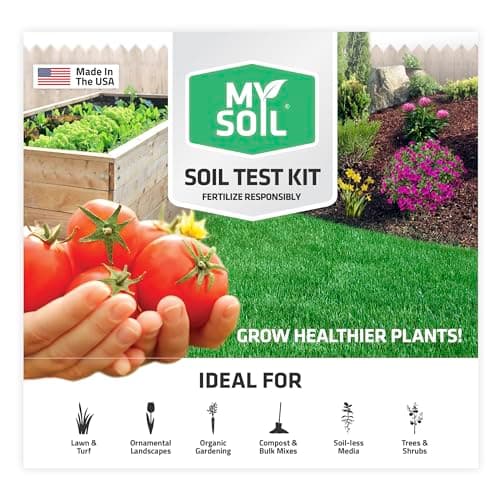
MySoil Soil Test Kit
A mail-in lab test that tells you which of the three numbers your soil actually needs.
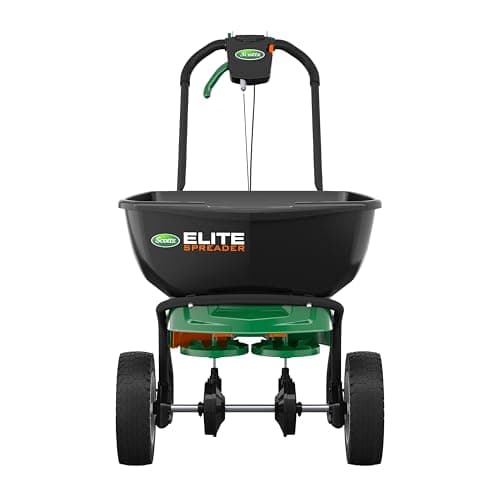
Scotts Elite Spreader
A twin-rotor broadcast spreader with a six-foot pattern for even granular coverage.
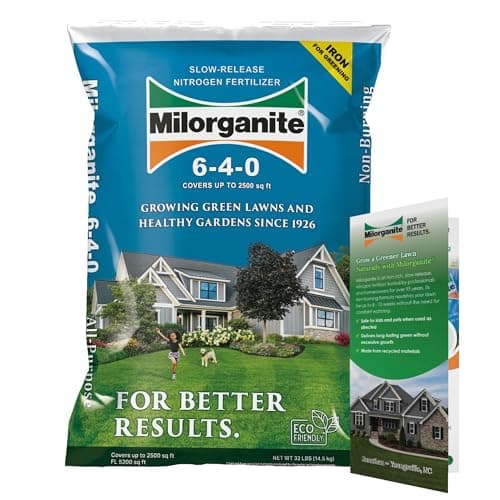
Milorganite 6-4-0 (32 lb)
A slow-release organic nitrogen source with iron and a low burn risk on any grass type.
Lawn Fertilizer Numbers Meaning by Season: How Often to Apply
The fertilizer numbers also interact with timing. A high nitrogen fertilizer at a strong rate lasts longer in the soil, while lighter doses or lower N percentages provide a gentler, shorter effect. Season and grass type decide how often you should feed.
For cool season grasses such as Kentucky bluegrass, fescue, and ryegrass, the main feeding window is fall, roughly September through early November in many temperate regions, when soil temperatures are cool but grass is still actively growing. A typical program might include 2 to 3 applications of 0.75 to 1.0 pound N per 1,000 square feet spaced 6 to 8 weeks apart in fall, using something like 24-0-6 or 29-0-4.
For warm season grasses such as Bermuda, zoysia, and St. Augustine, the primary fertilization period is late spring through summer once soil temperatures are consistently above about 65 degrees Fahrenheit. Early spring applications on dormant warm season turf usually provide little benefit and can encourage weeds more than grass.
Starter fertilizers like 18-24-12 are applied once at seeding or sodding, usually at a lighter nitrogen rate of about 0.5 pound N per 1,000 square feet. After establishment, you switch to a regular maintenance analysis based on your soil test and grass type.

- Ohio State University Extension notes that applying 1.5 to 2.5 pounds of nitrogen per 1,000 square feet per year, split into multiple applications, is appropriate for many home lawns, with most of that nitrogen applied in fall for cool season turf.
What Other Guides Miss: Common Mistakes to Avoid
Many basic articles on how to read fertilizer numbers stop at “N is for leaves, P is for roots, K is for stress,” but there are some practical points they often skip that matter for real lawns.
One missed step is confirmation with a soil test. If your phosphorus level is already high, adding a fertilizer with a high middle number does not improve rooting and can contribute to runoff issues. Before using high P or K products, test your soil at least every 3 to 4 years. This is outlined in more detail in How to Test Your Lawn's Soil.
Another gap is matching analysis to your grass type, not just the season. For example, a cool season blend like 32-0-4 marketed for spring green-up can be too aggressive for certain fine fescue lawns which prefer lower nitrogen. If you see rapid top growth that outpaces your mowing schedule or a flush of disease after fertilizing, you likely chose too high a nitrogen number or applied too much at once. Confirm by reviewing the bag rate and your spreader setting. Next time, step down to a product with a lower first number or reduce the application rate.
Safety intervals are also under-reported. If you suspect you over-applied, check for signs of burn such as brown streaks or patches appearing within 24 to 48 hours, especially along overlap zones of your spreader path. If detected early and the product is water soluble, deep watering within that 48 hour window can sometimes dilute the salts enough to reduce damage, though it will not fully reverse severe burn.
Bringing It All Together: A Simple Workflow for Fertilizer Choices
When you stand in the fertilizer aisle, you can make a fast, informed decision by following a simple workflow that uses the fertilizer numbers rather than marketing claims. First, identify your situation: established lawn, new seeding, or garden plants. Second, review your most recent soil test to see if phosphorus or potassium are low, adequate, or high. If you do not have a test and are planning more than one season of improvements, prioritize getting one done.
Third, pick an N-P-K ratio that matches your goal. For most established lawns with no extreme soil deficiencies, a nitrogen forward, low or zero phosphorus product such as 24-0-6 is appropriate, especially where phosphorus use is regulated. For seeding or sodding, use a starter blend with higher phosphorus only if your soil test indicates low P and local rules allow it. For stress tolerance going into summer or winter, consider an analysis with a somewhat higher third number if your soil test shows low potassium.
Fourth, calculate the rate. Keep each application at or below about 1 pound of nitrogen per 1,000 square feet unless a local extension recommendation and label rate suggest slightly different numbers for your grass type. Space applications by at least 6 to 8 weeks for full rate products, and adjust based on how your turf responds.
That is really all there is to it. The three numbers on the bag are a nutrient label, not a mystery code: nitrogen for green growth, phosphorus for roots, potassium for toughness. Match the shape of the ratio to your goal, keep the nitrogen rate honest, and let a soil test settle any question the label cannot. Your lawn will tell you the rest.
Top Picks
- Pennington Full Season Lawn Fertilizer 32-0-5Check price on Amazon
- Scotts Turf Builder EdgeGuard Mini Broadcast SpreaderCheck price on Amazon
- Scotts Wizz Spreader for Grass SeedCheck price on Amazon
As an Amazon Associate we earn from qualifying purchases.
Free Lawn Care Tools
The three numbers on a fertilizer bag are always in the order N-P-K, which stands for nitrogen, phosphorus, and potassium. Each number shows the percentage by weight of that nutrient in the product. For example, a 24-0-6 fertilizer is 24% nitrogen, 0% phosphorus, and 6% potassium, with the rest made up of filler and possibly secondary or micronutrients. These numbers let you compare how strong different fertilizers are and how they will affect your lawn.
For thick, green turf, look for a fertilizer with a higher first number, such as 20-0-5 or similar, because nitrogen is what drives color and leaf growth. High-nitrogen formulas help thicken the lawn and improve visual appeal when the grass looks pale or thin. Just be sure not to exceed 1 pound of nitrogen per 1,000 square feet in a single application. Allow 6 to 8 weeks between full-strength feedings to avoid burning the turf.
Multiply the first fertilizer number (nitrogen percentage) by the bag weight to find pounds of nitrogen. For example, a 50-pound bag of 24-0-6 contains 0.24 × 50 = 12 pounds of actual nitrogen. To stay within 1 pound of nitrogen per 1,000 square feet, you would spread that 50-pound bag over about 12,000 square feet. This simple calculation helps avoid over-applying and burning your grass.
The main fertilizer numbers (N-P-K) are the primary macronutrients that lawns use in the largest amounts. Below them, the label may list secondary nutrients like calcium, magnesium, and sulfur, along with micronutrients such as iron, manganese, and zinc. These extras help fine-tune color, root health, and stress response, especially if a soil test shows specific deficiencies. When choosing a product, focus on N-P-K first, then look at these added nutrients if you’re targeting a particular problem like yellowing from iron deficiency.
In summer, look for moderate nitrogen with meaningful potassium, something like 16-4-8 or 29-0-10 with at least half the nitrogen in slow-release form. The potassium (the last number) is what helps grass tolerate heat and drought. Warm-season grasses like Bermuda and zoysia can take a normal feeding in summer, but avoid high quick-release nitrogen on cool-season lawns in hot weather; it forces tender growth exactly when the grass can least afford it.
A 20-0-0 fertilizer contains 20 percent nitrogen by weight and no phosphorus or potassium. It is a straight nitrogen product, commonly ammonium sulfate, used when soil tests show the other two nutrients are already sufficient. Because most 20-0-0 products are fast-release, apply at modest rates and water in promptly to prevent burn.
29-0-10 means 29 percent nitrogen, 0 percent phosphorus, and 10 percent potassium by weight. It is a high-nitrogen lawn fertilizer with no phosphorus and a solid dose of potassium, so it pushes deep green growth while helping the lawn handle summer heat and drought. It suits established lawns in peak season rather than new seedings, since there is no phosphorus for root establishment. Follow the rate on the label or your local extension, and keep each feeding at or under 1 pound of nitrogen per 1,000 square feet.
18-24-6 means 18 percent nitrogen, 24 percent phosphorus, and 6 percent potassium. The high middle number marks it as a starter fertilizer aimed at root development and seedling establishment, which is why it is sold for new lawns from seed or sod. Only use a high-phosphorus product where local rules allow it and a soil test shows phosphorus is low, since many areas restrict phosphorus to protect waterways.
The third number in a fertilizer analysis is potassium, shown on the label as K2O or potash. It is the percentage by weight of potassium in the product. Potassium supports stress tolerance, disease resistance, and cold and drought hardiness rather than visible green growth, so blends meant for summer or winter resilience carry a higher third number. Match the amount to the label or your local extension and a recent soil test rather than adding extra potassium by default.
Starter fertilizer numbers have a big middle number relative to the first, since phosphorus drives the root development new seedlings and sod need. Classic starter analyses are 18-24-6, 18-24-12, and 10-18-10. Only use them where phosphorus is allowed and a soil test shows you actually need it, since many states restrict phosphorus applications to protect waterways.
The 3 numbers on fertilizer are the N-P-K analysis: the percentage by weight of nitrogen (N), phosphorus (P), and potassium (K), always in that order on the bag. A 16-4-8 bag is 16 percent nitrogen for blade growth and color, 4 percent phosphorus for roots, and 8 percent potassium for stress and disease tolerance. The rest of the bag is carrier material and any listed micronutrients, and the numbers on the fertilizer always appear in that same N-P-K order.
It depends on your grass. Cool-season lawns like Kentucky bluegrass, tall fescue, and ryegrass are in their best growing window, so use a high first number with a zero or low middle number, such as 24-0-6, 29-0-4, or 20-0-5, at 0.75 to 1.0 pound of nitrogen per 1,000 square feet. Warm-season lawns are shutting down, so skip the nitrogen and use a potassium-only product like 0-0-50.
Read the numbers rather than the word. Winterizer is a marketing term, and the bags behind it vary a lot. Some are high-nitrogen blends like 24-0-6, others are potassium-heavy. On a cool-season lawn a late-fall nitrogen feeding is genuinely useful. On a warm-season lawn nitrogen that late pushes tender growth into frost damage, so a potassium-forward analysis is the safer pick.
Yes, if you are actually seeding or overseeding. Starter numbers like 18-24-6 or 18-24-12 carry the phosphorus new seedlings need, and early fall is the best seeding window for cool-season grass. On an established lawn, skip it. Roughly a dozen states restrict phosphorus on established turf unless a soil test shows a deficiency, so check your state rules before you buy.
Photos: Digital Buggu / Pexels, Yan Krukau / Pexels, Alexas_Fotos / Pixabay

Beat weeds and brown spots from your phone
Snap a photo, get the fix, and follow a plan timed to your soil and weather. Free on iPhone.