

Is Scotts Weed and Feed a Pre-Emergent? Plain English Answer (2026)

As an Amazon Associate we earn from qualifying purchases.
Short answer: it depends on the product. Scotts sells several bags labeled with some variation of Weed and Feed, and they do not all do the same thing. Scotts Turf Builder Halts Crabgrass Preventer is a pure pre-emergent. Scotts Turf Builder Triple Action is a hybrid that contains pre-emergent plus post-emergent plus fertilizer. The standard Scotts Turf Builder Weed and Feed 3, the green bag most people think of when they hear the words weed and feed, is post-emergent only.
That distinction matters a lot. A post-emergent kills weeds you can already see. A pre-emergent stops weed seeds from germinating in the first place. Use the wrong one at the wrong time and you waste a bag of product and a Saturday.
This guide breaks down which Scotts products are pre-emergent, which are not, how to tell from the label, and what to buy if your real goal is preventing crabgrass this season.
Some Scotts Weed and Feed products are pre-emergent, some are post-emergent only. The short version of which is which:
- Pre-emergent: Scotts Turf Builder Halts Crabgrass Preventer (pendimethalin, no fertilizer)
- Pre-emergent plus more: Scotts Turf Builder Triple Action (pendimethalin pre-emergent, post-emergent broadleaf killer, and fertilizer in one bag)
- NOT pre-emergent: Scotts Turf Builder Weed and Feed 3 (post-emergent broadleaf only, plus fertilizer)
- NOT pre-emergent: Scotts Bonus S Southern Weed and Feed (atrazine plus fertilizer)
- NOT pre-emergent: Scotts Turf Builder Lawn Food (fertilizer only, no herbicide of any kind)
If your goal is to prevent crabgrass before it sprouts, you need Halts or Triple Action applied when soil temperature hits 50 to 55F in spring. Standard Weed and Feed will not prevent crabgrass.
What Pre-Emergent Actually Means
Before we sort the Scotts lineup, it helps to know what the words on the bag actually describe. Pre-emergent and post-emergent are not brand terms. They describe when an herbicide does its work relative to the weed's life cycle.
Pre-emergent vs post-emergent
A pre-emergent herbicide creates a chemical barrier in the top layer of soil. When a weed seed germinates and pushes its first root through that layer, the chemical blocks the seedling from developing. The weed never appears on the surface. Common pre-emergent active ingredients you will see on a label are pendimethalin, prodiamine, and dithiopyr. Scotts Halts uses pendimethalin.
A post-emergent herbicide attacks weeds that are already growing. It is absorbed through the leaves or roots of a plant that has already sprouted. Most broadleaf weed killers in standard weed and feed products are post-emergent. Common active ingredients are 2,4-D, MCPP, and dicamba. These products do nothing for seeds still sitting dormant in the soil.
Some products combine both. Scotts Triple Action is the obvious example, since it includes a pre-emergent (pendimethalin) for grassy weeds plus a post-emergent for broadleaf weeds plus fertilizer for the lawn itself.
When pre-emergents work
Pre-emergent timing is strict. The product has to be on the ground and watered in before the target weed seeds germinate. For crabgrass, that means soil temperature at a 2 to 4 inch depth needs to reach a consistent 50 to 55F. A few warm days do not count. You need a steady trend.
Use our soil temperature by ZIP code tool to check current soil temps in your area before you apply. Apply too early and the chemical breaks down before crabgrass germinates. Apply too late and the seeds are already up, at which point a pre-emergent does nothing.
Scotts Products That ARE Pre-Emergent (or Contain One)
Two Scotts products in the current lineup contain a true pre-emergent. Both rely on pendimethalin as the active ingredient.
Scotts Turf Builder Halts Crabgrass Preventer
Halts is the pure-play pre-emergent in the Scotts lineup. The active ingredient is pendimethalin. There is no fertilizer in the bag, no post-emergent, just a pre-emergent herbicide designed to prevent crabgrass and other grassy weeds from germinating.
This is the right product if you want to handle pre-emergent on its own schedule and feed the lawn separately. It is also the simpler choice if your lawn is in early spring and you do not want to push a heavy nitrogen feed yet. Scotts Turf Builder Halts Crabgrass Preventer on Amazon.
For complete timing and spreader-setting details, see our Scotts Halts application instructions.
Scotts Turf Builder Triple Action
Triple Action is the all-in-one. It contains pendimethalin (pre-emergent) plus a 2,4-D-based post-emergent for existing broadleaf weeds plus a standard turf fertilizer. Three jobs in one bag.
This is the right product if you want pre-emergent crabgrass prevention AND you have visible broadleaf weeds AND you want to feed the lawn at the same time. The trade-off is timing. Triple Action has to go down when soil temperatures hit the 50 to 55F crabgrass germination threshold, which can be earlier than ideal for a heavy broadleaf weed kill or for pushing fertilizer.
Scotts Turf Builder Triple Action on Amazon. For step-by-step application instructions and spreader settings, see our Triple Action instructions guide.
Scotts Snap-Pac Crabgrass
Snap-Pac was Scotts' attempt at a no-spill, snap-on spreader cartridge. Inventory and availability have been spotty over the past two years, and crabgrass preventer Snap-Pac SKUs come and go. If you find one in stock, the active ingredient is still pendimethalin and the timing rules are identical to Halts. If you cannot find a current Snap-Pac, the standard bag of Halts does the same job.
Scotts Products That Are NOT Pre-Emergent
These products carry the Scotts name and sometimes have Weed and Feed in the label, but they will not prevent crabgrass. They handle a different job.
Scotts Turf Builder Weed and Feed 3
This is the green bag most homeowners picture when they hear weed and feed. It is post-emergent broadleaf herbicide (think 2,4-D and similar actives) combined with fertilizer. It kills dandelions, clover, plantain, chickweed, and other visible broadleaf weeds while feeding the lawn.
It does not contain a pre-emergent. It will not prevent crabgrass. If you spread this in March hoping to stop crabgrass, you will be disappointed in June. Scotts Turf Builder Weed and Feed 3 on Amazon.
For full application timing and best practices, see our Scotts Weed and Feed application guide.
Scotts Bonus S Southern Weed and Feed
Bonus S is the warm-season equivalent of Weed and Feed 3. The active herbicide is atrazine, paired with fertilizer. Atrazine has some weak early post-emergent activity on tiny seedling weeds, but it is not a true pre-emergent like pendimethalin or prodiamine. It will not give you a season of crabgrass prevention.
Bonus S is also restricted on some warm-season grasses (it is generally labeled for St. Augustine and centipede, not Bermuda) and is regulated or restricted in several states. Read your label before applying.
Scotts Turf Builder Lawn Food
Plain Turf Builder Lawn Food is just fertilizer. No herbicide of any kind. It is a useful product for feeding the lawn, but it cannot prevent or kill any weed. Scotts Turf Builder Lawn Food on Amazon. Worth mentioning here only because people sometimes confuse it with the weed and feed line.
How to Tell from the Label
If you are standing in the aisle holding a bag and trying to figure out whether it is a pre-emergent, look at three things in this order.
1. The front of the bag. Pre-emergent products almost always say something like prevents crabgrass, stops crabgrass before it starts, or season-long crabgrass control. If you see the word prevent, that is a strong signal. If the bag only talks about killing weeds you can see, it is post-emergent.
2. The active ingredient list. Flip the bag over. Pre-emergent active ingredients are pendimethalin, prodiamine, dithiopyr, benefin, and oryzalin. If you see any of those, the product is a pre-emergent (or contains one). If you only see 2,4-D, MCPP, dicamba, quinclorac, or atrazine, it is post-emergent.
3. The timing instructions. A pre-emergent product will tell you to apply in early spring before forsythia blooms drop or when soil temperatures hit roughly 50 to 55F. A post-emergent will tell you to apply when weeds are actively growing and visible. The two timing windows do not overlap perfectly.
If You Need a Pre-Emergent, Buy This
For the typical homeowner who just wants to prevent crabgrass this spring, the decision tree is short. If you want pre-emergent plus broadleaf killer plus feed in one pass, buy Triple Action. If you want a pure pre-emergent and you will handle fertilizing on a separate schedule, buy Halts. Pros and people managing large lawns often step up to The Andersons Barricade, which uses prodiamine for longer residual control.
Recommended products
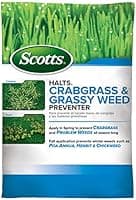
Scotts Turf Builder Halts Crabgrass Preventer
pure pendimethalin pre-emergent, no fertilizer.

Scotts Turf Builder Triple Action
pre-emergent plus post-emergent plus feed.
$44.95
View on AmazonThe Andersons Barricade
prodiamine-based pre-emergent with longer residual control.
$46.88
View on AmazonFor full timing details across regions and a sample schedule, see our Scotts pre-emergent application rate and timing schedule.
Timing: Pre-Emergent vs Post-Emergent Application
The single biggest reason pre-emergent fails is bad timing. Get this part right and the chemistry takes care of the rest.
Pre-emergent (Halts, Triple Action): apply in early spring when soil temperature at a 2 to 4 inch depth holds steady at 50 to 55F. Forsythia full bloom is the old-school visual cue and it still works in most of the country. After application, water in with about a quarter inch of irrigation or wait for a forecasted rain within 7 days.
Post-emergent (Weed and Feed 3, Bonus S): apply when air temperatures are consistently between 60F and 90F and weeds are actively growing. The lawn should be slightly damp so granules stick to the leaves. Do not water in for 24 hours, since the herbicide needs leaf contact time.
Check your local soil temperature trend before you decide which product to buy, not after. The soil temperature by ZIP code tool gives you the current reading and a 7-day forecast.
Common Mistakes
Three mistakes show up over and over in homeowner forums and customer support tickets.
1. Applying Triple Action too late. By May or June in most of the country, crabgrass has already germinated. The pendimethalin in Triple Action cannot do anything for seeds that are already up. The broadleaf killer and fertilizer still work, but you paid for a three-action product and only got two of them. If you missed the soil-temperature window, switch to a post-emergent crabgrass killer (quinclorac-based products) instead.
2. Applying standard Weed and Feed 3 hoping to prevent crabgrass. This is the most common mix-up. The bag says Weed and Feed, the homeowner assumes it does everything, and three months later crabgrass is everywhere. Weed and Feed 3 is post-emergent broadleaf only. To prevent crabgrass you need Halts, Triple Action, or another pendimethalin or prodiamine product.
3. Watering in a post-emergent immediately. If you spread a post-emergent product like Weed and Feed 3 or Bonus S and then run the sprinklers right away, you rinse the herbicide off the weed leaves before it can be absorbed. Wait at least 24 hours. Pre-emergent products are the opposite. They need to be watered in promptly to bind to the soil.
Conclusion
Is Scotts Weed and Feed a pre-emergent? Some are, some are not, and it depends entirely on which product is in the bag. Scotts Halts is a pure pre-emergent. Scotts Triple Action contains a pre-emergent alongside post-emergent herbicide and fertilizer. Scotts Turf Builder Weed and Feed 3 and Scotts Bonus S are post-emergent only. Scotts Turf Builder Lawn Food has no herbicide at all.
The practical takeaway: if your goal is to stop crabgrass before it sprouts, you need Halts or Triple Action, and you need to apply it when soil temperature hits 50 to 55F in early spring. If your goal is to kill dandelions and clover you can already see while feeding the lawn, standard Weed and Feed 3 (or Bonus S in the South) is the right pick. Read the active ingredient panel before you buy and you will never end up with the wrong product again.
Free Lawn Care Tools
Common questions about this topic
It depends on the exact product. Scotts Turf Builder Halts Crabgrass Preventer is a pure pre-emergent. Scotts Turf Builder Triple Action contains a pre-emergent (pendimethalin) plus a post-emergent broadleaf killer plus fertilizer. Standard Scotts Turf Builder Weed and Feed 3 is post-emergent only, meaning it kills weeds that have already sprouted but does not stop new seeds from germinating.
No. The standard Scotts Turf Builder Weed and Feed 3 contains 2,4-D and other post-emergent broadleaf herbicides plus fertilizer. It targets weeds you can already see, like dandelions and clover, but it does nothing for crabgrass seeds sitting in the soil waiting to germinate. If you want crabgrass prevention, you need Halts or Triple Action instead.
Yes, partially. Scotts Turf Builder Triple Action is a three-in-one product that includes pendimethalin, a true pre-emergent that prevents crabgrass and other grassy weeds from germinating. It also contains a post-emergent for existing broadleaf weeds and a standard turf fertilizer. Apply it in early spring when soil temperatures hit 50 to 55 degrees Fahrenheit for best pre-emergent results.
No. Scotts Turf Builder Halts Crabgrass Preventer is a pure pre-emergent herbicide with pendimethalin as the active ingredient. It does not contain fertilizer, so you can apply it without worrying about pushing too much nitrogen at the wrong time of year. If you want pre-emergent plus feed in one bag, use Triple Action instead.
Standard Scotts Weed and Feed 3 is fertilizer plus post-emergent broadleaf herbicide only. Scotts Triple Action adds a pre-emergent (pendimethalin) on top of the broadleaf killer and the feed. If you already have weeds up and want to feed the lawn, Weed and Feed 3 is enough. If you also want to prevent crabgrass from sprouting this season, you need Triple Action or a separate pre-emergent like Halts.
Usually not in the same week, and not as two separate granular applications stacked back to back. The simpler approach is to use a combined product like Triple Action that handles pre-emergent, post-emergent, and feed in one pass. If you want them separate, apply the pre-emergent first in early spring at 50 to 55 degree soil temperature, then wait at least 4 to 6 weeks before applying a standard weed and feed to handle any broadleaf weeds that emerged.
Apply Scotts Halts or Triple Action in early spring when soil temperatures at a 2 to 4 inch depth reach a consistent 50 to 55 degrees Fahrenheit. That window is typically February in the Deep South, March to early April in the transition zone, and mid-April to early May across the northern states. Apply too early and the chemical breaks down before crabgrass germinates. Apply too late and the seeds are already up, at which point a pre-emergent does nothing.
No. Scotts Bonus S Southern Weed and Feed uses atrazine paired with fertilizer. Atrazine is technically a hybrid herbicide that can offer some early post-emergent control of seedling weeds, but it is not a true pre-emergent in the same way as pendimethalin, prodiamine, or dithiopyr. For real crabgrass prevention on warm-season lawns, use a dedicated pre-emergent product.
Loading product recommendations...
Related Articles
Most weed and feed products show first results in 5 to 14 days with full weed kill in 2 to 3 weeks. Here is the complete day-by-day timeline by product type, what speeds it up, and how to tell it is w...
Grub treatment is only needed at 10+ per sq ft. Soap flushes confirm chinch bugs in minutes. Timing and spot-treating are critical for summer pest control.
Discover how to diagnose brown patch in tall fescue and use organic controls. Includes weather thresholds, mowing heights, and a seasonal action plan.