


Scotts Weed and Feed: Types, Reviews & Which One to Buy (2026)
 Marcus GreenTurf Management Pro | 18 Years
As an Amazon Associate we earn from qualifying purchases.
If your lawn has broadleaf weeds and you want a single product that kills them and feeds the grass, Scotts Turf Builder Weed and Feed 3 is the standard pick for cool-season lawns. For Southern lawns (St. Augustine, centipede, Bahia), use Scotts Bonus S Southern Weed and Feed, since the standard formulas can damage Southern grasses.
If you also need crabgrass prevention, step up to Scotts Turf Builder Triple Action, which combines pre-emergent, post-emergent, and feed. For pre-emergent only with no fertilizer, choose Scotts Turf Builder Halts Crabgrass Preventer. Apply when daytime highs are 60-90F, the lawn is slightly damp, and no rain is forecast for 24 hours.
Search for "Scotts weed and feed" on Amazon and you get a wall of bags that all look almost identical. Same blue and yellow branding, same Turf Builder name, same Scotts logo. The differences are buried in the fine print on the back of the bag, and the wrong one can damage your lawn. Not sure whether you need crabgrass prevention? Compare them in Scotts Weed and Feed vs Triple Action.
Scotts actually makes six different weed and feed products under the Turf Builder umbrella. Some are post-emergent only, some are pre-emergent only, some combine both. A few are formulated for cool-season grasses and will kill St. Augustine or centipede on contact. The price difference between the cheapest and most expensive options is about 2x, but the coverage and use cases vary a lot more than that.
This guide walks through every current Scotts weed and feed product, what each one does, and which one matches your specific grass and weed situation. By the end you will know exactly which bag to grab.
The Scotts Weed and Feed Lineup in 2026
Scotts has slowly expanded the Turf Builder line over the years, and the current 2026 lineup includes six products that get marketed as "weed and feed" or get used that way by homeowners. They split into three buckets: post-emergent plus fertilizer (kills weeds already growing), pre-emergent plus fertilizer (prevents weeds from sprouting), and the Triple Action formula that combines both. There is also a Southern-specific line and a liquid version for spot treatment.
Most homeowners only need one of these per season, sometimes two if they want both spring pre-emergent coverage and fall broadleaf cleanup. Buying multiple bags of overlapping products is one of the most common ways people overspend on lawn care. Here are the three I recommend most often.
Recommended products
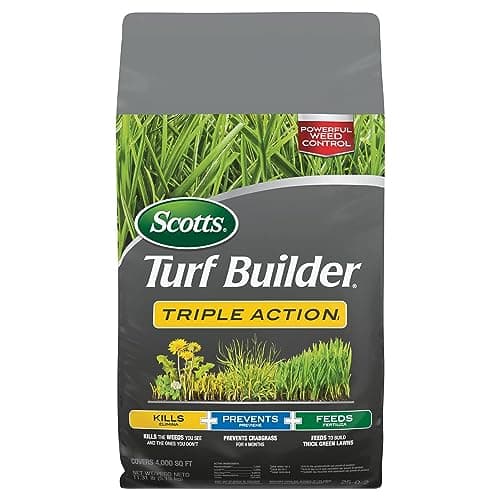
Scotts Turf Builder Triple Action
Built for the most common scenario: a lawn with broadleaf weeds in spring plus the start of crabgrass season.
Scotts Turf Builder Bonus S Southern Weed & Feed2
The southern combo pick: atrazine weed control plus feeding for St. Augustine and centipede, where Weed and Feed 3 is not safe.
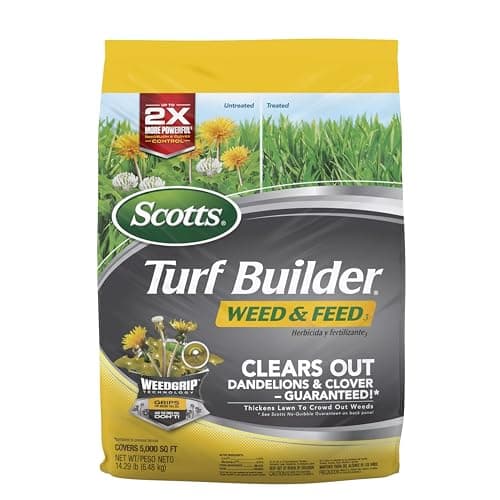
Scotts Turf Builder Weed and Feed 3
The original, and still the cheapest per square foot.
Scotts Turf Builder Weed and Feed 3
This is the flagship product, the one most people picture when they hear "Scotts weed and feed." It combines a 28-0-3 nitrogen-rich fertilizer with a broadleaf herbicide (2,4-D plus mecoprop and dicamba) that kills more than 50 listed weeds. It is strictly post-emergent, meaning it works on weeds that are already growing and visible.
The standard 14-pound bag covers 5,000 square feet, and the 28.13-pound bag covers 10,000. Per square foot, this is the lowest-cost option in the Scotts lineup. It is safe on Kentucky bluegrass, fescue (tall and fine), perennial ryegrass, Bermuda (when fully green and actively growing), and Zoysia. It is NOT safe on St. Augustine, centipede, Bahia, dichondra, or carpetgrass. Read the bag.
The N-rich blend pushes a fast green-up, usually within 3 to 5 days. Weeds curl within a week and die back over 2 to 3 weeks. It is best applied in late spring or early fall when broadleaf weeds are actively growing and air temperatures are in the 60s to mid-80s.
Scotts Turf Builder Triple Action
Triple Action is the newer formula that combines three jobs in one bag: pre-emergent for crabgrass and other annual grasses, post-emergent for broadleaf weeds, and a 21-0-3 fertilizer feed. The pre-emergent active is pendimethalin in some regional formulations and dithiopyr in others, both proven crabgrass blockers.
This is the product I recommend to most homeowners doing spring lawn care, because the timing window for crabgrass pre-emergent (soil temps 50-55F) overlaps with the timing for broadleaf control. One application, one trip across the lawn, two jobs done.
The downside is cost: a 12-pound bag covers only 4,000 square feet, and pricing runs roughly 60 to 80 percent more per square foot than the standard Weed and Feed 3. Like the standard, it is not safe on St. Augustine, centipede, Bahia, or dichondra. Apply once in early spring when soil temps reach 50F at a 4-inch depth.
Scotts Turf Builder Halts Crabgrass Preventer
Halts is the pre-emergent-only product in the lineup. It contains pendimethalin and a small amount of fertilizer (some formulations are 30-0-4, others 25-0-4 depending on the year and region), but the marketing positions it as a crabgrass preventer first, fertilizer second. If you already fed your lawn or plan to use a separate fertilizer, this gives you cleaner pre-emergent coverage without doubling up on nitrogen.
It has no post-emergent activity, so it will not touch weeds that are already growing. Time the application for early spring when forsythia is in full bloom or soil temps hit 50-55F, whichever comes first. A second application in early fall extends the pre-emergent window into the cool-season weed flush.
Coverage is generous: a 15-pound bag handles 5,000 square feet, and the larger 40-pound bag covers 15,000. Per square foot, it is the cheapest way to get pendimethalin-based pre-emergent protection.
Scotts Turf Builder Southern Lawn Food
This one is not technically a weed and feed, but it gets shopped alongside them constantly. It is a 32-0-10 fertilizer formulated for Southern grasses, with no herbicide component. Think of it as the safe base feed for St. Augustine, centipede, Bahia, and Zoysia, the grass types that cannot tolerate the standard Scotts weed and feed formulas.
If your lawn is mostly weed-free and you just need a Southern-safe feed, this is the bag. If you need weed control on a Southern lawn, pair this with a Southern-safe spot herbicide (atrazine-based products like Bonus S, or a non-selective spot kill on weeds only). Coverage is 5,000 square feet per 14-pound bag.
Scotts Bonus S Southern Weed and Feed
Bonus S is the Southern-grass-safe weed and feed in the lineup, and it is the product you reach for if you have St. Augustine, centipede, or Bahia and want a combo product. It uses atrazine as both the pre-emergent and post-emergent active, which is the standard chemistry for Southern lawns, plus a fertilizer feed. Atrazine is what makes Bonus S safe on St. Augustine when the standard formula would kill it.
Apply Bonus S in late winter or early spring when daytime highs are consistently 60-90F. It controls a long list of broadleaf weeds plus several annual grasses through the pre-emergent action. Do not apply Bonus S to newly seeded or sodded lawns, and keep it off Bermuda, Zoysia, and cool-season grasses (use the standard Scotts on those). Coverage is 5,000 square feet per 17.2-pound bag.
Scotts Liquid Turf Builder Weed and Feed
The liquid version comes in a hose-end bottle and is positioned as a quick spot-treatment option or a small-lawn solution. It delivers the same broadleaf herbicide plus a liquid fertilizer feed, with the convenience of a sprayer that attaches to a garden hose. Coverage from a 32-ounce bottle is roughly 6,000 square feet.
It is faster to apply than a granular product and useful for renters or small urban lawns where a spreader is overkill. The trade-off is consistency: hose-end sprayers vary in application rate depending on water pressure, and getting an even coverage across a larger lawn is harder than with a broadcast spreader. For lawns under 2,500 square feet or for targeted touch-ups, it works. For full-lawn coverage on anything larger, stick with granular.
Comparison Table
| Product | N-P-K | Weeds Killed | Grass Safe | Best For | Buy |
|---|---|---|---|---|---|
| Scotts Turf Builder Weed and Feed 3 | 28-0-3 | 50+ broadleaf (post-emergent) | KBG, fescue, rye, Bermuda, Zoysia | Cool-season lawns with broadleaf weeds | Check on Amazon |
| Scotts Turf Builder Triple Action | 21-0-3 | Crabgrass (pre) + broadleaf (post) | KBG, fescue, rye, Bermuda, Zoysia | Spring all-in-one application | Check on Amazon |
| Scotts Turf Builder Halts Crabgrass Preventer | 30-0-4 | Crabgrass + annual grasses (pre-emergent only) | Most lawn types per label | Pre-emergent only, no post-emergent needed | Check on Amazon |
| Scotts Turf Builder Southern Lawn Food | 32-0-10 | None (fertilizer only) | St. Augustine, centipede, Bahia, Zoysia | Southern lawn feeding without herbicide | Check on Amazon |
| Scotts Bonus S Southern Weed and Feed | 29-0-10 | Broadleaf + some annual grasses (atrazine) | St. Augustine, centipede, Bahia | Southern lawns needing combo weed + feed | Check on Amazon |
| Scotts Liquid Turf Builder Weed and Feed | Variable | Broadleaf (post-emergent) | KBG, fescue, rye, Bermuda, Zoysia | Small lawns, spot treatment | Check local retailer |
Which Scotts Weed and Feed by Grass Type

Grass type is the single biggest factor in picking the right Scotts product, because using a cool-season formula on St. Augustine or centipede can wipe out the lawn. Here is the breakdown by grass type.
Kentucky Bluegrass, Fescue, and Ryegrass
For cool-season grasses, you have the most options. Standard Scotts Turf Builder Weed and Feed 3 is the workhorse for spring or fall broadleaf cleanup. If you also want pre-emergent crabgrass protection, Triple Action is the better pick for spring. Halts Crabgrass Preventer is the call if you want pre-emergent only and prefer to feed separately with a balanced fertilizer.
Apply when soil temps are above 50F and air temps are in the 60-80F range. Cool-season grasses respond best to spring and fall applications. Skip the summer apps when temps are above 85F.
Bermuda Grass
Bermuda tolerates the standard Scotts formulas well once it has fully greened up in late spring. Triple Action is a strong choice because Bermuda lawns often deal with both crabgrass pressure and broadleaf weeds. Wait until Bermuda has been actively growing for at least 2 to 3 weeks before applying herbicide, since transition-period Bermuda is more stressed.
Avoid applying when air temps exceed 90F, which is common in Southern Bermuda regions. Early morning applications and irrigating the day before help reduce burn risk.
St. Augustine and Centipede
This is the most important section. Standard Scotts Turf Builder Weed and Feed 3 and Triple Action will damage or kill St. Augustine, centipede, and Bahia. The 2,4-D, mecoprop, and dicamba in those formulas are not safe for these Southern species. Read the bag every time, because Scotts packaging looks similar across products.
The Southern-safe options are Scotts Bonus S (combo weed and feed using atrazine) or Scotts Turf Builder Southern Lawn Food (feed only, no herbicide) paired with a separate atrazine-based spot herbicide. For centipede specifically, use atrazine sparingly and follow the lower rate on the label, since centipede is sensitive even to Southern-safe products.
Zoysia
Zoysia is in between cool-season and warm-season Southern grasses in herbicide tolerance. Standard Scotts Weed and Feed 3 and Triple Action are both labeled as safe on Zoysia, but apply during active growth (late spring through early fall) and skip applications when Zoysia is dormant or transitioning. Halts Crabgrass Preventer is safe at any point in the season for Zoysia.
Which Scotts Weed and Feed by Weed Problem
If you know what weeds are giving you trouble, you can narrow the choice down quickly. The Scotts lineup covers three main weed categories.
Crabgrass
Crabgrass needs a pre-emergent, applied before seeds germinate in spring. Scotts Turf Builder Halts Crabgrass Preventer is the dedicated option, with a small fertilizer kicker. Scotts Turf Builder Triple Action also prevents crabgrass and adds broadleaf control plus more fertilizer. If you have already seen crabgrass sprouting, no Scotts product will kill mature crabgrass effectively, you would need a separate post-emergent crabgrass killer (Quinclorac-based products) for that.
Dandelions, Clover, and Broadleaf Weeds
Dandelions, clover, chickweed, plantain, and other broadleaf weeds are exactly what standard Scotts Weed and Feed 3 is built for. The 2,4-D + mecoprop + dicamba combo handles all the common broadleaf offenders. Triple Action does the same job, just with the pre-emergent and feed added on. For broadleaf-only with no fertilizer, you would step outside the Scotts line to a product like Ortho WeedClear.
Both Pre-emergent and Post-emergent in One Pass
This is the Triple Action use case. If you are tackling spring crabgrass prevention plus the dandelions that already broke through, Triple Action does both jobs with one application. The pre-emergent works on seeds that have not germinated yet, the post-emergent kills the broadleaf weeds that are visible. Apply when soil temps are 50-55F at 4-inch depth, which usually means right around when forsythia blooms in your region.
Pros and Cons of Scotts Weed and Feed
Scotts is the most widely available and most widely tested weed and feed brand in the US. That has real advantages and a few real drawbacks worth knowing before you buy.
Pros:
- Widely available in every big-box retailer, hardware store, and online
- Predictable, consistent formulations year over year
- Coverage rates and spreader settings clearly labeled for all major Scotts spreaders
- Standard 2,4-D + mecoprop + dicamba blend handles most common broadleaf weeds
- Triple Action genuinely saves a trip across the lawn vs separate pre-emergent and weed and feed
- Backed by a green-up guarantee on most products
Cons:
- Easy to grab the wrong bag, since packaging looks similar across products
- Standard formulas damage St. Augustine, centipede, and Bahia, often without warning labels being noticed
- Combo products mean you cannot adjust the herbicide and fertilizer rates independently
- More expensive per square foot than buying separate pre-emergent and fertilizer for larger lawns
- Not designed for organic or low-input lawn programs
- Triple Action coverage is lower (4,000 sq ft per bag) than expected for the price
Alternatives to Consider
Scotts is not the only option in the weed and feed category, and a few alternatives are worth knowing about depending on your situation.
BioAdvanced Weed and Feed uses a different post-emergent active (a combo including triclopyr) that some homeowners find more effective on tough weeds like wild violet, ground ivy, and oxalis. Price is comparable to Scotts Triple Action.
Spectracide Weed Stop for Lawns is a liquid post-emergent without the fertilizer component. Useful for spot-treating weeds when you have already fertilized, or when you do not want extra nitrogen. Faster acting on visible weeds than granular options.
Ortho WeedClear Lawn Weed Killer is another liquid post-emergent, comparable to Spectracide. Good for tank-sprayer application on larger lawns where you want weed control without granular fertilizer.
The Andersons Barricade Pre-Emergent is the professional-grade pre-emergent alternative to Halts. Same active (prodiamine instead of pendimethalin) at a higher concentration, longer residual control (6+ months vs 3-4), and bigger bags. If you have a larger lawn or want season-long control, this is the upgrade path.
How to Apply Scotts Weed and Feed
Application is straightforward but the timing and conditions matter more than people think. The basic rule: apply when the lawn is slightly damp (morning dew is ideal, or after a light watering), no rain is forecast for 24 hours, and air temps are between 60F and 85F. Set your spreader to the rate listed on the back of the bag for your specific Scotts spreader model.
Walk the lawn in straight, slightly overlapping passes. After application, water the lawn lightly within 24 to 48 hours if no rain is expected, to activate the fertilizer. The herbicide needs contact with the weed leaves first, so do not water immediately after application or you will rinse it off.
For the full step-by-step including spreader settings, edge handling, and what to do if rain comes early, see our complete application instructions. For the timing breakdown on when you should see results, read how long it takes to work. For a real-world test of whether the product delivers on its claims, see our honest review. And if you want to calculate exactly how much fertilizer your lawn needs by square footage and grass type, our fertilizer calculator gives you the application math in seconds.
Conclusion
The single biggest mistake homeowners make with Scotts weed and feed is treating it as one product. It is six, and they are not interchangeable. Picking the wrong bag for your grass type or weed problem either wastes money on coverage you do not need or, in the case of Southern grasses, can damage the lawn you are trying to improve. Read the back of the bag before you buy, every time, even if the front looks familiar.
The short version: cool-season lawn with broadleaf weeds, use standard Weed and Feed 3. Cool-season lawn needing crabgrass prevention plus broadleaf cleanup, use Triple Action. Southern lawn, use Bonus S or pair Southern Lawn Food with a separate Southern-safe herbicide. Pre-emergent only, use Halts. Get the timing right (soil temps in the 50s for spring pre-emergent, air temps in the 60-80F band for post-emergent), water the lawn lightly the day before, and skip the application if rain is forecast within 24 hours. What is your grass type and the weed you are fighting? Drop a comment and I will point you to the exact product.
Top Picks
- Scotts Turf Builder Weed and Feed 3 (5,000 sq. ft.)Check price on Amazon
- Scotts Turf Builder Lawn FoodCheck price on Amazon
- Scotts Turf Builder Starter Fertilizer for New GrassCheck price on Amazon
As an Amazon Associate we earn from qualifying purchases.
Free Lawn Care Tools
It depends on your grass type and weed problem. For cool-season lawns (Kentucky bluegrass, fescue, ryegrass) with broadleaf weeds, Scotts Turf Builder Weed and Feed 3 is the standard pick. If you also need crabgrass prevention, step up to Scotts Triple Action. For Southern lawns (St. Augustine, centipede, Bahia), only use Scotts Bonus S Southern Weed and Feed, since the standard formulas can damage Southern grasses.
The standard Weed and Feed 3 is a post-emergent broadleaf killer plus fertilizer, so it kills weeds already growing and feeds the lawn. Triple Action adds a pre-emergent herbicide on top of that, so it also prevents crabgrass and other grassy weeds from germinating. Triple Action costs more and covers fewer square feet per bag, but it replaces two separate applications.
Yes, established Bermuda grass tolerates standard Scotts Weed and Feed 3 and Triple Action well when applied at label rates. Wait until Bermuda has fully greened up in spring before applying, since dormant or transitioning Bermuda can be stressed by herbicide. Avoid applying when temperatures exceed 90F to prevent fertilizer burn.
No, do not use the standard Scotts Turf Builder Weed and Feed 3 or Triple Action on St. Augustine. Those formulas contain herbicides that can severely damage or kill St. Augustine. Use Scotts Bonus S Southern Weed and Feed instead, which is formulated with atrazine and is safe on St. Augustine, centipede, and other Southern grasses at the labeled rate.
A standard 14-pound bag of Scotts Weed and Feed 3 runs about $25 to $30 and covers 5,000 square feet. Triple Action is $40 to $50 for the same coverage. Generic store-brand weed and feeds often cost 30 to 40 percent less but use older AI blends. Premium alternatives like BioAdvanced cost about the same as Triple Action.
Yes, Triple Action contains a pre-emergent component along with a post-emergent broadleaf herbicide and a fertilizer. The pre-emergent prevents crabgrass and other annual grassy weeds from germinating, the post-emergent kills broadleaf weeds already growing, and the fertilizer feeds your lawn. It is essentially three products in one bag.
Standard Scotts Weed and Feed 3 kills over 50 broadleaf weeds including dandelion, clover, chickweed, plantain, henbit, and dollarweed. It does not kill grassy weeds like crabgrass or nutsedge. Triple Action adds pre-emergent control of crabgrass, foxtail, and other annual grasses. Neither product kills perennial grassy weeds like quackgrass or bermudagrass in cool-season lawns.
You will see weeds curling and yellowing within 5 to 7 days, with full kill in 14 to 21 days. The fertilizer component greens up the lawn in 3 to 5 days. For best results, apply when weeds are actively growing, the lawn is slightly damp, and no rain is forecast for 24 hours. See our detailed breakdown on how long Scotts Weed and Feed takes to work for the full timeline.
Use caution in summer. Avoid applying when daytime highs exceed 90F, since the herbicide can stress the lawn and the fertilizer can burn. The ideal window is spring (60-80F) and early fall. If you must treat weeds in summer, water the lawn the day before, apply early in the morning, and skip the application if your grass is already heat-stressed.

Beat weeds and brown spots from your phone
Snap a photo, get the fix, and follow a plan timed to your soil and weather. Free on iPhone.
Related Articles
 Fertilizing
Best Fertilizer for Bermuda Grass in North Carolina (2026 Top Picks)
Jun 28, 2026•14 min read Fertilizing
Scotts Fall Weed and Feed: When to Apply, Settings and Which Bag to Buy
Sep 12, 2026•10 min read Fertilizing
Scotts Liquid Weed and Feed Instructions: Hose-End Sprayer Guide
Jul 18, 2026•11 min read

