The short list
Two tripods, one timer, enough hose. That's the kit for 15,000 sq ft.
| Product | Verdict | Buy it if / skip it unless | Price |
|---|---|---|---|
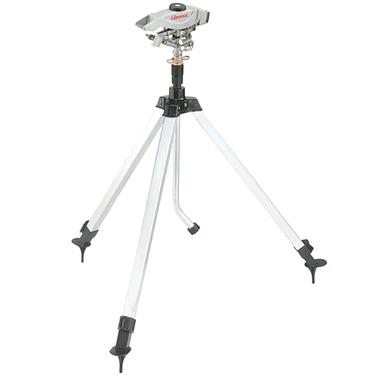
| Gilmour Pro Telescoping Tripod Sprinkler | Buy | Buy it for big open lawns. Up to 8,500 sq ft and 53 ft of throw, up to 58 inches tall, per the listing. | $78.19 |
| Melnor Pulsating Sprinkler, 2-pack | Buy | Buy it on a budget. Up to 85 ft diameter each on a metal spike, per the listing. | $18.12 |
| Orbit 2-Outlet Digital Hose Timer | Buy | Buy it to run two hoses from one spigot on a schedule, with rain delay. | $50.99 |
| Orbit B-hyve XD 4-Port Smart Hose Timer | Buy | Buy it if you want four outlets and phone control. Bluetooth, weather-adjusted, per the listing. | $79.01 |
| Melnor XT Oscillating Sprinkler | Skip | Skip it unless you're watering a long rectangle, like a side yard or new seed. Rated up to 4,500 sq ft. | $25.00 |
| Orbit Mechanical Hose Timer | Skip | Skip it unless you'll be home to start it. Shuts water off after 15 to 120 minutes. No schedule. | $9.99 |
Prices are Amazon prices checked November 27, 2026. They move. Check the listing.
Shop math: 15,000 sq ft on a hose
Start with the water. Then the sprinkler. Scenario numbers below. Yours will differ.
- How much water. 624 gallons puts 1 inch on 1,000 sq ft. That's Missouri Extension's number. 15,000 sq ft x 624 = 9,360 gallons per inch.
- How fast your spigot runs. Time a 5-gallon bucket at full open. 40 seconds means 7.5 gallons a minute.
- How long. 9,360 / 7.5 = 1,248 minutes. About 21 hours for one inch.
- How many spots. One Gilmour tripod is rated up to 8,500 sq ft. 15,000 / 8,500 = 1.8. Circles leave corners dry, and Missouri Extension says to overlap rotary sprinklers in a triangle pattern. Plan on three or four spots.
Two sprinklers on one spigot don't double the water. They split it. The timer's job is to run them back to back while you're asleep or at work.
How much per week? Missouri Extension says lawns may need 1 to 1.5 inches a week in summer, from rain plus watering. Subtract the rain gauge.
Pick the sprinkler type
Impact or rotary for big lawns. Missouri Extension rates each hose-end type:
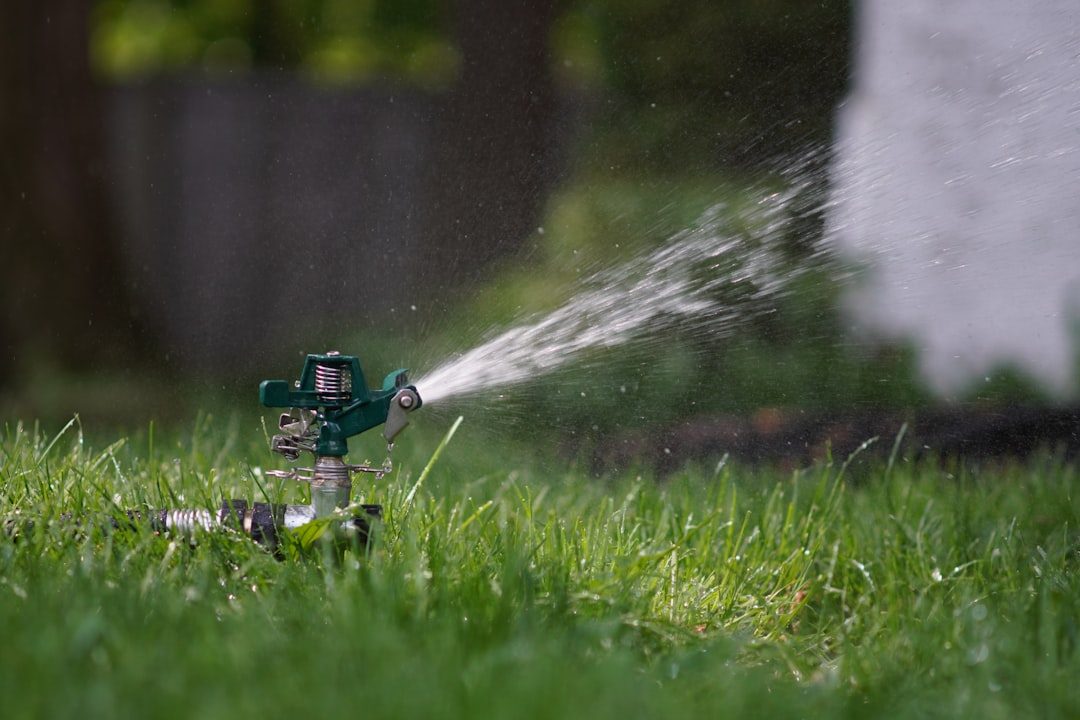
- Rotary or pulse (impact): best for large areas. Even water when placed in an overlapping triangle.
- Oscillating: rectangle pattern. Puts most of the water near the head. Hard to get even on large areas that need moving.
- Traveling: needs level ground and overlap. Wheel-drive models don't suit new seed.
- Whirling head: heaviest water closest to the head. Overlap by half.
Height matters too. A tripod throws over shrubs and tall grass. A spike sits low and gets blocked.
Best overall: Gilmour Pro Telescoping Tripod
Buy two. Each one is rated up to 8,500 sq ft with 53 ft of throw, per the listing. The tripod extends up to 58 inches. Metal head, spiked feet.
The collar sets part circle or full circle. Use part circle along the house and the driveway. The diffuser pin turns the jet into a softer spray for beds and new seed.
Rated distance assumes good pressure. Weak spigot? Expect less throw. Check with catch cups before you set run times.
Budget pick: Melnor pulsating 2-pack
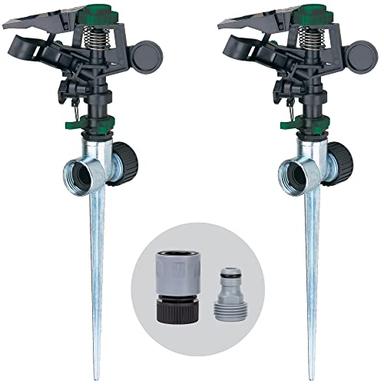
Cheap. Two pulsating heads on metal spikes, up to 85 ft diameter each, per the listing. Units connect to each other, so one hose can feed both.
Spikes sit low. Fine on an open lawn. Skip them where shrubs or a slope block the throw. That's what the tripod is for.
Recommended Products
- 1Check price
 Top pick
Melnor 65176AMZ Pulsating Sprinkler Set, 2 Pack, Waters Up to 85 Ft. Diameter, Metal Spike Base, Quick Connect Bundle, Black, Green
Two pulsating impact sprinklers on metal spikes, up to 85 ft diameter each, with unit-to-unit connections, per the listing.
As an Amazon Associate we earn from qualifying purchases.
The timer does the work
21 hours of watering doesn't happen by hand. Missouri Extension says any hose-end sprinkler can go on an inexpensive timer, and automatic controllers can run several short cycles.
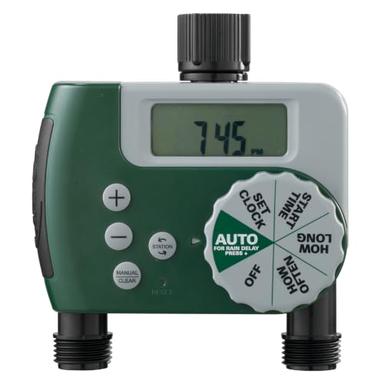
The Orbit two-outlet timer is the one I'd buy. Battery powered, LCD screen, rain delay. Two hoses, two sprinkler spots, one spigot. Give each outlet its own start time so they run one after the other and each gets the full flow. Check the manual for your model's per-outlet settings.
Want four spots without moving a hose, and phone control? The B-hyve XD 4-port has four outlets and weather-adjusted schedules over Bluetooth. The B-hyve single-outlet with Wi-Fi hub adds remote control from anywhere, but one outlet won't run a big lawn.
Recommended Products
- 1Check price
 Top pick
Orbit Programmable Digital Hose Watering Timer, 2 Outlet - 58910 | Battery Powered with LCD Screen, Built-in Rain Delay, Water-Resistant Design for Reliable Garden Watering
Two-outlet programmable hose timer with LCD screen and rain delay. Runs two hoses from one spigot on a schedule.
As an Amazon Associate we earn from qualifying purchases.
Dial in run times with catch cups
Catch cups. Tuna cans spread across the area to measure what the sprinkler actually puts down.
- Set straight-sided cans in a grid around one sprinkler spot.
- Run it for a set time. Measure the average depth.
- Work out inches per hour. Missouri Extension's example sprinkler put down 0.33 inch per hour. That's about three hours per spot for an inch.
- Split long runs. Missouri Extension says most soils there absorb only about half an inch per hour. Past that, water runs off.
Start times: 6 to 8 a.m. is best, per Missouri Extension. Avoid midday and wind. Long schedules start earlier and spread across two or three mornings.
Run times by grass and season are in how long to water your lawn in summer. Set it. Leave it.
When hoses are too much
Some summers the math loses. Two options.
- Let it go dormant. Missouri Extension says dormant lawns should get at least 1 inch every two or three weeks in summer to prevent complete loss. Far less hose time.
- Water the part you see. Front lawn on the timer. Back lawn on rain.
Already tired of moving hoses? The real price of an in-ground system is in our sprinkler system cost breakdown. Most people with 15,000 sq ft and no system do fine with two tripods and a timer.