How to Calculate the Right Amount of Fertilizer for Your Lawn
 Sarah MitchellLawn Diagnostics Specialist | 12 Years
As an Amazon Associate we earn from qualifying purchases.
To calculate fertilizer, divide your desired pounds of nitrogen per 1,000 sq ft by the percentage of nitrogen on the bag (as a decimal). For example, to apply 1 lb of nitrogen per 1,000 sq ft using a 24-0-11 fertilizer, divide 1 by 0.24 to get 4.17 lbs of product per 1,000 sq ft. Then multiply by your lawn's total area in thousands. Use our Fertilizer Calculator to do the math instantly.
Loading Fertilizer Calculator...
Why Getting Fertilizer Amounts Right Matters
I've spent 12 years diagnosing lawn problems, and one of the most common issues I see has nothing to do with weeds, diseases, or insects. It's fertilizer misapplication. Homeowners either put down too much (causing burn, excessive growth, and runoff) or too little (leaving the lawn nutrient-starved and vulnerable to weeds).
The math behind fertilizer application isn't complicated once you understand it, but it does trip people up. Let's walk through the calculation step by step so you can get it right every time.
Understanding Fertilizer Numbers (NPK)
Every bag of fertilizer has three numbers on the front, like 24-0-11 or 10-10-10. These represent the percentage by weight of three nutrients:
- N (Nitrogen): Drives leaf and blade growth. This is the number you'll calculate around most often.
- P (Phosphorus): Supports root development. Important for new lawns and overseeding.
- K (Potassium): Strengthens cell walls and improves stress tolerance (heat, cold, drought, disease).
So a 50-lb bag of 24-0-11 fertilizer contains 12 lbs of nitrogen (50 x 0.24), 0 lbs of phosphorus, and 5.5 lbs of potassium (50 x 0.11). The remaining weight is filler material that helps distribute the nutrients evenly.
For a complete breakdown of what those numbers mean and when to use different ratios, check out our guide on how to read fertilizer numbers.
The Fertilizer Calculator Formula: Pounds of Nitrogen Per 1,000 Square Feet
The lawn care industry standardizes fertilizer rates as "pounds of nitrogen per 1,000 square feet." This is the number you need to calculate. Most established lawns need between 0.5 and 1.0 lb of nitrogen per 1,000 sq ft per application, depending on grass type and time of year.
Step 1: Determine Your Target Nitrogen Rate
Your grass type determines how much nitrogen it needs annually and per application:
- Kentucky Bluegrass: 3 to 4 lbs N per 1,000 sq ft per year (0.75 to 1.0 lb per application, 4 applications)
- Tall Fescue: 2 to 3 lbs N per 1,000 sq ft per year (0.5 to 0.75 lb per application)
- Bermuda Grass: 3 to 5 lbs N per 1,000 sq ft per year (0.75 to 1.0 lb per application)
- Zoysia Grass: 2 to 3 lbs N per 1,000 sq ft per year (0.5 to 0.75 lb per application)
- St. Augustine: 2 to 4 lbs N per 1,000 sq ft per year (0.5 to 1.0 lb per application)
- Centipede Grass: 1 to 2 lbs N per 1,000 sq ft per year (0.5 lb per application max)
For this walkthrough, let's say you have a Kentucky bluegrass lawn and want to apply 1 lb of nitrogen per 1,000 sq ft.
Step 2: Calculate Product Needed Per 1,000 Square Feet
This is where the math comes in. The formula is:
Product needed (lbs per 1,000 sq ft) = Desired N rate / N percentage as decimal
Using a 24-0-11 fertilizer to apply 1 lb of N per 1,000 sq ft:
1.0 / 0.24 = 4.17 lbs of product per 1,000 sq ft
Let's try another example with 10-10-10 fertilizer:
1.0 / 0.10 = 10.0 lbs of product per 1,000 sq ft
See how a lower-analysis fertilizer requires you to put down a lot more product? This is why many lawn care professionals prefer higher-analysis fertilizers. Less product means fewer passes with the spreader and more even distribution.
Step 3: Scale to Your Lawn Size
Once you know how much product you need per 1,000 sq ft, multiply by your lawn's area in thousands of square feet.
For a 7,500 sq ft lawn using our 24-0-11 example:
4.17 lbs x 7.5 = 31.3 lbs of product total
For the same lawn using 10-10-10:
10.0 lbs x 7.5 = 75.0 lbs of product total
If you don't know your exact lawn size, use a measuring wheel, pace it off (one average stride is about 2.5 to 3 feet), or use a satellite measurement tool. Getting the area right is just as important as getting the rate right.
Worked Example: 16-4-8 Lawn Fertilizer on a 7,500 Sq Ft Lawn
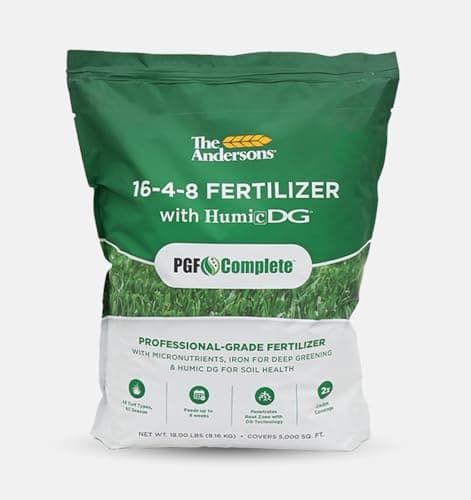
Say you picked up a 50 lb bag of 16-4-8 lawn fertilizer and you want the standard 1 lb of nitrogen per 1,000 square feet. Run the formula: 1 divided by 0.16 equals 6.25 lbs of product per 1,000 square feet. For a 7,500 square foot lawn, that is 6.25 times 7.5, or about 47 lbs. In other words, one 50 lb bag of 16-4-8 covers roughly 8,000 square feet at a full-rate feeding. That same logic tells you how many square feet any bag covers: divide your target nitrogen rate by the first number on the bag (as a decimal), then divide the bag weight by that result and multiply by 1,000.
Spreader Settings and Calibration
Knowing how much product to apply is only half the battle. You need your spreader to actually deliver that amount evenly across your lawn.
Broadcast Spreaders
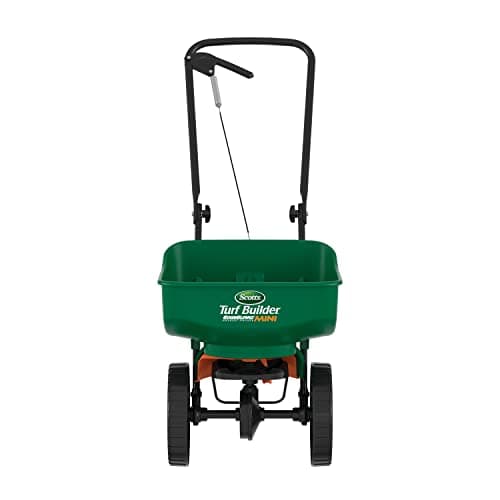
Most homeowner broadcast spreaders (like the Scotts Elite or Earthway 2150) have settings printed on the bag of fertilizer you're using. Start there, but understand that those settings are approximate. Factors like walking speed, hopper fullness, and product granule size all affect the actual delivery rate.
How to Calibrate Your Spreader
Here's a simple calibration method that takes about 10 minutes:
- Measure out a 1,000 sq ft test area on your driveway or a flat section of lawn (for example, 50 ft x 20 ft)
- Weigh out the exact amount of product you calculated for 1,000 sq ft (4.17 lbs in our example)
- Load that exact amount into your spreader
- Apply it over your measured area at a consistent walking pace using a back-and-forth pattern
- If you run out of product before covering the area, close the setting down one notch. If you have product left over, open it up one notch.
- Repeat until you use the right amount over the right area
Once you find the right setting, write it down and tape it to your spreader for future reference. Different products may require different settings, so recalibrate when switching fertilizers.
The Half-Rate Double-Pass Method
For the most even coverage, set your spreader to deliver half the recommended rate and make two passes over your lawn in perpendicular directions. This means if your target is 4.17 lbs per 1,000 sq ft, set the spreader for about 2.1 lbs per 1,000 sq ft and go over the lawn twice, once north-to-south and once east-to-west. This dramatically reduces the risk of streaking and ensures no spots are missed.
Common Fertilizer Calculation Mistakes
Here are the errors I see most often when homeowners try to calculate fertilizer on their own:
Mistake 1: Confusing Product Weight with Nutrient Weight
When someone says "apply 1 pound of nitrogen," they don't mean 1 pound of fertilizer. A 50-lb bag of 24-0-11 contains only 12 lbs of actual nitrogen. This is the most common and most costly mistake.
Mistake 2: Not Accounting for Lawn Size Accurately
Your "lawn size" is not your lot size. Subtract the house footprint, driveway, sidewalks, garden beds, and any other non-turf areas. Overestimating your lawn size means you'll buy too much product. Underestimating means you'll run out and end up with uneven coverage.
Mistake 3: Applying Too Much at Once
Never apply more than 1 lb of nitrogen per 1,000 sq ft in a single application with synthetic fertilizer. Going above this rate risks burning your lawn and contributes to nutrient runoff into waterways. If your grass type needs 4 lbs of N per year, split that into 4 to 5 separate applications.
Mistake 4: Ignoring Slow-Release vs. Quick-Release
Slow-release (also called controlled-release or water-insoluble) nitrogen feeds your lawn gradually over 6 to 8 weeks. Quick-release nitrogen gives an immediate green-up but can burn if over-applied. Most quality lawn fertilizers are a blend of both. Check the bag for the percentage of slow-release nitrogen, and aim for products with at least 30 to 50% slow-release.
Putting It Into Practice
Let's run through one complete real-world example. Say you have a Bermuda grass lawn that's 6,000 sq ft, and you want to apply the spring wake-up fertilization at 1 lb of N per 1,000 sq ft using a 32-0-10 fertilizer.
- Product per 1,000 sq ft: 1.0 / 0.32 = 3.125 lbs
- Total product needed: 3.125 x 6 = 18.75 lbs
- Potassium you're also applying: 18.75 x 0.10 = 1.875 lbs total, or 0.3125 lbs per 1,000 sq ft
That's it. Three simple calculations and you know exactly what to put down.
For specific product recommendations based on your grass type, our post on best fertilizer for Bermuda grass covers the top-rated options. And if you want to understand when balanced formulas like 10-10-10 make sense, check out our guide on 10-10-10 fertilizer: when and how to apply.
Skip the Math Entirely
If all of this feels like more arithmetic than you signed up for, I completely understand. That's why we built the Fertilizer Calculator. Enter your grass type, lawn size, and the NPK numbers from your fertilizer bag, and it gives you the exact amount of product to apply. No formulas, no decimal conversions, no guesswork. It even adjusts for slow-release percentages and gives you spreader setting recommendations for popular models.
Getting your fertilizer rates right is one of the most impactful things you can do for your lawn. Too little and your grass can't compete with weeds. Too much and you're wasting money while risking burn and environmental damage. The sweet spot is in the math, and now you know how to find it.
Free Lawn Care Tools
Divide your desired nitrogen rate (in lbs per 1,000 sq ft) by the first number on the fertilizer bag expressed as a decimal. For example, to apply 1 lb of nitrogen using a 24-0-11 fertilizer: 1 divided by 0.24 equals 4.17 lbs of product per 1,000 sq ft. Multiply that by your lawn size in thousands of square feet for the total amount needed.
Most established lawns need 0.5 to 1.0 lb of nitrogen per 1,000 sq ft per application. The exact rate depends on your grass type. Kentucky bluegrass and Bermuda can handle 0.75 to 1.0 lb per application, while low-input grasses like centipede should not exceed 0.5 lb per application. Never exceed 1 lb of synthetic nitrogen per 1,000 sq ft in a single application.
Over-fertilizing can burn your grass, causing yellow or brown patches that may take weeks to recover. Excess nitrogen also promotes excessive top growth at the expense of root development, making your lawn more vulnerable to drought and disease. Additionally, unused nutrients can wash into storm drains and waterways, contributing to algae blooms and water pollution.
Start with the setting recommended on the fertilizer bag for your spreader model. For more precise application, calibrate your spreader by measuring a 1,000 sq ft area, weighing out the exact amount of product needed, and adjusting the setting until you use the right amount over that area. For the most even coverage, use the half-rate double-pass method: set the spreader to deliver half the rate and make two perpendicular passes.
The formula is: pounds of product per 1,000 sq ft = desired lbs of nitrogen divided by (the first bag number as a decimal). For example, to apply 1 lb of nitrogen with a 24-0-6 fertilizer, divide 1 by 0.24 to get about 4.2 lbs of product per 1,000 square feet. Multiply that by your lawn size in thousands of square feet and you have your total.
It depends on the nitrogen percentage and your target rate. At the standard 1 lb of nitrogen per 1,000 sq ft, a 50 lb bag of 16-4-8 covers about 8,000 square feet, a 50 lb bag of 24-0-6 covers about 12,000, and a 50 lb bag of 32-0-4 covers about 16,000. Check the bag's stated coverage too, since some products are formulated for lighter rates.

Your lawn plan, in your pocket all season
Grass ID, a season plan, soil-timed reminders, and a lawn journal that remembers what you did. Free on iPhone.
Related Articles
 Fertilizing
How to Apply Liquid Lawn Fertilizer With a Hose-End Sprayer (Rates and Timing)
Jun 27, 2026•2 min read Fertilizing
Andersons PGF Complete 16-4-8 Application Guide: Rate, Schedule + Results
Jul 8, 2026•11 min read Fertilizing
Best Fertilizer for Kentucky Bluegrass in Ohio (2026)
Jul 18, 2026•9 min read