
Fertilizer fundamentals
Three numbers run lawn fertilizing. The N, P, and K on every bag (nitrogen, phosphorus, potassium) tell you what the grass actually gets. Nitrogen drives leaf growth and color. Phosphorus matters mostly at seeding time and during root establishment. Potassium does the unglamorous work of stress tolerance, disease resistance, and winter hardiness. A bag labeled 24-0-6 is 24% nitrogen, 0% phosphorus, 6% potassium by weight, and the remaining mass is filler and secondary nutrients (see UGA Extension's fertilizer label breakdown for the full anatomy of a bag).
The cardinal rule is: pounds of nitrogen per 1,000 square feet, applied at the right time of year for your grass. Too little and the lawn thins. Too much and you get surge growth, disease pressure, and burn. Most healthy lawns need about 2 to 4 pounds of total nitrogen per 1,000 sqft per year for cool-season grass, and 1 to 4 pounds for warm-season, split across several applications. Those ranges come straight from NC State's Carolina Lawns guide and align with what Penn State Extension's turf fertilization guide recommends for the northeast.
Not every lawn needs phosphorus. If your soil test shows adequate P, skip it. Many states (Florida is the strictest example) restrict or ban P on established turf except where a soil test proves a deficiency or you are establishing new grass.
Recommended Products
- 1Check price
 Top pick
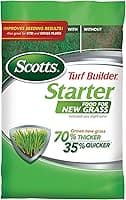
Scotts Turf Builder Starter Food for New Grass
Starter lawn food with phosphorus for seeding or new sod, the one situation where higher P actually matters.
As an Amazon Associate we earn from qualifying purchases.
Reading a fertilizer bag (and the math behind it)
The most useful skill in lawn care is the back-of-bag math. Take 16-4-8: that's 16% nitrogen by weight. A 50-pound bag of 16-4-8 contains 8 pounds of actual nitrogen (50 x 0.16). To deliver the standard 1 pound of N per 1,000 sqft, you need 6.25 pounds of product per 1,000 sqft (1 / 0.16). UGA puts the same example in their turfgrass fertility publication, and it's the calculation our fertilizer calculator runs for you automatically.
Common ratios you'll see and what they're for:
- 16-4-8 or 12-4-8: the workhorse 4-1-2 ratio for routine feedings on most lawns.
- 24-0-6, 28-0-3, 32-0-4: high-nitrogen maintenance blends, often slow-release, no phosphorus (legal in P-restricted states).
- 10-10-10 or 13-13-13: balanced ag-store blends. Fine for gardens, usually wrong for established lawns because the P is wasted and the N percentage is low (you have to spread a lot of product to hit your N rate).
- 15-0-15 or 0-0-7: high-potassium blends used in fall for winter hardiness or on coastal lawns dealing with salt stress. Common pick for centipede in the southeast.
- 18-24-12 starter: phosphorus-heavy starter fertilizer for new seed or sod where roots haven't established yet.
- 20-0-10 or similar: mid-N maintenance, P-free, K for stress tolerance. Popular on Bermuda.
If two products both deliver 1 lb N / 1,000 sqft, the higher-analysis bag (say 32-0-4) covers more square feet per pound and usually costs less per pound of N applied, but it's also easier to burn with. The lower-analysis bag (10-10-10) is more forgiving but wastes phosphorus and potassium most established lawns don't need.
Soil testing: the step almost everyone skips
A $12 to $25 soil test from your state extension lab is the highest-leverage thing you can do for a lawn. It tells you actual pH (most fertilizer becomes unavailable below 5.5 or above 7.5), phosphorus and potassium levels, and a custom fertilizer recommendation for the grass you grow. Texas A&M's Soil, Water and Forage Testing Lab, AgriLife Extension's how-to, and most other state extension labs offer the same service for around the same price. EPA's nutrient pollution guidance also recommends testing before fertilizing as a runoff-reduction step.
Pull a composite sample: 6 to 10 plugs about 4 inches deep from across the lawn, mixed in a clean bucket, then about a cup sent in. Test every 2 to 3 years (every year if you're correcting pH). The results dictate whether you actually need P and K, how much lime or sulfur to apply, and whether your "the lawn looks bad" problem is a fertility problem at all (often it's compaction or thatch instead).
Timing by grass type
Cool-season grasses (Kentucky Bluegrass, Tall Fescue, Fine Fescue, Perennial Ryegrass) take their heaviest feedings in fall, when roots are growing aggressively and the plant is storing energy for winter. A typical schedule: light feeding in early spring (April), optional light summer maintenance, then the two big feedings around Labor Day and again in late October ahead of dormancy. Penn State's seasonal lawn management calendar walks through the month-by-month timing for the northeast.
Warm-season grasses (Bermuda, Zoysia, St. Augustine, Centipede, Bahia, Buffalograss) feed during their active summer growth window. Don't fertilize warm-season grass before it's fully greened up in spring; you'll wake the wrong things first (weeds and roots before shoots). UGA's rule of thumb: hold the first nitrogen application until soil temperature at 4 inches is consistently 65°F. For most of the south, that's late April or early May. Texas A&M's Bermudagrass Home Lawn Calendar spells out the warm-season cadence for the gulf states.
Centipede is the exception that proves the rule: it wants very little nitrogen (1 to 2 pounds per 1,000 sqft per year, total) and gets sick from over-fertilization. A 15-0-15 in early summer is often all it needs. Centipede decline is almost always a too-much-nitrogen story.
Nitrogen sources compared
The N on a bag isn't all the same. The form of nitrogen affects how fast it greens, how long it lasts, how easily it burns, and how much leaches into groundwater. Purdue Turfgrass Science recommends mixing fast and slow sources, weighted slow-release in spring and summer, fast-release in fall.
- Urea (46-0-0): cheapest N per pound, water-soluble, greens up in days. Volatilizes (gases off) within hours if not watered in. The default in commercial blends.
- Ammonium sulfate (21-0-0): fast, acidifies soil (good for high-pH lawns), high burn risk. Common on southern lawns where alkaline soil is the bigger problem.
- Sulfur-coated urea (SCU) and polymer-coated urea (PCU): slow-release, feed for 6 to 12 weeks, low burn risk. The backbone of most premium homeowner blends.
- Methylene urea / urea formaldehyde: long-lasting slow-release, breaks down via soil microbes. Temperature-dependent, so it slows in cool weather.
- Milorganite and feather meal: organic slow-release. Lower N (5 to 13%), low burn risk, also adds iron and trace nutrients. Good for centipede, St. Augustine, and lawns near water bodies.
Practical rule: in spring and summer, use products with at least 30 to 50% slow-release N (it'll say on the bag, often as "WIN" or "water-insoluble nitrogen"). In late fall, a faster source greens the lawn before dormancy without driving excess shoot growth.
Granular vs liquid, slow vs fast
Granular fertilizer is what most homeowners reach for: spread it with a broadcast spreader, water it in, walk away. Slow-release granules feed the lawn for 6 to 8 weeks. Quick-release is cheaper and acts in days but burns more easily and leaches faster.
Liquid fertilizer (or fertigation through a sprinkler) is faster but harder to dose evenly. Most professional crews use granular slow-release as the backbone and only liquid-spike when they want a quick green-up before an event.
Whatever the form, water in lightly (about a quarter inch) within 24 hours unless the bag says otherwise. Dry granules sitting on hot turf are how you get fertilizer burn streaks. Don't apply if heavy rain is in the forecast inside that 24-hour window either; runoff is the worst-case outcome and the reason behind Florida's Urban Turf Fertilizer Rule and similar regulations elsewhere.
Going all-liquid: when it makes sense
If you would rather spray than spread, a liquid-only program is very doable, and it shines in summer when a heavy granular nitrogen load risks burning the lawn. Liquids green up in days, apply evenly through a hose-end sprayer, and let you feed little and often instead of in big hits.
The tradeoff is longevity: a liquid feed runs about 2 to 4 weeks against 6 to 8 for slow-release granular, so you spray more often. The trick is matching the formula to the job: a balanced 16-4-8 to maintain, a high-nitrogen 28-0-0 to push color, a phosphorus-free 15-0-15 for summer hardiness, iron for color without growth, and a 3-18-18 starter for new seed.
We ranked the leading options by need in the best liquid lawn fertilizer guide, with a side-by-side comparison and how to apply each one.
Common fertilizing mistakes
The patterns we see over and over:
- Fertilizing dormant grass. Warm-season lawns getting a March feeding before greenup just feed the winter weeds. Cool-season lawns getting heavy summer N during heat dormancy invite disease.
- Skipping the soil test. Adding P or K the lawn doesn't need wastes money and pollutes runoff. Add only what the lab says is missing.
- Spreader streaks. Dialed wrong, drop spreaders show every pass as a green stripe within a week. Calibrate against the bag's settings chart and apply half the rate in two perpendicular passes for evenness.
- Watering in too much or too little. A quarter inch is the target. Heavy watering after granular leaches nitrogen past the roots; no watering leaves urea to volatilize.
- Weed-and-feed timing. The fertilizer side wants warm, actively growing turf; the herbicide side wants the right weed stage. They rarely line up perfectly. Spot-spraying weeds and fertilizing separately almost always beats a combo bag.
- Fall fertilizer on warm-season grass. Late N on Bermuda or Zoysia delays dormancy, weakens cold tolerance, and invites spring dead spot. Stop feeding warm-season grass at least 6 weeks before your average first frost.
The USGA Green Section has a useful nutrient-loss checklist that overlaps heavily with this list, written for golf courses but applicable to home lawns.