8 Types of Grass in Nevada and How to Tell Which You Have

As an Amazon Associate we earn from qualifying purchases.
Nevada grows both kinds of lawn grass, just not in the same place. In the Las Vegas Valley, University of Nevada, Reno Extension calls the mid-elevation Mojave a turfgrass "transition zone" where warm-season bermudagrass, zoysiagrass, buffalograss and St. Augustinegrass all persist, and where turf-type tall fescue "has proven to be the most popular lawngrass." Around Reno, Carson City and Lake Tahoe it is cool-season country: Kentucky bluegrass, tall fescue, perennial ryegrass and the fine fescues.
The state-only part is water law. Southern Nevada lawns run on a mandatory schedule that swings from three assigned days a week in spring and fall to one day a week in winter, with Sunday sprinkling always banned, while Truckee Meadows Water Authority customers in Reno and Sparks get three sprinkler days set by whether their house number is odd or even. A December 2021 SNWA board resolution also prohibits installing irrigated grass in new commercial and residential developments, and SNWA says that prohibition reaches the front and backyards of new residential developments, with local jurisdictions adopting the code changes that implement it.
Nevada runs at least two lawn climates and two watering rulebooks, and they barely speak to one another. University of Nevada, Reno Extension writes its turf guidance that way too, splitting it between the Mojave Desert and the Lake Tahoe Basin with general northern Nevada advice in between. The grass that thrives in a Henderson backyard will sulk at Incline Village, and the reverse. On top of that, the rules differ: the Southern Nevada Water Authority tells Las Vegas Valley customers which days of the week their sprinklers may run and bans them outright on Sunday, while the Truckee Meadows Water Authority assigns Reno and Sparks three days by house-number parity and asks for Mondays off. So the honest answer to "what grass grows in Nevada" is a list of eight, plus a map of where each one belongs and what the local water rules will let you do with it.
The types of grass that grow in Nevada
Bermudagrass
Bermudagrass is the backbone warm-season lawn of southern Nevada, and it comes with a Nevada footnote most states do not have. University of Nevada, Reno Extension says bermudagrass "can be found as either the common or hybrid form producing both rhizomes and stolons," and then adds the local catch: because of its heavy pollen, "In Clark County, Nev., ordinances prohibit the planting of common bermudagrass for this reason." UNR repeats it in its establishment guide, saying common bermudagrass "cannot be planted in Clark County, Nev., due to allergies from its pollen production." UNR describes the hybrid forms as "finer textured, more restrained in its growth" and greener later into fall, and says "Hybrid bermuda produces less pollen and is more suitable where allergies are a concern," though hybrids must go in vegetatively because they "produce few living seeds." Bermuda is also the grass Nevada overseeds: UNR says that if you want winter color, "bermudagrasses are the best choice as a warm season grass since they can be overseeded more successfully than most other warm season grasses." Two things to plan around. UNR warns that "Very few bermudagrasses tolerate shade from trees," and that common bermudagrass "is an aggressive grass which can be invasive in flower beds and gardens and difficult to contain," adding that "Frequent mowing and trimming helps keep it restrained."
Tall Fescue
Tall fescue is the surprise of southern Nevada. It is a cool-season grass, and yet UNR Extension says turf-type tall fescue "has proven to be the most popular lawngrass in the transition zone of the Mojave Desert, even though it is among the highest in water use." UNR credits three things for that: "its tolerance to high summer temperatures, relatively low maintenance and persistence of its green color through the winter months." In other words, it stays green in January when the bermuda next door is straw-colored, which is exactly what a lot of Las Vegas homeowners want. UNR explains the heat trick as biology, saying tall fescue "can better withstand high temperatures due to its basic biology and extensive root system compared with other cool-season grasses," and its establishment guide calls it the cool-season grass that "tolerates our desert summer heat the best." It works up north too. UNR planted three dwarf turf-type tall fescues in its Lake Tahoe Basin demonstration plots and noted that "Because of their late green-up in the spring and early dormancy in the fall, gardeners may have a tendency to overwater these grasses." Tall fescue is a bunchgrass, and UNR says that because bunchgrasses "do not form rhizomes or stolons, they cannot mend sizable damaged areas and must be repaired by seeding or sodding." That is also why UNR notes plastic netting "is sometimes used in producing tall fescue sod."
Kentucky Bluegrass
Kentucky bluegrass is a northern Nevada grass that southern Nevada should mostly leave alone. In UNR Extension's Lake Tahoe Basin turf trials it anchors the traditional lawn mixes, with Turf Mix 1 built from "80 percent 'Baron' Kentucky bluegrass (Poa pratensis 'Baron') and 20 percent perennial ryegrass," and UNR notes it "is one of the most commonly used turf grasses, but requires frequent irrigation." Head south and the verdict flips. UNR's Mojave guidance is blunt: "Most Kentucky bluegrass varieties suffer from high temperature stress during the hot summer months in the middle and lower elevations of the Mojave Desert. It should probably be avoided unless grown in a mixture with other turfgrasses, and the variety has been documented for tolerance to high temperatures." What bluegrass brings anywhere it does work is self-repair. UNR describes it as a sod-forming grass that produces rhizomes, which is why it gets blended into tall fescue sod: UNR says "the bluegrass has been used for its sod-forming characteristics" to knit the bunchgrass together. If you are in Reno, Elko or the Tahoe Basin and your lawn quietly fills in its own worn patches, bluegrass can be one reason, though other spreading grasses in a blend can do the same.
Perennial Ryegrass
Perennial ryegrass has two completely separate jobs in Nevada. In the south it is the overseed. When a bermuda lawn goes dormant, UNR Extension says "Perennial ryegrass is preferred to annual ryegrass for overseeding because of its superior color, texture and mowing qualities. However the seed is more expensive." UNR also flags that the arrangement resets every year: "Even though some perennial ryegrasses persist through the heat of the summer, the bermudagrass must be overseeded each fall if a solid stand of perennial ryegrass is desired." A few heat-tolerant cultivars, UNR names Palmer and Prelude, have shown promise as year-round lawns in the middle elevations of the Mojave. In the north, ryegrass is the fast starter in a seed mix. UNR's Tahoe publication describes it as "a short-lived perennial grass that establishes quickly, but is shade intolerant," and gives it a hard limit worth knowing at elevation: "It does need a minimum of 100 frost-free days for survival. It tolerates temperatures down to minus 18 degrees F." Like tall fescue it is a bunchgrass, and UNR groups both with the grasses that "do not form rhizomes and stolons."
Fine Fescue
The fine fescues are northern Nevada specialists, and UNR Extension's Tahoe Basin work sorts them into two useful groups. Creeping red fescue is the one that behaves like turf: UNR says it "quickly forms a turf with its strong spreading rhizomes," has "a fine leaf texture," and "can be long-lived at high elevations and tolerates shade well." It went into two of the four demonstration lawn mixes, and one plot was creeping red fescue on its own. Hard fescue and sheep fescue are the low-input group. UNR notes that "Hard fescue and sheep fescue grow in clumps. The spreading growth pattern of red fescue helps fill in bare areas between clumps," and puts all three into an erosion-control mix that, once established late in its second summer, needs "only once-per-week watering and little fertilizer to keep them green throughout the growing season." That is the pitch for a Tahoe Basin property. UNR notes those erosion-control plots are cut down once late in the summer when the stalks dry out, and that the dead stems "should be removed for fire safety," which is a maintenance step a conventional lawn does not ask for.
Zoysiagrass
Zoysiagrass is the patient option for a southern Nevada lawn that takes a beating. UNR Extension says zoysias "are tough and wear resistant grasses after establishment. They tolerate our desert soils, survive in moderate shade and are very resistant to foot traffic," which makes it the rare warm-season grass that handles both a play area and some tree cover. The price is time. UNR notes mowing is infrequent "every 10-14 days," but that the same slow growth means lawns started from sprigs or stolons "may take two to three seasons to fill in completely," so "it is best to establish it from sod." That slowness also closes off the winter overseed that bermudagrass allows: UNR says the slow growth "prevents it from being overseeded in the fall due to poor spring recovery," so a zoysia lawn is simply brown in a Las Vegas winter. UNR points to faster newer selections, saying "Newer selections of zoysia, such as El Toro, establish more quickly and are more desirable as a lawn grass." UNR also notes that "Once damaged, zoysias are slow to recover," so it rewards a yard that is used steadily rather than torn up.
Buffalograss
Buffalograss is the low-water native, and in a state where the water agency pays people to remove lawn, that matters. UNR Extension lists it among the warm-season grasses that grow in the mid-elevation Mojave transition zone and says these grasses "are drought tolerant, low in water use and require little additional fertilizer and are sod forming," adding that the newer introductions "rival some of the better hybrid bermudagrasses in appearance." Up north, UNR's northern Nevada lawn alternatives guide names blue grama, a close prairie relative, among the ornamental grasses that suit the Reno area. The trade-offs are real and UNR states them plainly. Buffalograss is "not as wear-tolerant as bermuda and, like bermuda, do not persist in the shade." It also does not enjoy being pampered: "Unlike zoysia and bermudagrass, buffalograss is not a strong competitor when fertilized and irrigated. It tends to get weedy under these conditions and will not tolerate overseeding for winter color." And UNR adds an allergy note that echoes the Clark County pollen rule: "Seeded buffalograss, like common bermudagrass, is NOT recommended if allergies are a problem."
St. Augustinegrass
St. Augustinegrass is southern Nevada's shade answer, and UNR Extension frames it as a fix for landscapes that have grown up around their trees. UNR says it "is a very coarse-textured grass that probably has the best shade tolerance of the warm-season grasses. It has been used to replace bermudagrass in shady locations of maturing desert landscapes and tolerates our desert soils." That is a precise use case, not a general recommendation. UNR is equally clear about the limits: "It may have difficulty surviving low winter temperatures in some colder areas," which keeps it in the warm valleys and out of northern Nevada, and "Like zoysias, St. Augustine is also slow to fill in after planting from plugs, requiring a full season or more to cover. It should not be overseeded." So expect a full brown winter with no ryegrass cover crop. The texture is the giveaway, since UNR calls it very coarse where it calls hybrid bermuda and creeping red fescue fine.
Other Nevada grasses and lawn alternatives did not get their own photo. Seashore paspalum is the salt specialist: UNR Extension says it "was considered to be a specialty grass used primarily for its tolerance to very high salts," that by the 1990s it "had become a mainstream warm-season turfgrass," and that it "tolerates our desert soils, persists under low fertility and is drought-tolerant" while refusing shade. It matters in southern Nevada mostly on golf courses and reclaimed-water sites rather than front lawns. Streambank wheatgrass and the meadow-mix grasses are the Tahoe Basin's erosion-control set; UNR describes 'Sodar' streambank wheatgrass as an erosion control grass that "is low-growing and spreads readily through underground stems called rhizomes," and its meadow mix folds in Sandberg bluegrass, mountain brome, slender wheatgrass and tufted hairgrass. And blue grama shows up in UNR's northern Nevada lawn alternatives guide alongside blue fescue, Great Basin wild rye and blue oat grass as an ornamental grass for the Reno area, which is a different job from a mowed lawn but often the right one.
Nevada grass types compared at a glance
Read the water column against your own utility's rules, not against a national average. A grass that is "moderate" everywhere else is a different proposition when Sunday sprinkling is banned twelve months a year.
| Grass | Season | Best role | Sun / shade | Water need | Maintenance |
|---|---|---|---|---|---|
| Bermudagrass | Warm | Main warm-season lawn in southern Nevada | UNR: very few bermudagrasses tolerate shade from trees | Warm-season; UNR says these generally use less water than cool-season grasses | UNR: frequent mowing and trimming helps keep it restrained |
| Tall Fescue | Cool | Most popular lawn grass in the Mojave transition zone | UNR: tolerates moderate shade | UNR: among the highest in water use | UNR: relatively low maintenance |
| Kentucky Bluegrass | Cool | Northern Nevada workhorse; risky in the Las Vegas Valley | Full sun to part shade | UNR: requires frequent irrigation | UNR: suffers heat stress in the mid and lower Mojave |
| Perennial Ryegrass | Cool | Winter overseed in the south, quick-cover partner in the north | UNR: shade intolerant | Cool-season; UNR gives no separate Nevada water rating | Overseeding bermuda must be repeated each fall |
| Fine Fescue | Cool | Shade and low-input turf in northern Nevada and Tahoe | UNR: creeping red fescue tolerates shade well | UNR: established erosion mixes need once-per-week watering | UNR: little fertilizer; one late-summer cut for the erosion mixes |
| Zoysiagrass | Warm | High-traffic warm-season lawn in southern Nevada | UNR: survives in moderate shade | Warm-season; UNR says these generally use less water than cool-season grasses | UNR: mowing is infrequent, every 10 to 14 days |
| Buffalograss | Warm | Low-water native lawn where a green season can be short | UNR: does not persist in the shade | UNR: drought tolerant and low in water use | UNR: requires little additional fertilizer; will not tolerate overseeding |
| St. Augustinegrass | Warm | Shaded warm-season patches in southern Nevada | UNR: probably the best shade tolerance of the warm-season grasses | Warm-season; UNR gives no separate Nevada water rating | UNR: slow to fill in, cold sensitive, should not be overseeded |
How to tell which type you already have
Start with the calendar, because in Nevada it does most of the work. If the lawn is brown in January and green in July, it is a warm-season grass: bermudagrass, zoysiagrass, buffalograss or St. Augustinegrass. If it is green in January, it is a cool-season grass or a bermuda lawn that has been overseeded with ryegrass, and you can tell those apart by looking for wiry bermuda runners underneath the green. From there, leaf texture sorts things quickly, using UNR Extension's own descriptions: St. Augustinegrass is "very coarse-textured," the dwarf turf-type tall fescues are "semi-coarse," and creeping red fescue has "a fine leaf texture." Then check whether the grass spreads. UNR groups bermudagrass, Kentucky bluegrass, zoysiagrass, buffalograss and St. Augustinegrass as sod-forming grasses that run by stolons or rhizomes, and puts tall fescue and the ryegrasses in the bunchgrass column that forms neither.
| Grass | Blade | Growth habit | Standout tell |
|---|---|---|---|
| Bermudagrass | Short, fine, sharply pointed, gray-green | Spreads by both stolons and rhizomes | Wiry surface runners escaping into beds; brown from about November to March |
| Tall Fescue | UNR calls the dwarf turf types semi-coarse in leaf texture | Bunching; forms no rhizomes or stolons | Grows in clumps and holds its green color through the winter months |
| Kentucky Bluegrass | Fine and soft | Sod forming, spreads by rhizomes | Fills worn patches without reseeding |
| Perennial Ryegrass | Fine to medium | Bunching; forms no rhizomes or stolons | The green that appears on a dormant bermuda lawn after an October overseed |
| Fine Fescue | UNR: creeping red fescue has a fine leaf texture | Creeping red fescue spreads by rhizomes; hard and sheep fescue grow in clumps | Fine texture in shade, or distinct clumps with gaps between them |
| Zoysiagrass | Similar in appearance to bermudagrass, per UNR | Sod forming, but slow to fill in | Looks like bermuda yet needs mowing only every 10 to 14 days; brown all winter with no overseed |
| Buffalograss | Fine and soft | Sod forming, low and open | Thin, meadow-like stand that UNR says turns weedy when fertilized and irrigated hard |
| St. Augustinegrass | UNR calls it a very coarse-textured grass | Sod forming, spreads by above-ground runners | Much coarser in texture than the other Nevada lawn grasses; brown all winter |
Still not certain? Our free AI grass identifier reads a close-up photo, names the grass, and builds a 12-month care plan tuned to your ZIP.
Which types grow in your part of Nevada
Nevada does not have a single lawn climate, and UNR Extension does not write as if it does. Its turf publications split between the Mojave Desert and the Lake Tahoe Basin, with general lawn-care guidance for northern Nevada in between. Elevation is the variable underneath all of it, running from the Colorado River corridor up past 6,000 feet in the Great Basin and the Sierra, and in practice the local watering rules shape a Nevada lawn as much as the winter lows do.
- Las Vegas Valley (Las Vegas, Henderson, North Las Vegas, Boulder City): The turfgrass transition zone. UNR Extension says the mid-elevation Mojave at "2,000 - 3,000 feet" has "a climate that can grow either warm-or cool-season grasses," and that "All of the warm-season grasses grow in the transition zone." In practice that means hybrid bermudagrass, zoysia, buffalograss and St. Augustine on the warm side, and turf-type tall fescue as the most popular lawn grass of all. Common bermudagrass is off the table; UNR says Clark County ordinances prohibit planting it because of its pollen. This is also where Southern Nevada Water Authority rules bite hardest, and where the SNWA resolution against installing irrigated grass in new residential developments applies.
- Lower Mojave and the Colorado River corridor (Laughlin, Mesquite, Moapa Valley, Pahrump): Hotter and lower than the Las Vegas Valley, which narrows the list. UNR's warning that Kentucky bluegrass "suffer[s] from high temperature stress during the hot summer months in the middle and lower elevations of the Mojave Desert" applies with more force here. Warm-season grasses are the sensible default, with tall fescue as the cool-season option that UNR says handles desert summer heat best.
- Truckee Meadows (Reno, Sparks and the rest of the TMWA service area): Cool-season country. UNR Extension describes northern Nevada as "a high desert climate, so traditional lawns require a lot of water and maintenance." Kentucky bluegrass, tall fescue, perennial ryegrass and the fine fescues are the working set, usually in a blend. Sprinkler days for TMWA customers are assigned by house number rather than by a seasonal calendar. Carson City, the Carson Valley and Fallon share the same cool-season grass list but are served by different water utilities, so check your own provider's rules rather than assuming the TMWA schedule.
- Lake Tahoe Basin (Incline Village, Zephyr Cove, Stateline): The most rule-bound lawn in Nevada, for reasons that have nothing to do with drought. UNR says "erosion control Best Management Practices (BMPs) are required on all developed properties at Lake Tahoe," and its demonstration plots at Incline Village were planted to answer which grasses work inside those rules and inside wildfire defensible space. Bluegrass and ryegrass mixes, creeping red fescue and dwarf turf-type tall fescues all held up. UNR also asks for restraint with the fertilizer bag: "in the Lake Tahoe Basin, using the least amount of fertilizer possible is recommended," because what leaches out ends up in the lake.
- Great Basin interior (Elko, Winnemucca, Ely, Tonopah): Cool-season grasses again, in harder conditions. UNR's high-desert landscape guide for this region describes elevations "from 4,000 feet to 6,000 feet in USDA cold-hardiness zones 6 and 7," soils that are "often poor and gravelly, containing less than 1 percent organic matter," pH "from 6.5 to over 7.5," and "Precipitation is less than 10 inches per year." Searching UNR Extension's publications turned up turf guidance written for the Mojave Desert, for the Tahoe Basin and for northern Nevada generally, but nothing written specifically for Elko or Ely, so the northern Nevada lawn advice is the closest fit and the county Extension office is the better call for anything local.
Nevada grass timing that matters
Nevada timing splits by region, and so does the rulebook that governs it. The southern dates come from UNR Extension's Mojave Desert establishment guide; the northern ones come from its northern Nevada lawn-care publications and its Tahoe Basin trials.
- Seeding warm-season grasses (southern Nevada): UNR says to "Establish warm-season grasses from seed or sprigs from April through June," and that "Sod establishment from warm season grasses extends the season an additional month to the beginning of August." UNR's reason for the window is that warm-season grasses "need enough time after planting to become established before fall."
- Seeding cool-season grasses (southern Nevada): UNR's window is "February through March and mid-September through mid-October." Sod is more forgiving: cool-season grasses "can be established from sod nearly any time of the year but is best if the hottest summer months (June, July and August) and coldest winter months (December and January) are avoided."
- Seeding in the north: UNR's Tahoe Basin researchers seeded in mid-May and note that "seed can be planted in fall or spring, once the soil is warm." Their establishment routine was aggressive on purpose: "We irrigated the seeded areas three times a day, 15 minutes per time, with a microspray, for the first six weeks until the grass was 4 inches to 6 inches tall," at a seeding rate of 7 pounds per 1,000 square feet for the lawn mixes.
- Overseeding bermuda for winter color: UNR says overseeding "with ryegrass in October will provide good winter color," but not in year one: "Warm-season grasses should not be overseeded for winter color the first year after planting." Zoysia, buffalograss and St. Augustine should not be overseeded at all.
- Watering in the Las Vegas Valley: SNWA sets mandatory restrictions by season. Winter is "limited to one assigned day per week." March and April go to "three assigned days per week." From "May 1 through Aug. 31" the day limit lifts but "watering restrictions prohibit landscape irrigation between the hours of 11 a.m. and 7 p.m." and "Watering is allowed Monday through Saturday." September and October return to three assigned days. Sunday sprinkling is banned all year. SNWA also recommends splitting a run into "three, 4-minute watering cycles" so the water soaks in instead of running off. New plantings get a break, and the current rule is the one to follow: SNWA says restrictions "allow for the extra watering of new plants for the first 14 days" and that hand-watering is allowed anytime. UNR's 2011 Mojave establishment guide describes a more generous first-month allowance, but SNWA's own current page is the authority on what is permitted today, so confirm the establishment terms with your water provider before you seed.
- Watering in Reno and Sparks: TMWA assigns sprinkler days by address. "Even (0, 2, 4, 6 or 8), you may run the sprinklers on Tuesdays, Thursdays and Saturdays," and "Odd (1, 3, 5, 7 or 9), you may run the sprinklers on Wednesdays, Fridays and Sundays." Drip and hand watering are exempt: "Assigned-day watering only applies to sprinklers." TMWA asks customers to shut sprinklers off "between 12 noon and 6 p.m. from Memorial Day through Labor Day," and to "give your sprinklers a rest on Mondays." Its soak method is worth copying anywhere in Nevada: water "until puddles begin to form, then stop and wait for it to soak in (about 1-2 hours)," repeating "until water penetrates 6-8 inches deep."
- Fertilizer: UNR's northern Nevada advice is to "Fertilize no more than three times a year, and never in the heat of summer. If you only fertilize once a year, do it in the fall." The fall trigger is a temperature, not a date: apply "after average daily temperatures are below 50 degrees Fahrenheit for three or more days in a row and after the last mowing of the year," at "no more than one-half of a pound of nitrogen for every 1,000 square feet."
- Mowing and aeration: UNR says to set the mower "to 3 inches (or to your mower's highest setting), take off no more than one-third of the grass blade, and leave the clippings on the lawn." Mow more often in spring and fall, because "our cool-season turfgrasses grow faster in spring and fall." Core aerate "in the spring to relieve soil compaction and reduce thatch."
The through-line for Nevada is that the calendar you follow is set by your water utility as much as by your grass. Pick the species that survives your assigned days, then make those days count. TMWA's method is to water "until puddles begin to form," wait one to two hours for it to soak in, and repeat "until water penetrates 6-8 inches deep," while SNWA suggests splitting a southern Nevada run into three short cycles for the same reason.
Next steps
Not sure whether that brown January lawn is dormant bermudagrass or a tall fescue in trouble? Snap a close-up photo for a free AI identification, or start from the home page analyzer for a 12-month plan built around your ZIP. Deciding between bermuda and tall fescue before you commit a Las Vegas backyard to one of them? The grass comparison tool puts them side by side, and the seeding calculator turns square footage into pounds of seed for an October overseed. For the wider picture, see how every state compares.
Top Picks
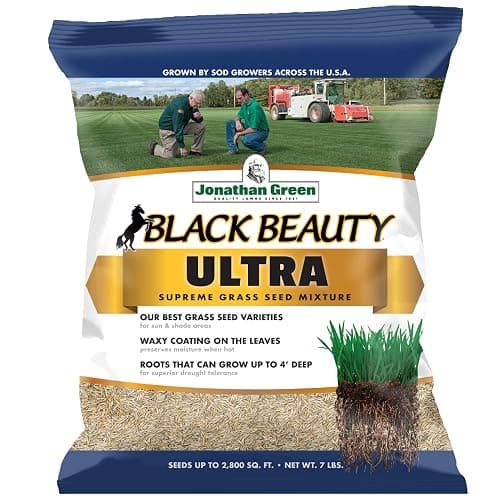
 Jonathan Green Black Beauty Ultra Grass SeedCheck price on Amazon
 The Andersons Professional PGF Complete 16-4-8 FertilizerCheck price on Amazon
As an Amazon Associate we earn from qualifying purchases.
Free Lawn Care Tools
Eight conventional lawn grasses are covered here: bermudagrass, zoysiagrass, buffalograss and St. Augustinegrass on the warm-season side, and tall fescue, Kentucky bluegrass, perennial ryegrass and the fine fescues on the cool-season side. University of Nevada, Reno Extension names all eight in its Mojave Desert and Lake Tahoe Basin turf publications. Beyond those, UNR also covers specialty and erosion-control grasses that are not conventional front lawns, including seashore paspalum, streambank wheatgrass, the Tahoe meadow-mix species, and blue grama among the northern Nevada ornamental grasses.
It depends which half of the state you are in. For southern Nevada, UNR Extension says turf-type tall fescue has proven to be the most popular lawn grass in the transition zone of the Mojave Desert, with bermudagrass as the main warm-season lawn. In northern Nevada and the Tahoe Basin, Kentucky bluegrass anchors the traditional lawn mixes UNR tested, usually blended with perennial ryegrass or fine fescue.
Not residential lawns you already have. The 2021 state law prohibits using Colorado River water delivered by Southern Nevada Water Authority member agencies to irrigate nonfunctional grass beginning in 2027, and SNWA is explicit that it "applies to Southern Nevada commercial, multi-family, government and other properties" and "does not apply to grass in single family residences, such as grass in front and back yards." A separate SNWA board resolution from December 2021 is what stops new lawns: it prohibits installing irrigated grass in new commercial and residential developments, including the front and backyards of new homes.
Yes. SNWA's Water Smart Landscapes rebate pays single-family homeowners for grass removed and replaced with desert landscaping, at a published rate of $5 per square foot for the first 10,000 square feet and $2.50 per square foot after that, per property per fiscal year, as listed on SNWA's rebate page in September 2026. Rates have changed before, so check the current figure. Two conditions catch people out: at least 400 square feet must be converted, and you must have a pre-conversion site visit before you remove anything, because starting without approval makes the conversion ineligible.
In southern Nevada, UNR Extension puts warm-season seeding and sprigging from April through June, and cool-season seeding from February through March or from mid-September through mid-October. If you want winter color on an established bermuda lawn, overseed with ryegrass in October, but not in the lawn's first year. In the Tahoe Basin, UNR seeded its demonstration lawns in mid-May and says seed can go in during fall or spring once the soil is warm.
Sources (12)
- University of Nevada, Reno Extension: Turfgrasses for Urban Mojave Desert Landscapes (Morris and Devitt, 2011, FS-11-52)
- University of Nevada, Reno Extension: Lawn Establishment in the Mojave Desert (Morris and Devitt, 2011, FS-11-54)
- University of Nevada, Reno Extension: Choosing Turf and Erosion Control Grasses for the Lake Tahoe Basin (Cobourn and Skelly, 2009, SP-09-07)
- University of Nevada, Reno Extension: Lawn Alternatives for Northern Nevada (Jensen and Kratsch, 2023, FS-24-07)
- University of Nevada, Reno Extension: Tips for a Healthy Lawn (Hefner, 2019)
- University of Nevada, Reno Extension: Mow This Way for a Healthy, Attractive, Hardworking Lawn (Andrews, 2017)
- University of Nevada, Reno Extension: Fall Lawn Care Grows Healthy Spring Lawns (Andrews, 2015)
- University of Nevada, Reno Extension: Gardening Guide of High-Desert Urban Landscapes of Great Basin Regions in Nevada and Utah
- Southern Nevada Water Authority: Understand Laws and Ordinances (nonfunctional grass law, turf definitions, new-grass prohibition)
- Southern Nevada Water Authority: Water Smart Landscapes Rebate
- Southern Nevada Water Authority: Watering and Maintaining Your Landscape (seasonal mandatory watering restrictions)
- Truckee Meadows Water Authority: Assigned-Day Watering
Photos: Jason Eckberg / iNaturalist · CC BY 4.0, Russell P. Rai / iNaturalist · CC BY 4.0, Wendy McCrady / iNaturalist · CC BY 4.0, Darius Regnier / iNaturalist · CC0, Nathan Aaron / iNaturalist · CC BY 4.0, Kevin Faccenda / iNaturalist · CC BY 4.0, Craig Martin / iNaturalist · CC0

Beat weeds and brown spots from your phone
Snap a photo, get the fix, and follow a plan timed to your soil and weather. Free on iPhone.
Related Articles
 Climate & Regional Tips
7 Types of Grass in New Mexico and How to Tell Them Apart
Sep 2, 2026•8 min read Climate & Regional Tips
6 Types of Grass in West Virginia and How to Tell Which You Have
Sep 2, 2026•7 min read Climate & Regional Tips
4 Types of Grass in Connecticut and How to Tell Which You Have
Sep 2, 2026•7 min read