6 Types of Grass in West Virginia and How to Tell Which You Have

As an Amazon Associate we earn from qualifying purchases.
West Virginia lawns are cool-season lawns. WVU Extension says "Lawns in West Virginia are usually composed of cool season grasses, such as perennial ryegrass, Kentucky bluegrass and tall fescue," and it names fine fescue as the grass "best adapted for shady areas." Zoysiagrass and bermudagrass are the two warm-season grasses WVU mentions, and it is careful about them: they are "not generally grown in West Virginia's cool climate, but are grown in some areas of the state with varying levels of success."
Seed cool-season grass in early to mid-September. Put crabgrass pre-emergent down in early to mid-April, when the forsythias begin to bloom. And get a soil test, because WVU says West Virginia soils are typically acidic with a pH that "may vary between 4 and 7," while most lawn grasses want about 6.5.
WVU Extension writes two of its lawn recommendations with a condition inside them, and in West Virginia that condition is the whole story. It does not recommend fine fescue "in parts of the state where summer temperatures are above 85°F for prolonged periods," without saying which parts those are. It limits warm-season grass to "some areas of the state," without naming them. Filling in those blanks takes the state's own climate numbers, and they vary more than almost anywhere else in the East: the state climatologist puts the elevation range at 247 feet near Harpers Ferry and 4,863 feet at Spruce Knob, rising gradually from the Ohio River eastward, and NOAA calls this the highest average elevation east of the Mississippi River. Add the acid soil WVU keeps warning about and you have the two questions worth answering before you buy seed. Here is the grass lineup, how to tell which one is already in your yard, and the dates WVU publishes.
The types of grass that grow in West Virginia
Tall Fescue
Tall fescue is one of the three grasses WVU Extension names when it describes a typical lawn here: "Lawns in West Virginia are usually composed of cool season grasses, such as perennial ryegrass, Kentucky bluegrass and tall fescue." Against Kentucky bluegrass specifically, WVU credits it on three counts. It establishes faster, since "Perennial ryegrass and tall fescue establish faster than Kentucky bluegrass and are more tolerant to wear." It costs less to feed, because "the fertility requirements of Kentucky bluegrass are higher than those of fescues." And it resists weed invasion better: WVU's weed sheet says "A lawn of Kentucky bluegrass, for example, is more susceptible to weed competition than a lawn of ryegrass or tall fescue." WVU also notes fescues are "more tolerant of drought and higher mowing heights," which matters on a sloped lot where water runs off before it soaks in. Virginia Cooperative Extension, just across the ridge, explains why: tall fescue "has the deepest root system of the cool-season lawn grasses grown in this area." The catch applies to the cool-season grasses generally. WVU says these species "tend to become semi-dormant during the hot summer months making lawns prone to attack by crabgrasses." Seed it at 4 to 8 pounds per 1,000 square feet.
Kentucky Bluegrass
Kentucky bluegrass is the better-looking and more demanding option, and WVU Extension is direct about the trade. Its seed guidance says bluegrass "prefers full sun and provides darker color and better mowing quality than ryegrass or tall fescue," then immediately adds that "the fertility requirements of Kentucky bluegrass are higher than those of fescues" and that it establishes more slowly than either ryegrass or tall fescue. WVU's weed sheet lists it as the more weed-prone lawn of the group. Mowing height is where a bluegrass lawn is usually won or lost: WVU reports that bluegrass "mowed at a height of 1 inch produces fewer grass roots and rhizomes compared to the same grass mowed at 2.5 to 3 inches," and it is those rhizomes that let bluegrass close its own bare spots. Shade is the other limit, and it rules out a lot of wooded lots. WVU says "Certain improved Kentucky bluegrass cultivars have also shown varying levels of adaptation to shade, although most cultivars of this grass species require full sunlight." Watch for leaf spot too: WVU notes common Kentucky bluegrass "is susceptible to Drechslera Leaf Spot and may be seriously affected." Seed at 1 to 2 pounds per 1,000 square feet.
Fine Fescue
Fine fescue is WVU Extension's answer for shade, and it says so without hedging: "Of the cool-season turfgrasses, fine fescues are best adapted for shady areas," with "finer leaf textures compared to other turf species." It is also the low-input member of the group, since WVU rates the fescues below bluegrass on fertility and above it on drought and mowing height. Then comes the sentence that turns fine fescue into a question about your particular yard. WVU says fine fescues "grow quite well in cool, dry shade" but "are not recommended for poorly-drained soils or in parts of the state where summer temperatures are above 85°F for prolonged periods." WVU never says which parts. NOAA's West Virginia climate summary is the closest thing to an answer: summer average maximum temperatures run "around 85°F in the southwest, near the Ohio River, to less than 80°F in the east-central mountains." That is a gradient across the state rather than a line on a map, but it tells you which end you are nearer. Drainage is the other half of the same WVU sentence and it is easier to check: if the spot stays soggy, fine fescue is not the fix. Seed at 3 to 5 pounds per 1,000 square feet, which is the rate WVU gives for what it calls the thin fescues.
Perennial Ryegrass
Perennial ryegrass is the third grass in WVU Extension's description of a typical West Virginia lawn, and it often turns up in a mixture doing a specific job. WVU explains the role: "Some mixtures may contain a 'nurse grass' such as ryegrass that will encourage swift lawn establishment but later transition to the dominant grass species in the lawn." It earns that job honestly, because WVU rates ryegrass and tall fescue as faster to establish than bluegrass and "more tolerant to wear," which is worth something on a slope you are trying to hold through a wet spring. Where it disappoints is shade, and WVU spells out exactly how: ryegrass in shade "will give a good cover early in the season" but the stands "are usually severely thinned by the end of the season; annual reseeding helps remediate this condition." So ryegrass in a shaded yard is a recurring job rather than a finished lawn. Virginia Cooperative Extension is blunter about the wider trade, listing "Poor drought, heat, and cold tolerance" among its weaknesses and rating its overall maintenance requirement as high. Read the seed tag before you buy, so you know how much of the bag is doing long-term work. Seed at 4 to 8 pounds per 1,000 square feet.
Zoysiagrass
Zoysiagrass is one of two warm-season grasses WVU Extension mentions for West Virginia, and the mention comes with a caveat attached: warm-season grasses "such as zoysiagrass and Bermudagrass, are not generally grown in West Virginia's cool climate, but are grown in some areas of the state with varying levels of success." WVU does not name those areas, publishes no zoysia cultivar list, and does not recommend it as a default anywhere in the state. The one distinction WVU does draw between the two is shade: "Certain varieties of zoysiagrass are more shade-tolerant than others, but Bermudagrass will not tolerate shade." For anything beyond that you have to cross the state line. Virginia Cooperative Extension, writing for the Virginia mountains next door, says zoysiagrass "has satisfactory cold tolerance" there, describes an "exceptionally dense canopy," and rates its maintenance as low once established, while warning it is slow to repair damage and a heavy thatch producer. Know what you are signing up for either way. WVU's weed sheet treats "volunteer Bermudagrass or zoysia grass" as species that must be killed completely before a new lawn goes in, because they "can be difficult to manage if not controlled completely prior to establishing the new lawn." Warm-season grass goes in during late spring or early summer, not September.
Bermudagrass
Bermudagrass sits inside the same careful WVU Extension sentence as zoysia: warm-season grasses "are not generally grown in West Virginia's cool climate, but are grown in some areas of the state with varying levels of success." WVU names no West Virginia region for it and endorses no cultivar. It does add one hard limit: "Bermudagrass will not tolerate shade." That single clause disqualifies a great many yards in a state where the state climatologist reports Elkins and Beckley at 212 and 210 days of heavy cloud cover a year, and where hillsides and mature trees shade plenty of lots outright. The other place WVU discusses bermudagrass is its weed sheet, which groups "volunteer Bermudagrass" with zoysia as previous turf that has to be controlled completely before a new lawn is established, warning that these grasses "can be difficult to manage if not controlled completely prior to establishing the new lawn." Virginia Cooperative Extension describes the spread that makes that true: bermudagrass has "rhizomes and stolons" and is "noted for their extremely fast lateral spread rates." If you find wiry runners on the surface of a fescue lawn and that patch browns well before the rest of the yard, identify it before you decide what to do about it.
Two absences are worth stating plainly, because seed racks in border towns will suggest otherwise. WVU Extension publishes no lawn guidance for St. Augustinegrass, centipedegrass, bahiagrass, or buffalograss in West Virginia, so none of them appear here. WVU also publishes no recommended cultivar list for lawn turf at all, which is why this page names species and not varieties. When a bag promises a named variety "for West Virginia," that claim is coming from the seed company, not from the extension service.
West Virginia grass types compared at a glance
Four of these six are the practical choice for most of the state. The two warm-season entries are here because WVU names them, not because WVU recommends them, and the cells marked VCE come from Virginia Cooperative Extension next door, since WVU rates neither.
| Grass | Season | Best role | Sun / shade | Water need | Maintenance |
|---|---|---|---|---|---|
| Tall Fescue | Cool | Lower-input alternative to Kentucky bluegrass | Sun to moderate shade | More drought tolerant than bluegrass (WVU) | Lower fertility need than bluegrass (WVU) |
| Kentucky Bluegrass | Cool | Dark colour and mowing quality in full sun | Most cultivars require full sunlight (WVU) | Enters summer dormancy in heat and drought (VCE) | Higher fertility need than the fescues (WVU) |
| Fine Fescue | Cool | Shade and low-input areas | Best adapted for shady areas (WVU) | Cool, dry shade; not poorly drained soils (WVU) | Low |
| Perennial Ryegrass | Cool | Quick cover and nurse grass in mixes | Shaded stands thin severely by season end (WVU) | Poor drought and heat tolerance (VCE) | High (VCE) |
| Zoysiagrass | Warm | Warm-season option WVU notes in some areas only | Some varieties more shade tolerant than others (WVU) | Warm-season; no WVU water rating for the state | Low once established (VCE) |
| Bermudagrass | Warm | Warm-season option WVU notes in some areas only | Will not tolerate shade (WVU) | Warm-season; no WVU water rating for the state | Extremely fast lateral spread (VCE) |
How to tell which type you already have
WVU Extension does not publish a turfgrass identification key, so the blade and growth-habit details below come from Penn State Extension's cool-season identification guide and Virginia Cooperative Extension, both of which cover the same species grown just over the state line. Start with the calendar, because it separates the two groups instantly: warm-season grasses lose their green colour for months from late fall to early spring, while the cool-season four green up early and may look tired in a hot August instead. Among the cool-season four, tall fescue is the only one with a pointed tip and no dominant mid-vein, and it grows in obvious clumps. Kentucky bluegrass is the only one that spreads by rhizomes and closes its own bare spots. That leaves two fine-bladed bunch grasses, and ryegrass is glossy on the underside of the blade while fine fescue is very narrow, folded, and usually living somewhere shaded.
| Grass | Blade | Growth habit | Standout tell |
|---|---|---|---|
| Tall Fescue | Coarsest of the four, many equal-sized veins, pointed tip | Bunching, no runners | Coarse clumps that stand out against a finer lawn |
| Kentucky Bluegrass | Fine to medium, prominent mid-vein, boat-shaped tip | Spreads by rhizomes | Closes its own bare spots; darker green than ryegrass or tall fescue |
| Fine Fescue | Very narrow and folded, veins usually not visible | Bunching, some types with rhizomes | Needle-thin blades, typically in the shaded parts of a yard |
| Perennial Ryegrass | Fine to medium, glossy underneath, boat-shaped tip | Bunching, no runners | Glossy blade back; among the first up after seeding |
| Zoysiagrass | Fine to medium, in a very dense canopy | Spreads by stolons and rhizomes | Loses green colour for months over winter |
| Bermudagrass | Fine to medium, short, pointed | Both stolons and rhizomes, fast lateral spread | Runners visible on the soil surface; brown for months over winter |
Still not certain? Our free AI grass identifier reads a close-up photo, names the grass, and builds a 12-month care plan tuned to your ZIP.
Which types grow in your part of West Virginia
The state climatologist describes West Virginia as "the most northern of the southern states, the most southern of the northern states, and the most western of the eastern states," and the lawns follow. Precipitation alone runs from about 30 to 35 inches in the Eastern Panhandle rain shadow to roughly 62 inches on the western mountain slopes. WVU does not publish region-by-region grass recommendations for the state, so what follows is the climate picture for each area, next to the WVU conditions it bears on. (USDA zones run roughly from 5a in the Allegheny highlands to about 7a in the Eastern Panhandle and the lower Ohio Valley. Neither WVU nor the state climate office publishes those zones for lawn purposes, so use them as orientation only.)
- Eastern Panhandle (Martinsburg, Charles Town, Harpers Ferry, Berkeley Springs): The lowest and driest corner of the state, about 50 miles from Washington, DC, sitting in a rain shadow that the state climatologist puts near 30 inches a year while NOAA puts it around 35. Harpers Ferry, at 247 feet, is the state's low point. Low elevation and low rainfall are the two conditions that make drought tolerance worth paying for, which is where WVU's note that fescues are "more tolerant of drought" earns its keep.
- Ohio Valley and the Kanawha (Huntington, Charleston, Parkersburg, Wheeling, Weirton): Low elevation, the warmest summers in the state, and around 40 inches of rain a year near the river. NOAA puts summer average maximum temperatures near 85°F in the southwest, which is the same figure that appears in WVU's caution against fine fescue "in parts of the state where summer temperatures are above 85°F for prolonged periods." If any part of West Virginia triggers that caveat, this is the likeliest, so check the shade and drainage of a spot before committing it to fine fescue.
- Southern coalfields (Beckley, Bluefield, Princeton, Logan, Williamson): The state climatologist puts the warmest annual average temperatures here, in the upper 50s, and NOAA puts winter average minimums around 30°F in the far south. Beckley is also one of the two cloudiest reporting points in the state at 210 days of heavy cloud cover a year. Warm on paper, dim in practice, and full of steep lots, so WVU's shade guidance and its three-inch shade mowing height matter more here than the temperature alone suggests.
- North-central and the Monongahela valley (Morgantown, Fairmont, Clarksburg, Buckhannon): Middle elevations, between the warm river lowlands and the cold highlands, and squarely inside the cool-season description WVU gives for the state as a whole. Acid soil and a soil test matter as much here as species choice, since WVU ties both the lime decision and the fertilizer amounts to a test.
- Allegheny highlands (Elkins, Davis, Marlinton, Petersburg, the Snowshoe area): The coldest, wettest, cloudiest, shortest-season lawns in the state. NOAA puts summer average maximums below 80°F in the east-central mountains and winter minimums in the low 20s; the state climatologist notes Elkins sits at 1,927 feet, takes just over 60 inches of snow a year, and is the second cloudiest location east of the Mississippi River. This is the end of the state furthest from WVU's 85°F fine-fescue caveat, and the end where a short growing season leaves the least room for a late seeding.
West Virginia grass timing that matters
WVU Extension does not publish a month-by-month turf calendar, and the dates it does give are stated for the state as a whole rather than by region. These are its dated recommendations, pulled from the individual fact sheets.
- Seeding and overseeding: WVU says cool- and warm-season turf "can be seeded almost any time of the year," but "the optimal time is early- to mid-September for cool-season grasses and late spring or early summer" for warm-season grasses. The reason is germination conditions, not the calendar itself: "Temperature and moisture conditions that favor rapid germination result in better establishment." Rates per 1,000 square feet are 1 to 2 pounds of Kentucky bluegrass, 4 to 8 pounds of tall fescue or perennial ryegrass, and 3 to 5 pounds of fine fescue. WVU suggests a calibrated drop spreader "making two passes at right angles to each other," each at half the rate.
- Soil test and lime, the West Virginia step people skip: WVU says "In West Virginia's typically acidic soils, pH may vary between 4 and 7; therefore, well-established lawns may require applications of lime periodically," while "Most lawn grasses prefer a pH of around 6.5." Soil test mailers come from your county WVU Extension office. On an established lawn, "lime is best applied during fall, winter, or early spring, in that order." Do not exceed 150 pounds of lime per 1,000 square feet in one application, and expect to lime only "every three to five years." WVU is blunt that "adding too much lime can be as damaging to lawn grasses as adding too little."
- Crabgrass pre-emergent: "If applying a pre-emergent herbicide alone, it is best if applied in early to mid-April," and WVU gives a phenological backup that beats any date: "apply the herbicide while the forsythias begin to bloom." A pre- plus post-emergent combination can go down in late May while smooth crabgrass is actively growing. Corn gluten products suppress germination for two to three weeks and add some nitrogen.
- Fertilizer: "The growth rate of cool-season grasses is higher during spring and fall months; therefore, they should be fertilized in spring and fall. A higher dose of fall fertilizer also helps the growth." At establishment WVU ties the decision to a test: "Fertilizer or lime application during the establishment of turfgrass should be based on the results of a soil test to determine if the soil is deficient in phosphorus and/or potassium." It also warns against pushing "fast lush growth, especially in hot, humid weather."
- Aeration: "It is best to aerate cool season grasses in the early spring or fall, while warm season grasses should always be aerated in the fall. Aeration works best when the soil is moist." Use a plug aerator, not a spike aerator, because spikes cause compaction around the holes.
- Mowing: Never take more than a quarter to a third of the leaf surface at a time, and "Mow the lawn throughout the fall until the grass stops growing." In shade, WVU says to "raise the mowing height to a minimum of three inches." Dethatch once thatch reaches three quarters of an inch. Water deeply and infrequently, and in shaded areas do it in the morning so the blades dry.
The through-line for West Virginia: September seeds the lawn, a soil test decides the lime, and the shade decides the species. Watch the weeds too, because WVU says they read your soil for you. Red sorrel and broomsedge point to acid soil, while black medic, white clover, hawkweed, and broomsedge "typically indicate that soils are low in nitrogen."
Next steps
Not sure whether that coarse clump in the yard is tall fescue or something else? Snap a photo for a free AI identification, or start from the home page analyzer for a 12-month plan tuned to your ZIP. Deciding between tall fescue and a bluegrass blend before a September seeding? The grass comparison tool lines them up, and the seeding calculator turns square footage into pounds of seed. For the wider picture, see how every state compares.
Top Picks
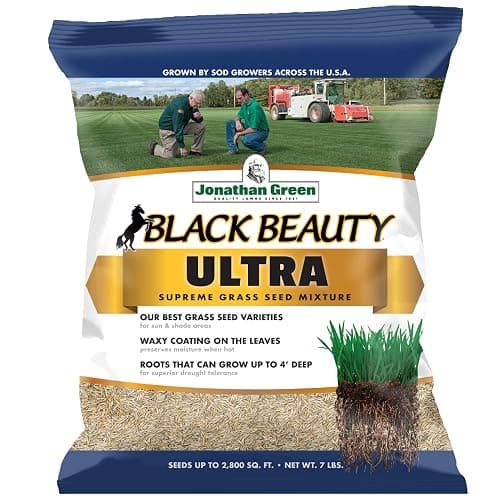
 Jonathan Green Black Beauty Ultra Grass SeedCheck price on Amazon
 The Andersons Professional PGF Complete 16-4-8 FertilizerCheck price on Amazon
As an Amazon Associate we earn from qualifying purchases.
Free Lawn Care Tools
Six species come up in WVU Extension lawn guidance. The four that matter for most yards are cool-season: tall fescue, Kentucky bluegrass, fine fescue, and perennial ryegrass. Zoysiagrass and bermudagrass are the two warm-season names WVU mentions, and it says they are not generally grown in West Virginia's cool climate but are grown in some areas of the state with varying levels of success. WVU publishes no cultivar recommendations for lawn turf, so species is as specific as the official guidance gets.
WVU Extension describes a typical lawn here as cool-season, "usually composed of cool season grasses, such as perennial ryegrass, Kentucky bluegrass and tall fescue," and it does not rank the three or say which is most planted. What it does say is how they differ: ryegrass and tall fescue establish faster than bluegrass and are more tolerant to wear, bluegrass gives darker colour and better mowing quality but needs more fertility, and a bluegrass lawn is more susceptible to weed competition than one of ryegrass or tall fescue.
It decides whether two WVU conditions apply to your yard. WVU does not recommend fine fescue in parts of the state where summer temperatures stay above 85 degrees for prolonged periods, and NOAA puts summer average maximums near 85 degrees in the southwest by the Ohio River but under 80 degrees in the east-central mountains. WVU also limits warm-season grasses to some areas of the state without naming them. West Virginia has the highest average elevation east of the Mississippi River and runs from 247 feet at Harpers Ferry to 4,863 feet at Spruce Knob, so those conditions land very differently in different yards.
Often, but only a soil test can say. WVU Extension says West Virginia soils are typically acidic and pH may vary between 4 and 7, while most lawn grasses prefer a pH of around 6.5. Get a soil test mailer from your county WVU Extension office. On an established lawn WVU says lime is best applied during fall, winter, or early spring, in that order, at no more than 150 pounds per 1,000 square feet at once, and generally only every three to five years.
Early to mid-September for cool-season grass, which is WVU Extension's stated optimal window and is given for the state as a whole rather than by region. Warm-season grasses like zoysiagrass go in during late spring or early summer instead. WVU notes seed can go down almost any time of year, but the September timing gives the temperature and moisture conditions that favor rapid germination.
Sources (13)
- WVU Extension: Choosing the Right Seed
- WVU Extension: Establishing a Lawn
- WVU Extension: Turfgrass in Shady Areas
- WVU Extension: Liming the Lawn
- WVU Extension fact sheet ANR-IPM-15-008: Lawn Liming (PDF)
- WVU Extension fact sheet ANR-IPM-15-010: Weed Management in Lawns (PDF)
- WVU Extension: Crabgrass
- WVU Extension: Lawn Aeration
- WVU Extension: Tips to Avoid Lawn Problems
- Penn State Extension: The Cool-season Turfgrasses, Identification
- Virginia Cooperative Extension SPES-748: Selecting Turfgrass for Virginia
- Kevin Law, West Virginia State Climatologist: West Virginia's "Wild and Wonderful" Climate (PDF)
- NOAA NCEI: West Virginia State Climate Summary 2022
Photos: Greghig Jirheg / iNaturalist · CC BY 4.0, Andrew Conboy / iNaturalist · CC BY 4.0, D Defreese / iNaturalist · CC BY 4.0, Bonnie Semmling / iNaturalist · CC BY 4.0, Kevin Faccenda / iNaturalist · CC BY 4.0, Craig Martin / iNaturalist · CC0

Beat weeds and brown spots from your phone
Snap a photo, get the fix, and follow a plan timed to your soil and weather. Free on iPhone.
Related Articles
 Climate & Regional Tips
4 Types of Grass in Connecticut and How to Tell Which You Have
Sep 2, 2026•7 min read Climate & Regional Tips
4 Types of Grass in New York and How to Tell Which You Have
Aug 30, 2026•7 min read Climate & Regional Tips
4 Types of Grass in Oregon and Which Side of the Cascades Wants Each
Aug 30, 2026•7 min read