Which grub killer fits the month you're in?
When are you buying? The calendar picks the product more than the brand does.
| Product | Type | Fits when | Price |
|---|---|---|---|
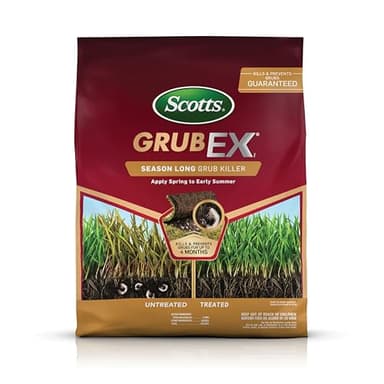
| Scotts GrubEx1 (14.35 lb, 5,000 sq ft) | Preventive (chlorantraniliprole) | Spring or early summer, before grubs hatch. Up to 4 months of control, per the listing. | $29.47 |
| Scotts GrubEx1 (28.7 lb, 10,000 sq ft) | Preventive (chlorantraniliprole) | Same product for lawns over 5,000 sq ft. | $54.98 |
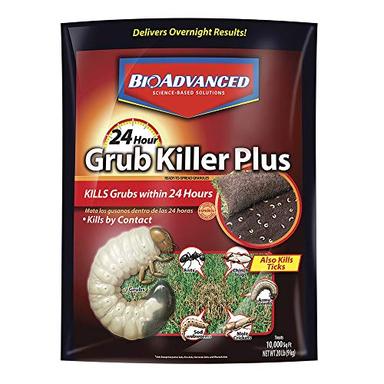
| BioAdvanced 24-Hour Grub Killer Plus (20 lb, 10,000 sq ft) | Curative (trichlorfon 9.3%) | Late summer or early fall, when grubs are feeding and you've counted them. | $69.69 |
Prices are Amazon prices checked November 27, 2026. They move, so check the listing. The label is the legal instruction: follow its rate and watering directions.
Do you have grubs, moles, or both?
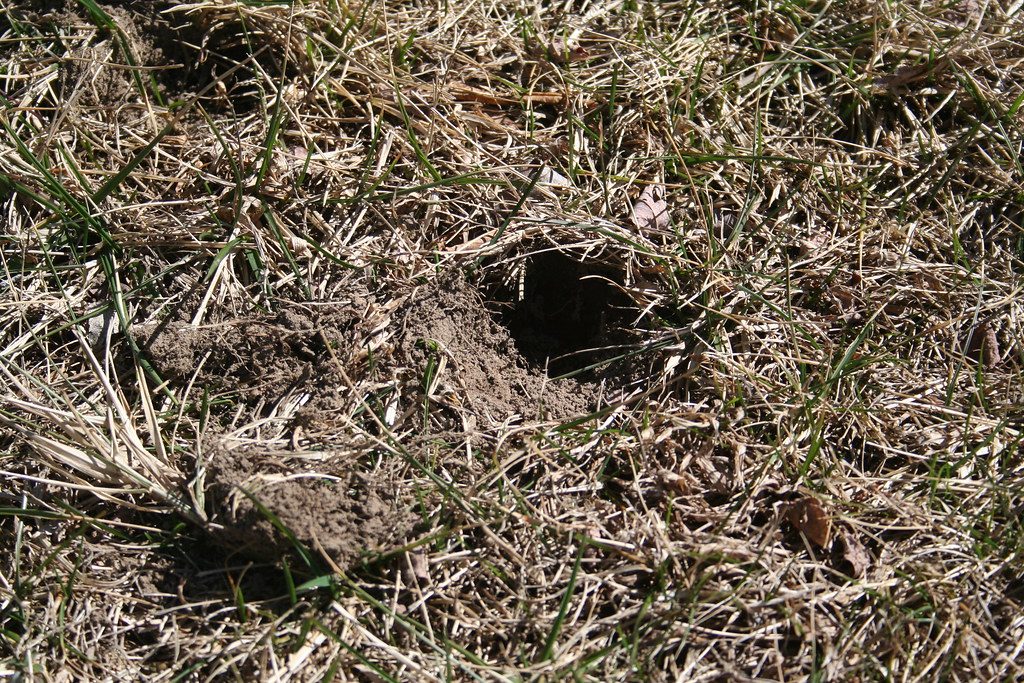
Is the turf lifting like carpet, or is it pushed up into ridges? Those are two different animals, and the test takes five minutes.
- Grubs: dead turf that peels back because the roots are chewed off. Penn State's check: with a garden spade, remove one square foot of turf and soil, 2 to 4 inches deep, in several spots. Five to ten grubs per square foot is often used as the threshold for curative treatment. Lay the sod back and pack it down.
- Moles: raised ridges and cone-shaped mounds of soil, with the turf on top still rooted. Flatten a ridge and check it the next day. If it's pushed back up, that runway is active.
- Both: Penn State notes that skunks, crows or moles feeding on turf can point to grubs, then adds that moles also feed on earthworms.
If you counted fewer than five grubs per square foot, a grub product has little to do. The white grubs page covers species and damage. The moles page covers the ridges.
Will killing grubs get rid of moles?
Rarely. Iowa State Extension says applying insecticides for grubs will not solve the mole problem, because earthworms are the primary food. Rutgers says grub control will not provide much long-term relief, and that even moles that leave a treated area won't move far. Nebraska Extension calls soil insecticides expensive, with no immediate reduction of damage.
So what does that mean for your cart? Buy a grub product only if the sod test found grubs at or above the threshold. Then you are treating the grubs on their own merits. For the moles themselves, University of Minnesota Extension's mole trapping guide and our moles page cover what extension services say works.
If the test found no grubs and the ridges keep spreading, the moles are hunting earthworms in healthy soil. A grub bag won't change that.
Best preventive: Scotts GrubEx1
Did the same lawn lose turf to grubs last year? Then prevention fits. GrubEx1 uses chlorantraniliprole, and Scotts says to apply it to a dry lawn in spring or early summer so it kills grubs as they develop. One application lasts up to four months, per the listing. NC State says chlorantraniliprole gives optimal control when applied at egg hatch, with higher rates later in summer.
Pick the bag size by square footage. The 14.35 lb bag covers 5,000 sq ft. The 28.7 lb bag covers 10,000 sq ft. Water it in per the label.
Preventive products only make sense where grubs have a history. NC State says the preventive approach should only be used in areas that have a history of grub infestations.
Best curative: BioAdvanced 24-Hour Grub Killer Plus
Are the grubs already there, and is it late summer? A preventive is too slow. A curative product kills the grubs that are feeding now.
The 24-Hour Grub Killer Plus bag lists trichlorfon 9.3% as its active ingredient. The listing says it kills grubs in 24 hours and treats up to 10,000 sq ft per 20 lb bag. NC State says trichlorfon can be used with some success as a rescue treatment in August and September.
Two watering steps help. NC State suggests irrigating a day or two before you apply, to draw grubs toward the surface, and watering in after. Penn State notes curative products have short residual periods, so this is a one-time rescue.
Step-by-step spreader directions are in our BioAdvanced grub killer instructions.
Recommended Products
- 1Check price
 Top pick
BioAdvanced 24-Hour Grub Plus Insect Killer Outdoor for Lawns, Ant, Tick, 20-Pound Ready-to-Spread Granules, Standard Bag
Curative trichlorfon granules that kill grubs within 24 hours. Use at the first sign of grubs; one 20 lb bag treats up to 10,000 sq ft for grubs, per the listing.
As an Amazon Associate we earn from qualifying purchases.
When should you apply grub killer in the North?
Which window are you in? Grubs feed near the surface twice a year, and only one of those windows responds well to treatment.
- Preventive, late spring to midsummer: labels say to apply before egg hatch. Penn State's central Pennsylvania example ran mid-June through mid-July. Scotts says spring or early summer for GrubEx1.
- Curative, late summer to early fall: Penn State says August through mid-September. That's also the best time to cut sod and count.
- Spring curative: Penn State says spring treatment is usually less effective than summer, because the grubs are larger and harder to control.
Mow first. Michigan State University Extension says to mow immediately before applying a grub insecticide so no clover or other weeds are flowering, which protects bees. Purdue says the same for any lawn insecticide.
The grub control calculator works out your window and the product amount for your lawn size.
Working a case: mole ridges in a 10,000 sq ft lawn
The givens, as a scenario: a 10,000 sq ft Kentucky bluegrass lawn in upstate New York. It's early September. There are ridges across the front lawn and a few brown patches near the walk. The homeowner asked a friend what to buy so the moles lose their food.
- Ridge check. Two flattened ridges are pushed back up the next morning. Moles are active.
- Sod check. Four one-foot squares cut 2 to 4 inches deep. Front yard average: two grubs per square foot. Brown patch by the walk: eleven.
- Read the result. The front yard is under Penn State's five-to-ten threshold. The patch by the walk is over it.
If those counts fit, treat the patch by the walk with a curative now, since it's inside Penn State's August through mid-September window. Spot-treat that area at the label rate instead of the whole lawn. For the moles, go to trapping, because the grub count says the moles aren't living on grubs.
If the same walkway patch fills with grubs again next year, put a preventive down the next June. At the November 27, 2026 price, the 10,000 sq ft GrubEx1 bag is $54.98, and two 5,000 sq ft bags are $58.94.