Fall Pre-Emergent: When to Apply for Poa Annua and Winter Weeds
 Sarah MitchellLawn Diagnostics Specialist | 12 Years
As an Amazon Associate we earn from qualifying purchases.
Apply a fall pre-emergent as soil at a 2-inch depth cools toward 70°F, and get it down before the reading drops much below that. Poa annua starts germinating once soil falls below 70°F, per UGA Extension, and Texas A&M AgriLife starts the fall program at about 70°F. That point arrives first in the upper Midwest and Northeast, next across the transition zone and mid-South, and last on the Gulf Coast and in Texas. Check your soil temperature by ZIP code before you buy the bag.
Skip it wherever you seeded this fall. A pre-emergent stops grass seed the same way it stops poa annua, and most labels need months between the two. Water it in with about half an inch of rain or irrigation, and plan a second pass 8 to 9 weeks later if you're in the Deep South or had heavy poa last spring.
Which weeds a fall pre-emergent actually stops
Did your lawn have bright green clumps with white seed heads last March, or a purple haze of flowers across the thin spots? Those weeds germinated the September before. That timeline is the whole argument for a fall application, and it's the part most homeowners never hear.
Poa annua, henbit, common chickweed, lawn burweed, Carolina geranium, and rescuegrass are winter annuals. They sprout as soil cools in late summer and fall, sit low through winter, and then take over in late winter and early spring, right when everyone else is thinking about crabgrass. By the time you can see them, a pre-emergent can't touch them. You're into post-emergent control, which is more selective, costs more, and is harder on your turf.
Here is what a fall pre-emergent stops:
- Poa annua (annual bluegrass). The headline target. It germinates in a heavy flush as soil cools and produces seed heads by early spring.
- Henbit and purple deadnettle. The purple carpet you see in February lawns and roadsides.
- Common chickweed. Low, mat-forming, and aggressive in thin turf.
- Lawn burweed (spurweed). The one with the spiny burs that make a Deep South lawn unwalkable barefoot in April. Fall is the time to stop it, because by spring the burs are already forming.
- Carolina geranium and rescuegrass, mostly in warmer zones.
How do you know whether the weed you're fighting is one of these? Check how it grows back. A pre-emergent is a soil barrier that stops germinating seedlings, so it has no effect on anything already growing. If you already have visible poa annua clumps, you need a post-emergent approach for annual bluegrass instead. Perennial weeds like dandelion, wild violet, and nutsedge come back from roots and tubers every year, so a barrier does nothing for them either.
One more limit. A pre-emergent doesn't empty the seed bank. UGA's bulletin on annual bluegrass control in residential turfgrass notes that a single poa plant can produce hundreds of viable seeds, even when closely mowed. If your lawn was thick with it last spring, plan on more than one season of clean fall applications.
Your fall pre-emergent window by region
When is your window? The trigger is 2-inch soil temperature falling toward 70°F, and it moves by a week or two every year. Texas A&M AgriLife Extension says it plainly in its fall preemergence guidance: start the fall program when soil reaches about 70°F, and don't rely on the same calendar date every year.
Direction matters as much as the number. In spring, soil warms toward the threshold, so you have time. In fall, soil cools toward it, and once it drops below 70°F, poa annua seed is already germinating underneath you. If your soil reads 68°F and still falling, apply now. Some seed has already sprouted, and a late barrier still stops the rest.
Here is how to read the Soil Temperature Tracker for this decision:
- Above 80°F: too early. Check again next week.
- 75 to 80°F and falling: buy the product and watch the forecast. You're usually one to two weeks out.
- 70 to 74°F and falling: apply this week, ahead of a rain if you can.
- Below 70°F: apply as soon as possible. The first flush has started, and you'll catch the later ones.
The table shows when each region usually reaches that point. Treat it as a guide to when you should start checking, and let your reading make the call.
| Region | Example cities | Soil usually nears 70°F | Primary targets |
|---|---|---|---|
| Upper Midwest, Northeast | Minneapolis, Chicago, Boston | Late August to early September | Poa annua, chickweed |
| Transition zone, mid-South | Louisville, Raleigh, Charlotte | Mid to late September | Poa annua, henbit, chickweed |
| Upper South | Nashville, Atlanta, Birmingham | Late September to early October | Poa annua, henbit, chickweed |
| Gulf Coast, Texas | Dallas, Houston, New Orleans | October, sometimes later near the coast | Poa annua, lawn burweed, rescuegrass |
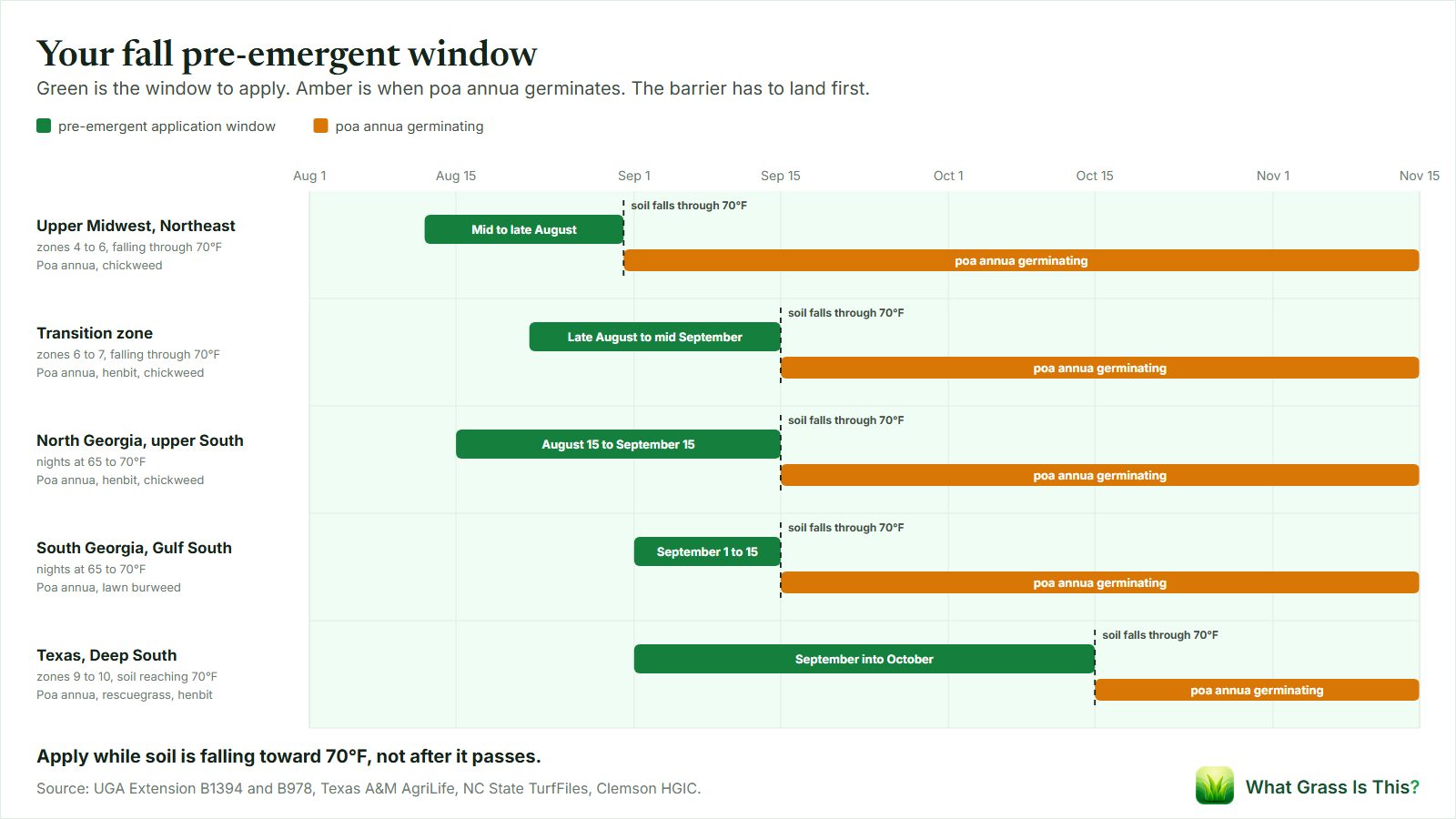
Why do the extension calendars disagree with each other? They're built for different goals. UGA's Weed Control in Home Lawns (Bulletin 978) gives August 15 to September 15 for north Georgia and September 1 to 15 for south Georgia, which puts the barrier down well before soil reaches 70°F. Texas A&M ties its timing to the soil reading itself, which lands in September or October depending on where you are in Texas. The early calendar trades a little residual at the back end for never being late. If you can't check soil at all, the earlier date is the safer miss.
Microclimates shift this by a week in either direction on the same property. South-facing slopes and areas near driveways and walls hold heat and cool later. Shaded north sides and low spots cool first and germinate first. If your lawn has both, time the application to the earliest-cooling section.
How to read soil temperature without a thermometer
A REOTEMP 5-inch soil thermometer costs less than a bag of pre-emergent, and pushing it 2 inches into the turf mid-morning for three days running is the most accurate check you can make. You don't strictly need one, though.
The simplest field cue comes from UGA's Bulletin 978: apply when nighttime temperatures drop to 65 to 70°F. Overnight lows pull soil temperature down, so they lead the soil reading by several days. Clemson's fescue lawn weed management factsheet uses a cooler cue for the Carolina piedmont and mountains: nighttime lows of 55 to 60°F for four consecutive days, which it puts at September 1 to 15 on average. When two cues disagree, the soil reading breaks the tie.
Two other reliable checks:
- The five-day trend. One cool front doesn't cool the soil. You want several days of a downward trend, with overnight lows staying in the 60s or below.
- Regional soil data. Our Soil Temperature Tracker shows the current 2-inch reading for your ZIP code and which direction it's moving, so you can skip the probe.
Don't time this off daytime highs. Air temperature can swing 20°F in an afternoon. Soil at 2 inches barely moves day to day, which is why extension services use it as the trigger.
What to apply
Which active ingredient fits your lawn? Three standard residential actives will stop poa annua if the barrier is intact and watered in on time. They differ in how well they control annual bluegrass, how long they last, and how long they block grass seed. UGA's Bulletin 1394 rates each one on annual bluegrass, and those ratings are in the table.
| Active (brand) | UGA rating on poa annua | Residual | Wait before seeding | Notes |
|---|---|---|---|---|
| Prodiamine (Barricade) | Good to excellent | Longest of the three | Several months, per label | Lowest cost per 1,000 sq ft, no post-emergent activity |
| Dithiopyr (Dimension) | Fair to good | Medium | 2.5 to 4 months on most grasses (UGA) | Some activity on very young crabgrass seedlings |
| Pendimethalin (Scotts Halts, Pendulum) | Good | Shortest of the three | Several months, per label | Can stain concrete and hardscape yellow |
Rates depend on the product's concentration, so use the rate printed on your bag. The Andersons Barricade 18 lb bag, for example, covers up to 5,800 sq ft. If your product is a fertilizer with a pre-emergent built in, the weed and feed calculator converts the bag rate into pounds for your lawn size.
For most people who aren't seeding, prodiamine is the default. It has the best UGA rating of the three on poa annua, lasts longest, and costs the least per thousand square feet. For rates, spreader calibration, and a side-by-side of the three bags, compare prodiamine, dithiopyr, and pendimethalin in our granular pre-emergent guide.
I leave indaziflam and simazine off this list on purpose. Both work, and both show up often in enthusiast forums. Simazine is for warm-season grass only, and UGA's Bulletin 978 says not to overseed within four months before or six months after it. UGA lists indaziflam for established warm-season lawns only, so it's a poor fit for anyone with cool-season grass or a renovation on the calendar. If you're new to this, the three actives above will do the job.
Recommended products
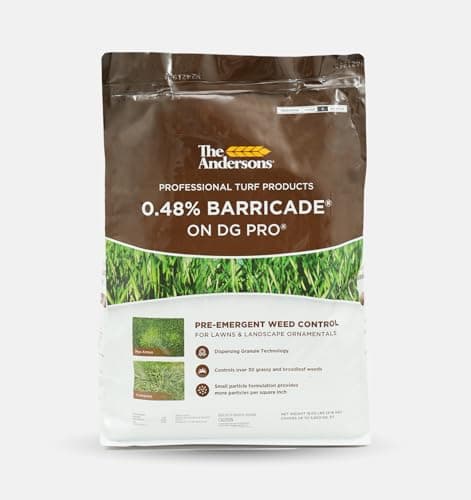
The Andersons Barricade Professional-Grade Granular Pre-Emergent (18 lb)
a granular prodiamine that goes down with any broadcast spreader.
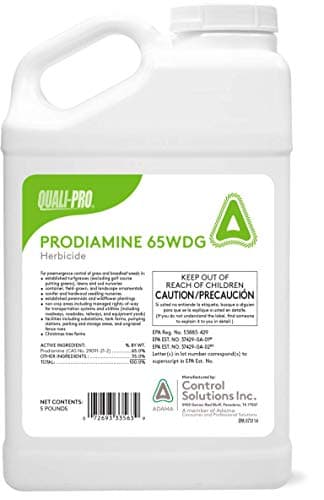
Quali-Pro Prodiamine 65 WDG Pre-Emergent (5 lb)
a sprayable prodiamine that costs far less per 1,000 sq ft than granular.
Watering it in is not optional
Is the product still sitting on the grass blades? If so, it isn't doing anything yet. It has to move off the leaf and into the top fraction of an inch of soil to form a barrier, and that takes water.
UGA's Bulletin 978 says prodiamine should get at least 0.5 inch of rainfall or irrigation within 14 days of application, before weed seeds germinate. Sooner is better. Texas A&M recommends watering granular products in right after you apply, usually a quarter to half an inch, and following the label. If a front is coming through in two days, apply ahead of it and let the rain do the work.
A few practical notes on activation:
- Put out a tuna can or a straight-sided cup to measure. Most people overestimate how much their sprinklers put down in 20 minutes.
- Apply to dry grass. Granules that stick to wet blades don't fall through evenly.
- Don't dethatch, aerate, or heavily rake after the barrier is set. Any of those break the layer and give seed a clean path through.
- If you bag clippings, return them to the lawn until the product has been watered in. UGA's Bulletin 1394 gives the same advice for unirrigated lawns.
The overseeding conflict and how to work around it
Did you seed or overseed in the last month or two? Then skip the fall pre-emergent on the seeded areas this year. The barrier can't tell tall fescue or ryegrass seed from poa annua, and it can stunt the roots of young grass. Clemson's fescue factsheet says not to apply a pre-emergent to a newly seeded lawn until rooting and regular growth have taken place, which typically means at least two mowings. Purdue's herbicide delays after seeding table is more specific for prodiamine: wait 60 days after seeding or until after the second mowing, whichever is longer.
For most fall-seeded lawns, 60 days lands in late fall, after the main poa annua flush is over. The seedlings you protect this fall are worth more than one year of poa control.
If you haven't seeded yet, you have three real choices:
- Split the lawn. Seed the thin areas and put the pre-emergent down on the established sections that don't need seed. This is what most people should do, because usually only part of the lawn needs renovating.
- Seed now, skip the barrier. Accept some poa annua this spring on the seeded areas and treat what comes up with a post-emergent chosen for your grass.
- Pre-emergent now, seed later. Put the barrier down and push seeding out to when the label allows, usually 3 to 4 months or more. For a cool-season lawn, that often means seeding next spring or next fall instead.
What about mesotrione (Tenacity)? Purdue lists it as safe to apply before seeding cool-season grass, and it protects new seedlings from crabgrass and many broadleaf weeds. Purdue's table doesn't list annual bluegrass among its targets, though, so it doesn't replace a poa annua barrier.
The waiting periods run in both directions:
| Situation | Wait | Source |
|---|---|---|
| Dithiopyr, then seed | 2.5 to 4 months on most grasses | UGA Bulletin 978 |
| Prodiamine or pendimethalin, then seed | Several months, set by the label and rate | UGA Bulletin 1394 |
| Seed, then prodiamine | 60 days or the second mowing, whichever is longer | Purdue |
| Seed, then any pre-emergent | Rooted and growing, at least two mowings | Clemson |
| Mesotrione | Can go down before seeding cool-season grass | Purdue |
| Broadleaf spray, then seed | 3 to 4 weeks | NC State |
The 3 to 4 week reseeding interval after a broadleaf spray comes from NC State TurfFiles fall weed control guidance. If you aren't seeding at all, none of this applies, and there's no reason to skip the fall pass.
Do you need a second application?
How long does your germination window run? That question decides it. Poa annua germinates in a heavy flush as soil drops below 70°F, and then in smaller waves whenever conditions allow. In mild Southern winters, that can continue for months.
Clemson's fescue factsheet says pre-emergents are generally effective for 6 to 12 weeks, depending on the product, and recommends a second application eight or nine weeks after the first for season-long control. UGA's Bulletin 1394 also allows a second application in winter to catch later-germinating poa annua.
A second pass makes sense if any of these fit:
- You're in the Deep South or on the Gulf Coast, where winter never fully shuts germination down.
- You had heavy poa annua pressure last spring, which points to a large seed bank.
- You used pendimethalin or a lower rate of prodiamine, both with a shorter residual.
Read your label before you plan it. Not every product allows a split application, and the total yearly rate on the label is the legal limit.
Which matters more, the fall pass or the spring one? They stop different weeds. The fall pass stops winter annuals, and the spring pass stops crabgrass. If winter weeds are your main complaint, most homeowners have it backwards by doing only the spring application. For the spring half of the program, see our pre-emergent timing guide by ZIP code and soil temperature.
Warm-season lawns: bermuda and zoysia
Why does a fall pre-emergent matter so much on warm-season turf? Bermuda and zoysia go dormant and turn tan, while poa annua stays bright green. Every weed you fail to prevent shows against a brown lawn all winter.
A few specifics for these lawns:
- Timing runs later. Soil across the Gulf Coast and most of Texas doesn't fall toward 70°F until late September or October. Use the regional table and your soil reading, not northern advice.
- Apply while the turf is still growing or just entering dormancy. UGA's Bulletin 978 rates prodiamine, dithiopyr, and pendimethalin tolerant on bermuda, zoysia, centipede, and St. Augustine.
- St. Augustine and centipede lawns use the same timing. For what to do about winter weeds that are already up in St. Augustine, see our guide to weeds in St. Augustine grass.
- If you overseed bermuda with ryegrass for winter color, the seed conflict applies to you too. UGA says dithiopyr allows ryegrass overseeding six to eight weeks after application, and Clemson puts the delay at 6 to 16 weeks depending on the product and rate. If you're seeding ryegrass now, skip the pre-emergent on those sections.
Should you feed a warm-season lawn at the same time? Usually not this late in the year. Our fertilizer timing rules for every grass type cover when warm-season grass should get its last feeding. For aeration, mowing height, and the rest of the season, see the fall lawn care schedule and checklist.
If you already missed the window
It happens. Say it's late October, soil has been below 60°F for weeks, and fine-bladed green clumps are coming in. How much can you still save?
First, a late pre-emergent is still worth applying in most cases. Poa annua germinates in waves, and a barrier put down in late October won't touch what's already up but will stop the next flush. You get partial control instead of none.
Second, anything already emerged needs post-emergent control. That's a different chemistry, with different options for cool-season and warm-season lawns, and our guide on how to get rid of poa annua covers it.
Third, set a reminder for a few weeks before your region's usual date next year, and start checking your soil reading then. Missing the window one year is a nuisance. Missing it three years running builds a seed bank that takes several seasons of clean applications to draw down.
Watch the soil reading, get the barrier down as it falls toward 70°F, and put half an inch of water on it within two weeks. Do that, and next March looks very different.
Top Picks
- Quali-Pro Prodiamine 65 WDG Pre-EmergentCheck price on Amazon
- REOTEMP K82-3 Soil Thermometer (5" Stem, Waterproof)Check price on Amazon
- The Andersons Barricade Professional-Grade Granular Pre-Emergent (5,800 sq ft, 18 lb)Check price on Amazon
As an Amazon Associate we earn from qualifying purchases.
Free Lawn Care Tools
Apply it as soil at a 2-inch depth cools toward 70°F, before the reading drops much below that. Poa annua starts germinating once soil falls below 70°F, per UGA Extension. That point usually comes in late August or early September up north, mid to late September in the transition zone, and October on the Gulf Coast and in Texas. Check your ZIP code's soil reading before you apply.
If soil at 2 inches has already dropped well below 70°F, the first flush of poa annua has germinated and the barrier won't touch it. A late application is still worth making, because poa annua germinates in waves and you'll stop the later ones. Expect partial control this season rather than none.
No. Skip it on any area you seeded this fall, because the barrier stops grass seed and can stunt young roots. Purdue says to wait 60 days after seeding or until after the second mowing, whichever is longer, before prodiamine. In the other direction, UGA gives 2.5 to 4 months between dithiopyr and reseeding on most grasses, and other products set their interval on the label.
No. Pre-emergent herbicides form a soil barrier that stops germinating seedlings, so they have no effect on plants that have already emerged. Visible poa annua clumps need a post-emergent product chosen for your grass type, and the options differ between cool-season and warm-season lawns.
UGA's Bulletin 978 says prodiamine needs at least 0.5 inch of rainfall or irrigation within 14 days of application. Texas A&M recommends watering granular products in right after you apply. Until it's watered in, the granules sit on the leaf blades and no barrier exists, so measure with a straight-sided cup.
UGA's Bulletin 978 rates prodiamine, dithiopyr, and pendimethalin tolerant on bermuda, zoysia, centipede, and St. Augustine. Apply at label rates to established turf. Fall pre-emergent matters more on warm-season lawns, because every winter weed you miss stays bright green against tan dormant turf.
It depends on how long your germination window runs. Clemson recommends a second application eight or nine weeks after the first for season-long control, and UGA allows a winter application for late-germinating poa annua. It makes the most sense in the Deep South, after heavy poa pressure, or with a shorter-residual product. Check your label for the yearly rate limit first.
Both, if you can. They target different weeds. The fall pass stops winter annuals like poa annua, henbit, and chickweed, and the spring pass stops crabgrass and summer annuals. If winter weeds are your main complaint, the fall pass is the one to add.

Beat weeds and brown spots from your phone
Snap a photo, get the fix, and follow a plan timed to your soil and weather. Free on iPhone.