Does 1 gallon mean water or finished spray?
Store presets use a measured gallon of water plus the listed concentrate. For example, GroundClear Year Long uses 24 fl oz plus 1 gallon of water. The finished batch exceeds 1 gallon, so use a label-permitted sprayer with enough capacity. Stay below its fill limit. Pro spot recipes also use measured water. Pro blanket recipes use a gallon of finished spray per 1,000 sq ft; add water to reach that final volume. Check your exact bottle label before mixing.
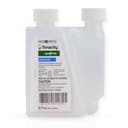
How much Tenacity do I mix per gallon of water?
For spot spraying, mix half a teaspoon (about 0.08 fl oz) of Tenacity per gallon of water plus 1.5 teaspoons of non-ionic surfactant, and spray it at about 1 gallon per 1,000 sq ft. A blanket broadcast is a separate label rate: 4 to 8 fl oz per acre, about 0.09 to 0.18 fl oz (0.55 to 1.1 teaspoons) per 1,000 sq ft. The calculator uses the low end. Always confirm against your label before spraying.
How much Spectracide Weed Stop do I mix per gallon of water?
Spectracide Weed Stop For Lawns Concentrate2 changes by grass: 2 fl oz (4 Tbsp) per gallon of water on bluegrass, fescue, ryegrass, and zoysia, 1 fl oz (2 Tbsp) on Bermuda, bahia, bentgrass, and centipede, and 0.75 fl oz (1.5 Tbsp) on St. Augustine. Each batch made with 1 gallon of water treats 500 sq ft. Plus Crabgrass Killer uses 5 fl oz per gallon of water for spot spraying (500 sq ft) or 6.4 fl oz per gallon of water for a whole lawn (1,000 sq ft). It is not for St. Augustine, centipede, bahia, or bentgrass. Check the exact bottle and grass exclusions before mixing.
What is the Ortho WeedClear concentrate mix ratio?
WeedClear Lawn Weed Killer Concentrate (the North bottle that kills crabgrass) mixes at 2.5 fl oz (5 Tbsp) per gallon of water for every 400 sq ft, on bluegrass, ryegrass, fescue, Bermuda, zoysia, and buffalograss only. WeedClear Weed Killer for Lawns Concentrate uses 2 fl oz per gallon of water on northern grasses and 1 fl oz per gallon of water on southern grasses. Each batch made with 1 gallon of water treats 500 sq ft. Follow your bottle's grass and cultivar exclusions.
How much Roundup concentrate do I mix per gallon?
Roundup Weed & Grass Killer Concentrate takes 6 fl oz (12 Tbsp) per gallon of water, or 3 fl oz for newly emerged annual weeds under 3 inches. Roundup Super Concentrate uses 1.5 fl oz (3 Tbsp) per gallon of water for annual weeds and 2.5 fl oz (5 Tbsp) for tough ones. Each batch made with 1 gallon of water treats 300 sq ft. Both kill lawn grass. Use only on sites listed on the bottle, and keep spray off plants you want to keep.
What is the Ortho GroundClear concentrate mix ratio?
GroundClear Super takes 5 fl oz per gallon of water for most weeds and 10 fl oz for established ones. Each batch made with 1 gallon of water treats 350 sq ft. GroundClear Year Long takes 24 fl oz (3 cups) per gallon of water for up to 300 sq ft. The finished batch exceeds 1 gallon. Year Long stays in the soil for up to a year. Never use it near a lawn, tree roots, or anywhere you plan to plant.
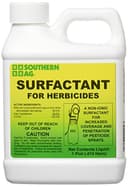
How much surfactant do I add per gallon?
Non-ionic surfactant (NIS) is typically 1 to 2 teaspoons per gallon of finished mix (about 0.25 fl oz). Methylated seed oil (MSO) runs stronger at about 3.3 teaspoons (0.55 fl oz) per gallon. Use the surfactant your herbicide label calls for: quinclorac works best with MSO, while Tenacity and most broadleaf herbicides pair with NIS.
What order do I mix herbicide and surfactant in the tank?
Follow your product label's mixing order. For these store presets, measure half the required water into a permitted sprayer, add the concentrate and agitate, then add the remaining measured water. Do not add surfactant to store presets. Pro recipes add the listed surfactant only when the label calls for it. A water-based recipe needs all the measured water plus the products; a pro blanket recipe needs water added to the stated finished spray volume. Use a sprayer with enough capacity and stay below its fill limit.
Why are spot spray rates different from blanket rates?
Spot and blanket directions can use different product amounts and coverage rules. Follow the selected label row. The pro blanket calculation assumes 1 gallon of finished spray per 1,000 sq ft. Tenacity's spot recipe uses half a teaspoon per gallon of water and requires application at about 1 gallon per 1,000 sq ft. Store presets use their own label coverage, shown with each recipe. A spot recipe does not remove the label's area or annual limits.
Can I mix two herbicides in the same tank?
Often yes, but only when both labels allow it. Do a jar test first: mix small amounts in a jar of water and watch for clumping or separation. Common safe combos include quinclorac plus a three-way broadleaf herbicide for crabgrass and broadleaf weeds in one pass. Never tank-mix products whose labels prohibit it.
How long is mixed herbicide good for in the tank?
Plan to spray the same day you mix. Most herbicides begin degrading in water within 24 hours, and some (like sulfonylureas) break down faster in acidic or warm water. Mix only what you'll use, and triple-rinse the sprayer afterward.