Andersons PGF Complete 16-4-8 Application Guide: Rate, Schedule + Results
 James ThorntonLawn Equipment & Maintenance Expert | 20 Years
As an Amazon Associate we earn from qualifying purchases.
If you have spent any time on lawn care YouTube or the lawn subreddits, you have seen it: the striped, almost unnaturally dark-green lawn, and somewhere in the comments, "PGF Complete." The Andersons PGF Complete 16-4-8 has become a cult favorite among lawn enthusiasts, and unlike a lot of internet-famous products, this one mostly earns the hype. But the bag alone does not tell you how to build a season around it, when it beats alternatives like Milorganite, or why your neighbor's results came faster than yours.
This guide covers the full picture: what actually makes PGF Complete different, how much to put down and how often, spreader technique for its unusually fine particles, and what a realistic results timeline looks like.
Not sure fertilizer is what your lawn needs? If your grass is yellowing, thinning, or patchy, feeding it harder is not always the fix. Upload a photo for a free diagnosis and find out whether you are looking at a nutrient deficiency, disease, or something else entirely before you spend money on another bag.
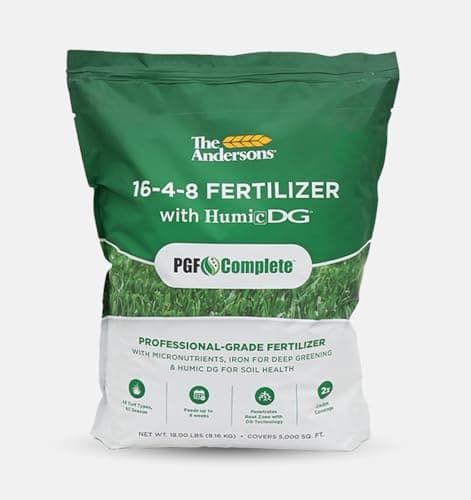
Fast Answer: Andersons PGF Complete 16-4-8 is a fine-particle, slow-release lawn fertilizer with humic acid. The small particle size puts far more granules on every square foot than a standard fertilizer, so feeding is more even, and the humic acid component helps nutrient uptake, especially in tired or compacted soils. It works on every common grass type, warm-season and cool-season.
Apply it at the rate printed on the bag roughly every 4 to 8 weeks during your grass's active growing season, and water it in with about a quarter inch of irrigation. Expect a gradual deepening of color over two to three weeks rather than an overnight transformation. That slow build is the slow-release nitrogen doing its job.
What Makes PGF Complete Different From a Box-Store Bag
Three things separate PGF Complete from the typical big-box fertilizer, and they explain most of the results people post online.
Fine particle size means even feeding
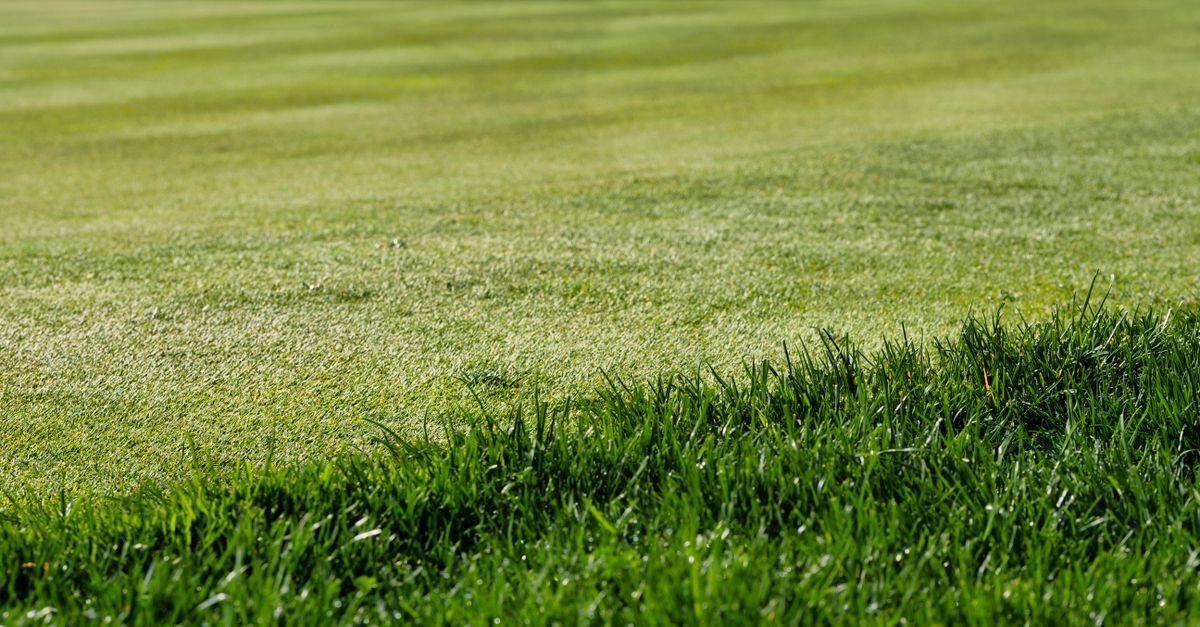
PGF Complete uses a much smaller granule than standard lawn fertilizer. Smaller particles mean dramatically more individual granules land on every square foot of turf. With a coarse fertilizer, each granule feeds a little circle of grass around itself and you can end up with subtle mottling, dark dots where prills landed, paler grass in between. With PGF's fine particles, the coverage is close to a dusting, so the whole lawn greens up uniformly. This is the single biggest practical difference you will notice.
Humic acid built into every granule
The "DG" humic component is a soil amendment, not a nutrient. Humic acid helps chelate nutrients so grass roots can actually take them up, and it is most valuable in soils that are compacted, sandy, alkaline, or just worn out. It will not transform bad soil in one application, but paired with every feeding across a season, it nudges soil biology in the right direction. If your lawn sits on builder-grade subsoil, this is a meaningful feature rather than marketing.
Slow-release nitrogen
A significant fraction of the nitrogen in PGF Complete is slow-release. That means a portion of the feeding is metered out over weeks instead of dumping all at once. The practical upsides: lower burn risk, steadier color instead of a surge-and-crash growth flush, and less nitrogen lost to leaching. The trade-off is patience. If you want neon green in five days, a fast-release fertilizer will beat it in a sprint and lose over the season.
The PGF Product Family: Complete, Balance, and 16-0-8
The Andersons sells several PGF formulations, and picking the right one matters more than most guides let on.
PGF Complete 16-4-8 is the flagship and the right default for most lawns. The 16-4-8 ratio (roughly 4-1-2) matches the way established turf actually consumes nutrients: lots of nitrogen, a little phosphorus, moderate potassium. If you have not soil tested and you want one bag to run all season, this is it.
PGF Balance 10-10-10 delivers equal parts of all three nutrients. Reach for it when a soil test shows your lawn is genuinely low in phosphorus and potassium, which is common in new construction soils and long-neglected lawns. It is also a sensible choice around seeding projects where local regulations allow phosphorus for establishment. Running 10-10-10 year after year on a lawn that does not need the P and K just wastes money and, in the case of phosphorus, can contribute to runoff problems.
The Andersons 16-0-8 with Humic DG is the phosphorus-free sibling, sold under the Andersons Premium line rather than the PGF name. Several states and municipalities restrict phosphorus application on established lawns unless a soil test documents a deficiency. If you live in one of those areas, or your soil test already shows ample phosphorus, 16-0-8 gives you the same fine-particle, humic-loaded feeding without the P.
What 16-4-8 Actually Means for Your Lawn
The three numbers are the percentages by weight of nitrogen (N), phosphorus (P), and potassium (K) in the bag. Nitrogen drives color and leaf growth, phosphorus supports root development and establishment, and potassium builds stress tolerance against heat, cold, and disease. A 16-4-8 is nitrogen-forward with supporting potassium, which is exactly what mature turf wants for maintenance feeding.
If you want the full breakdown of how to read any fertilizer label and match ratios to your lawn's situation, we cover it in our guide to what fertilizer numbers actually mean. And if you are deciding between granular products like PGF and spray-on feeding, see liquid vs granular fertilizer.
Application Schedule: When to Apply PGF Complete
PGF Complete works on any grass, but the calendar looks different depending on which kind you grow.
Warm-season grasses (Bermuda, Zoysia, St. Augustine, Centipede)
Warm-season grasses feed during the heat. Start after the lawn has fully greened up in late spring, never on dormant or half-awake turf, and continue through summer at roughly 4 to 8 week intervals. Bermuda, the hungriest of the group, can run the tighter end of that window; Centipede wants far less nitrogen overall, so stretch the interval and consider fewer total applications. Make your last feeding 6 to 8 weeks before your area's first expected frost so the grass hardens off instead of pushing tender growth into cold weather.
Cool-season grasses (Kentucky bluegrass, tall fescue, ryegrass)
Cool-season lawns feed hardest in fall, moderately in spring, and barely at all in summer. A typical PGF season: one application in mid-to-late spring once the lawn is growing steadily, then one to two applications in early and mid fall, when cool-season grass builds roots and recovers from summer. Skip or minimize summer feeding; pushing nitrogen on heat-stressed fescue is how you feed disease instead of grass.
Exact timing depends on your climate zone and the year's weather, so treat these windows as the shape of the season, not gospel. This is exactly the kind of guesswork a personalized plan removes: our premium care plan tells you the exact week to feed for your zip code and grass type, adjusted to the current season.
How Much to Apply: Rates and Coverage
Use the application rate printed on the bag. That sounds like a dodge, but it is the honest answer: The Andersons publishes the rate per 1,000 square feet, and it is calibrated to deliver an appropriate dose of nitrogen per feeding. What you control is the accuracy of the two numbers that rate depends on.
First, your actual lawn size. Most homeowners guess, and most guesses are badly wrong in one direction or the other. Measure it once with our lawn size calculator and write the number down; every fertilizer decision for the rest of your life gets easier.
Second, how much product that size demands. Our fertilizer calculator converts your square footage and grass type into how much fertilizer to buy and put down, so you are not doing bag math in the store aisle.
Spreader Settings and Technique
The bag carries a spreader settings chart for common models. Use it, and do not borrow a setting from a different fertilizer: PGF's fine particles flow through a spreader very differently than standard prills, so a setting that was right for your last product will overapply or underapply this one. If your spreader is not on the chart, set it low, spread a measured strip, weigh or eyeball what you used against the target rate, and adjust upward.
Two technique notes that matter more with PGF than with coarse fertilizers:
Overlap wheel-to-edge. Broadcast spreaders throw a pattern that is heaviest in the middle and thins at the edges. Run your passes so the edge of the throw reaches the wheel tracks of the previous pass. Because PGF applies so evenly, striping from missed overlap stands out badly against the uniform green everywhere else.
Consider a two-direction pass. A trick popular in the PGF community: set the spreader to half the target rate and make two full passes at right angles to each other, like mowing a checkerboard. It takes twice the walking and produces the most even application possible. Optional, but if you are chasing that YouTube lawn, this is part of how it is done.
Watering In: Do Not Skip This
Water PGF Complete in with roughly a quarter inch of irrigation or a well-timed rain shortly after application. Watering does three jobs: it washes the fine particles off grass blades and down to the soil surface, it activates the release of nutrients, and it eliminates the small burn risk of granules sitting on wet leaf tissue in hot sun. The fine particle size means product can cling to blades more than a coarse fertilizer would, so this step is less optional than usual. Avoid applying right before a downpour heavy enough to wash product into gutters and storm drains.
Extension guidance: Before building a season-long fertilizer program, get a soil test through your county extension office or a reputable lab. A test tells you whether you need the phosphorus and potassium in a 16-4-8, whether PGF Balance 10-10-10 makes more sense, and what your pH is doing to nutrient availability. Take exact application rates from the product bag and your state extension's turf fertilization guidelines for your specific grass; university recommendations for annual nitrogen totals vary meaningfully by species and region.
Results Timeline: What to Expect and When
PGF Complete is a marathon product. Here is a realistic arc:
Week 1: Little visible change. The fast-release fraction is starting to work, but color shifts are subtle.
Weeks 2 to 3: Noticeable deepening of green and a modest uptick in growth rate. This is when most people photograph the before-and-after.
Weeks 4 to 8: The slow-release fraction carries steady color without a growth surge. Toward the end of this window, color begins to fade, which is your cue that the next application is due.
Across a season: The compounding effect is real. Two or three consecutive feedings, plus the cumulative humic acid, produce the dense, dark turf the product is known for. One bag will not do it.
If your lawn is still yellow or pale two to three weeks after a properly watered-in application, stop and reassess before feeding again. Iron deficiency, pH problems, disease, and grubs all masquerade as hunger. A free photo diagnosis can tell you in about a minute whether you are looking at a deficiency or a disease, which saves you from throwing more nitrogen at a problem nitrogen cannot fix. For iron-driven yellowing specifically, see our Ironite application guide.
PGF Complete vs Milorganite
This is the comparison everyone asks about, because both products own a corner of lawn-forum culture. They are genuinely different tools.
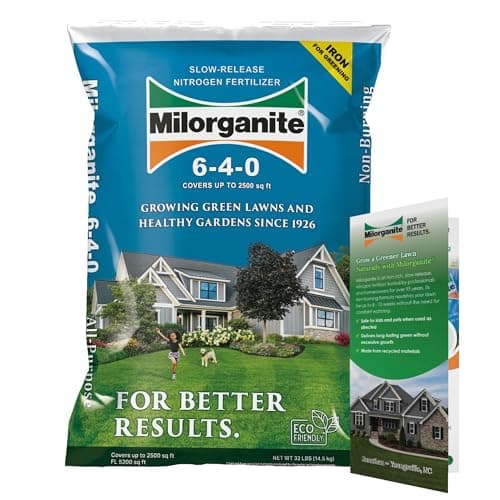
What they are. PGF Complete is a synthetic slow-release fertilizer with humic acid. Milorganite is an organic biosolid, recycled and heat-dried microbes from Milwaukee's water treatment process, with a low-analysis 6-4-0 ratio and iron.
Nitrogen delivery. PGF carries 16 percent nitrogen to Milorganite's 6 percent, so pound for pound of product, PGF delivers well over twice the nitrogen. That also means the cost per pound of actual nitrogen typically favors PGF, even when bag prices look similar. Milorganite's nitrogen releases very slowly and gently, which makes it nearly burn-proof but also slower and subtler in effect.
Color. PGF wins on raw green-up from nitrogen. Milorganite's iron content gives it a distinctive darkening effect without a growth surge, which is why people love it as a summer application when they want color but not mowing.
How enthusiasts actually use them. Not as rivals. A common pattern is PGF Complete as the backbone feedings of the season, with Milorganite slotted between them or during summer heat when a gentler feed is safer. If you only buy one, and your goal is the fastest path to a dark green lawn, PGF Complete is the more efficient choice. Full details on the alternative are in our Milorganite application guide.
What Other Guides Miss
The coverage claim on the bag assumes the low rate. When a bag advertises its maximum square footage, that figure is calculated at the lightest labeled application rate. Feed at the standard maintenance rate and the real-world coverage is smaller. Budget bags accordingly, and use your measured lawn size rather than the marketing number to decide how many to buy.
Phosphorus may be restricted where you live. Because PGF Complete contains phosphorus, several states restrict applying it to established lawns unless a soil test shows a deficiency or you are seeding. Check your state's fertilizer rules; if phosphorus is restricted, The Andersons 16-0-8 with Humic DG is the compliant sibling with the same feeding behavior.
The fine particles punish sloppy edges. Because coverage is so even, any strip you miss shows up as a visible pale band within three weeks. The half-rate, two-direction pass exists precisely to eliminate this.
It will not fix what fertilizer cannot fix. PGF Complete is a feeding product. Compaction, thatch, pH problems, shade, grubs, and fungus all cap your results no matter how good the fertilizer is. If two applications have not moved your lawn, the bottleneck is somewhere else.
Your PGF Complete Action Plan
- Measure your lawn with the lawn size calculator so every rate and coverage decision starts from a real number.
- Soil test first through your county extension. It tells you whether Complete 16-4-8, Balance 10-10-10, or 16-0-8 is the right family member, and whether pH is working against you.
- Time the first application to active growth: after full green-up for warm-season lawns, mid-to-late spring for cool-season lawns.
- Set the spreader from the bag chart, or run the half-rate two-direction pass for the most even feed possible.
- Water it in with about a quarter inch soon after application.
- Wait two to three weeks before judging results, and reapply on the bag's interval through the growing season.
- Investigate, do not re-feed, if color does not respond. A photo diagnosis or soil test finds the real bottleneck faster than another bag.
PGF Complete rewards consistency more than intensity. Follow the schedule for a full season and the lawn in the YouTube thumbnails stops looking like a trick of the lighting. And if you would rather not track intervals and frost dates yourself, our care plan tells you the exact week to feed for your zip code and grass type, all season long.
Top Picks
 The Andersons Professional PGF Complete 16-4-8 FertilizerCheck price on Amazon
 Milorganite 6-4-0 Slow-Release Nitrogen Fertilizer (32 lb)Check price on Amazon
As an Amazon Associate we earn from qualifying purchases.
Free Lawn Care Tools
Most lawns do well with an application roughly every 4 to 8 weeks during the active growing season. Warm-season grasses like Bermuda can handle the shorter end of that range in summer, while cool-season lawns should feed mainly in spring and fall and back off during summer heat stress. Always follow the interval and rate printed on the bag.
Use the setting chart printed on the PGF Complete bag for your specific spreader model. Because the particles are much finer than standard fertilizer, settings from other products do not transfer over. If your spreader is not listed, start low, walk a measured test area, and adjust until you are putting down the bag rate.
Yes. Water it in with roughly a quarter inch of irrigation or rain soon after application. Watering moves the fine particles off the grass blades and into the soil where the humic acid and nutrients can go to work, and it reduces any risk of tip burn in hot weather.
They are different tools. PGF Complete is a synthetic slow-release 16-4-8 with humic acid, so it delivers more nitrogen per bag and a faster, more visible green-up. Milorganite is an organic biosolid with much lower nitrogen that feeds very slowly and gently. Many lawn enthusiasts use PGF Complete as the main feeding program and Milorganite as a supplemental summer or between-feed application.
PGF Complete 16-4-8 is the general-purpose maintenance fertilizer, higher in nitrogen for color and growth. PGF Balance 10-10-10 delivers equal parts nitrogen, phosphorus, and potassium, which makes sense when a soil test shows your lawn is low in phosphorus and potassium, or when establishing new turf where local rules allow starter phosphorus.
If color has not improved two to three weeks after a properly watered-in application, nitrogen may not be the problem. Iron deficiency, soil pH issues, compaction, disease, and grub damage all mimic underfeeding. A soil test or a photo diagnosis can tell you whether to keep feeding or treat something else.

Beat weeds and brown spots from your phone
Snap a photo, get the fix, and follow a plan timed to your soil and weather. Free on iPhone.