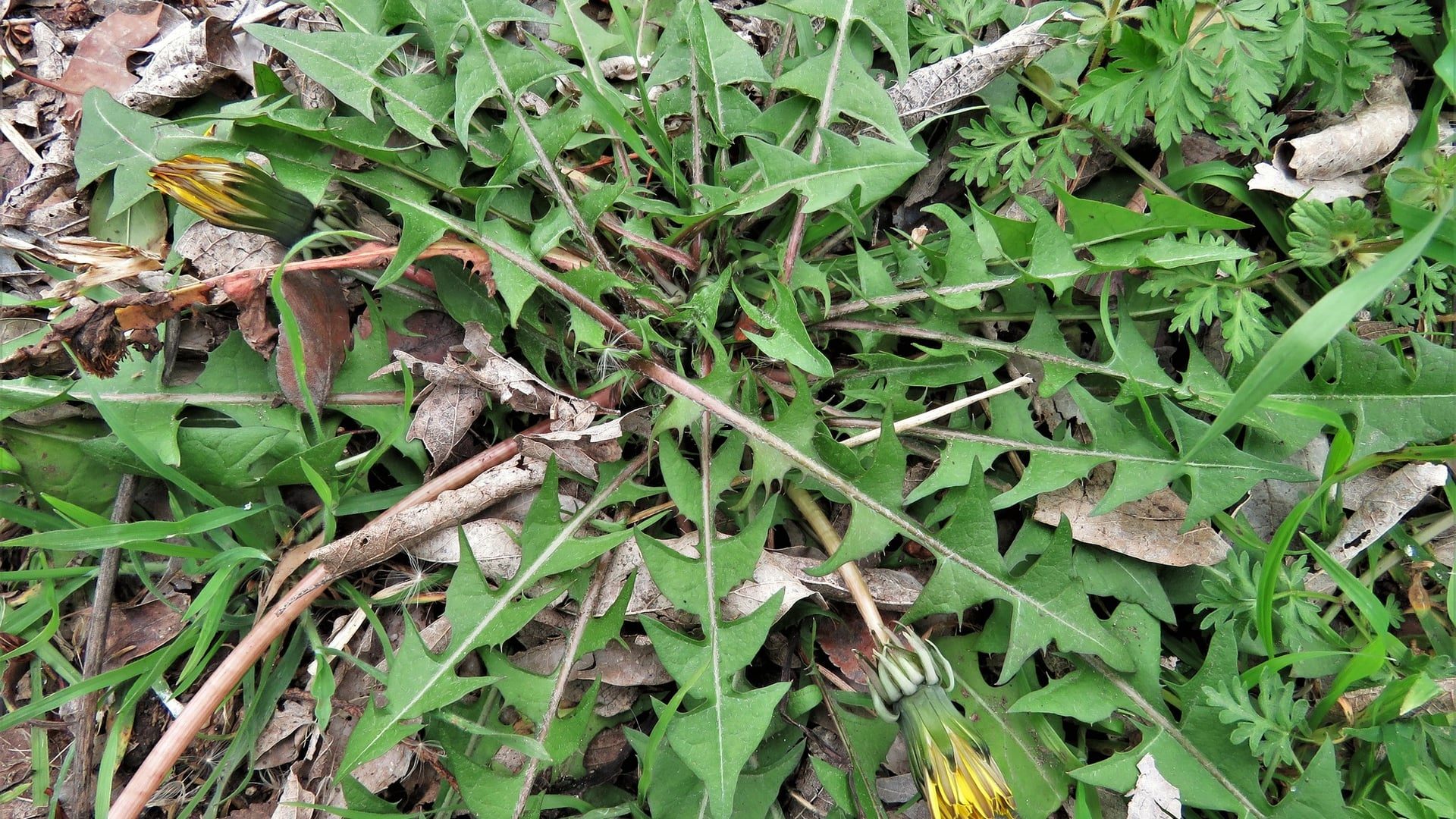
How to Use Ortho WeedClear Lawn Weed Killer: Mix Ratio, Timing + What It Kills
 James ThorntonLawn Equipment & Maintenance Expert | 20 Years
As an Amazon Associate we earn from qualifying purchases.
Two bottles. Same brand, same shelf, both say WeedClear. One mixes at 2.5 fl oz per gallon and kills crabgrass. The other mixes at 2 fl oz or 1 fl oz depending on your grass, and leaves crabgrass alone. Grab the wrong one for a St. Augustine lawn and you're spraying your own yard. Here's how to tell them apart, the exact rate for each, and when to spray.
Loading Herbicide Timing Calculator...
Mix Ortho WeedClear Lawn Weed Killer Concentrate at 2.5 fl oz per gallon of water for every 400 sq ft, and WeedClear Weed Killer for Lawns Concentrate at 2 fl oz per gallon per 500 sq ft on northern grasses or 1 fl oz per gallon per 500 sq ft on southern grasses, per the current Ortho labels. Spray small, actively growing weeds below 90°F, skip mowing for 2 days before and after, and give it a dry 24 hours.
Curling shows in a few days. Tough weeds get a second pass at 21 days or 30 days, depending on the bottle. The crabgrass bottle kills crabgrass under 4 inches tall, and it's off-limits on St. Augustine, centipede, and bahia. Neither one touches dallisgrass. Pets stay off until the spray dries.
What Ortho WeedClear Is (and What Happened to Weed B Gon)
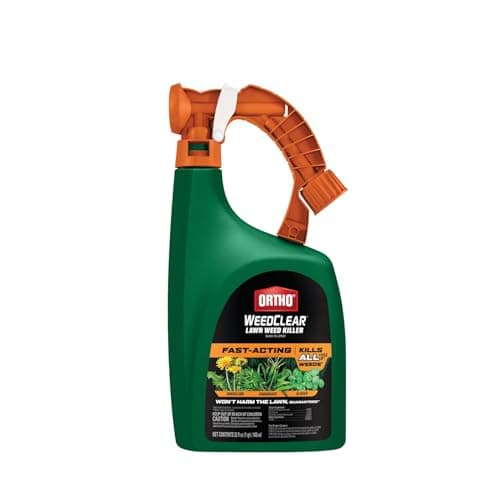
WeedClear is Ortho's selective lawn weed killer line. Selective means it kills the weeds and leaves listed lawn grasses standing. Simple enough. The catch is the name. WeedClear covers several different chemistries, and the front of the bottle is the only thing telling them apart.
The two concentrates you'll find in the aisle:
- WeedClear Lawn Weed Killer Concentrate, sold as the North version. 2,4-D, quinclorac, and dicamba. The quinclorac is the crabgrass killer. EPA Reg. No. 2217-896-239.
- WeedClear Weed Killer for Lawns Concentrate. 2,4-D, mecoprop-p, and dicamba. Broadleaf weeds only. EPA Reg. No. 239-2744.
The ready-to-use bottles are different formulas again. The South ready-to-use adds carfentrazone to a 2,4-D, mecoprop-p, and dicamba mix. One Weed Killer for Lawns ready-to-use swaps in MCPA. Same logo on all of them. Read the active ingredients box before you read anything else. Ingredient percentages come from Ortho's Lawn Weed Killer Concentrate page and Weed Killer for Lawns Concentrate page.
Is Weed B Gon being discontinued?
The name is going away. The chemistry stays. WeedClear Weed Killer for Lawns Concentrate carries EPA Reg. No. 239-2744. EPA's file for that number lists the product as "WBG 553 Concentrate," with the same three actives at the same percentages: 8.658% 2,4-D salt, 2.127% mecoprop-p salt, 0.371% dicamba. Same engine, new badge on the hood.
So if Weed B Gon worked for you, the Weed Killer for Lawns concentrate is the closest match. Ortho sells its lawn weed killers under the WeedClear name now. Find an old Weed B Gon bottle in the garage? Use the rate on that bottle. Label wording changed between printings.
Which Weeds WeedClear Kills
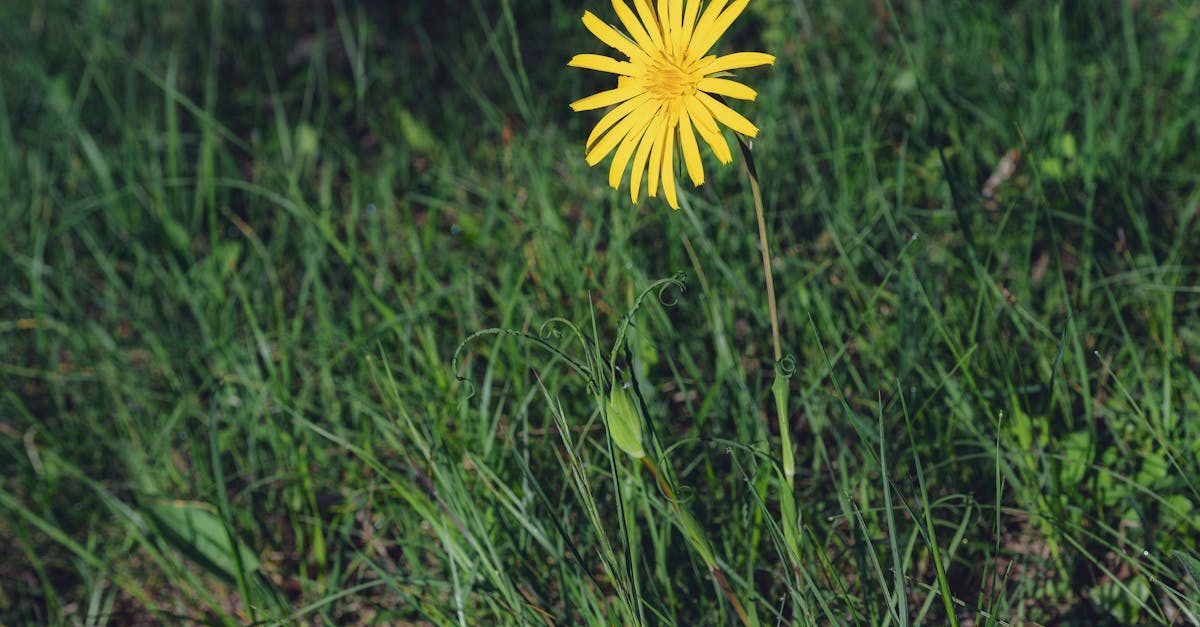
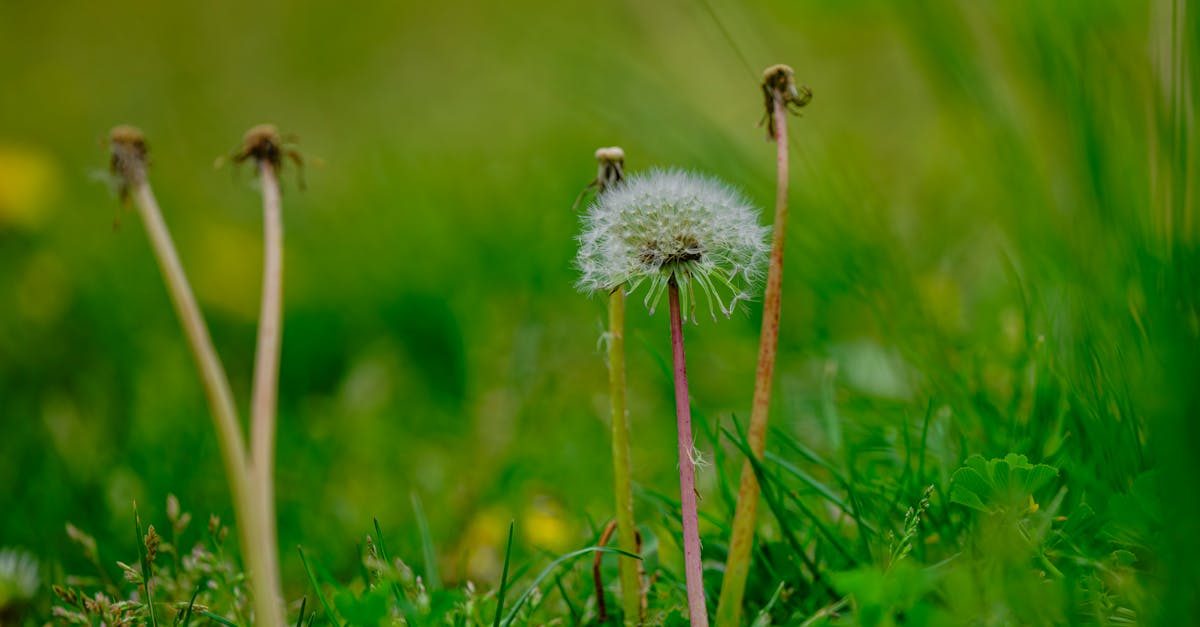
Both concentrates list the everyday broadleaf weeds. They split on crabgrass and wild violet. Here's what each label lists for the weeds people actually search for, plus what extension research says to expect.
| Weed | Lawn Weed Killer Concentrate (crabgrass bottle) | Weed Killer for Lawns Concentrate | What to expect |
|---|---|---|---|
| Dandelion | Listed | Listed | Easy target. One spray usually does it. |
| White clover | Listed | Listed | Dies. So does clover you wanted in the lawn. |
| Crabgrass (large, smooth) | Listed, under 4 inches tall | Not listed | Only the quinclorac bottle. Hit it young. |
| Creeping charlie (ground ivy) | Listed | Listed | Needs fall timing and a second pass. |
| Wild violet | Listed | Not listed | Hard. Plan on repeat treatments over more than one season. |
| Prostrate and spotted spurge | Listed | Listed | Summer annual. Spray while small. |
| Dallisgrass | Not listed | Not listed | Wrong tool. See below. |
Label listings from the Lawn Weed Killer Concentrate label (PDF) and the EPA master label for Weed Killer for Lawns (PDF). The Weed Killer for Lawns label says it outright: "Clover will be damaged if sprayed." Skip it if you overseeded clover on purpose.
Does WeedClear kill crabgrass?
One of them does. The Lawn Weed Killer Concentrate lists large and smooth crabgrass, plus foxtail and broadleaf signalgrass. The label timing is specific: spray in spring before crabgrass hits 4 inches tall, or when you first notice it. Dense patches get a second application after 3 weeks.
The Weed Killer for Lawns concentrate doesn't list crabgrass at all. If crabgrass is the problem, check the front panel for the word "crabgrass" at the store. And plan on a pre-emergent next spring, because spraying crabgrass every June is the expensive way to do it.
Creeping charlie and wild violet: the two that come back
Both are on a WeedClear label. Both regrow. Budget for two passes.
Creeping charlie first. Purdue turf research found fall applications made from September 1 through October 15 cut ground ivy to 5% cover or less, against 45% in untreated plots. Purdue also notes it often regrows after about 24 days and recommends a second application at 28 days. Your label sets the floor, though: 21 days on the crabgrass bottle, 30 days on Weed Killer for Lawns. Wait for the label date. One more Purdue finding worth knowing: dicamba and quinclorac do little on ground ivy. On either bottle, the 2,4-D does the heavy lifting. Source: Purdue Turfgrass Science.
Wild violet is worse. Penn State Extension blames a thick, waxy leaf coating that blocks herbicide uptake and tough underground rhizomes that regrow, and says triclopyr products give the best control, with repeat treatments across multiple years. Penn State's list of products labeled for violet does include the 2,4-D, quinclorac, and dicamba combination, which is the crabgrass bottle's recipe. Works, slowly. Violets the target? Skip the Weed Killer for Lawns concentrate. They aren't on its label. Source: Penn State Extension.
The dallisgrass problem: why WeedClear won't fix it
Dallisgrass is a grass. WeedClear is built to spare grass. Neither concentrate lists it, and the crabgrass bottle's grass-weed list stops at crabgrass, foxtail, and signalgrass. Re-spraying won't change that.
Real options for dallisgrass: spot-treat clumps with a non-selective herbicide and reseed the dead spot, dig clumps out, and run a pre-emergent program to stop new seedlings next season. Not sure the ugly clump is dallisgrass, crabgrass, or tall fescue? Upload a photo for a free diagnosis before you spend a season spraying the wrong product at it.
Is WeedClear Safe for Your Grass? North vs. South Formulas
Match the bottle to the grass. That's the whole safety rule. Ortho sells a North and a South version of Lawn Weed Killer, and the Weed Killer for Lawns concentrate covers both regions with two different rates. Most lawn damage from this product line comes from skipping that step.
| Your grass | Lawn Weed Killer Concentrate (North, kills crabgrass) | Weed Killer for Lawns Concentrate |
|---|---|---|
| Kentucky bluegrass, ryegrass, tall and fine fescue | Yes: 2.5 fl oz per gal per 400 sq ft | Yes: 2 fl oz per gal per 500 sq ft |
| Bermuda, common | Yes: 2.5 fl oz per 400 sq ft, not above 85°F | Yes: 1 fl oz per gal per 500 sq ft |
| Bermuda, hybrid | Yes: 2.5 fl oz per 400 sq ft, not above 85°F | Yes: 1 fl oz per 500 sq ft, not above 85°F |
| Zoysia, buffalograss | Yes: 2.5 fl oz per 400 sq ft | Yes: 1 fl oz per 500 sq ft |
| Bahia | No | Yes: 1 fl oz per 500 sq ft |
| Centipede | No | Yes: 1 fl oz per 500 sq ft |
| St. Augustine (not Floratam) | No | Yes: 1 fl oz per 500 sq ft |
| Floratam St. Augustine, bentgrass, carpetgrass | No | No |
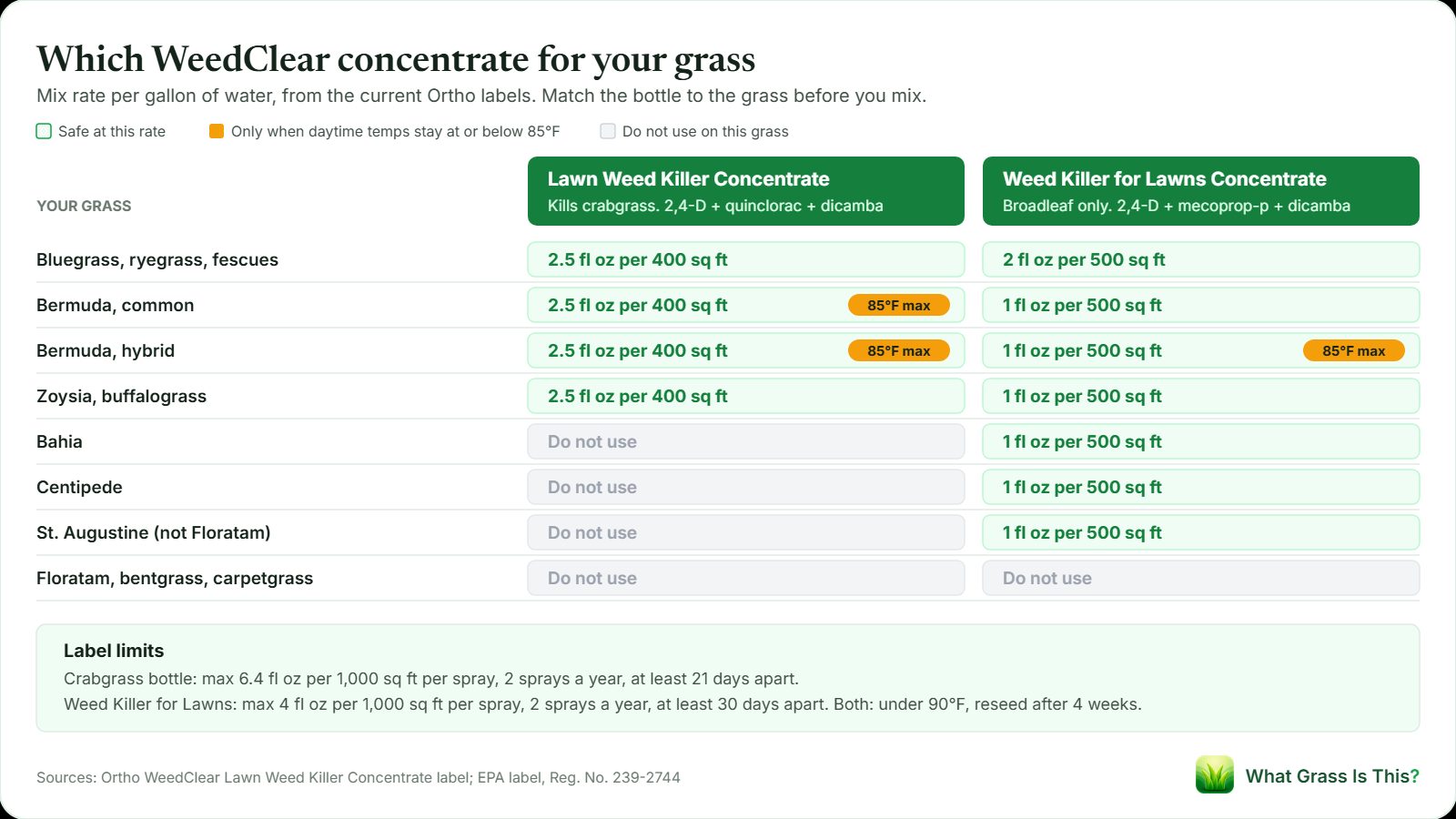
Grass lists come from the Lawn Weed Killer Concentrate label and the Weed Killer for Lawns EPA label. Bermuda may yellow for a bit after either spray. Both labels say full recovery can be expected.
St. Augustine or centipede lawn and you want a ready-to-use bottle? Ortho's Lawn Weed Killer (South) lists both, except Floratam. It's a different mix with carfentrazone, and it says to spray below 90°F with no 90°F heat expected for 6 hours. For Bermuda and zoysia specifically, the tolerant warm-season grasses like Bermuda and zoysia get their own rundown.
Your exact rate and temperature cutoffs come from the label on your bottle. Not from a blog, including this one.
Mixing and Applying WeedClear
Ready-to-spray vs. concentrate
The Ortho WeedClear ready-to-spray hose-end bottle meters itself. Hook up the hose, walk the lawn at an even pace, done. Buy it if you're treating the whole yard and don't own a tank sprayer. The concentrate is cheaper per square foot and better for spot-spraying, but you mix it yourself in a pump sprayer.
Concentrate mix ratio
Two concentrates, three rates. These numbers come straight from the current labels. If your bottle ever disagrees, the bottle wins.
| Concentrate on your shelf | Mix rate | One gallon of mix covers | Product per 1,000 sq ft | Dial N Spray setting |
|---|---|---|---|---|
| WeedClear Lawn Weed Killer Concentrate (the bottle that also kills crabgrass) | 2.5 fl oz (5 Tbsp) per gallon of water | 400 sq ft | 6.25 fl oz (label cap 6.4) | 2.5 oz |
| WeedClear Weed Killer for Lawns Concentrate, northern grasses (bluegrass, ryegrass, fescues) | 2 fl oz (4 Tbsp) per gallon of water | 500 sq ft | 4 fl oz (label cap 4) | 2 oz |
| WeedClear Weed Killer for Lawns Concentrate, southern grasses (Bermuda, zoysia, bahia, buffalograss, centipede, St. Augustine except Floratam) | 1 fl oz (2 Tbsp) per gallon of water | 500 sq ft | 2 fl oz | 1 oz |
Two pieces of fine print. First, the older directions still on EPA's Weed Killer for Lawns file give southern grasses 1 fl oz per gallon over 1,000 sq ft in a pump sprayer. Half the dose. If that's what your bottle says, use it. Second, Ortho's web page for the crabgrass concentrate shows 3 fl oz per gallon per 500 sq ft, while the bottle label says 2.5 per 400. Both work out to about 6 fl oz per 1,000 sq ft. Go with the bottle.
Application limits from the labels. The Lawn Weed Killer Concentrate caps at 6.4 fl oz of product per 1,000 sq ft per application, two applications per year, at least 21 days apart. The Weed Killer for Lawns Concentrate caps at 4 fl oz per 1,000 sq ft, two applications per year, at least 30 days apart. Don't freelance a stronger mix. Overdosing a selective herbicide turns a weed treatment into lawn damage, and it doesn't kill tough weeds any deader. Sources: the current retail label (PDF) and the EPA master label for the Weed Killer for Lawns formula (PDF).
Shop math: a 5,000 sq ft lawn
Givens: 5,000 sq ft of lawn, measured. Pump sprayer.
- Kentucky bluegrass with crabgrass in it, using the Lawn Weed Killer Concentrate: 5,000 ÷ 400 = 12.5 gallons of mix.
- 12.5 gallons × 2.5 fl oz = about 31 fl oz of concentrate. That's one 32 oz bottle. Ortho rates the bottle at up to 5,000 sq ft and listed it at $14.49 in September 2026, so call it about $2.90 per 1,000 sq ft.
- Same lawn, broadleaf weeds only, using Weed Killer for Lawns (northern rate): 5,000 ÷ 500 = 10 gallons of mix, 10 × 2 fl oz = 20 fl oz of concentrate.
- Southern lawn with the same bottle: 10 gallons of mix, 10 fl oz of concentrate. A 32 oz bottle covers 16,000 sq ft at that rate, per the label.
Weeds in three patches? Measure the patches, not the yard. You don't repaint the whole truck for a scratch on the door.
To get square footage, measure the area first. The Lawn Size Calculator gets it from a satellite trace in about a minute. Then the table above tells you how many gallons to mix.
When to spray
The setup sheet, straight off the labels:
- Weeds: small and actively growing, spring or fall. Dormant or drought-stressed weeds take up very little.
- Temperature: below 90°F. The crabgrass bottle's page gives a 45°F to 90°F window. Bermuda: not above 85°F.
- Mowing: none for 2 days before and 2 days after. You want leaf surface for the spray to land on, and time for it to move into the plant.
- Water: if the lawn is dry, water it 24 hours before spraying. Then no watering for 24 hours after.
- Wind: calm. Spray drifts onto flowers, vegetables, and shrubs, and WeedClear kills those too. Broadleaf means broadleaf.
- Sprayer: coarse spray. Fine mist drifts.
Set it. Spray it. Leave it alone.
Juggling this against pre-emergent windows, fertilizing, and seeding? The Herbicide Timing Tool maps when each product belongs on your lawn so the applications don't fight each other. Seeding matters most. Both concentrate labels say wait 4 weeks after spraying before you reseed. On a new lawn, the crabgrass bottle wants the grass at least 2 inches tall, and Weed Killer for Lawns wants it mowed 3 times first.
How Long Does WeedClear Take to Work?
A few days to see it. A few weeks to judge it.
- First few days: the Weed Killer for Lawns label says "Effects begin to show after a few days, and weeds gradually die." Treated weeds twist, curl, and cup. That twisting is the signature of growth-regulator herbicides like 2,4-D and dicamba. It means the spray landed. Ortho's product pages advertise results "in hours." Early symptoms, maybe. Dead weeds take weeks.
- Three to four weeks: the re-treat check. The crabgrass bottle allows a second application or spot treatment at 21 days. Weed Killer for Lawns says if tough weeds aren't dead within 30 days, repeat.
Wild violet and creeping charlie routinely look half-dead at week three, then push new leaves from surviving roots. Perennial biology. Wait for the label's date, then hit the regrowth. Two applications a year is the cap on both concentrates, so make them count.
Rainfast window
The marketing and the labels don't agree. Here's each claim, side by side.
| Bottle | Product page claim | What the label says |
|---|---|---|
| Lawn Weed Killer Concentrate | Rainproof in 1 hour | Do not water lawn within 24 hours of treatment |
| Weed Killer for Lawns Concentrate | Rainproof in 1 hour | Do not apply if rain is expected within 24 hours; allow 12 hours before watering |
| Lawn Weed Killer Ready-to-Use (South) | Rain or watering 6 hours after won't wash it away | Same 6 hours on the product page |
My call: plan on a dry 24 hours with the concentrates. Check the radar and shut off the irrigation controller for the day. Rain inside that window waters a diluted spray into the soil, where it does nothing for you. Sources: the Lawn Weed Killer Concentrate page, the Weed Killer for Lawns Concentrate page, and the two labels linked above.
Is WeedClear Safe for Pets?
Keep pets and people off until the spray dries. Both concentrate labels say it word for word: "Do not allow people or pets to enter the treated area until sprays have dried." Ortho's page for the crabgrass concentrate adds that they "may safely reenter once the area has dried."
Make it easy on yourself. Spray in the morning so the lawn is dry by afternoon. Treat the backyard and front yard on different days so the dog always has somewhere to go. Store the concentrate in its original container, locked up, which is what the label asks for anyway. If you keep rabbits or other pets that graze the lawn, read your bottle's precautionary statements first. They vary by formula.
WeedClear vs. Roundup: Not the Same Tool
Roundup (glyphosate) is non-selective. It kills about everything green it touches, your lawn included. WeedClear is selective. It kills listed weeds growing in listed grasses and spares the grass. Use WeedClear on weeds in the lawn. Use a non-selective product for driveway cracks, gravel, fence lines, and total-kill renovations where dead grass is the point. If you're clearing an area completely, or you came here for the GroundClear mix ratio, the Ortho GroundClear vs. Roundup guide covers the non-selective side of the aisle.
- Exact mix rates, per-grass maximums, and seasonal application counts come from your product label, which is a legal document. When the label and any blog disagree, the label wins.
- University of Illinois Extension calls fall the ideal time to control broadleaf weeds in turf, because perennial weeds are preparing for winter.
- Purdue turf research found fall sprays from September 1 through October 15 controlled ground ivy well, and recommends a second application about four weeks after the first. Stay inside your label's minimum interval.
- Penn State Extension rates triclopyr products best for wild violet and warns that control can take repeat treatments over multiple years.
- If you're planning to overseed, both WeedClear concentrate labels require 4 weeks between spraying and seeding. Your county extension office can confirm the safe spray temperatures for your grass and region.
What Other Guides Miss
The name hides the chemistry. Most WeedClear write-ups treat it as one product. It's at least four. The crabgrass concentrate runs quinclorac. The Weed Killer for Lawns concentrate runs mecoprop-p and is the old Weed B Gon registration. The South ready-to-use adds carfentrazone. One ready-to-use runs MCPA. That's why the rates, the grass lists, and the weed lists all differ. Read the active ingredients box and the grass list on the bottle in your hand.
The failure is lopsided, too. Use the southern rate on a northern lawn and you get weaker weed control. Use the crabgrass bottle on St. Augustine, centipede, or bahia and you can kill the lawn. Big-box stores stock both bottles side by side.
Weed identity matters as much as the bottle. A lot of "WeedClear didn't work" complaints come from spraying a broadleaf herbicide at grassy weeds like dallisgrass, quackgrass, or coarse tall fescue clumps. The product did its job. It spared the grass. The weed just turned out to be a grass. Thirty seconds of identification saves a season of useless spraying, which is why the free photo diagnosis keeps coming up before the sprayer does.
Last one. Killing weeds without a follow-up plan just books the rematch. Every dead dandelion leaves a bare patch, and bare patches are where next year's weeds sprout. Pair the spraying with a pre-emergent and feeding schedule. That's what the site's paid 12-month care plan does: it gives you the week to put down pre-emergent for your ZIP code and grass type, so you reach for products like WeedClear less often.
Comparing Notes with Other Herbicides
WeedClear sits in a crowded aisle. Spectracide Weed Stop is the budget-shelf rival with similar selective chemistry, and the Spectracide Weed Stop instructions guide covers it the same way. Fighting weeds during a seeding project? Tenacity (mesotrione) plays a very different role and can go down around new seed where WeedClear can't.
Your WeedClear Action Plan
- Identify the weed. Photo, free AI diagnosis, then confirm it's on your bottle's label. Dallisgrass or another grassy weed? Stop. Different tool.
- Pick the bottle by grass. Crabgrass concentrate for cool-season lawns, Bermuda, zoysia, and buffalograss. Weed Killer for Lawns for anything else except Floratam.
- Measure. Use the Lawn Size Calculator, then mix to the label rate: 2.5 fl oz per gallon per 400 sq ft, or 2 fl oz or 1 fl oz per gallon per 500 sq ft.
- Pick the day. Weeds actively growing, calm, under 90°F (85°F on Bermuda), dry for the next 24 hours, no mowing 2 days either side.
- Spray to wet, then wait. Curling in a few days. Pets off until dry.
- Re-treat survivors at the label interval: 21 days or 30 days. Wild violet and creeping charlie almost always need it, ideally in fall.
- Close the loop. Reseed bare spots no sooner than 4 weeks after spraying, then get on a pre-emergent and feeding schedule so the gaps fill with grass instead of next year's weeds.
Right bottle, right rate, right week. That's the job.
Top Picks

As an Amazon Associate we earn from qualifying purchases.
Free Lawn Care Tools
Ortho WeedClear Lawn Weed Killer Concentrate, the bottle that also kills crabgrass, mixes at 2.5 fl oz per gallon of water for every 400 sq ft, per its label. WeedClear Weed Killer for Lawns Concentrate mixes at 2 fl oz per gallon per 500 sq ft on northern grasses and 1 fl oz per gallon per 500 sq ft on southern grasses. Check the front of your bottle and use its rate.
Only the WeedClear Lawn Weed Killer Concentrate does, because it contains quinclorac. Its label lists large and smooth crabgrass and says to spray in spring before crabgrass is 4 inches tall, with a second application after 3 weeks for dense patches. The Weed Killer for Lawns concentrate does not list crabgrass.
Yes, both WeedClear concentrates list ground ivy, also called creeping charlie. Purdue research found fall sprays from September 1 through October 15 controlled it well and that ground ivy often regrows, so plan on a second application. Wait at least 21 days (crabgrass bottle) or 30 days (Weed Killer for Lawns) between sprays, per the labels.
Wild violet is listed on the WeedClear Lawn Weed Killer Concentrate label but not on the Weed Killer for Lawns concentrate label. Penn State Extension says triclopyr products control violets best and that repeat treatments over multiple years may be needed. Spray in fall and expect regrowth.
No, Ortho WeedClear does not reliably kill dallisgrass, because dallisgrass is a perennial grass and neither WeedClear concentrate lists it. Spot-treat clumps with a non-selective herbicide and reseed, dig them out, and use a pre-emergent the next season to stop new seedlings.
Weeds start twisting and curling within a few days, and the Weed Killer for Lawns label says weeds then gradually die. Judge the result at the label's re-treat date: 21 days for the crabgrass bottle and 30 days for Weed Killer for Lawns. Re-spray survivors then, and not before.
The WeedClear labels say not to let people or pets into the treated area until the spray has dried. Ortho's product page adds that they may safely reenter once the area has dried. Spray in the morning so the lawn is dry by afternoon, and read your bottle's precautions if your pets graze the lawn.
Yes, both WeedClear concentrates list common and hybrid Bermuda. Use 2.5 fl oz per gallon per 400 sq ft with the crabgrass bottle or 1 fl oz per gallon per 500 sq ft with Weed Killer for Lawns. The labels say not to spray hybrid Bermuda when daytime temperatures exceed 85°F, and the crabgrass bottle applies that limit to all Bermuda.
The Weed B Gon name is being replaced by WeedClear, but the chemistry carries on. WeedClear Weed Killer for Lawns Concentrate uses EPA Reg. No. 239-2744, which EPA's records list as WBG 553 Concentrate, with the same three active ingredients at the same percentages. If you liked Weed B Gon, that is the closest WeedClear bottle.
Photos: Annika Lindqvist / iNaturalist · CC BY 4.0

Beat weeds and brown spots from your phone
Snap a photo, get the fix, and follow a plan timed to your soil and weather. Free on iPhone.