6 Types of Grass in Utah and How to Tell Which You Have

As an Amazon Associate we earn from qualifying purchases.
Utah lawns are mostly Kentucky bluegrass, usually blended with perennial ryegrass and fine fescue, with turf-type tall fescue as USU Extension's "good general purpose" alternative. Buffalograss is the low-water option, and bermudagrass is used as a lawn in Washington County around St. George.
Seed cool-season grasses in late summer, 4 to 6 weeks before the first frost. When your water district cuts you to twice a week, USU says tall fescue may get by on somewhat less irrigation and buffalograss needs much less water to stay green in summer; bluegrass goes dormant and recovers in the fall.
Along the Wasatch Front and in Cache Valley, a lot of yards run on secondary water, the untreated canal water that the state now requires to be metered by 2030, and in a drought year the local district decides how many days a week you get to use it. That changes which grass makes sense here. The Utah State University Extension turf program has a clear lineup, and it is mostly cool-season: Kentucky bluegrass, tall fescue, fine fescue, and perennial ryegrass, with buffalograss for people who want to water less on purpose and bermudagrass in the warm St. George corner. Here is the rundown, how to tell which one you already have, and the timing USU publishes for each part of the state.
The types of grass that grow in Utah
Kentucky Bluegrass
Kentucky bluegrass is the default Utah lawn. USU's northern Utah establishment guide says "Cool-season turf species, such as Kentucky bluegrass, are most commonly planted in northern Utah," and USU's plant pest lab puts it plainer: "Most lawns in Utah are comprised of cultivars of Kentucky bluegrass (KBG), perennial ryegrass and fine fescue." USU's cultivar guide says it is "best suited to lawns that will have a lot of traffic and full sun to partial shade" and that it "recovers well from frequent use," which is the rhizomes talking: bluegrass heals its own bare spots. The Utah catches are water and salt. It is a higher-water option than tall fescue or buffalograss, so it is the lawn most likely to go dormant when the district drops you to two waterings a week, and USU's salt guide says high soil salt limits "some turfgrasses, especially Kentucky bluegrass," which matters on the alkaline soils west of the Wasatch. USU also flags summer patch and necrotic ring spot as diseases it is susceptible to when it is mismanaged.
Tall Fescue
Tall fescue is the grass USU keeps nudging Utah homeowners toward. The cultivar guide calls it "a good general purpose turfgrass for Utah" that "often has greater heat tolerance and can tolerate more shade than Kentucky bluegrass," and adds that it "may also get by on somewhat less irrigation due to its deep rooting." That deep rooting is the whole story on secondary water: when the canal schedule gets tight, a grass that reaches deeper for moisture has more to work with. USU's pest lab recommends turf-type tall fescue as "a viable alternative to KBG, ryegrass, fine fescues, and other cool-season species for home lawns in Utah," particularly for lawns that keep getting summer patch and necrotic ring spot, and USU's salt guide rates its salt tolerance well above bluegrass. USU's cultivar list for Utah includes Coronado Gold, Blade Runner, Inferno, Matador GT, Cayenne, and Silverstar. Like the other bunch-type grasses it does not spread by runners, so bare spots are generally filled by overseeding rather than by the grass itself.
Fine Fescue
Fine fescues are the quiet third of a typical Utah blend, the species USU's pest lab names alongside bluegrass and ryegrass as what most Utah lawns are made of. USU's cultivar guide says they are "ideal for shady areas" with "slower growth and low fertilizer needs," and that "most are drought tolerant." Read that as: the north side of the house, under the big spruce, along the fence where the sprinklers barely reach. Slow growth and low fertilizer needs also make them the low-input member of the group. Fine fescues are bunch-type grasses that thin under heavy foot traffic, so they suit quieter areas better than a play lawn. USU's salt guide rates their salt tolerance in the middle of the pack, better than bluegrass. USU lists a long cultivar set for Utah, including Marco Polo, Bighorn, Audubon, Inverness, Garnet, Dawson, and Tiffany. In practice you will meet them inside a blend rather than as a whole lawn, and the thread-thin blades give them away.
Perennial Ryegrass
Perennial ryegrass earns its spot in a Utah blend for speed. It is the fastest of the cool-season lawn grasses to germinate, so it holds the soil on a new seeding while the slower bluegrass comes up behind it, and USU's cultivar guide says it "can provide the most formal appearance of the turfgrasses." The same sentence carries the warning: it is "relatively high maintenance." Ryegrass wants regular water and fertilizer to keep that formal look, which is a real cost on a rationed canal schedule. It is a bunchgrass and will not fill damage on its own. Where it does shine is salt: USU's salt guide rates it alongside tall fescue at the top of the common lawn grasses for salinity tolerance, which is worth knowing if your secondary water runs a little brackish. USU's Utah cultivar list includes Amazing GS, Calypso II, Caddieshack II, Paragon GLR, and Uno. Read the seed label; a bag that is mostly ryegrass buys a fast lawn now and a high-maintenance one after that.
Buffalograss
Buffalograss is the grass USU points to when someone asks how to keep a lawn and stop fighting the water district. The cultivar guide says buffalograss lawns "require much less water to remain green during summer," and USU's Center for Water-Efficient Landscaping calls it "a good turf choice for Intermountain landscapes." The catch is the calendar: USU notes it is "dormant (brown) in early spring and much of the fall season," and its salt-affected-sites guide says these warm-season natives "green up in late May and brown with the first hard frost in the fall." So you trade a long green season for a lawn that asks far less of the canal schedule. USU lists Texoka, Cody, Bison, Sharps Improved, Legacy, Bowie, and SWI 2000 as cultivars that fit Utah, and says it is among the "excellent choices for naturalized or low maintenance lawns" where soil salt is relatively low. It is a warm-season native with a gray-green color rather than a bluegrass green, and USU notes that the common Utah lawn species, "including buffalograss, can all be mowed at a height of 2-4 inches."
Bermudagrass
Bermudagrass is used as a lawn in Washington County, especially around St. George. USU's southern Utah establishment guide says "Warm-season grasses grown in the region include buffalograss, bermudagrass (in Washington County), and zoysiagrass," and the St. George turf calendar says warm-season grasses such as "Buffalograss and bermudagrass, should be seeded in the spring or early summer months to take best advantage of the warmer temperatures." Outside that warm corner, USU's weed control guide treats it as an invader: it "actively grows when daytime temperatures are above 80° F," it "spreads by rhizomes, stolons and seed," and removing it from a cool-season lawn takes triclopyr or fenoxaprop where "repeated applications are necessary over a period of 2-3 years." Along the Wasatch Front it is a weed, and a stubborn one. Bermuda is a warm-season grass that is mowed lower than the cool-season lawns and goes brown through the cold months, so a St. George bermuda lawn spends winter dormant.
Two more names deserve a mention without a photo. Blue grama is the other native warm-season grass USU recommends for Utah, and its salt-affected-sites guide says "Where salt levels are relatively low, blue grama and buffalograss are excellent choices for naturalized or low maintenance lawns," with the note that the two "can be planted together, but do not mix well with other grass species." Expect the same late-May green-up and first-frost shutdown as buffalograss. Wheatgrasses (USU lists RoadCrest, Fairway, and Ephraim) are for the far end of the water scale: USU calls them "most appropriate in areas where you cannot or do not plan to irrigate," which makes them a pasture-edge grass rather than a front lawn. Zoysiagrass also turns up in southern Utah, but USU offers no cultivar guidance for it, so it stays a footnote here.
Utah grass types compared at a glance
The water column is the one that matters in Utah. Read it as "how much does this ask of the canal schedule," using USU's own wording where it gives any.
| Grass | Season | Best role | Sun / shade | Water need | Maintenance |
|---|---|---|---|---|---|
| Kentucky Bluegrass | Cool | Most common lawn in northern Utah | Full sun to part shade | Higher than the alternatives | Medium-high |
| Tall Fescue | Cool | General-purpose alternative to bluegrass | Sun to part shade; more shade than bluegrass | May get by on somewhat less irrigation | Low-medium |
| Fine Fescue | Cool | Shade and low-input partner in mixes | Best shade tolerance | Most are drought tolerant | Low |
| Perennial Ryegrass | Cool | Quick-cover mix partner | Sun to part shade | Moderate to high | Relatively high |
| Buffalograss | Warm | Low-water native lawn | Full sun | Much less water to stay green in summer | Low maintenance |
| Bermudagrass | Warm | Washington County / St. George lawns | Full sun | Warm-season; not rated by USU for Utah | Medium; a weed elsewhere |
How to tell which type you already have
Start with the calendar: if the patch is brown in early spring and again through much of the fall but green in summer, it is buffalograss, blue grama, or (in St. George) bermudagrass. The cool-season grasses do the opposite, greening up in spring and often going dormant in a hot, dry summer. Among those, Kentucky bluegrass spreads by rhizomes and forms a dense sod that fills bare spots on its own; tall fescue and ryegrass grow strictly in clumps, and blade width sorts them from there.
| Grass | Blade | Growth habit | Standout tell |
|---|---|---|---|
| Kentucky Bluegrass | Fine, soft, boat-shaped tip | Spreads by rhizomes, dense sod | Fills bare spots on its own; often the first lawn to go dormant in a dry summer |
| Tall Fescue | Wider, coarser, ribbed on top | Bunching, no runners | Grows in clumps; coarser blade than bluegrass |
| Fine Fescue | Very fine, needle-like | Bunching, some short rhizomes | Wispy, hair-thin blades in the shady corners |
| Perennial Ryegrass | Fine to medium, glossy underside | Bunching | Shiny blade back; first to sprout in a new seeding |
| Buffalograss | Fine, soft, curly, gray-green | Spreading by stolons, low and open | Brown in early spring and much of fall; visible surface runners |
| Bermudagrass | Short, fine, pointed | Spreads by both stolons and rhizomes | Wiry runners on the surface; brown in winter; a weed outside Washington County |
Still not certain? Our free AI grass identifier reads a close-up photo, names the grass, and builds a 12-month care plan tuned to your ZIP.
Which types grow in your part of Utah
USU publishes four separate turf calendars for Utah, which tells you how much the state varies. (USDA zones run roughly from 5a in Cache Valley and the Sanpete valleys, through 6b to 7a along the Wasatch Front, to 8a and warmer around St. George; use them as orientation, but the irrigation schedule decides more than winter lows do.)
- Wasatch Front (Salt Lake City, Ogden, Provo, Layton, Sandy): Kentucky bluegrass country, usually blended with perennial ryegrass and fine fescue, and where much of the secondary water system sits. Many yards here irrigate from canal water on a district schedule, and this is where the 2030 metering mandate lands. USU's northern calendar covers this region. Tall fescue is the sensible upgrade for a lawn that keeps going dormant or catching summer patch, and USU rates it far more salt tolerant than bluegrass on the salty west-side soils. Bermudagrass shows up as a weed here.
- Cache Valley and northern Utah (Logan, Brigham City, Tremonton): Also on USU's northern calendar. Kentucky bluegrass is the anchor, with ryegrass and fine fescue as blend partners and tall fescue as the general-purpose alternative. Late-summer seeding is the target here as everywhere in northern Utah: USU says "4-6 weeks before expected first frost."
- Central Utah and the high valleys (Ephraim, Richfield, Fillmore, Cedar City): USU's southwest calendar covers Beaver, Iron, Millard, and Piute counties plus parts of Sanpete, Sevier, Garfield, and Kane. Bluegrass and the fescues are the standard, but this is also where USU names buffalograss and blue grama as fits, to be "seeded, sprigged or plugged in the early summer months."
- Castle Country and canyon country (Price, Moab, Blanding): USU's southeast calendar covers Carbon, Emery, Grand, Wayne, and San Juan counties plus parts of Sanpete, Sevier, and Garfield. It names Kentucky bluegrass, the fescues, buffalograss, and blue grama, and its warm-season fertilizer schedule runs a month longer than up north, June through August.
- Dixie / St. George (St. George, Washington, Hurricane, Ivins): The one part of Utah where USU says "both cool- and warm-season grass species may be grown." Bermudagrass is a real lawn grass here, buffalograss works, and tall fescue is the cool-season pick with the heat tolerance USU credits it with. The St. George calendar runs on its own clock: cool-season seeding from February to May and August to November, warm-season seeding March to May, and pre-emergent in February, March, and October.
Utah grass timing that matters
USU publishes dated calendars for northern Utah, southwest Utah, southeast Utah, and St. George. The dates below follow the northern calendar, which covers the Wasatch Front and Cache Valley, with the St. George version noted where it differs.
- Seeding and overseeding: USU says "late summer is the optimum seeding time in northern Utah," with the target of "4-6 weeks before expected first frost." Mid-spring is the backup; USU says cool-season grasses "may be seeded any time from midspring to early fall." Warm-season grasses (buffalograss, blue grama) go in the other direction: USU's northern and St. George calendars say spring or early summer, and the southwest calendar says "the early summer months." In St. George, cool-season seeding runs February to May and August to November, and warm-season seeding March to May.
- Crabgrass pre-emergent: USU's trigger is soil temperature: "Springtime soil temperatures of 50-55°F indicate that crabgrass will begin to germinate within a few weeks." Its northern calendar puts the application "in early to midspring," roughly March to May, with a second application in June or July. St. George moves it to February and March, with a fall application in October.
- Fertilizer: The northern calendar puts cool-season nitrogen in May, September, and November at about 1 pound of actual nitrogen per 1,000 square feet each time, 2 to 4 pounds a year total. Warm-season lawns get fed in June and July up north, June through August in the southeast, and April, May, and August in St. George.
- Aeration: April to May and September for cool-season lawns, May through July for warm-season lawns, timed to "periods of active grass growth."
- Watering under restrictions: USU's general advice is "putting out ½ inch of water with each irrigation, so irrigating twice per week equates to 1 inch of irrigation per week," and its drought guidance is blunter: "Even during the hottest part of the summer, lawns only need watering once every three days, so even alternate day watering is too much." The state's drought watering guide targets two days a week in northern Utah and three in southern Utah to keep grass alive. When the district cuts further, USU's advice is to let the lawn go dormant; it "will recover as temperatures cool and water becomes available."
- Mowing and dormancy: USU's minimum is 2.5 to 3 inches through the season, with the last cut of the year shorter at about 1.5 inches. Cool-season lawns green up in spring and may go dormant in the heat of summer; buffalograss and blue grama are brown in early spring and again after the first hard frost.
The through-line: Utah lawn care is fall-loaded for the cool-season grasses, and the summer question is not how to keep bluegrass green but how much you are willing to pay in canal days to do it.
Next steps
Not sure whether that gold patch is dormant bluegrass or a struggling tall fescue lawn? Snap a photo for a free AI identification, or start from the home page analyzer for a 12-month plan tuned to your ZIP. Weighing bluegrass against tall fescue or buffalograss before the next drought year? The grass comparison tool lines them up, and the seeding calculator turns square footage into pounds of seed. For the wider picture, see how every state compares.
Top Picks
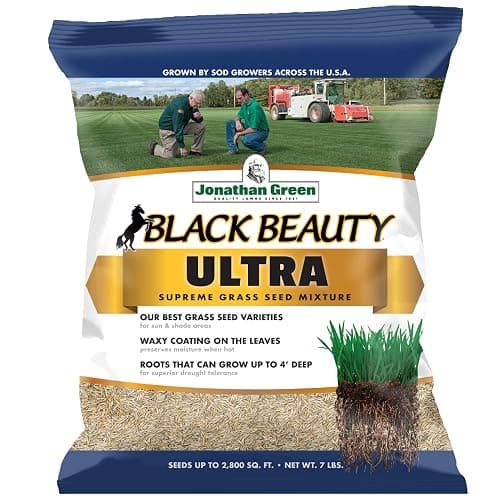
 Jonathan Green Black Beauty Ultra Grass SeedCheck price on Amazon
 The Andersons Professional PGF Complete 16-4-8 FertilizerCheck price on Amazon
As an Amazon Associate we earn from qualifying purchases.
Free Lawn Care Tools
Six make up the main set USU Extension covers: Kentucky bluegrass, turf-type tall fescue, fine fescue, and perennial ryegrass on the cool-season side, plus buffalograss and, in Washington County, bermudagrass on the warm-season side. Blue grama and the wheatgrasses are the low-water extras, and zoysiagrass turns up in southern Utah without much USU guidance behind it.
Kentucky bluegrass. USU says cool-season species such as Kentucky bluegrass are the most commonly planted in northern Utah, and its plant pest lab notes that most Utah lawns are cultivars of Kentucky bluegrass, perennial ryegrass, and fine fescue, usually together in a blend.
Buffalograss for a lawn that asks the least of the canal, and turf-type tall fescue for a lawn that still looks conventional. USU says tall fescue may get by on somewhat less irrigation because of its deep rooting, and that buffalograss needs much less water to remain green during summer. Kentucky bluegrass is the higher-water option, but under a twice-a-week schedule it goes dormant rather than dying and recovers in the fall.
As a lawn, in Washington County around St. George, where USU lists it among the warm-season grasses grown in the region. Outside Washington County it is a weed that creeps into cool-season lawns, and USU says removing it takes repeated herbicide applications over two to three years. If you see wiry surface runners in a bluegrass lawn elsewhere in the state, treat it as an invader, not a lawn choice.
Late summer for cool-season grasses. USU calls it the optimum seeding time in northern Utah and targets four to six weeks before the first expected frost, with mid-spring as the backup. Buffalograss and blue grama go in during spring or early summer. St. George stretches cool-season seeding from February to May and August to November, and warm-season seeding from March to May.
Sources (18)
- Utah State University Extension: Turfgrass Cultivars for Utah
- Utah State University Extension: Preparing Soil for Turfgrass Establishment, Northern Utah
- Utah State University Extension: Preparing Soil for Turfgrass Establishment, Southern Utah
- Utah State University Extension: Northern Utah Turfgrass Management Calendar
- Utah State University Extension: Southwest Utah Turfgrass Management Calendar
- Utah State University Extension: Southeast Utah Turfgrass Management Calendar
- Utah State University Extension: St. George, Utah Turfgrass Management Calendar
- Utah State University Extension: Growing Turf on Salt-Affected Sites
- Utah State University Extension: Weed Control Options for Residential Lawns in Utah
- Utah State University Extension, Utah Pests Newsletter (Fall 2016): Tall Fescue as an Alternative for Utah Lawns
- Utah State University Center for Water-Efficient Landscaping: Lawn in the Low Water Landscape
- Utah State University Center for Water-Efficient Landscaping: No Miracle Cure for Drought
- Utah State University Extension: Responsible Water Use Imperative This Summer
- Utah State University Extension: Basic Turfgrass Care
- Utah Division of Water Resources: Secondary Irrigation System Metering
- Utah Division of Water Resources: Drought Watering Guide
- Utah Division of Water Resources: Weekly Lawn Watering Guide
- Utah Division of Water Resources: Water Restrictions
Photos: lazarus / iNaturalist · CC BY 4.0, Julie Wittmann / iNaturalist · CC BY-SA 4.0, elik03 / iNaturalist · CC BY 4.0, Alex Zorach / iNaturalist · CC BY 4.0, Alaina Krakowiak / iNaturalist · CC BY 4.0, Isaac Krone / iNaturalist · CC BY 4.0

Beat weeds and brown spots from your phone
Snap a photo, get the fix, and follow a plan timed to your soil and weather. Free on iPhone.
Related Articles
 Climate & Regional Tips
7 Types of Grass in New Mexico and How to Tell Them Apart
Sep 2, 2026•8 min read Climate & Regional Tips
Types of Grass in Nebraska: Bluegrass to Buffalograss
Aug 2, 2026•6 min read Climate & Regional Tips
6 Types of Grass in West Virginia and How to Tell Which You Have
Sep 2, 2026•7 min read