

Weeds With Purple Flowers: Identify What's Blooming in Your Lawn
 Marcus GreenTurf Management Pro | 18 Years
As an Amazon Associate we earn from qualifying purchases.
Some April morning you walk outside and half the lawn has gone purple. It looks almost intentional, like a wildflower meadow moved in overnight. Then you get closer and the "meadow" is a mat of low, sprawling stems that took over every thin spot. Purple flowering weeds are a lawn problem in disguise, and the flowers you notice first tell you the least.
The purple flowering weed in your lawn is almost always one of five plants, and the calendar narrows it down fast. Early spring purple carpets are henbit or purple deadnettle. Mid to late spring points to wild violet or creeping Charlie. From early summer on, short purple spikes in mowed turf mean selfheal, and tall spiny purple heads mean thistle.
The fastest way to confirm any of them is not the flower at all. Roll a stem between your fingers. Square with four flat sides puts you in the mint family: henbit, deadnettle, creeping Charlie, selfheal. Round stem plus heart-shaped leaves means wild violet. Round plus spines means thistle. That one test beats an hour of comparing flower photos.
Henbit and Purple Deadnettle: The Spring Twins
These two get grouped together for a reason. They bloom at the same time, grow in the same conditions, belong to the same genus, and get misidentified as each other constantly. For control it barely matters which one you have, but knowing the difference makes you faster at reading the rest of the lawn.
What the flowers look like
Both produce small tubular flowers in a pinkish purple to magenta shade, clustered in whorls near the top of the stem. Individually they are not showy. You notice them because there are thousands at once, reading as a purple haze from the driveway.
The non-flower tells
Henbit has square stems, your mint family signal, and rounded scalloped leaves that clasp the stem directly with no leaf stalk, so they look like they are hugging it. It sprawls low, then sends flowering stems up, staying under a foot.
Purple deadnettle also has square stems, but its upper leaves are triangular, taper to a point, sit on short stalks, and take on a purple or reddish tint toward the top, as if the plant dipped its head in dye. Purple up top before the flowers open means deadnettle. Round, scalloped, and green all the way up means henbit.
Bloom time and control
Very early. Both are winter annuals: they germinate in fall, sit small through winter, and explode the moment temperatures allow, usually March into April. By the time your lawn is growing hard they are setting seed and dying back. That timing is why an April spray is mostly a moral victory. The real intervention is a fall pre-emergent that stops the next generation, plus turf thick enough that seedlings have nowhere to land. For the seasonal plan, see the henbit weed profile.
Creeping Charlie, Also Known as Ground Ivy
If henbit shows up and leaves, creeping Charlie moves in permanently. It is the most persistent purple bloomer on this list and the one homeowners ask about most often, usually in frustrated terms.
What the flowers look like
Small funnel-shaped flowers in a blue purple to violet shade, in loose clusters where the leaves meet the stem. They are prettier up close than most lawn weeds, which is partly why the plant escaped gardens in the first place. Peak bloom is spring.
The non-flower tells
Square stems again, since this is another mint. Round to kidney-shaped leaves with scalloped edges, opposite each other. The defining feature is how it moves: creeping Charlie spreads by above-ground runners that root at every node they touch, which is why pulling it feels like unrolling a carpet and why any fragment left behind comes back.
The confirmation test is the smell. Mow over a patch and you get a distinctly minty, slightly sharp aroma. If your mower deck smells like an herb garden, you have ground ivy.
Control in short
This one shrugs off casual effort. Hand pulling rarely gets the whole runner network, and a spring spray knocks it back only until the nodes you missed regrow. Fall applications work better because the plant is moving resources downward. It also loves shade and damp soil, so fixing those conditions takes away its advantage. The creeping Charlie and ground ivy guide covers timing and condition fixes.
Wild Violet
Wild violet is the one people feel guilty about removing, which is fair, because it is genuinely attractive. It is also one of the hardest broadleaf weeds to clear from turf, so guilt and difficulty arrive together.
What the flowers look like
Classic violet flowers, five petals, deep purple to blue purple and occasionally white, each on its own slender stalk just above the leaves. Unlike the mint family weeds, they are individually recognizable and unmistakably violet-shaped. Spring is the show.
The non-flower tells
Heart-shaped leaves with a waxy, glossy surface, each on a long stalk coming up from the base rather than a creeping stem, forming a tidy clump instead of a sprawl. Violets prefer shade and moist soil, so they show up under trees, along fence lines, and on the north side of the house, exactly where your turf already struggles. That waxy surface is not trivia: it is why sprays bead up and roll off, and why this is one of the few lawn weeds where a surfactant changes the outcome.
Control in short
Expect a multi-season project, not a weekend fix. Violets grow from rhizomes, so pulling the tops leaves the plant intact underground. Fall treatments outperform spring ones, and repeat applications are the norm rather than a sign you did something wrong. The wild violet control guide covers the realistic timeline.
Common Selfheal, Also Called Heal-All
Selfheal is the purple weed most people cannot name. No reputation, no dramatic carpets, and it hides well in mowed turf. Once you learn it, you see it everywhere in mid summer.
What the flowers look like
Short, dense, cylindrical flower spikes with purple to violet blooms packed in tight, on a squarish head that looks like a small pinecone wearing petals. The flowers open a few at a time rather than all at once, giving the head a ragged look.
The non-flower tells
Square stems, so another mint, though without the strong smell of creeping Charlie. Oval to lance-shaped leaves growing opposite each other on short stalks. In an unmowed field it stands a foot tall, but in a mowed lawn it grows flat and low, forming dark green patches with those flower spikes poking up just above cutting height. That adaptation is why it survives mowing so comfortably.
Bloom time and control
Early summer through fall, which sets it apart from the spring crowd. If you are looking at purple flowers in July, selfheal and thistle are your two candidates and they look nothing alike. Selfheal is a perennial spreading by seed and creeping stems, and it takes hold in turf that is thin, compacted, or mowed too short. It responds to broadleaf treatment timed for active growth, but the durable fix is raising your mowing height and feeding the lawn. Of everything here, selfheal is the most likely to fade on its own once the turf gets healthier.
Thistle
Thistle is the outlier. Everything else here is low and sprawling. Thistle is tall, armed, and impossible to mistake once you have met one.
What the flowers look like
Fluffy, brush-like purple to magenta heads sitting on spiny bracts, held well above the turf on upright stems, peaking mid to late summer. When the heads finish they turn into white fluff that drifts across the yard, which is exactly how the next patch starts.
The non-flower tells
Spines. That is the whole test. Deeply lobed leaves with sharp spiny margins you will find the hard way if you grab one barehanded. Stems are round, not square, and often ridged. Canada thistle spreads by underground roots and forms colonies, while bull thistle grows as a single large rosette that bolts into a tall stalk.
Control in short
Which type you have changes the strategy, because root-spreading thistle regenerates from fragments and mowing alone can make it worse. Our guide on how to get rid of thistle in your lawn covers both types and the timing that works.
Four More Purple Bloomers That Turn Up in Lawns
Every season on the course, the rough along the tree line threw up a few flowers that matched nothing on the weed poster in the maintenance barn. Home lawns do the same thing. If what's blooming in your yard matches none of the plants above, check it against these four next. Two of them run closer to lavender or pale blue than true purple, which is how they end up in the purple pile. Each one has a tell that settles it in the field.
| Weed | Flower | The tell | Bloom time |
|---|---|---|---|
| Creeping bellflower | Blue-purple bells, five pointed lobes, mostly along one side of the stalk | Milky sap when you snap a stem | Summer to early fall |
| Common vetch | Purple, on a pea-family plant | Narrow compound leaves with tendrils at the tips; trailing mats | March through July |
| Carolina geranium | White to lavender, two or more per stalk | Deeply lobed leaves and a beaked seed pod about 1/2 inch long | Mostly April and May |
| Common field speedwell | Light blue with dark blue stripes, about 1/3 inch across | Heart-shaped seed pods with spreading lobes | Spring |
The bellflower is the one to take seriously. University of Minnesota Extension describes it as an invasive perennial that spreads from seed and from tuber-like roots, and new plants can form from small root pieces left in the soil. In a regularly mowed lawn it won't flower at all, so you may be looking at a patch of heart-shaped basal leaves with no bells to go on. The same UMN page says 2,4-D and quinclorac don't work on it, while dicamba and triclopyr give some control at higher rates with repeat applications, and fall is the most effective window. The straight 2,4-D bottle that handles henbit won't clear this one.
The other three are cool-weather weeds that mostly fade as summer heat builds: NC State TurfFiles classes common vetch as a winter annual and Carolina geranium as a winter annual or biennial, and UC IPM puts common vetch in bloom from March through July. Penn State Extension says field speedwell tends to drop out of turf in the hot summer months, and that better turf density cuts it back. NC State calls a dense, vigorous stand the best way to keep winter annuals out, and UMass Extension notes that annual speedwells can be controlled with pre-emergent products. Mark the thin spots where they bloomed. That's where the fall work goes.
Purple Bloomers That Are Not Weeds
Worth a quick mention, because people spray these by mistake. Ajuga, also sold as bugleweed, is an ornamental groundcover with glossy dark leaves and upright purple flower spikes. It is a mint family plant, so it passes the square-stem test, and it spreads by runners, so it behaves exactly like creeping Charlie. The only difference is that somebody planted it before it escaped the bed. If the purple radiates out from a planting bed in a clean sweep, and the leaves look too polished to be a weed, check the bed edge before you reach for the sprayer.
How To Tell Them Apart In 30 Seconds
You do not need a botany key. You need three checks, in this order.
First, roll the stem between your fingers. Square with four flat faces means mint family: henbit, deadnettle, creeping Charlie, selfheal, or an escaped ajuga. Round means violet or thistle.
Second, crush a leaf and smell it. Strong mint aroma means creeping Charlie. The other square-stemmed weeds have little scent, a useful negative result.
Third, check the leaf shape and how it attaches. That finishes the job.
| Weed | Stem | Smell | Leaf | Bloom time |
|---|---|---|---|---|
| Henbit | Square | None | Round, scalloped, clasping the stem | Early spring |
| Purple deadnettle | Square | Faint | Triangular, stalked, purple-tinted on top | Early spring |
| Creeping Charlie | Square | Strongly minty | Kidney-shaped, scalloped, opposite | Spring |
| Wild violet | Round | None | Heart-shaped, waxy, long stalks from the base | Spring |
| Common selfheal | Square | None | Oval to lance-shaped, opposite | Summer into fall |
| Thistle | Round | None | Lobed with sharp spines | Mid to late summer |
If all three checks still leave you unsure, that is reasonable. Regional lookalikes exist, and these plants look different in shade than in full sun. Upload a photo and get an identification instead of committing to a guess, because the wrong guess means the wrong product at the wrong time of year.
Do You Even Need To Remove Them?
Here is the answer most weed articles skip: for some, genuinely no.
Henbit and purple deadnettle die on their own as soon as it warms up, and they are among the earliest nectar sources for bees, when almost nothing else is blooming. If you are not chasing a flawless spring lawn, letting them run their short course is defensible. Violets and selfheal in a low-input lawn are a similar story. A mixed lawn that stays green, handles foot traffic, and supports pollinators is a legitimate goal, not a failure.
Removal matters when the weed displaces turf instead of filling gaps in it. Creeping Charlie is the clearest case, because it keeps expanding until it owns the area, and a small patch is cheaper to fight than a whole yard. Thistle is the other, being painful to walk on and, in some states, a noxious weed you are legally required to control. If the purple concentrates in the same thin, shaded, compacted spots every year, the weed is a symptom.
- Extension programs favor fall applications for perennial broadleaf weeds like wild violet, creeping Charlie, and thistle, because the plants are moving resources to their roots and carry the treatment down with them.
- For winter annuals like henbit and purple deadnettle, the recommendation is a fall pre-emergent timed to soil temperature, not a spring rescue spray after the plants are visible.
- Wild violet's waxy leaf surface is the standard reason guidance calls for a surfactant and repeat applications.
- Product selection, rates, and windows vary by state and turf species, and warm season lawns carry restrictions cool season lawns do not. Check your state extension service and read the label before buying.
- Never apply broadleaf herbicide to a lawn under heat or drought stress, and observe the label's interval before seeding.
Once you know what you have, timing is the whole game. Our herbicide timing tool tells you when the window opens for your area, and the weed and feed calculator works out rates for your lawn size.
Recommended products
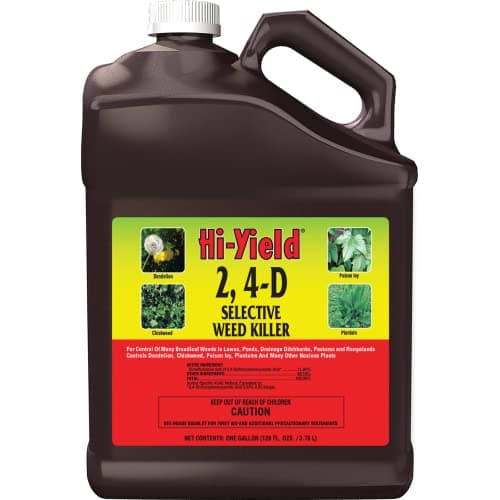
Hi-Yield 2,4-D Amine Selective Herbicide
A selective broadleaf herbicide for henbit, purple deadnettle and thistle on cool-season lawns, bermuda and zoysia.
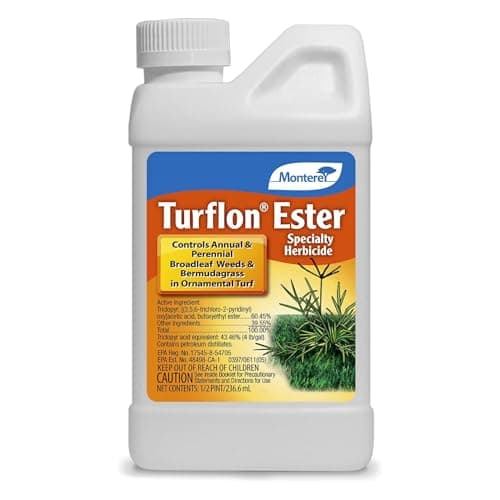
Triclopyr 4EC (Turflon Ester)
The active ingredient that finally moves creeping Charlie and wild violet.
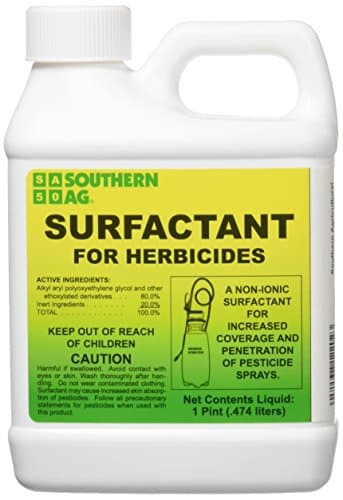
Southern Ag Non-Ionic Surfactant for Herbicides
A spreader-sticker that keeps herbicide on waxy violet and ground ivy leaves.
What Other Guides Miss
The flower is the worst identification feature you could pick. Most of these plants bloom two to four weeks a year, which makes every guide organized around flower color useless for the other eleven months. Stems, leaves, growth habit, and smell are there the entire season. Learn those and you can identify creeping Charlie in September as easily as in May.
The square-stem shortcut deserves to be better known. Four of the six purple bloomers here are mint family plants, and square stems are a family trait. That one test splits the field in half in under two seconds, works in any season, and needs no equipment. Hardly any lawn guide mentions it.
The henbit and deadnettle mix-up is nearly universal. Search results, garden center staff, and neighborhood forums swap these two constantly. The consequence is small, since the control approach is identical, but it explains why the photos you find contradict each other. If a "henbit" photo shows purple-tinted triangular top leaves, you are looking at mislabeled deadnettle. Trust the leaf shape, not the caption.
Purple is not one color. Henbit reads pinkish magenta, creeping Charlie blue violet, thistle bright magenta, violets deep purple. People call all of them "purple" and then wonder why the photos do not match, which is why photo identification beats text searching, a pattern we dug into comparing the best grass identification apps.
Your Purple Flower Action Plan
Identification is only useful if it changes what you do next. Here is the order of operations.
- Identify before you spend anything. Run the three checks: stem, smell, leaf. If it does not resolve cleanly, snap a photo for a free diagnosis rather than buying a product for the wrong plant.
- Write down what you found and when. The bloom date is half the identification. A note reading "purple carpet, first week of April, thin area by the driveway" tells you next year what to pre-empt.
- Decide honestly whether it needs to go. Spring annuals in a low-input lawn can be left alone. Spreading perennials and thistle should not be.
- Treat on the plant's schedule, not yours. For nearly all of these perennials, fall is the productive window and spring is the frustrating one. Check it with the herbicide timing tool before you buy.
- Fix the reason it was there. Shade, compaction, thin turf, and low mowing invited the weed in. Overseed, raise the cutting height, and feed on a real schedule, or you repeat this next April.
- Put it on autopilot. A personalized care plan schedules broadleaf weed control against your zip code's actual season, so the pre-emergent lands before the henbit germinates and the perennial treatment lands in the fall window, without you tracking either date.
Purple flowers in the lawn are not an emergency. They are information. Once you can name what is blooming, the fix stops being a guessing game and becomes a calendar entry.
Top Picks
- Bonide Chickweed, Clover & Oxalis Killer (Ready-to-Use)Check price on Amazon
- T-Zone SE Broadleaf HerbicideCheck price on Amazon
- Scotts Turf Builder Weed and Feed 3 (5,000 sq. ft.)Check price on Amazon
As an Amazon Associate we earn from qualifying purchases.
Free Lawn Care Tools
In early spring, small purple flowers on low sprawling stems are almost always henbit or purple deadnettle, two closely related winter annuals with square stems. In mid spring, small funnel-shaped blue purple flowers on creeping runners point to creeping Charlie, also called ground ivy. From early summer on, short purple flower spikes in mowed turf are usually common selfheal. The stem test separates them faster than the flowers do.
Start with the calendar. Very early spring means henbit or purple deadnettle, mid to late spring means wild violet or creeping Charlie, and summer means selfheal or thistle. Then roll a stem between your fingers: square stems mean the mint family, which covers henbit, deadnettle, creeping Charlie, and selfheal. Round stems leave you with wild violet, which has heart-shaped leaves, or thistle, which has spines.
Look at the upper leaves. Henbit has rounded, scalloped leaves that clasp the stem directly with no leaf stalk, and they stay green all the way to the top. Purple deadnettle has triangular leaves on short stalks that take on a purple or reddish tint near the top of the plant. Control is identical for both, so a mix-up costs you nothing practical.
It depends on the species. Henbit and purple deadnettle are winter annuals that die off on their own once it warms up, and they feed pollinators at a time of year when little else is blooming. Creeping Charlie and thistle are different, because they actively displace turf and keep expanding until you intervene. If the purple shows up in the same thin or shaded spots every year, the weed is a symptom of a turf problem worth fixing.
For perennials like wild violet, creeping Charlie, and thistle, fall is generally the productive window, because the plants are moving resources to their roots and carry the treatment down with them. For winter annuals like henbit and deadnettle, a fall pre-emergent works better than a spring spray, since by the time you see the flowers the plant has already finished its life cycle. Always check your state extension guidance and the product label for your grass type.
Sometimes. Ajuga, also sold as bugleweed, is an ornamental groundcover with glossy dark leaves and upright purple flower spikes that spreads by runners and escapes planting beds into lawns. Creeping thyme does the same thing. If the purple radiates out from a bed in a clean sweep and the leaves look unusually polished and uniform, check the bed edge before you treat it.

Your lawn plan, in your pocket all season
Grass ID, a season plan, soil-timed reminders, and a lawn journal that remembers what you did. Free on iPhone.
Related Articles
 Problem Solving
Weeds in St. Augustine Grass: How to Identify the Lookalikes and Kill Them Safely
Sep 16, 2026•5 min read Problem Solving
How to Get Rid of Onion Grass in Your Lawn
Sep 20, 2026•4 min read Problem Solving
Ragweed Identification: What It Looks Like and How to Control It
Aug 12, 2026•6 min read

