
The short version: our top liquid picks
If you just want the answer for your situation, start here. Each pick is covered in depth below, and most lawns only need one or two of these, not the whole shelf.
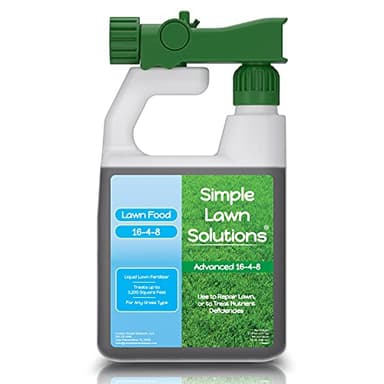
- Best overall: Simple Lawn Solutions Advanced 16-4-8. A balanced, do-everything spring and summer feed with seaweed and humic acid built in. The pick for most lawns, most of the time.
- Best for a fast green-up: Simple Lawn Solutions Maximum Green 28-0-0. High nitrogen with a quick and slow-release blend when the lawn is hungry and pale and you want color in days.
- Best for summer heat and phosphorus-restricted areas: Simple Lawn Solutions Superior 15-0-15. High potassium for stress and drought hardiness with zero phosphorus, the right call for established turf and Florida-style P bans.
- Best for color without extra mowing: Simple Lawn Solutions Liquid Iron. Chelated iron deep-greens the lawn without forcing top growth, so you get the color without the Saturday mow.
- Best starter for new seed or sod: Simple Lawn Solutions Ultimate 3-18-18. High phosphorus and potassium to drive root establishment, and a fall hardiness feed on mature lawns.
Below you will find a side-by-side comparison, how we ranked them, and a deeper look at each one with who it is for.
Liquid lawn fertilizer comparison
Every product here is a concentrate you spray through a hose-end sprayer (most ship with the sprayer attached). Coverage is the manufacturer figure for the 32 ounce bottle on an established lawn, and prices move, so treat them as a recent snapshot.
| Product | NPK | Best for | Coverage (32 oz) | Recent price | |
|---|---|---|---|---|---|
| Simple Lawn Solutions Advanced 16-4-8 (best overall) | 16-4-8 | All-purpose spring and summer green-up | up to 3,200 sq ft | ~$24 | Check price |
| Simple Lawn Solutions Maximum Green 28-0-0 (fast green-up) | 28-0-0 | Hungry, pale lawns that need nitrogen now | up to 3,200 sq ft | ~$25 | Check price |
| Simple Lawn Solutions Superior 15-0-15 (summer / phosphorus-free) | 15-0-15 | Summer heat, stress, and P-restricted areas | up to 3,200 sq ft | ~$25 | Check price |
| Simple Lawn Solutions Liquid Iron (color) | Chelated iron + micros | Deep green color without forcing growth | up to 4,000 sq ft | ~$24 | Check price |
| Simple Lawn Solutions Ultimate 3-18-18 (starter) | 3-18-18 | New seed and sod, plus fall hardiness | up to 3,200 sq ft | ~$26 | Check price |
| PetraTools Liquid Nitrogen 28-0-0 (alternative) | 28-0-0 | High-nitrogen alternative if SLS is out of stock | varies by size | check listing | Check price |
| PetraTools Liquid Iron (alternative) | Iron + micros | Color alternative to the SLS iron | varies by size | check listing | Check price |
The Simple Lawn Solutions line is the spine of this list because it covers every common job with one consistent, well-reviewed formula family, and the two PetraTools options are honest alternatives if you want a second brand or hit a stockout.
How we ranked them
A liquid fertilizer is not better because it costs more or lists more ingredients. We weighed the things that actually change how your lawn looks and how far your money goes.
- NPK fit for the job. The ratio has to match the problem. A balanced 16-4-8 maintains, a 28-0-0 pushes growth, a 15-0-15 hardens for heat, and a 3-18-18 establishes roots. A formula is only "best" relative to what your lawn needs that week.
- Quick plus slow-release nitrogen. The better liquids blend fast-acting nitrogen for immediate color with a slow-release fraction that keeps feeding between sprays, so you are not back out every ten days.
- The extras that matter. Seaweed, humic acid, and chelated micronutrients are not just label dressing. Humic acid improves nutrient uptake and chelated iron resists tie-up in the soil, which is why it greens without a nitrogen surge.
- Sprayer convenience. A bottle with an accurate attached hose-end sprayer is far easier to apply evenly than one you have to mix and meter yourself, and even application is most of what separates a good result from a striped one.
- Cost per 1,000 square feet. The number that matters. A $24 bottle that treats a 3,000 square foot lawn three or four times is cheaper per feed than a "deal" that covers it once.
Best overall: Simple Lawn Solutions Advanced 16-4-8
If you only buy one liquid fertilizer, make it a balanced 16-4-8, and this is the one we keep coming back to. The 16-4-8 ratio is the textbook all-purpose lawn food: enough nitrogen for steady color and growth, a little phosphorus, and potassium for root and stress resilience. It works on every common grass type, warm and cool season alike, through the whole spring and summer growing window.
What lifts it above a generic feed is the package. Simple Lawn Solutions blends in seaweed and humic acid, so beyond the macros you are improving uptake and feeding soil biology, not just dumping nitrogen. The attached sprayer meters the concentrate as you go, which makes an even application genuinely easy. For most readers this is the default pick, and the rest of this guide is really about the situations where you would reach for something more specialized instead.
The 32 ounce bottle covers up to 3,200 square feet and applies through the attached hose-end sprayer, so for a typical lawn one bottle is several feeds. Check the current price and your coverage below.
Pick by situation: which formula for your problem
Once you are past the all-purpose 16-4-8, the right liquid is the one that fixes your specific issue. Here is the quick map.
- Lawn is hungry and pale, you want color fast: a high-nitrogen 28-0-0 like Maximum Green 28-0-0 pushes a quick green-up with a slow-release tail.
- Summer heat, drought stress, or a phosphorus ban: a phosphorus-free Superior 15-0-15 builds hardiness without pushing P into waterways.
- You want a deeper green without more mowing: chelated liquid iron darkens color without a growth surge.
- New seed, sod, or plugs: a high-phosphorus 3-18-18 starter drives root establishment.
- Not sure which one to buy: compare the formulas side by side in the table above, then match the ratio to your need.
Pick by grass type
The formula matters more than the grass, but a few species have real preferences worth honoring. If you are not sure what you are growing, that is the first thing to nail down before you feed.
- Bermuda: a heavy feeder that loves nitrogen through summer. A 16-4-8 base with a 28-0-0 push during peak growth suits it well. See the bermudagrass guide.
- St. Augustine: responds beautifully to balanced liquid feeding and to iron for that deep tropical green. See the St. Augustine guide.
- Centipede: the low-input exception. It wants very little nitrogen and often just iron for color, which makes liquid iron and a light 15-0-15 ideal. See the centipede guide.
- Zoysia: a moderate feeder that does well on a balanced 16-4-8 with potassium support heading into stress. See the zoysiagrass guide.
How to apply liquid lawn fertilizer (without burning it)
Liquids are forgiving on burn but easy to over-apply, so a little technique goes a long way.
- Mow and water first. Apply to a dry, recently mowed lawn so the spray hits the blades evenly and is not diluted by standing water.
- Feed in the cool of the day. Early morning or evening, ideally under 80 degrees. Spraying in the heat of the day is the main way people scorch an otherwise gentle liquid.
- Use the attached sprayer and walk an even pattern. Overlap your passes slightly. Striping almost always comes from uneven coverage, not the product.
- Water it in (mostly). Most macro feeds benefit from a light watering after application to move nutrients to the roots. Foliar iron is the exception: give it a few hours on the blade before any water so the leaf can take up the color.
- Little and often beats one big hit. Because liquids run two to four weeks, a lighter feed on a tighter schedule gives steadier color than a single heavy application.
Not sure on the exact rate? Run your lawn through the fertilizer calculator for ounces per 1,000 square feet.
Liquid vs granular: do you need both?
Short answer: liquids win on speed and gentleness, granular wins on longevity, and a lot of strong lawn programs use both. Liquid foliar feeding greens up in days and barely burns, which is why it owns the summer. Slow-release granular feeds for six to eight weeks and does the heavy lifting in spring and fall. Many owners run granular as the backbone and spike with liquid for a fast correction or summer color.
We dug into the full tradeoff, including a season-long plan that combines the two, in liquid vs granular fertilizer: which is better. If you are deciding between formats rather than between liquids, start there.