
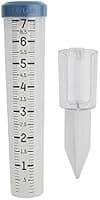
The one-inch rule, with caveats
The shorthand most homeowners hear is "one inch of water per week." That's a useful starting point but it leaves out the variables that actually matter: grass type, soil type, irrigation efficiency, root depth, and weather. EPA WaterSense notes landscapes typically want about one inch a week, but the right number swings widely with location and recent weather.
One inch of water across 1,000 square feet works out to roughly 623 gallons, so the UGA Extension irrigation guide rounds it to "1 inch equals 600 gallons per 1,000 sqft" as a planning number. A 5,000 sqft lawn is in the 3,000-gallon-per-week range during peak summer.
The real rule is: water deeply enough to wet the root zone (4 to 6 inches in most lawns, deeper if you've got the soil for it) and infrequently enough that the top inch dries out between waterings. That cycle trains roots to grow down. Daily shallow watering trains them to stay near the surface, where the lawn fries in the first heat wave. UGA's research-backed target is to wet the soil 6 to 8 inches deep on each cycle.
Evapotranspiration: the number that drives everything
Evapotranspiration (ET) is the combined water loss from soil evaporation and plant transpiration. It is the actual demand your lawn places on water on any given day, and it is what smart controllers and university irrigation guides use instead of a calendar. The UF/IFAS reference ET calculation is the canonical breakdown of the math.
For practical purposes: cool spring or fall mornings might pull 0.10 inches per day from a lawn. Hot, dry, breezy summer afternoons in Texas, Florida, or the desert Southwest can push past 0.30 inches per day. That is the difference between needing half an inch a week in October and needing 1.5+ inches in July.
You don't have to compute ET by hand. Local weather services and most state extension turfgrass sites publish daily or weekly ET. If your area runs hot and dry, your lawn will tell you the same thing through wilt before the math catches up.
Soil type changes everything
Sandy soil drains fast and can't hold a deep soak. Schedule shorter, more frequent waterings (roughly half an inch twice a week) so water doesn't run past the roots. Clay soil holds water for days but accepts it slowly. Long single waterings will pool and run off; cycle-and-soak is better (15 minutes on, 30 minutes off, 15 minutes on).
Loam, the middle ground, accepts most schedules well. The watering schedule generator linked above adjusts the math for whichever soil type you select.
Soil depth matters as much as texture. A Texas A&M AgriLife drought study found that turfgrass varieties planted over 16 to 18 inches of topsoil all survived 60 days without water, while the same varieties on 4 inches of topsoil did not. If your builder dumped sod over compacted subgrade, no irrigation schedule will fully compensate.
Catch-can test: measure your sprinkler output
Most homeowners have no idea how much water their sprinkler actually puts down per minute. That is the difference between guessing and dialing it in. The NMSU catch-can audit guide walks through the procedure and the math.
Set 5 to 8 empty tuna cans (or straight-sided cups) across one zone, spaced 5 to 8 feet apart for spray heads or 10 to 20 feet apart for rotors. Run the zone for 30 minutes. Measure the water depth in each can with a ruler, average them, and double the result to get inches per hour. If the average is 0.25 inches in 30 minutes, your zone delivers 0.5 inches per hour. To put down half an inch you would run that zone for 30 minutes; to put down an inch, 60 minutes (often split as cycle-and-soak on clay).
While you're at it, calculate uniformity. Average the lowest 25% of cans, divide by the overall average. Anything under 0.65 means dry corners are dragging the schedule longer than it needs to be. Adjust head spacing or replace clogged nozzles before bumping run times.
Recommended Products
- 1Check price
 Top pick
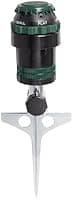
Orbit H2O-Six Gear-Drive Sprinkler
An adjustable-pattern sprinkler to dial in the even coverage you're checking for with the catch-can test above.
As an Amazon Associate we earn from qualifying purchases.
Why morning matters
Water before 10 a.m. if possible. Two reasons: less evaporation loss (you're delivering more of what you paid for to the roots), and the blades dry out before evening. Evening watering leaves leaves wet overnight, which is how lawn diseases like dollar spot, brown patch, and pythium take hold.
UGA Extension specifically calls the window between 9 p.m. and 6:30 a.m. the most efficient time, because the dew is already on the canopy and you're not adding hours of leaf wetness. The middle of the day is the worst time: EPA WaterSense notes a large share of midday irrigation is lost to evaporation on hot, breezy days.
If your only window is evening, water early enough that the canopy dries before sundown.
How long to water in summer
Summer is when the question shifts from "should I water" to "how much, how often, how long." A reasonable starting point for most lawns in hot weather: 1 to 1.5 inches per week, split into two or three deep waterings rather than seven shallow ones. Use the catch-can output above to convert inches into minutes for your specific system.
Texas A&M's Bermudagrass Home Lawn Management Calendar recommends waiting for visible wilt before triggering the next cycle, then watering deeply at night or early morning. That deficit-irrigation approach keeps roots reaching down instead of camping at the surface.
In 100°F-plus stretches, raise the mowing height a notch first. Taller blades shade soil, lower surface temperature, and cut ET by a measurable amount before you ever change the irrigation timer.
Reading drought stress (and dormancy vs death)
Three classic signs your lawn needs water, in order of appearance:
- Color shift. The blades turn from bright green to a dull blue-gray or smoky green.
- Footprints linger. Walk across the lawn. Healthy turf bounces back; stressed turf holds the imprint for a minute or longer.
- Folded or rolled blades. The grass curls inward to reduce leaf surface and slow water loss.
UGA Extension's threshold for irrigating is when 30% to 50% of the lawn shows those signs. That deficit-irrigation approach saves water without crossing into damage territory.
If you push past stress and the lawn turns tan or straw-colored, warm-season grasses (Bermuda, Zoysia, Buffalograss, Bahia) usually go into summer dormancy rather than die. The crowns stay alive and green-up returns when water comes back, often within 2 to 3 weeks. Cool-season grasses (Kentucky Bluegrass, Tall Fescue, Fine Fescue) tolerate roughly 4 to 6 weeks of dormancy before crown death starts. If you choose to let a lawn go dormant, give it about half an inch every 2 to 3 weeks to keep crowns hydrated, and stop foot traffic across it.
Smart controllers and soil moisture sensors
A clock-based controller waters the same minutes whether it rained yesterday or it is 102°F and dry. A WaterSense-labeled weather-based irrigation controller pulls local weather and ET to adjust automatically, and EPA estimates households save thousands of gallons per year after the swap.
Soil moisture sensors are the other lever. They sit in the root zone and tell the controller "skip the cycle, the soil is still wet." The UF/IFAS smart-controller publication documents irrigation reductions of 30% to 70% versus standard timers without quality loss in residential trials.
If you keep a clock-based controller, at minimum install a working rain sensor (required by code in many states) and reset the schedule each season instead of letting "summer settings" run through October.
Recommended Products
- 1Check price
 Top pick
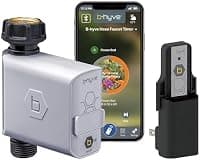
Orbit B-hyve Smart Hose Watering Timer
The hose-tap version of the smart controllers described here: app scheduling plus weather-based skips, without rewiring an in-ground system.
As an Amazon Associate we earn from qualifying purchases.