
The one-third rule
Never cut more than one third of the leaf blade in a single mowing. If your target height is 3 inches, mow when the grass hits 4.5. Cut more than that and you scalp the plant, a stress event that triggers thinning, weed encroachment, and slow recovery. This is the single most cited mowing principle in turfgrass research, and every land-grant extension service teaches it the same way (see the NCSU Extension Gardener Handbook chapter on lawns).
Why one third? When you remove more leaf tissue than that, the plant stops sending energy to roots and pours it into regrowing the shoot. Root depth flattens, drought tolerance drops, and recovery from any other stressor (heat, foot traffic, disease) slows down for weeks.
Irregular mowing schedules cause more damage than people realize. A two-week gap during peak spring growth often forces a scalping cut just to get back to height. If you fall behind, raise the deck for the first pass, drop it the next mow, and ease back to your normal height over two or three cuts instead of one.
Right height for the right grass
Mowing height is grass-dependent, not preference-dependent. Cut a Kentucky Bluegrass lawn at 1 inch and it thins out. Let St. Augustine grow to 5 inches and it falls over and shades itself out. Use the species ranges below; they line up with the recommendations from the UGA Master Gardener mowing-height table and the Texas A&M AgriLife warm-season mowing chart.
Cool-season grasses
- Tall Fescue: 3 to 4 inches. Most home lawns thrive at 3.5.
- Kentucky Bluegrass: 2 to 3 inches solo, 2.5 to 3.5 in a blend.
- Fine Fescue: 2 to 3 inches; happy at 3+ in shade.
- Perennial Ryegrass: 1.5 to 2.5 inches in a blend with KBG.
Warm-season grasses
- Common Bermuda: 1 to 2 inches with a rotary mower.
- Hybrid Bermuda (Tifway, Latitude 36): 0.5 to 1 inch with a reel mower for tournament-grade turf, or 1 to 1.5 inches with a sharp rotary.
- Zoysia: 1 to 2.5 inches depending on cultivar; Emerald and Zeon take the lower end, Meyer the upper.
- St. Augustine: 3.5 to 4 inches. Cutting below 3 invites brown-patch and weed pressure.
- Centipede: 1 to 2 inches. Mow when it reaches 1.5 to stay inside the one-third rule.
- Bahia: 3 to 4 inches; expect coarse seedheads even with frequent mowing.
Within a season, raise the deck a half-inch during summer heat or drought. Taller blades shade the soil, slow evaporation, and protect crowns. Drop back down by 0.25 inch increments as conditions ease.
Best time of day to mow
Mid-morning to early evening, after the dew has burned off and before peak heat, is the best window. Wet grass clumps under the deck, plugs the discharge chute, and leaves a ragged cut that browns at the tip. Mowing at noon in 95-degree heat compounds drought stress and bruises freshly cut leaf edges.
Practical target: between 9 and 11 a.m., or after 4 p.m. once the heat backs off. Avoid mowing within 24 hours of a fungicide or herbicide application so the product has time to absorb.
Mulching, bagging, or side discharge
Default to mulching. The clippings break down within a week or two and return nitrogen, potassium, and micronutrients to the soil. The University of Minnesota Extension grass-clippings guide notes that recycled clippings add the equivalent of one fertilizer application per year and do not contribute to thatch (a long-running myth).
Bag when the lawn is actively diseased (leaf spot, dollar spot, rust, brown patch), when seedheads are heavy in spring, or when you let the lawn get too tall and clippings would mat together and smother the canopy.
Side discharge works for tall, dry grass when you want to spread clippings thin and walk back over them with a second pass. It is the cleanest option for the first cut of spring on a lawn that grew too long over winter dormancy.
Reel vs rotary vs robotic
The mower type matters more on warm-season lawns than cool-season ones. A rotary blade impacts the leaf with brute speed; a reel cuts with a scissoring action that leaves a much cleaner edge.
- Rotary (gas or battery): the right tool for cool-season lawns and any cut above 1.5 inches. Versatile, handles uneven terrain, easy to maintain.
- Reel: the right tool for hybrid Bermuda or Zoysia kept under 1 inch. A rotary cannot maintain a clean cut at that height; the deck scalps high spots and skips low ones.
- Robotic: mows daily or every other day, removes only a sliver each pass, and inherently respects the one-third rule. Best for flat, fenced lawns with consistent turf. Cuts so little leaf tissue per pass that clippings disappear into the canopy.
Battery mowers have closed most of the gap with gas on small to mid-size lawns, with the bonus of quieter operation and zero exhaust. Gas still wins for lawns over half an acre or for thick, wet spring growth where torque matters.
Recommended Products
- 1Check price
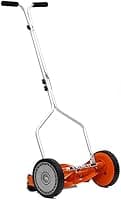 Top pick
American Lawn Mower Company 14-Inch Reel Mower
A classic push reel mower for the clean scissor cut described here, ideal for the low, well-groomed heights that suit reel mowing.
As an Amazon Associate we earn from qualifying purchases.
Mowing patterns and striping
Alternate your mowing direction every cut. Always going north-south compacts the soil along the same wheel tracks and trains the leaf blades to lay over in one direction, which dulls the visual contrast. Cycle through north-south, east-west, and the two diagonals over four mows.
Striping is leaf-blade orientation reflecting light. Push a roller-equipped mower (or a striping kit clamped behind the deck) in straight lines and the bent-toward-you blades look dark while the bent-away blades look light. Cool-season grasses (especially Kentucky Bluegrass) stripe far better than warm-season because their leaf blades are softer and bend more readily. Bermuda and Zoysia stripe weakly even with a roller.
Spring scalping for warm-season lawns
Once a year, in early spring, warm-season lawns benefit from a deliberate low cut to remove last season's dormant top growth. Drop the deck a notch or two below your normal height, bag the clippings, and let sunlight hit the soil to warm it and trigger green-up. Time it after the last hard frost but before active growth resumes. This is standard practice for Bermuda and Zoysia. It is risky on St. Augustine and not recommended for cool-season lawns.
Do not attempt a spring scalp once the grass has greened up; you will cut into living tissue and set the lawn back by weeks.