15-0-15 Liquid Fertilizer: The Phosphorus-Free Summer Feed (2026)
 Marcus GreenTurf Management Pro | 18 Years
As an Amazon Associate we earn from qualifying purchases.
If your lawn is established and you are feeding it through summer heat, a phosphorus-free 15-0-15 liquid is often the smartest choice on the shelf. It delivers nitrogen for color and a heavy dose of potassium for stress tolerance, while skipping the phosphorus most mature lawns do not need and many areas restrict. Here is how it works and when to reach for it.
For how 15-0-15 stacks up against the other liquids, see our best liquid lawn fertilizer guide.
15-0-15 liquid fertilizer is a phosphorus-free summer feed for established lawns. The three numbers mean 15 percent nitrogen, zero phosphate, and 15 percent potash, so the nitrogen drives color while the potassium builds heat, drought, and disease tolerance without adding phosphorus most mature lawns already have.
Reach for it on established lawns, in phosphorus-restricted areas like Florida, or through the middle of summer. Skip it on new seed or sod, which want phosphorus for rooting. Apply to a dry, recently mowed lawn in the cool of the day, water in lightly, and repeat every two to four weeks per the label, within your season's nitrogen total.
What Is 15-0-15 Fertilizer and When Should You Use It?
The three numbers on the bag or bottle are the NPK ratio: 15-0-15 means 15 percent nitrogen, zero phosphate, and 15 percent potash, the label forms of phosphorus and potassium (written as P2O5 and K2O on the fine print). In plain terms, it is a feed built for lawns that are already up and growing. The nitrogen keeps the grass green and pushing new blades, the potassium toughens it against heat, drought, disease, and foot traffic, and the zero in the middle means you are not adding phosphorus. Many established lawns already have plenty of it in the soil, and a soil test is the way to know for sure. The zero-P formula is built for lawns that do not need more phosphorus, or for places where local rules restrict it.
Reach for 15-0-15 when your lawn is established rather than newly seeded, when you live somewhere with phosphorus restrictions (Florida is the big one, but many states and counties have similar rules), or when you are feeding through the stressful middle of summer. It works on any grass type, and it is a particularly common recommendation for warm-season lawns and for low-nitrogen grasses like centipede.
You will find the 15-0-15 ratio sold in both granular and liquid form. The numbers mean the same thing either way; this post focuses on the liquid version, which sprays on through a hose-end sprayer and moves to the roots with a light watering.
Why phosphorus-free
The middle number on a fertilizer label is phosphorus, which supports root establishment. The catch is that most established lawns already have plenty of phosphorus in the soil, and adding more does nothing but run off into waterways. That is why many states and counties, Florida especially, restrict phosphorus on established lawns. A 15-0-15 gives your lawn nitrogen and potassium with zero phosphorus, which keeps you compliant and wastes nothing.
What the potassium does
The standout feature of a 15-0-15 is the high potassium, equal to the nitrogen. Potassium is the stress nutrient: it strengthens cell walls, improves drought and heat tolerance, and helps the lawn shrug off disease and foot traffic. That is exactly what an established lawn needs going into the hardest part of summer, which is why a balanced nitrogen-and-potassium feed is the classic warm-season summer choice.
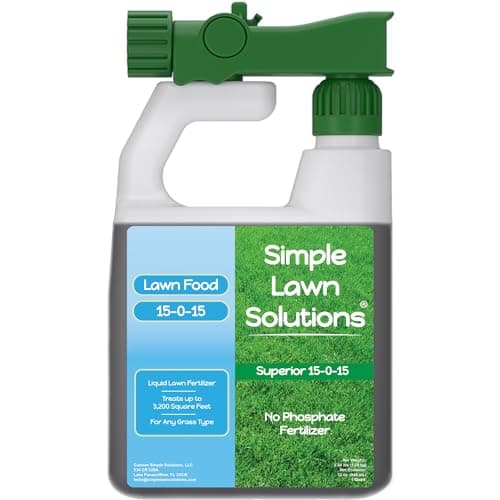
The pick: Simple Lawn Solutions Superior 15-0-15
For a liquid 15-0-15, Simple Lawn Solutions Superior 15-0-15 is the straightforward choice. It blends the nitrogen and potassium with humic acid and seaweed, sprays on through the attached hose-end sprayer, and works on any grass type. It is a strong fit for established warm-season lawns and for anyone in a phosphorus-restricted municipality.
A note for centipede lawns
The 15-0-15 ratio comes up constantly for centipede grass, which wants very little nitrogen and no phosphorus. A light liquid 15-0-15 plus iron is a good centipede program, but centipede has its own rules around rate and timing. For that specific case, see our best fertilizer for centipede grass guide.
How to apply it
Apply to a dry, recently mowed lawn in the cool of the day, water it in lightly to move the nutrients to the roots, and repeat every two to four weeks through the growing season, per the label and within your season's nitrogen total. Use the fertilizer calculator to dial in the rate for your lawn.
How Much 15-0-15 Fertilizer per 1,000 Square Feet
On the course we never spread a bag by feel. We worked backward from the nitrogen the turf needed that week, and the bag rate fell out of the math. Clemson Extension gives the shortcut for any granular bag: divide 100 by the first number for the pounds of product that put down 1 pound of nitrogen per 1,000 square feet, or divide 50 by it for half a pound. Clemson uses ½ to 1 pound of nitrogen per feeding, depending on the soil. The table gives pounds per 1,000 square feet, plus the bag total for a 5,000 square foot lawn. With 15-0-15, every pound of nitrogen brings a pound of potash along with it.
| Nitrogen | 15-0-15 | Potash | 5,000 sq ft |
|---|---|---|---|
| ½ lb | 3.3 lb | ½ lb | 16.7 lb |
| ¾ lb | 5 lb | ¾ lb | 25 lb |
| 1 lb | 6.7 lb | 1 lb | 33.3 lb |
Liquid 15-0-15 is measured in fluid ounces, and how much nitrogen sits in each ounce depends on the product, so follow the rate on that label. For bermuda, Clemson's spring dead spot guidance caps any single feeding at 1 pound of nitrogen per 1,000 square feet, because extra nitrogen feeds spring dead spot the next year, and its yearly program adds up to 2 to 4 pounds a season in about three summer feedings. Space liquid repeats so they stay inside that total. Measure the lawn first with the lawn size calculator, because a guessed square footage is an easy way to over-apply. Weigh it, then spread it.
When to Use 15-0-15 on Bermudagrass
Late summer is where this ratio earns its keep on bermudagrass. Clemson's bermudagrass calendar names a high-potassium feed such as 15-0-15 for the June or July feeding and for the last nitrogen of the season, which it wants down before August 15. Its spring dead spot sheet splits that cutoff by region: August 15 in the South Carolina Upstate, September 1 along the coast. After the cutoff the nitrogen stops, and potassium goes on alone, about 1 pound of potash per 1,000 square feet 4 to 6 weeks before the first expected frost, if a soil test says the lawn is short on it. These are Clemson's South Carolina dates, so shift them for your climate, and check local rules first, because some Florida counties ban summer nitrogen. Feed with the season, not the calendar on the bag.
Frequently asked questions
- What is 15-0-15 fertilizer good for? Feeding established lawns through summer heat without adding phosphorus. The nitrogen drives color and the high potassium builds drought and stress tolerance.
- Is 15-0-15 fertilizer good for lawns? Yes, as long as the lawn is established. The one place it falls short is brand new seed or sod, where seedlings want some phosphorus for root establishment that this formula deliberately skips.
- Why is there no phosphorus in 15-0-15? Most established lawns already have enough phosphorus, and many areas restrict it to protect waterways. A phosphorus-free feed meets the lawn's real needs and stays compliant.
- How much 15-0-15 fertilizer per 1,000 square feet? For granular 15-0-15, 3.3 pounds per 1,000 square feet puts down half a pound of nitrogen and 6.7 pounds puts down 1 pound, with the same amount of potash. For liquid, follow the label.
- Is 15-0-15 good for summer? Yes. The high potassium makes it one of the best summer feeds for established warm-season lawns, since it improves heat and drought hardiness.
- Can you use 15-0-15 on any grass type? Yes, it is labeled for all grass types. It is especially well suited to established lawns and low-phosphorus programs.
For the full lineup ranked by need, see the best liquid lawn fertilizer guide.
Top Picks

As an Amazon Associate we earn from qualifying purchases.
Free Lawn Care Tools
Related Articles
 Fertilizing
Which Simple Lawn Solutions Should You Buy? 16-4-8 vs 15-0-15 vs 28-0-0 (2026)
Jun 27, 2026•2 min read Fertilizing
Liquid Lawn Feeding Schedule: Which Simple Lawn Solutions Product Each Season (2026)
Jun 27, 2026•1 min read Fertilizing
Best High-Nitrogen Liquid Lawn Fertilizer: Simple Lawn Solutions 28-0-0 (2026)
Jun 27, 2026•2 min read