Broadcast vs Drop Spreader: Which Should You Buy?
 James ThorntonLawn Equipment & Maintenance Expert | 20 Years
As an Amazon Associate we earn from qualifying purchases.
Standing in the store aisle staring at two spreaders that cost about the same, it is genuinely hard to tell why one flings fertilizer in a wide arc and the other just dribbles it straight down, or which one is going to give you the lawn you want. I have watched plenty of homeowners grab whichever box was cheaper or bigger, get it home, and then spend the next three seasons fighting stripes or slinging weed and feed into the flower beds. The spreader you buy shapes every fertilizer and seed application you will ever do, so it is worth getting right the first time.
Not sure what your lawn actually needs spread on it, or when? Snap a photo for a free AI diagnosis and get your grass type identified in seconds, then a personalized plan that tells you exactly what to put down and the week to do it, before you spend a dime on the wrong product or the wrong spreader.
This is a tradeoff, not a winner. A broadcast (rotary) spreader spins granules out in a wide arc, so it covers big open lawns fast and lays a more even coat because its passes overlap and blend. A drop spreader releases granules straight down in a narrow band exactly as wide as the hopper, so it is far more precise and keeps product out of beds and off pavement, but it is slow and it stripes mercilessly if your passes do not line up perfectly. Buy a broadcast spreader if your lawn is large and mostly open. Buy a drop spreader if your lawn is small, oddly shaped, or hemmed in by gardens, walkways, and water.
For most suburban lawns over about 2,000 to 3,000 square feet of fairly open turf, a broadcast spreader is the right default, and a handheld version handles the small jobs. For compact city lots, lawns broken up by lots of beds and borders, or anywhere you cannot afford to throw product where it should not go, a drop spreader earns its keep. Whichever you buy, the spreader is only half the job. Calibration and steady, overlapping passes are what actually decide whether you get an even lawn, and we cover that in depth in our guide to spreader settings and application.
How Each Spreader Actually Works
Before you can choose, you need to understand the one mechanical difference that drives everything else. It is not about brand, price, or hopper size. It is about how the granules leave the machine.
Broadcast (rotary) spreaders: throw
A broadcast spreader, also called a rotary spreader, drops granules onto a spinning disc at the bottom of the hopper. As you push, the wheels turn the disc, and the disc flings the product outward in a fan-shaped arc, typically 6 to 12 feet wide depending on the model and the granule weight. Heavier granules fly farther; lighter ones drop closer. The pattern is densest near the center of the throw and tapers off at the edges, which matters a lot for how you overlap your passes.
The big advantage is speed and blending. Because each pass covers a wide swath and the edges of adjacent passes overlap, small inconsistencies average out into a fairly even coat. The big disadvantage is exactly that throw: the spreader does not know the difference between your lawn, your tulips, your driveway, and the storm drain at the curb. Anything within the arc gets product.
Drop spreaders: drop
A drop spreader has a row of holes along the bottom of the hopper with a sliding gate that controls the opening. Product falls straight down through those holes between the two wheels, laying a band of granules exactly as wide as the hopper, usually around 18 to 24 inches. There is no spinning, no flinging, and no throw at all. What sits directly under the hopper gets fertilizer, and not one granule lands anywhere else.
That gives you surgical control. You can run the wheel right along a bed edge or a sidewalk and trust that nothing sprays into the mulch or onto the concrete. The cost of that control is twofold: it is slow, because each pass only covers a narrow band, and it is unforgiving, because there is no overlapping spray to hide your mistakes. Miss a sliver between passes and you get a starved pale stripe. Double up on a pass and you get a dark or burned stripe. With a drop spreader, your wheel tracking is the whole game.
The third option: handheld and shoulder spreaders
There is a middle category worth knowing about. Handheld spreaders (and larger shoulder-strap or chest-mounted versions) are essentially small broadcast spreaders. You turn a crank or squeeze a trigger to spin a little disc that flings product in an arc, just on a smaller scale. They hold less, so they are not for doing a whole acre, but they are excellent for spot work: small lawns, slopes a wheeled spreader cannot handle, narrow side yards, and touching up bare patches. We will come back to where these fit, because for a lot of people a handheld is the smart second spreader rather than the main one.
Head to Head: The Tradeoffs That Decide It
Here is where the rubber meets the road. After years of watching how these play out on real lawns, these are the dimensions that actually matter when you choose.
Precision
Drop spreaders win precision, full stop. Product goes exactly where the hopper is and nowhere else, so you get clean lines along beds, hardscape, and property edges. Broadcast spreaders trade precision for coverage. Their throw is wide and a little unpredictable at the margins, so they are far harder to keep off the surfaces you want to protect.
Speed and coverage
Broadcast spreaders win speed by a mile. A 10-foot throw means you cover a given lawn in roughly a third to a fifth as many passes as a 2-foot drop band. On a large lawn that is the difference between a 20-minute job and an hour-plus slog. If your time and your patience are limited and your lawn is big, this one factor often settles the decision on its own.
Edges, beds, and water
This is the broadcast spreader's biggest weakness and the drop spreader's home turf. A broadcast spreader will reliably throw fertilizer into your flower beds, onto your driveway and sidewalk (where it can stain concrete and wash into storm drains), and toward any pond, creek, or drainage your lawn borders. Fertilizer runoff into waterways is a real environmental problem, and product on pavement is wasted money headed for the gutter. A drop spreader sidesteps all of it. If your lawn is laced with garden beds or backs up to water, that is a strong vote for drop.
Striping risk
Drop spreaders stripe far more easily, and this is the single most common regret I hear from people who bought a cheap one without understanding it. Because there is no overlap to blend passes, every gap and every double-up shows up weeks later as a visible line of lighter or darker grass. Broadcast spreaders are much more forgiving here, since the tapered edges of each pass are designed to overlap and average out. If you are not the meticulous type who will carefully line up every wheel track, a broadcast spreader hides your imperfections better.
Slopes and rough ground
Broadcast spreaders handle slopes and uneven ground a bit better, because the throw still distributes product even if your speed varies. Drop spreaders are sensitive to terrain: bounce over a bump or slow down on a hill and the drop rate effectively changes, which can leave heavy and light spots. On a steep or lumpy lawn, a handheld broadcast spreader is often the safest bet of all.
Price
At the homeowner level the two types overlap heavily in price, and you can find good and bad versions of each at similar cost. Build quality matters more than type when it comes to your budget: a well-made spreader with a smooth, accurate gate and an even pattern will outperform a flimsy one of either kind. Do not assume one type is the budget option and the other is the premium one. They are not.
Lawn size, summed up
If you remember one rule from this whole comparison, make it this: lawn size and layout decide the type. Big and open leans broadcast. Small and complex leans drop. Everything else is a refinement on that. Before you buy anything, it helps to actually know your number, so run your yard through our lawn size calculator and let that square footage anchor the decision instead of guessing.
Which Spreader Should You Buy? By Scenario
Let me make this concrete. Here is how I would steer people based on the lawn in front of them.
Large, open lawn (3,000+ sq ft, few obstacles): broadcast
If you have a wide expanse of turf with a clear perimeter and not much in the way of beds chopping it up, buy a broadcast (rotary) spreader and do not overthink it. The speed is worth everything here, the open layout means the throw is not a problem, and the overlapping pattern keeps your big lawn even. Just plan to shut the hopper or slow down along the few edges you do have.
Small or complex lawn (lots of beds, borders, tight shapes): drop
If your lawn is small, or it is carved up by garden beds, walkways, a patio, and fence lines, a drop spreader is the better tool. On a compact lot the slowness barely matters because there is not much ground to cover, and the precision saves you from constantly slinging product where it does not belong. The striping risk is real, so commit to careful overlapping passes, but on a small lawn that discipline is easy to maintain.
Lawn bordering gardens, ponds, or storm drains: drop (or a careful broadcast)
Anywhere keeping product out of a sensitive area is non-negotiable, a drop spreader is the safe default. If you already own a broadcast spreader and do not want to buy another, you can make it work by shutting the hopper near edges and laying a slow border pass first, but you are fighting the tool. For lawns dominated by these borders, drop is simply the right purchase.
Mixed situation: a broadcast spreader plus a handheld
Honestly, the setup I recommend most often is a full-size broadcast spreader for the open body of the lawn and an inexpensive handheld broadcast spreader for edges, small patches, slopes, and the tight spots the big one cannot reach gracefully. This combo costs less than two premium wheeled spreaders, covers nearly every scenario, and is what a lot of experienced homeowners eventually land on. The handheld becomes your precision tool without the slowness of a full drop spreader.
Recommended products
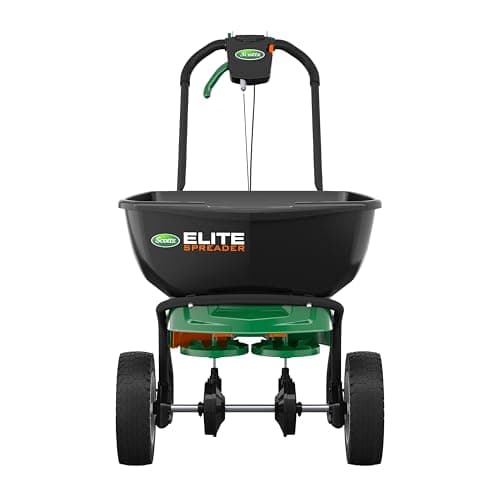
Scotts Elite Spreader
A dual-rotor broadcast spreader with the widest and most even pattern of the three.
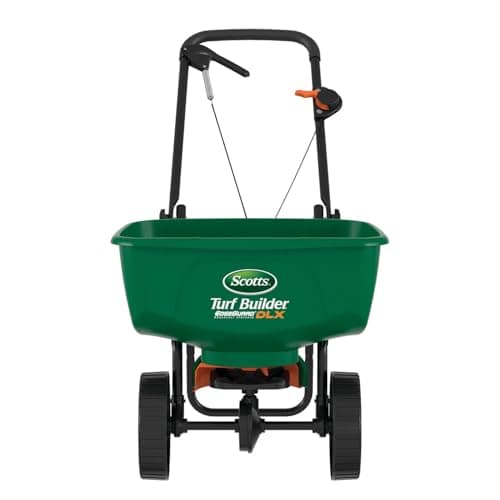
Scotts Turf Builder EdgeGuard DLX Broadcast Spreader
A mid-size broadcast spreader whose edge guard blocks the right-side throw near beds and pavement.
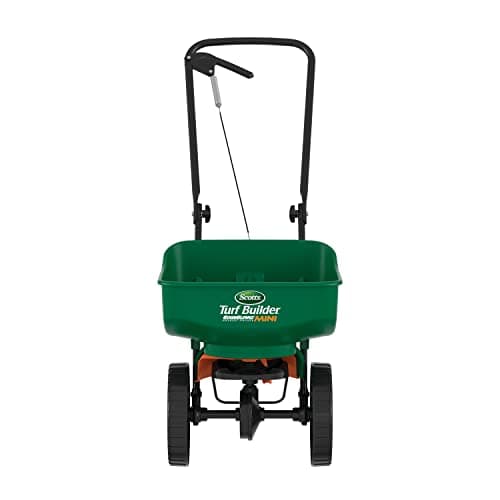
Scotts Turf Builder EdgeGuard Mini Broadcast Spreader
A compact broadcast spreader for lawns under about 5,000 square feet and tight gates.
Calibration Matters More Than Which Type You Buy
Here is the part that humbles every spreader debate: the wrong spreader calibrated correctly will beat the right spreader used carelessly. The type you choose sets the ceiling, but calibration and technique decide whether you actually reach it.
Every spreader, broadcast or drop, has a setting dial that controls how much product flows out, and that setting has to be matched to the specific fertilizer you are using and to your walking pace. The bag usually lists a recommended setting for common spreader models, but real-world conditions vary, so the only way to be sure is a catch test: run a measured amount over a known area and check whether the output matches the label rate. Get this wrong and even a great spreader will burn or starve your lawn.
The two spreader types fail differently when miscalibrated, which is worth understanding. A broadcast spreader set too high or too low tends to over or under apply fairly evenly across the lawn, so you get a uniformly too-strong or too-weak result. A drop spreader's failures show up as sharp stripes from gaps or overlaps in your tracking. Knowing your spreader's failure mode tells you what to watch for.
I am not going to re-cover the full calibration walkthrough here because we already have a thorough one. For the step-by-step catch test, the overlap strategy for each spreader type, the two-direction application trick, and how to read the settings off the bag, work through our companion guide to spreader settings and application. And once you know how much product you actually need for your lawn and grass type, our fertilizer calculator turns that into a concrete amount so you are calibrating toward the right number, not a guess. If the numbers on the bag itself are tripping you up, our explainer on how to read fertilizer numbers clears up what the N-P-K ratio means before you ever load the hopper.
- University extension turf programs consistently recommend calibrating any spreader to the product label rate rather than trusting the dial number alone, because output varies by granule size, humidity, and walking speed. Confirm the exact setting and overlap pattern for your specific model against the bag and, when in doubt, your state or county cooperative extension office.
- To protect water quality, extension guidance generally advises keeping fertilizer off hard surfaces and maintaining a buffer of several feet from storm drains, streams, and ponds. This is precisely the situation where a drop spreader, or a broadcast spreader with the hopper shut near edges, prevents both waste and runoff.
Care and Storage (So Your Spreader Lasts)
Whichever type you buy, a spreader is a piece of equipment that fertilizer salts will happily corrode if you let them. The maintenance is simple and it roughly doubles the life of the tool. Rinse the hopper and the spreading mechanism thoroughly with water after every use, because leftover fertilizer is hygroscopic and will draw moisture, clump, and rust the metal parts. Let it dry fully before storing. Periodically check and lightly lubricate the moving parts: the spinning disc and gate on a broadcast spreader, the agitator and the row of gate holes on a drop spreader, which love to clog with caked product. Store it indoors or under cover, never loaded with fertilizer overnight. A spreader treated this way will outlast several bags-worth of seasons; one left dirty and wet will seize and spread unevenly within a year or two.
What Other Guides Miss
Most spreader comparisons give you a tidy pros-and-cons table and stop there. Here are the two things that table almost never tells you, and they are the things that actually cause regret.
The edge and bed overthrow problem is bigger than it sounds. Articles mention that broadcast spreaders are "less precise near edges" as if it were a minor footnote. On a real lawn it is not minor. A rotary spreader throwing weed and feed several feet to the side will, over a season, deposit herbicide into your flower beds and vegetable garden, stain your concrete walkways, and send a slug of nitrogen straight down the storm drain every time you fertilize. People notice their hostas looking rough or their tomatoes struggling and never connect it to the spreader. If your lawn is wrapped in beds and borders, the "less precise" line is really telling you this tool will quietly damage the things you care about around the lawn, not just leave the turf a touch uneven.
A cheap drop spreader stripes because of why it stripes, not just that it does. Guides warn that drop spreaders can stripe, but they rarely explain the mechanism, which is what lets you actually avoid it. A drop spreader lays a hard-edged band exactly the width of the hopper with zero feathering at the sides. A broadcast spreader's pattern, by contrast, tapers at the edges and is designed for those tapered edges to overlap so adjacent passes blend into a smooth gradient. With a drop spreader there is no gradient to blend, so the boundary between "got fertilizer" and "got none" is razor sharp. Leave a one-inch gap between passes and that gap becomes a one-inch pale stripe of underfed grass weeks later. Overlap by an inch and that overlap becomes a dark, possibly burned stripe. The fix is not buying a more expensive drop spreader; it is overlapping the wheel tracks slightly on every single pass and, for valuable applications, splitting the rate in half and going over the lawn twice in perpendicular directions so any tracking error in one direction is covered by the other. Understand why it stripes and a budget drop spreader performs like a good one.
Your Spreader Buying Checklist
Here is the decision condensed into the order I would actually run it.
- Measure your lawn first. Know your real square footage and note how much of it is open versus broken up by beds and borders. Use the lawn size calculator rather than eyeballing it.
- Map your edges. Walk the perimeter and count how much of your turf borders flower beds, pavement, fences, ponds, or storm drains. The more sensitive edge you have, the more a drop spreader (or a handheld for the borders) makes sense.
- Match the type to the lawn. Large and open leans broadcast for speed and even blending. Small or complex leans drop for precision and edge control. Borders dominated by gardens or water lean drop.
- Consider the combo. For mixed lawns, a broadcast spreader for the open body plus an inexpensive handheld for edges and patches beats forcing one tool to do everything.
- Judge build quality, not just type. A smooth, accurate gate and an even pattern matter more than broadcast versus drop. Spend on quality within your chosen type.
- Plan to calibrate before you ever spread. Whatever you buy, set it to the bag rate, run a catch test, and walk steady overlapping passes. Calibration beats spreader choice every time. The spreader settings guide walks it step by step.
- Lock in what to actually put down. The right spreader is useless if you spread the wrong product at the wrong time. For a plan built around your grass type, climate, and the exact week to feed, start with a free photo diagnosis and get a personalized care schedule that tells you what goes in the hopper and when.
Buying a spreader feels like a small decision, but it sets the terms for every feeding and overseeding you will do for years, from the fall fertilizer pass to spreading lime when a soil test calls for it. If you are not sure your lawn even needs lime, our guide on when to apply lime and how much covers that, and if you are spreading seed to start a lawn from bare ground rather than feeding an existing one, our comparison of sod versus seed helps you decide whether a spreader is even the right tool for the job. Get the type matched to your lawn, respect the calibration step, and either tool will give you a lawn you are proud of. Get it backwards, fling product where it does not belong or stripe your turf, and you will fight the consequences season after season. When you are ready to turn the right spreader into the right results, snap a photo for a free diagnosis and build your plan from there.
Free Lawn Care Tools
Neither is universally better. A broadcast (rotary) spreader is faster and lays a more even coat across large, open lawns, while a drop spreader is more precise and keeps product out of beds and off pavement on small or complex yards. Choose by your lawn size and how much edge and border work you have, not by which one is generically best.
A broadcast spreader uses a spinning disc to fling granules outward in a wide arc, covering a lot of ground per pass. A drop spreader releases granules straight down between its wheels in a band exactly as wide as the hopper, with no throw at all. The mechanism is the whole difference: throw versus drop.
They can, because each pass only covers product the width of the hopper, so any gap between passes shows up later as a pale stripe and any overlap shows up as a dark or burned stripe. Drop spreaders demand careful wheel-to-wheel alignment on every pass. Broadcast spreaders are more forgiving because their overlapping spray pattern blends pass to pass.
A drop spreader or a handheld broadcast spreader usually suits a small lawn best. A small yard often has lots of edges, beds, and pavement relative to its area, and that is exactly where a drop spreader's precision pays off and a full-size rotary spreader's wide throw becomes a liability.
You can, but carefully. A broadcast spreader throws product several feet to the side, so it will sling granules into beds, onto pavement, and toward ponds or storm drains unless you shut the hopper near edges and make a slower drop-style border pass first. If most of your lawn borders sensitive areas, a drop spreader avoids the problem entirely.
Yes. Both need calibration, but the failure modes differ. A miscalibrated broadcast spreader tends to under or over apply evenly, while a miscalibrated drop spreader leaves sharp stripes. Always calibrate to the bag rate for your specific model and confirm with a catch test before a full application.

Your lawn plan, in your pocket all season
Grass ID, a season plan, soil-timed reminders, and a lawn journal that remembers what you did. Free on iPhone.