Best Time to Apply Lime to Your Lawn (and How Much You Need)
 Marcus GreenTurf Management Pro | 18 Years
As an Amazon Associate we earn from qualifying purchases.
If you have heard that lime is the secret to a thicker, greener lawn, here is the part most people skip: lime only helps if your soil is actually acidic, and the amount you need is not a number you can read off the bag. Liming a lawn that does not need it is one of the easiest ways to create a brand new problem, because lime raises pH and an overshoot into alkaline soil is slow and frustrating to undo.
This guide is specifically about lime: when to apply it, why fall is the ideal window, how to figure out how much your lawn needs, which type to buy, and how long it takes to work. If you want the bigger picture on soil pH in general, including how to lower pH that is too high, read How to Improve Soil pH for Grass alongside this article. This post stays focused on the lime side of that equation.
Get a soil test before you buy a single bag. Lime only raises pH, so it helps only if your soil is acidic, and the right amount depends on your current pH, your buffer pH, and your soil texture. A sandy soil needs far less lime than a clay soil at the same pH. Your soil test report will give you a specific lime rate per 1,000 square feet, which is the only number you should trust over a generic bag label.
Once you know you need lime, fall is the ideal time to apply it. The soil is still warm, moisture is reliable, and lime has months to react before spring. Spread it evenly with a broadcast spreader, water it in lightly, and be patient: lime is slow, taking three to six months for a measurable pH change and up to a year or more for the full effect. It is a soil correction, not a quick green-up. If you want a starting rate while you wait on your report, run your numbers through the Lawn Lime Calculator.
Why Soil pH Decides Whether Your Fertilizer Even Works
Before lime, you need to understand the thing lime is fixing. Soil pH controls how available nutrients are to your grass roots. When soil drifts too acidic, nutrients that are physically present in the soil get chemically locked up, so your grass can look hungry and pale even right after you fertilize. You are spreading food the lawn cannot reach.
Most lawns are happiest in slightly acidic soil, roughly 6.0 to 7.0, where the widest range of nutrients stays available. When the pH sinks below that, fertilizer efficiency drops, moss and acid-tolerant weeds tend to move in, and growth thins out. That is the situation lime is designed to correct: it raises an acidic pH back up toward the comfortable range. For the full breakdown of how pH affects nutrient availability and the ideal range by grass type, see How to Improve Soil pH for Grass.
Target pH is not identical for every lawn, which matters before you decide your number is too low. Here is what extension programs recommend by grass type.
| Grass | Target pH | Source |
|---|---|---|
| Kentucky bluegrass | 6.5 to 7.2 | Penn State |
| Tall fescue, ryegrass | 6.0 to 7.0 | Penn State |
| Bermuda, zoysia | 6.0 to 6.5 | Clemson |
| Centipede | 5.5 to 6.0, rarely needs lime | Clemson |
Centipede is the one to watch. It prefers acidic soil, so a reading that would send a bluegrass lawn straight to the lime aisle can be perfectly normal for centipede.
The key thing to hold onto: lime is a one-way tool. It raises pH and only raises pH. That is exactly why you cannot apply it blindly, which brings us to the rule that matters most.
Step One: Do a Soil Test Before You Touch Lime
If you take one thing from this article, make it this: do not lime blind. A soil test is the difference between fixing your lawn and accidentally pushing it into a worse spot that takes years to walk back.
Signs Your Lawn Might Be Acidic
There are clues that your soil could be on the acidic side and a candidate for lime:
- Moss thriving in spots, especially in shade and damp areas
- Pale or thin turf that does not respond well to fertilizer
- A history of heavy pine needle or oak leaf drop, which can acidify the surface over time
- Acid-loving weeds taking over thin areas
- Sandy soil in a high-rainfall region, where natural acidification happens faster
Here is the catch: every one of those signs can also be caused by something that has nothing to do with pH. Moss loves shade and compaction regardless of pH, so a moss problem is a reason to read our guide on how to get rid of moss and test your soil, not to assume acidity and reach for lime. Pale grass is far more often a nitrogen or iron issue than an acidity issue. These signs tell you to test, not to lime. They are a reason to check, never a substitute for checking.
Why Guessing Backfires
Two lawns can show the same pH number and need completely different amounts of lime. That is because of buffer pH, a second measurement that reflects how strongly your soil resists pH change. Clay soils and high-organic soils are heavily buffered, so they need much more lime to move; sandy soils move with far less. A soil test measures both your active pH and your buffer pH, which is why its recommendation is trustworthy and a bag label's generic instruction is not.
Overshooting is the real danger. Apply too much lime and you can push pH above the ideal range, where iron, manganese, and zinc become less available and your lawn develops the same pale, struggling look you were trying to fix. Lowering an over-limed pH is slow and far harder than raising it was. A few dollars and a couple of weeks for a soil test is cheap insurance against months of regret.
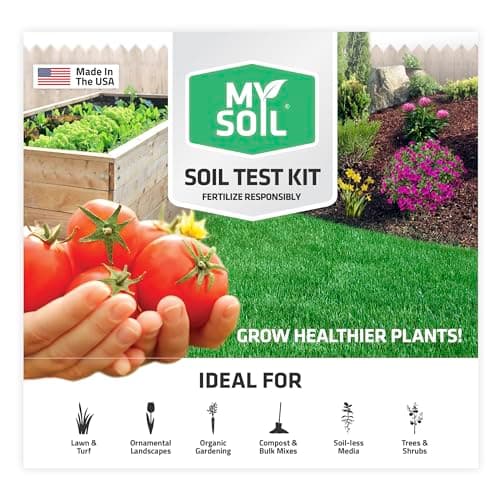
Most state and county extension services run inexpensive soil tests and hand back a specific lime rate for your soil, and if you would rather not wait on a mail-in queue, our roundup of the best soil test kits for lawns covers the at-home options. Use the Soil Test Analyzer to make sense of the numbers when your results come back, and reach for the Lawn Size Calculator so you know your real square footage before you translate a per-1,000-square-foot rate into bags.
- Penn State Extension recommends basing lime applications on a soil test that includes buffer pH, since two soils at the same pH can require very different lime amounts depending on texture and buffering capacity.
- Clemson Cooperative Extension advises retesting soil roughly every two to three years to track pH drift, and notes that lime rates should always come from the test report rather than a fixed rule of thumb.
When Is the Best Time to Apply Lime to a Lawn?
The best time to apply lime to a lawn is fall, ideally September through November. Soil is still warm enough for the reaction to run, fall rain carries lime down into the root zone, and winter freeze and thaw cycles work it in further. That gives lime the months it needs before spring growth starts. Early spring is the next best window. Skip summer heat, drought-stressed turf, and frozen ground.
Once a soil test confirms your lawn is acidic and gives you a rate, timing is the next decision. Lime can technically go down almost any time the ground is not frozen or waterlogged, but the seasons are not equal.
The exact months shift with your climate, since the window closes earlier in the north and stays open later in the south.
| Region | Best window | Second choice |
|---|---|---|
| Northern, cool-season | Sept to Nov, before ground freezes | Late March to April |
| Transition zone | Oct to Dec | March |
| Southern, warm-season | Oct to Jan, dormant turf is fine for lime | Feb to March |
Fall Is the Sweet Spot
Fall is the best time to lime, and the reasoning is straightforward. The soil is still warm, so the chemical reaction that neutralizes acidity is active. Fall moisture, from rain and dew, helps carry lime down into the root zone. And most importantly, lime is slow, so applying it in fall gives it the entire dormant season to work before your grass wakes up and starts demanding nutrients in spring. You are setting the table months ahead of the meal.
This also lines up neatly with the rest of a strong fall program. Fall is prime time for core aeration and overseeding, and aerating before you lime gives the material channels to move down through instead of sitting on the surface. If you are already planning fall lawn work, folding liming into that same window is efficient and effective. Our guide on when to aerate your lawn can help you sequence the two.
Spring Works Too, With a Caveat
Early spring is a solid second choice, especially if you missed fall or your soil test came back late. The same logic applies: cool, moist conditions and active soil. Pairing a spring liming with aeration helps the lime move in rather than washing off. The only real downside is that spring lime has less lead time before the growing season, so it is doing more of its work while the grass is already trying to grow.
When Not to Lime
Avoid these conditions:
- Frozen ground. Lime cannot react, and much of it can run off with snowmelt before it does any good.
- Dormant or drought-stressed turf. Lime will not burn your grass the way fertilizer can, but walking a stressed lawn with a loaded spreader adds traffic it does not need.
- Right before heavy rain. A downpour can wash lime off the surface and into storm drains before it settles in.
- The peak of summer heat. Same logic as drought stress; wait for milder conditions.
One more sequencing note: keep lime and fertilizer apart. Lime first, water it in, then wait two to four weeks before you feed, and size that feeding with the Fertilizer Rate Calculator.
Not sure whether your lawn is in good enough shape to lime right now, or whether acidity is even your problem this season? Run a free diagnosis first so you are treating the actual issue rather than the one you assumed.
How Much Lime to Apply
This is the question everyone wants a tidy number for, and the honest answer is that the right number lives on your soil test report, not in a blog post. Anyone who tells you a fixed pounds-per-1,000-square-feet figure without seeing your soil is guessing, and guessing is how lawns get over-limed.
What the amount actually depends on:
- How far below target your pH is. A soil at 5.4 needs far more correction than one at 6.1.
- Your soil texture and buffer pH. Heavy clay resists change and needs more lime; sandy soil shifts with less.
- Your grass type. Most turf wants 6.0 to 7.0, but centipede grass naturally prefers more acidic soil and is easy to over-lime, so it usually needs little or none.
Run your numbers through the Lawn Lime Calculator. Enter your soil pH, grass type, soil texture, and square footage and it returns a rate per 1,000 square feet plus a total for your yard. Treat it as a planning estimate. When your soil test report comes back, its rate wins.
Your soil test report gives you the real number. If you are still waiting on results and want to know roughly what you are buying, these are the ranges extension programs publish, in pounds of lime per 1,000 square feet to reach roughly pH 6.5.
| Current pH | Sandy | Loam | Clay |
|---|---|---|---|
| 6.0 to 6.4 | 15 | 25 | 35 |
| 5.5 to 5.9 | 25 | 40 | 60 |
| 5.0 to 5.4 | 40 | 60 | 85 |
| Below 5.0 | 50 | 80 | 100 plus, split |
Every row above is a placeholder until your report arrives. A soil test with buffer pH overrides the table, and anything above 50 pounds per 1,000 square feet gets split across two passes.
Your soil test report ties all of those together into one recommended rate, expressed as pounds of lime per 1,000 square feet. From there, the math is simple: multiply that rate by your lawn's square footage and divide by 1,000. If the report calls for a large total correction, it will usually tell you to split it across two or more applications spaced months apart rather than dumping it all at once, because a single massive dose can overshoot and is harder for the soil to absorb evenly. As a homeowner-safe cap, keep any single application at or below 50 pounds per 1,000 square feet. Run your yard through the Lawn Size Calculator first so the per-1,000 rate turns into an accurate bag count.
- University of Maryland Extension notes that lime needs are determined by soil test results and that large recommended amounts are best split into separate applications, since a single very heavy application is less effective and risks overshooting the target pH.
- Many extension programs cap a single lime application on established turf and spread larger corrections over a year or more, so always defer to the split schedule on your own soil report rather than applying a full correction in one pass.
Types of Lime and How to Apply It
Choosing a Type
Lime comes in a few forms, and the choice is less complicated than the labels make it look. There are two separate questions: the form (how it is physically packaged) and the chemistry (what minerals it adds).
- Pelletized lime. Finely ground lime pressed into pellets. It flows evenly through a broadcast spreader, throws almost no dust, and is the easy default for home lawns. It costs a bit more per bag, but the clean, even application is worth it for most people.
- Powdered or pulverized lime. Cheaper and fast-reacting because of its fine particle size, but messy, dusty, and prone to drifting on a breezy day. It is more common on farms than tidy suburban lawns.
- Calcitic lime. The standard chemistry, made from calcium carbonate. It raises pH and supplies calcium. Reach for this when your soil test shows magnesium is already adequate.
- Dolomitic lime. Adds magnesium carbonate alongside the calcium. Choose it when your soil test flags low magnesium, since it corrects pH and the magnesium shortfall in one product. If magnesium is fine, you do not need dolomitic and calcitic is the cleaner choice.
For most homeowners the practical answer is pelletized lime, calcitic or dolomitic depending on what your soil test says about magnesium.
Calcitic vs dolomitic lime
Both raise pH the same way. The only real question is whether your soil also needs magnesium.
| Factor | Calcitic | Dolomitic |
|---|---|---|
| Supplies | Calcium carbonate | Calcium plus magnesium carbonate |
| Choose when | Soil test magnesium is adequate | Soil test magnesium is low |
| Risk if wrong | None meaningful | Magnesium builds up over repeat applications |
How to Spread It
- Measure your lawn. Get an accurate square footage with the Lawn Size Calculator so your rate math is right.
- Calculate the total amount. Multiply your soil test's recommended pounds per 1,000 square feet by your square footage, then divide by 1,000.
- Use a broadcast spreader. A rotary broadcast spreader gives the most even coverage for a job this size, and if you are choosing a spreader or deciding between types, our guide on broadcast versus drop spreaders covers which fits your lawn. Check the lime bag for a spreader setting and test the flow on a tarp or driveway first.
- Apply in a crosshatch pattern. Spread half the lime walking one direction, then the other half walking perpendicular to it. This evens out coverage and prevents streaks.
- Water it in lightly. A light watering rinses lime off the grass blades and starts it moving into the soil. Skip heavy irrigation that could cause runoff.
- Rinse your spreader. Clean it thoroughly afterward so leftover lime does not cake or corrode the hopper.
How Long Does Lime Take to Work?
Set your expectations now: lime is slow. You will typically see a measurable pH change within three to six months, with the full effect landing somewhere between twelve and eighteen months out, depending on your soil type, the form of lime, and how finely it was ground. Finer particles react faster, which is part of why pelletized and powdered lime work sooner than coarse agricultural lime.
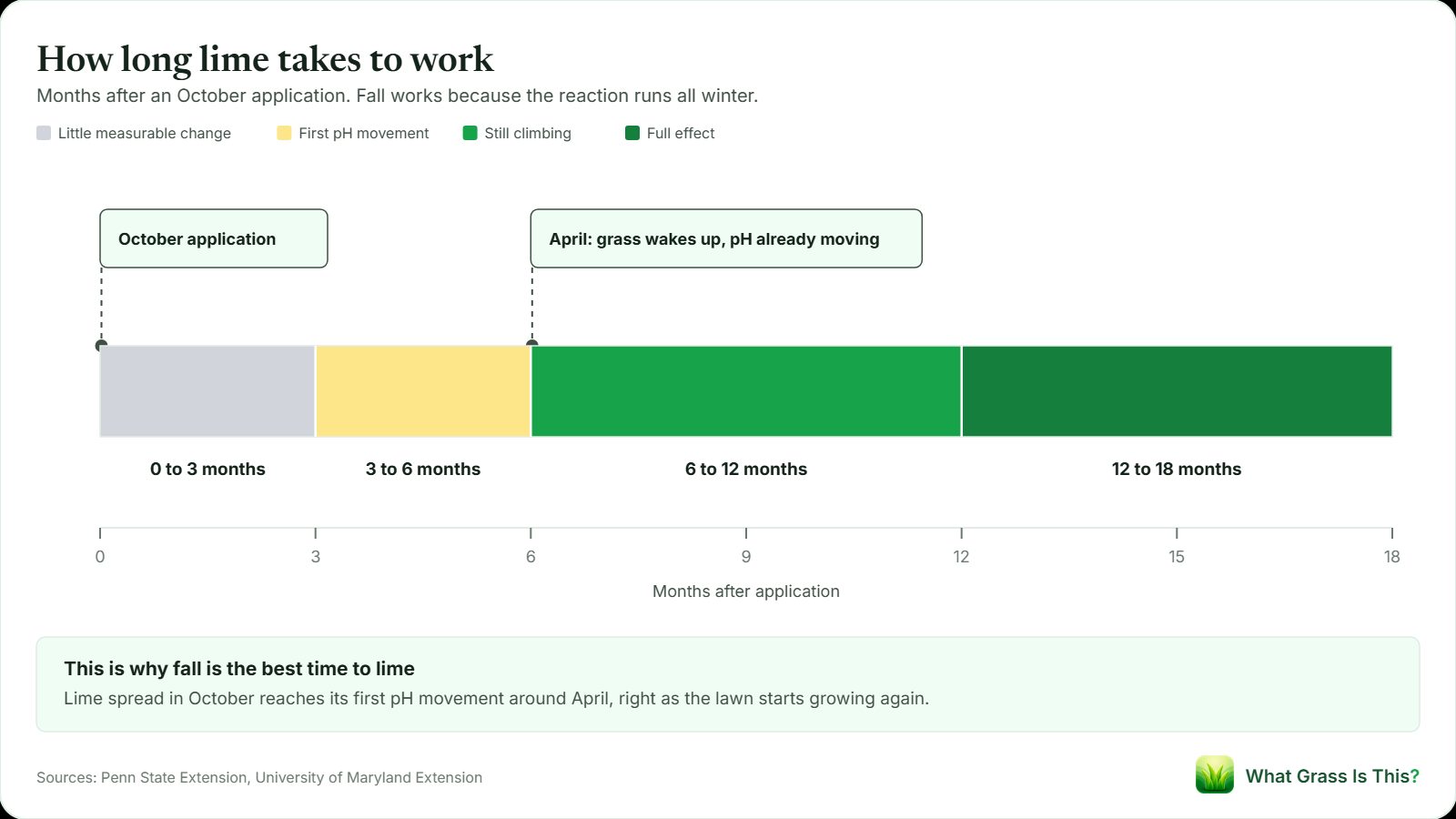
As the pH climbs back into range, the visible payoff shows up as your lawn responding better to fertilizer, denser turf, and less moss and weed pressure in the spots that were thin. But that is the soil chemistry working over seasons, not a weekend transformation. Retest your soil about a year after a major liming to see how far the pH actually moved and whether a follow-up pass is warranted. If acidity tends to creep back in your area, expect to lime again every couple of years.
What Other Guides Miss
Most lime articles hand you a tidy rate and a thumbs up. Here is what they tend to leave out, and where lawns actually go wrong.
Liming without a test can overshoot and lock out nutrients. This is the big one. Because lime only raises pH, applying it to soil that was not very acidic, or applying too much to soil that was, can push you past the ideal range into alkaline territory. Up there, iron and other micronutrients become less available, and your lawn turns pale, the exact symptom many people were trying to cure with lime in the first place. The cruel irony is that over-liming produces lawn problems that look like a reason to add more lime. Walking pH back down is slow, sometimes requiring sulfur and a lot of patience. A soil test prevents the whole spiral.
Lime is not a green-up product. Lime gets marketed and shelved next to fertilizers, so people expect it to green up a lawn the way nitrogen does. It will not, at least not quickly. Lime is a soil correction that pays off over seasons by making nutrients available again. If your grass is pale right now and you want a faster response, the likely levers are nitrogen and iron, not lime. Reading the bag's nutrient label helps here, and our guide on how to read fertilizer numbers explains what those values actually do so you do not mistake a slow soil amendment for a quick feed.
Your Lime Action Plan
- Test first. Get a soil test through your local extension service. Do not buy lime until you have a current pH, a buffer pH, and a recommended rate in hand.
- Confirm you actually need it. Lime only helps acidic soil. If your test is in range, skip the lime and look elsewhere for the cause of your lawn troubles.
- Measure your lawn. Use the Lawn Size Calculator to turn your soil test's per-1,000 rate into a real bag count.
- Pick the right lime. Pelletized for easy spreading; dolomitic if your test shows low magnesium, otherwise calcitic.
- Apply in fall. Spread evenly with a broadcast spreader in a crosshatch pattern, ideally after aerating, and water it in lightly.
- Be patient and retest. Give it months, not days, then retest about a year later to see whether you need a follow-up pass.
The whole game with lime is matching the fix to the actual problem. If you are not certain acidity is what is holding your lawn back this season, start with a free lawn diagnosis and let it tell you whether lime belongs in your fall plan, plus how much your specific yard and ZIP code call for, before you spend a dollar at the store.
Free Lawn Care Tools
Fall is the ideal window. The soil is still warm, moisture is more reliable, and lime has several months to react and move into the root zone before spring growth resumes. Early spring is the next best option, especially if you pair it with core aeration so the lime works in faster. Avoid liming frozen, dormant, drought-stressed, or waterlogged turf, since the lime cannot react and you are just adding foot traffic to a stressed lawn.
There is no single answer, and that is the point. The correct amount depends on your current pH, your buffer pH, and your soil texture, all of which come from a soil test. A sandy soil that is mildly acidic needs far less lime than a heavy clay soil at the same pH, because clay resists pH change. Get a soil test from your local extension service first and follow the lime rate on the report rather than guessing from the bag.
You can, but it is the single most common and costly liming mistake. Lime only raises pH, so if your soil is not actually acidic, you can overshoot into alkaline territory, which locks out iron and other nutrients and is slow and difficult to reverse. A soil test costs a few dollars through most extension services and tells you whether you need lime at all and how much.
Pelletized and powdered describe the form. Pelletized lime is finely ground lime pressed into pellets that spread evenly through a broadcast spreader with far less dust, so it is the easy choice for home lawns. Powdered or pulverized lime is cheaper but messy and prone to drifting. Calcitic versus dolomitic describes the chemistry. Calcitic lime supplies calcium, while dolomitic lime adds magnesium too, which helps if your soil test shows low magnesium.
Lime is slow by nature. You will usually see measurable pH movement within three to six months, but the full effect can take twelve to eighteen months depending on soil type, the form of lime, and how finely it was ground. Lime is not a quick green-up product, so if your lawn looks pale right now, your fastest fix is usually correcting nitrogen and iron, not waiting on lime.
Only as often as your soil test says you need to. For many lawns that is roughly every two to three years, but acidic-leaning soils, heavy rainfall regions, and lawns fed with acidifying fertilizers may drift faster. Retest about a year after any major liming so you can see how far the pH moved before deciding on a follow-up application.
No. Lime is not a salt fertilizer and will not burn grass blades the way a heavy nitrogen application can. The real risk with lime is overshooting pH, not burning. Water it in lightly after spreading to rinse residue off the blades, and keep any single application at or below 50 pounds per 1,000 square feet.
Yes, and it is the most common liming mistake. Too much lime pushes pH above the ideal range, where iron, manganese and zinc become less available and the lawn turns pale. Never exceed 50 pounds per 1,000 square feet in a single application, and split anything larger across two passes months apart.
Better to separate them. Lime can react with nitrogen fertilizer at the surface and lose some of that nitrogen to the air. Apply lime first, water it in, then wait two to four weeks before fertilizing. Use the fertilizer rate calculator to size that later feeding so you are not stacking two corrections at once.

Your lawn plan, in your pocket all season
Grass ID, a season plan, soil-timed reminders, and a lawn journal that remembers what you did. Free on iPhone.