

Common Lespedeza in Lawns: Identification and What to Do

Does a wiry, clover-like mat remain after you mow? Common lespedeza is one possibility. Check the leaflet veins and the tiny hairs on the stem before deciding what to do with the patch.
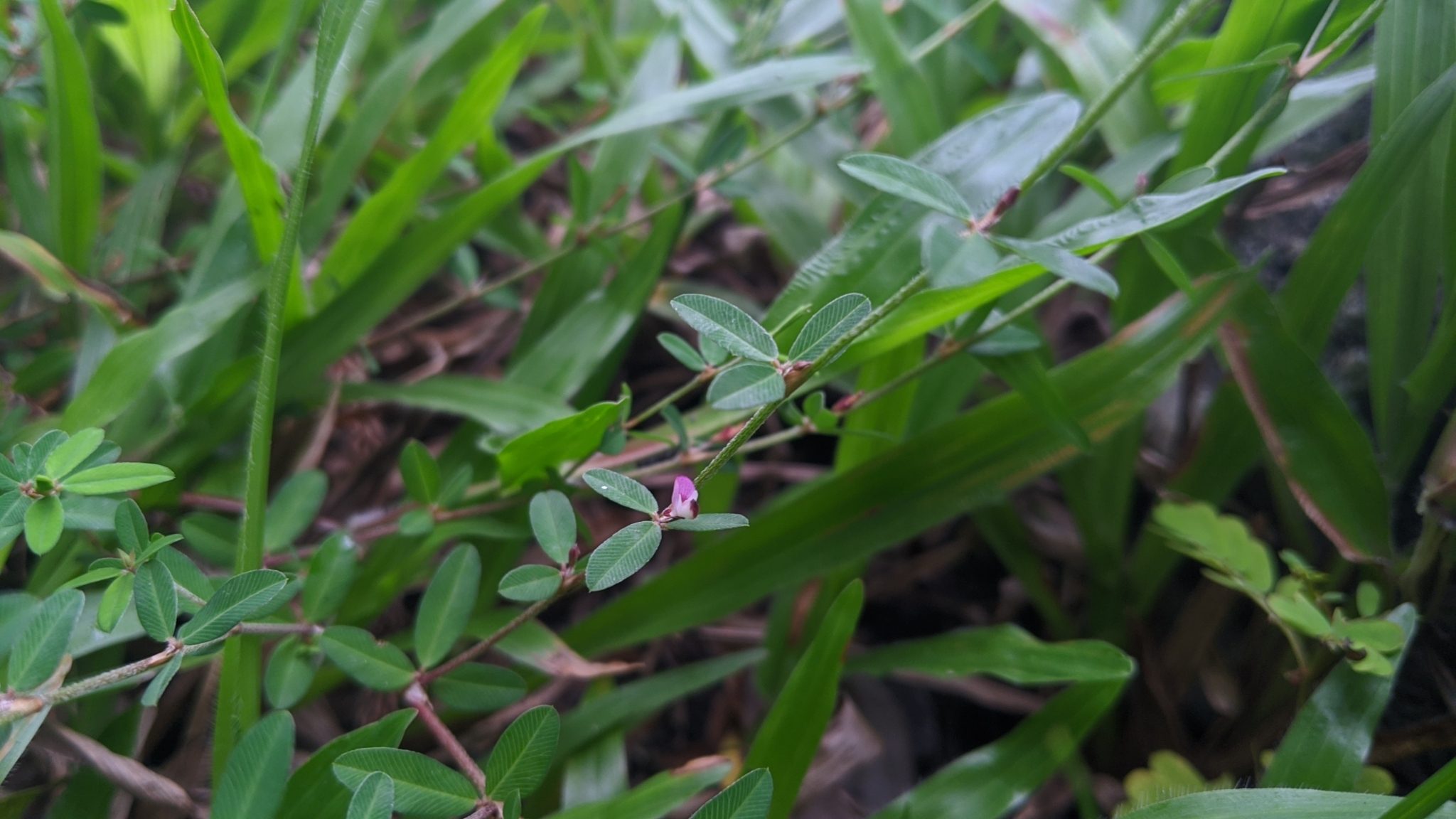
Common lespedeza, also called Japanese clover (Kummerowia striata), is a summer annual lawn weed. NC State Extension describes low, spreading stems, three oblong leaflets per leaf, and small pink or purple flowers where leaves meet stems. The side veins run almost at right angles to each leaflet's central vein.
Look at several features together. Three leaflets alone cannot separate it from clover or woodsorrel. If the features fit, remove small patches by hand and improve the surrounding turf; ask your local Extension office to confirm uncertain plants before choosing a herbicide.
How can you recognize common lespedeza?
Are the leaflets smooth along the edges? Hold a leaf against a plain background. Common lespedeza has elongated oval leaflets with many straight side veins. NC State describes a dark-green, ground-hugging plant whose low branches often escape the mower.
Which way do the stem hairs point? Use a phone's close-focus setting or a hand lens. UGA Extension's Bulletin 1395 distinguishes common lespedeza by hairs angled down the stem toward its base. Korean clover has hairs angled upward toward the growing tip. Record the direction as unknown if you cannot see it clearly.
Are there tiny flowers at the leaf joints? UGA describes pink to purple flowers at these joints, called leaf axils. Stems become woody as common lespedeza matures. A close-up can document those features, but an absent flower leaves that part of the identification unresolved.
Is it clover, woodsorrel, or another lespedeza?
Follow one stem to its own leaves and flowers. A mixed patch can put a clover flower beside a lespedeza leaf. Compare the features on the same plant.
| Possible plant | What to check | What the result means |
|---|---|---|
| White clover | Rounded flower heads on long stalks; leaflets often have a pale crescent. | NC State describes clustered white or pink-tinged flowers. This differs from the small individual flowers at common lespedeza's leaf joints. |
| Yellow woodsorrel | Heart-shaped leaflets and yellow flowers with five petals. | Clemson Extension identifies these features in oxalis. Check this possibility if the leaflets have a deep notch at the tip. |
| Korean clover | Hairs point up the stem toward its tip. | UGA uses hair direction to separate this similar annual from common lespedeza. Unclear hairs mean the species remains uncertain. |
| Sericea lespedeza | Hairy leaflets and clustered white flowers with purple markings. | UGA describes a perennial with an upright habit when unmowed. Mowing can hide that habit, so height alone cannot settle the identification. |
If the flowers point elsewhere, the yellow woodsorrel identification guide and clover and oxalis comparison can help narrow the alternatives.
Why does it grow where the lawn is thin?
Is the patch beside a worn path or in dry, sparse turf? LSU AgCenter associates common lespedeza with dry, compacted, underfertilized areas. Record those conditions, but do not diagnose a fertilizer shortage from the weed alone.
Mississippi State Extension explains that lespedeza forms root nodules with bacteria that fix nitrogen. It can compete where the grass receives little nitrogen. The same source makes an exception for centipedegrass when discussing supplemental nitrogen. Identify your turf and follow its care requirements before adding fertilizer.
What can you do with a confirmed patch?
Is it a small patch you can remove without tearing out much turf? Clemson Extension lists hand-pulling as an option. Remove the plants carefully, then watch the cleared area for new seedlings. A large, mature patch may need a longer recovery plan.
Can the surrounding grass fill the gap? NC State recommends dense turf, appropriate mowing and relief from compaction. Use the mowing height calculator after identifying your lawn grass. Avoid lowering the mower to chase a weed that already grows beneath the blades.
If the lawn needs aeration, timing depends on the grass. UGA advises early-fall aeration for tall fescue after summer stress has passed, and active-growth timing for warm-season grasses. An October date alone cannot establish that your lawn is ready.
For a persistent infestation, take the confirmed weed name, your grass species and recent treatments to a local Extension adviser. Clemson says herbicide choice must match the turf species and product label. An older Extension product list cannot establish the directions for a bottle sold today. Follow its current lawn-use, rate, temperature, repeat-application and reseeding restrictions.
Your common lespedeza diagnosis checklist
- Photograph the whole patch and note your location, date, lawn grass and recent mowing or treatments.
- Photograph one connected stem with its leaves. Add close-ups of the leaflet veins, stem hairs and any flowers.
- Compare the clues above. Write down which fit and which remain unknown; do not guess the direction of blurred hairs.
- Send unresolved features to your local Extension office for identification. Once confirmed, choose hand removal, turf recovery or label-specific control advice to suit the patch.
Need help identifying the surrounding grass? Start with a photo diagnosis so mowing and recovery advice match the lawn. Keep the weed photographs for Extension confirmation.
This identification method combines the Extension references linked above. It does not report a field inspection, herbicide trial or treatment result.
The photograph is cropped for display.
Free Lawn Care Tools
Yes. UGA Extension uses Japanese clover and annual lespedeza as common names for Kummerowia striata. Check the leaflet veins, flowers and stem hairs because other three-leaflet plants can look similar.
Mississippi State Extension describes downward-pointing stem hairs on common lespedeza and upward-pointing hairs on Korean clover. Use a clear close-up or hand lens. If you cannot see the direction, leave the species uncertain and ask Extension to identify it.
Clemson Extension describes a low-growing weed that is difficult to cut with a mower. Maintain the correct height for your lawn grass instead of cutting lower to reach it. Dense turf helps reduce openings for weeds.
Its presence can accompany thin turf with limited nitrogen, according to Mississippi State Extension, but it does not establish a fertilizer rate. Identify the grass first, especially centipedegrass, which the source treats differently. Follow grass-specific soil and fertility advice.
Confirm the weed and the lawn grass, then check the current product label. Clemson Extension says herbicides must suit the turf species and follow label directions. For an uncertain or mature infestation, ask local Extension for advice using photographs and your treatment history.
Sources (7)
Photos: Cheng-Te Hsu / iNaturalist · CC BY 4.0

Beat weeds and brown spots from your phone
Snap a photo, get the fix, and follow a plan timed to your soil and weather. Free on iPhone.
Related Articles
 Problem Solving
Common Purslane in a Lawn: How to Identify It and What to Check First
Sep 22, 2026•4 min read Problem Solving
Prostrate Knotweed in a Lawn: How to Identify It and Clear a Patch
Sep 24, 2026•3 min read Problem Solving
Torpedograss in Lawns: How to Identify It and What to Do Next
Sep 20, 2026•5 min read
