

Florida Betony in Lawns: Identify the Tubers and Control Regrowth

Are leafy shoots returning in the same lawn patch each fall? Check below the soil before you spray. Florida betony stores new growth in pale, segmented tubers, so removing the leaves can leave the next outbreak in place.
Fast Answer: For a small Florida betony patch, dig out the plants with their underground stems and tubers. For a larger infestation, identify your lawn grass and choose a labeled treatment for actively growing betony. University extension guidance supports repeated control during cool growing periods, with special care on centipedegrass and St. Augustinegrass.
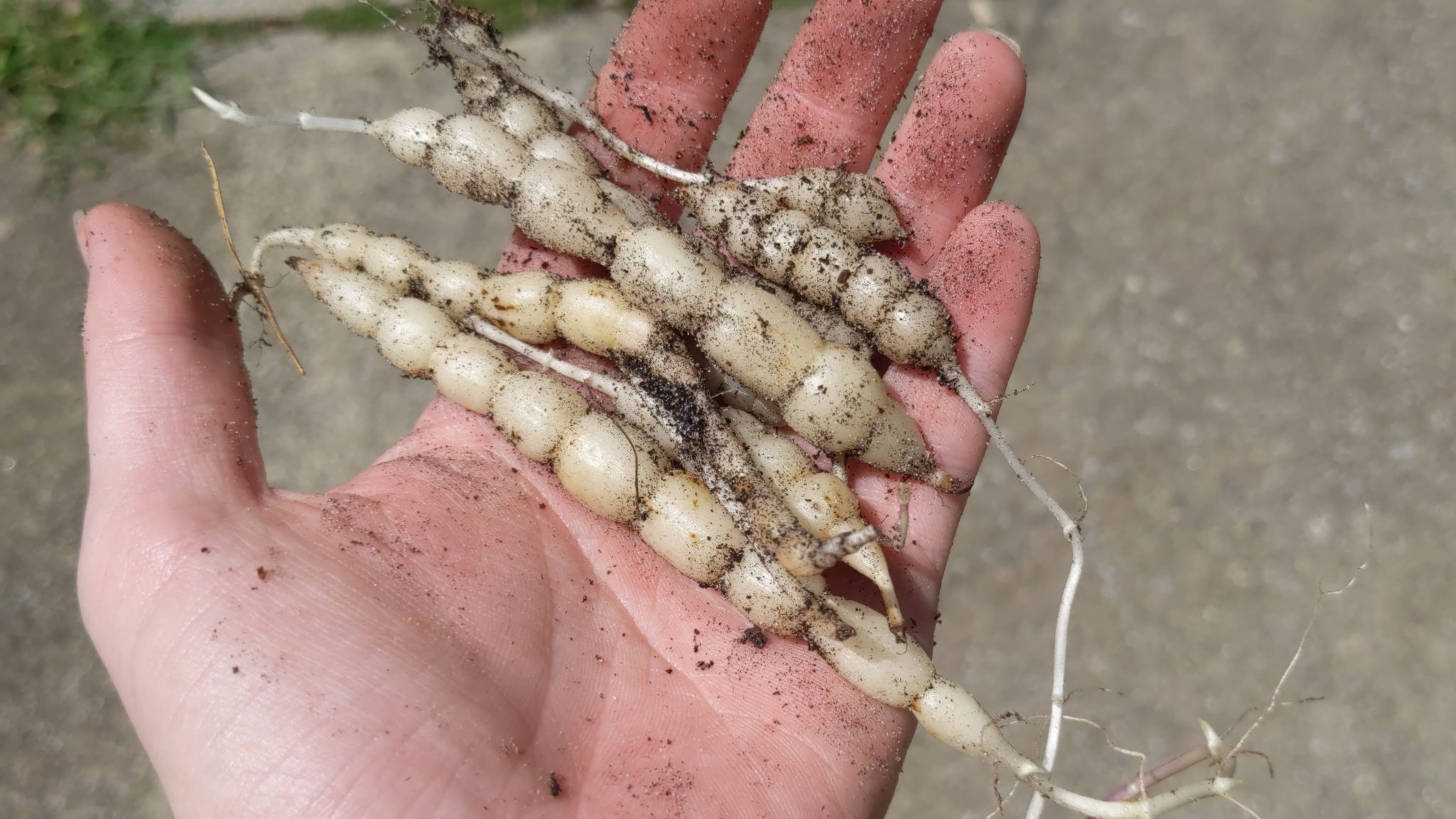
Confirm the plant first. Look for opposite, toothed leaves, a square stem, and white tubers shaped like a rattlesnake's tail. The University of Florida's identification guide shows those features. A square stem alone does not confirm Florida betony.
Is it Florida betony?
Do the leaves grow in pairs on opposite sides of the stem? Florida betony (Stachys floridana) has toothed, lance-shaped leaves and square, hairy stems. Pink to white flowers can help, but you can check a plant before it flowers.
Lift one plant with a hand trowel and inspect what is attached. Rhizomes are underground stems; tubers are swollen storage structures. Florida betony's pale tubers have distinct segments. UF/IFAS distinguishes it from related hedgenettles by these tubers.
Do the stem and leaf checks fit, but you cannot find a tuber? Keep the identification provisional. Send photographs of the leaves, stem, and lifted underground parts to your county extension office before selecting a herbicide.
Why does it disappear and return?
Did the shoots fade in summer, then return when the weather cooled? University of Georgia Extension describes active growth during fall and spring in Georgia, with slower growth or dormancy in summer heat. Local weather changes that schedule.
Summer disappearance does not show that the underground growth is gone. UF/IFAS explains that broken rhizomes and tubers can produce new plants. Mowing the shoots keeps the lawn tidy, but it does not remove those storage structures.
Can you remove a small patch by hand?
Can you reach each plant without disturbing a large part of the lawn? Digging is a reasonable first option for a small patch. UF/IFAS recommends digging deeply enough to remove the tubers and rhizomes, which break easily.
- Photograph the patch and note its location so you can find it after the shoots disappear.
- Use a trowel to loosen soil beside the plant. Lift the underground parts with the soil instead of tugging only on the stem.
- Separate the soil gently and collect the visible tubers and rhizomes. Avoid chopping through them.
- Check the same area during the next period of active growth. Dig out returning plants while the patch remains small.
This digging procedure follows UF/IFAS guidance. If new shoots keep appearing across a wide area, ask your extension office about a control program that fits your grass. Repeated digging can leave the lawn thin.
Which treatment fits your lawn grass?
Do you know whether the lawn is tall fescue, bermudagrass, zoysiagrass, centipedegrass, or St. Augustinegrass? That answer changes the herbicide options. Clemson Extension's Florida betony guidance supports these starting points for established turf.
Tall fescue, bermudagrass, and zoysiagrass
Check a lawn herbicide containing 2,4-D, mecoprop, and dicamba. The exact product must list your grass and use site. Check its limits for newly planted or stressed turf.
Centipedegrass and St. Augustinegrass
Check a compatible atrazine lawn product, or a broadleaf product specifically labeled for your grass. These grasses are sensitive to some broadleaf treatments. Use the label rate and avoid spring green-up.
For centipedegrass, avoid fertilizer-based atrazine products during late fall and late winter. Georgia Extension warns that the fertilizer can increase winter injury.
Grass type uncertain
Use identification and small-patch digging first. Wait to choose a chemical treatment until the grass is confirmed.
Need help with the grass check? Compare a clear blade and runner photograph with the centipedegrass guide or St. Augustinegrass guide, or use photo grass identification. The St. Augustine weed guide explains why grass tolerance matters.
Read the current label for the exact formulation. Follow its rate, repeat interval, protective equipment, watering directions, reseeding limits, and child and pet re-entry restrictions. Clemson warns against broadleaf applications above 85°F or during spring green-up of warm-season turf. Keep spray off nearby landscape plants, avoid spraying over their root zones, and avoid drift.
Clemson calls for fall and early-spring control and notes that complete control can take two years. Use the product's interval for repeat applications; the season alone is not an instruction to spray.
What other guides misdiagnose
Are you treating betony as a weed that comes back only from seed? UF/IFAS says it spreads mainly through tubers and rhizomes. A routine pre-emergent program may leave an established patch in place.
Is the patch crossing from a flower bed into the lawn? Keep the treatment areas separate. A lawn herbicide can harm flowers and shrubs. UF/IFAS's landscape-bed guidance covers that different use site; a bed treatment should not be carried onto lawn grass.
Your Florida betony diagnosis checklist
- Check opposite leaves, a square stem, and segmented white tubers together.
- Confirm your lawn grass before selecting a herbicide.
- Dig out a small patch with its tubers and rhizomes, then monitor regrowth.
- For wider infestations, plan control around active growth and the exact product label.
- Repair thin turf with the right mowing, watering, and soil-test guidance for your grass.
Georgia Extension links betony infestations with thin turf and care conditions that weaken the lawn. The mowing height calculator can help you check your cutting height. If you need a care schedule for your grass and location, a personalized lawn care plan can organize routine maintenance alongside the weed control program.
Display crop varies by screen.
Free Lawn Care Tools
Check opposite toothed leaves and a square stem, then lift a plant to inspect its underground parts. UF/IFAS identifies pale segmented tubers, shaped like a rattlesnake tail, as the feature that separates Florida betony from related hedgenettles.
Mowing removes shoots but leaves the underground storage structures in place. UF/IFAS explains that tubers and rhizomes can produce new plants, so check for regrowth and use a control method that addresses them.
For a small patch, loosen the soil and lift the tubers and rhizomes with the plant. UF/IFAS warns that those parts break easily and can regrow, so remove them carefully and monitor the same area during active growth.
Check that the weed is actively growing and that the current product label permits application. Clemson Extension recommends fall and early-spring control, with repeat timing set by the label, and warns against broadleaf treatment above 85°F or during warm-season spring green-up. For centipedegrass, Georgia Extension warns against fertilizer-based atrazine products in late fall and late winter because they can increase winter injury.
Confirm your grass before choosing a product. Clemson notes that centipedegrass and St. Augustinegrass need particular care with broadleaf herbicides. The exact formulation must list your grass and use site; follow its rate and restrictions. Keep broadleaf spray off landscape plants and their root zones, as Clemson directs.
Sources (4)
- UF/IFAS: Biology and management of Florida betony in landscape planting beds. Identification, underground growth, digging, and limits of pre-emergent control.
- Clemson Extension: Florida betony. Turfgrass compatibility, treatment timing, and application cautions.
- University of Georgia Extension: Controlling Florida betony in the landscape. Growth timing and turf care. Its older product examples do not replace current labels.
- Hero photograph by Nonbinary-Naturalist on iNaturalist, photo 557610898, CC0 1.0. The hero shows the diagnostic tubers; display crops vary by screen.
Photos: Nonbinary-Naturalist / iNaturalist · CC0 1.0

Beat weeds and brown spots from your phone
Snap a photo, get the fix, and follow a plan timed to your soil and weather. Free on iPhone.
Related Articles
 Problem Solving
Common Purslane in a Lawn: How to Identify It and What to Check First
Sep 22, 2026•4 min read Problem Solving
Torpedograss in Lawns: How to Identify It and What to Do Next
Sep 20, 2026•5 min read Problem Solving
Prostrate Knotweed in a Lawn: How to Identify It and Clear a Patch
Sep 24, 2026•3 min read
