Gray Leaf Spot in Lawns: How to Identify and Treat It

As an Amazon Associate we earn from qualifying purchases.
It usually starts the week after a warm, sticky rain. You walk out to a St. Augustine lawn that looked fine on Friday and by Tuesday the blades have a peppering of small tan spots with dark rims, and whole sections look scorched and thin. Or you are up north, you overseeded with perennial ryegrass, and the new stand melted out in patches during a humid August stretch. Two very different lawns, same fungus. In my years diagnosing turf, gray leaf spot is the disease people misidentify the longest, because the spots look like a dozen other things until you get close enough to see the border.
Gray leaf spot is a fungal disease caused by Pyricularia grisea. It hits St. Augustinegrass in the humid South and perennial ryegrass and tall fescue farther north, and it needs the same trigger in both places: warm temperatures plus long stretches of leaf wetness. On the blade you will see oval lesions roughly a quarter inch long with straw or gray centers and a distinct dark brown to purple border. Under heavy dew the centers can look fuzzy, which is the fungus sporulating.
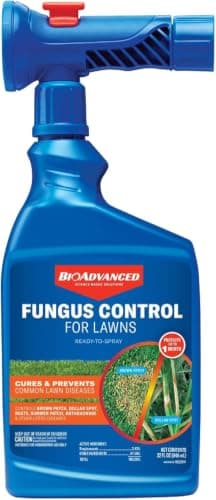
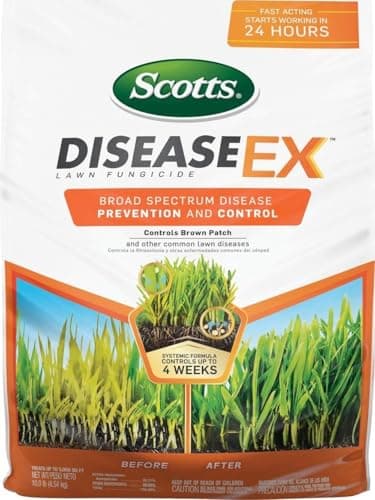
To treat an active outbreak, spray a systemic propiconazole lawn fungicide such as BioAdvanced Fungus Control for Lawns, or spread a granular azoxystrobin such as Scotts DiseaseEx if you would rather use a spreader. Then fix what fed it: stop the nitrogen, water early in the morning instead of at night, and raise your mowing height. Fungicide without those three changes buys you a few weeks and then you are back where you started.
What Gray Leaf Spot Actually Looks Like
Almost every lawn disease produces "brown patches." That is why patch shape is a terrible place to start. Gray leaf spot gives you something better: a lesion on the individual blade that you can hold up and identify with your own eyes. Pull a handful of blades from the edge of a bad area, not the middle, and look at them in good light.
The Lesion Is the Diagnosis
You are looking for oval to oblong spots that run lengthwise along the blade. University of Georgia Extension describes them as starting small and brown, then enlarging to roughly a quarter inch long and turning bluish gray, with depressed centers and irregular purple to brown margins. That dark margin is the part that matters. Drought scorch and mower damage do not draw a ring around themselves. A lesion with a defined border is a fungus doing the work.
The color inside the border varies with how wet things have been. In a dry spell the centers go olive green to tan. After a few humid nights, the centers can carry a gray, felt-like fuzz. That fuzz is the fungus producing spores, and it is the origin of the disease's name. If you see it, you are looking at an actively spreading infection, not old damage that has stopped moving.
Where It Shows Up First, and What It Does to the Stand
On St. Augustine, lesions appear on the leaf blades, the leaf sheaths, and the stolons. That last part is what makes it more than a cosmetic problem. When the disease moves into the stolons, the runners that St. Augustine uses to fill in cannot carry the repair job, so a thinned area keeps thinning instead of closing back up. Areas under tree canopy, along fence lines, and anywhere air movement is poor go first, because those are the spots that stay wet longest after dew.
On perennial ryegrass and tall fescue, the pattern is faster and uglier. Blades take on a twisted, fishhook look as the lesion girdles them, and a heavily infected stand can go from green to gray brown in a matter of days during a hot humid run. Newly seeded and newly overseeded ryegrass is hit hardest of all, which is why this disease is such a problem on fall overseeding projects.
Gray Leaf Spot Versus the Things It Gets Confused With
Three misidentifications account for most of the wasted money on this disease.
Leaf spot and melting out is the big one, mostly because the names overlap. That disease is caused by a completely different group of fungi and it goes after cool-season lawns, especially Kentucky bluegrass, with purple to black bordered spots that later rot the crowns. If you have a bluegrass lawn in the North thinning out in spring or fall, read our guide to leaf spot and melting out instead. Gray leaf spot is a hot weather disease of St. Augustine, ryegrass, and fescue, and the fungicides that work best on it are not the same ones.
Brown patch produces circular patches with a smoky outer ring and blades that pull loose easily from rotted sheaths, and it does not put a bordered lesion in the middle of the blade. On St. Augustine lawns both diseases can run in the same season, sometimes in the same month, which is why the blade check matters. Our full breakdown of St. Augustine grass diseases walks the whole set side by side.
Drought and chinch bug damage both produce straw colored turf in the sunniest parts of the lawn, but neither draws a dark ring on the blade. If the blades are uniformly dry and unspotted, you are chasing the wrong problem. Get your irrigation honest first with our watering schedule calculator before you spend anything on a fungicide.
If your blades are somewhere in the middle and you are not confident, that is exactly what the free photo diagnosis is for. It compares what your lawn is doing against the diseases and pests that are actually active in your region and season, so you get a ranked answer instead of a coin flip.
What Triggers an Outbreak
Gray leaf spot is not random. It needs a specific combination, and every one of those conditions is something you influence.
Warm temperatures plus long leaf wetness. NC State Extension puts the active range at roughly 70 to 95 degrees Fahrenheit with at least fourteen hours of continuous leaf wetness needed to start an infection. University of Florida IFAS Extension describes the same setup from a Florida angle: warm rainy spells, humidity above 95 percent, and twelve hours or more of leaf wetness, with air temperatures hovering between 80 and 90 degrees. Fourteen unbroken hours of wet leaves sounds like a lot until you realize that evening irrigation plus overnight dew delivers it on a schedule.
Too much nitrogen. Both sources point at the same accelerant. Excessive nitrogen produces lush, soft leaf tissue that the fungus colonizes faster, and UF/IFAS flags excess nitrogen specifically as a driver of gray leaf spot on St. Augustine. A summer feeding in the middle of a humid stretch is the single most reliable way to turn a few spots into a thinned lawn.
Stress and shade. Heat stressed turf, compacted soil, and shaded corners with no air movement all extend the wet period and weaken the plant's ability to wall off the infection.
- Fungicide active ingredients, legal rates, and reapplication intervals differ by state and are revised periodically. Get the current homeowner recommendation from your local cooperative extension office rather than a rate you read online, and follow your product label.
- NC State Extension notes that resistance to the QoI (strobilurin) fungicides has developed in gray leaf spot populations, which is why rotating between chemistry groups matters more on this disease than on most. Your extension office can tell you what is still working locally.
- Extension plant disease clinics will confirm a diagnosis from a physical sample. On a large or expensive stand, that confirmation is worth more than a second bag of product.
- Nitrogen rates that are safe in spring can be actively harmful during a humid summer disease window. Ask extension for the seasonal nitrogen guidance for your grass and region.
How to Treat an Active Gray Leaf Spot Outbreak
If the lesions are fresh and the thin areas are still expanding, you are in curative territory and a fungicide is justified. Here is the practical approach.
Spray or spread, then hold the water. A systemic propiconazole product goes down as a liquid and moves into the plant, which is what you want when the infection is already inside the leaf. Hook the bottle to the hose, cover the affected area plus a buffer of healthy turf around it, and then leave the irrigation off for the rest of the day so the product stays where it landed. Granular azoxystrobin works the opposite way: spread it dry, then water it in lightly so it reaches the crown and thatch. Read the bottle or bag you actually bought, because those two instructions are not interchangeable.
Treat in the morning. Not because the fungus cares, but because an evening application adds hours of leaf wetness to a disease that is triggered by leaf wetness. Morning also gives the spray time to dry before dew sets.
Expect to reapply, and mind which way you rotate. One application is a knockdown, not a cure. Most homeowner labels list a reapplication interval in the range of two to four weeks while conditions stay favorable. Do not apply the same active ingredient back to back. Direction matters here: resistance in this pathogen is documented in the QoI (strobilurin) group, which is the azoxystrobin in the granular product, so that is the one to use sparingly. If you started with the granular strobilurin, come back with the propiconazole rather than the other way around, and ask your extension office what is still performing locally before a third application.
| Product | Active ingredient | Format | How it goes down | Best for |
|---|---|---|---|---|
| BioAdvanced Fungus Control for Lawns, Ready-to-Spray | Propiconazole (a DMI) | Hose-end ready-to-spray | Clip to the hose, spray the affected zone plus a buffer, then keep irrigation off that day | An outbreak that is already visible, on either St. Augustine or ryegrass, with no mixing or measuring |
| Scotts DiseaseEx Lawn Fungicide | Azoxystrobin (a QoI) | Granule | Spread with the spreader you already own, then water in lightly per the label | People who would rather use the spreader they already own than a hose-end bottle. Use it sparingly, since this is the class with documented resistance |
If the lesions are old and gray with no dark margin left and nothing is actively expanding, the outbreak has already burned out. In that case skip the fungicide and put the money into recovery and cultural fixes, which is the more common situation by the time most people get around to searching.
The Cultural Fixes That Actually End It
Fungicide buys you a few weeks. These three changes are what decide whether it comes back.
Cut the nitrogen for the rest of the disease window. This is the hardest one to accept, because a thinning lawn looks like it needs feeding. It does not. Soft new growth is exactly what the fungus is waiting for. Hold off on quick-release nitrogen until temperatures and humidity break, then resume at a moderate rate. Our fertilizer calculator will tell you what a moderate rate looks like for your square footage instead of guessing off the bag.
Move irrigation to before sunrise. This is the highest leverage free change available. Watering at 5 or 6 in the morning means the leaves dry as the sun comes up, and you never stack irrigation hours on top of dew hours. Watering in the evening does the opposite and hands the fungus the fourteen hour wet window it needs. Deep and infrequent beats daily and light for the same reason.
Raise the mower and keep the blade sharp. Taller turf handles heat stress better, and a sharp blade leaves a clean cut instead of a shredded tip that gives spores an easy entry point. Check your height against your grass type with the mowing height calculator. On St. Augustine that usually means mowing at the taller end of the range, not scalping it in an attempt to remove the diseased tissue.
If you tend to be reactive about fungicide, timing is half the battle. Our guide to when to apply fungicide to your lawn covers how to read the seasonal window rather than waiting for symptoms, which on a chronically affected lawn is the cheaper path.
What Other Guides Miss: The Overseeding Trap
Most gray leaf spot articles pick a lane. They either write about St. Augustine in Florida or about perennial ryegrass on a golf course, and the homeowner reading the wrong one never finds their situation described. The case that falls through the crack is the most common one in the transition zone: you overseed a warm-season lawn with perennial ryegrass in early fall for winter color, the weather stays hot and humid for another three weeks, and the brand new ryegrass seedlings get flattened before they ever fill in.
Seedling perennial ryegrass is the most susceptible stage of the most susceptible species. It has no established root system, it is being irrigated frequently to get it up, and frequent light irrigation is the exact wetness pattern the disease needs. So the standard overseeding routine is, from the fungus's point of view, an invitation.
The fix is timing, not chemistry. Wait until nighttime temperatures have genuinely dropped before you overseed rather than going by a calendar date, and do the establishment watering in short morning cycles rather than evening ones. If you have lost an overseeding to this before, that is the year to plan a preventive fungicide application into the establishment schedule instead of reacting after the seedlings collapse.
The second thing guides skip is that gray leaf spot on St. Augustine is often a recurring site problem rather than a one-time event. If the same shaded, poorly drained corner lights up every August, no amount of spraying fixes the corner. Thinning the canopy above it, improving drainage, or accepting that the spot wants a different ground cover will.
Your Gray Leaf Spot Action Plan
- Check the blade, not the patch. Pull blades from the edge of the damage and look for oval lesions about a quarter inch long with a dark purple to brown border. No border, no gray leaf spot.
- Rule out the look-alikes. Leaf spot and melting out on bluegrass, brown patch on St. Augustine, and plain drought all get blamed on this disease. Confirm before you buy, or get a free photo diagnosis if the blades are ambiguous.
- Treat only what is actively expanding. Fresh lesions with dark margins justify a fungicide. Old gray lesions on a stable area do not.
- Apply in the morning and match the method to the format. Liquid propiconazole stays on the leaf, so hold the irrigation. Granular azoxystrobin needs a light watering in.
- Rotate chemistry on the second application rather than repeating the same active ingredient, because resistance is documented in this pathogen.
- Fix the three conditions. Stop the nitrogen for the season, move irrigation to before sunrise, and raise the mowing height. These are what keep it from returning next August.
- Build it into a plan. A personalized care plan tells you the weeks gray leaf spot pressure peaks for your grass type and zip code, so you can move irrigation and hold nitrogen before the lesions show up rather than after.
Free Lawn Care Tools
Look for oval lesions running lengthwise along the blade, roughly a quarter inch long, with straw to bluish gray centers and a distinct dark purple to brown border. Under humid conditions the centers can carry a gray, felt-like fuzz, which is the fungus producing spores. The dark border is the key detail, because drought scorch and mower injury do not draw a ring around the damage. Pull blades from the edge of the damaged area rather than the middle, since the middle is usually already dead.
St. Augustinegrass is the warm-season grass most affected, particularly in humid coastal areas. Perennial ryegrass and tall fescue are the cool-season hosts, and perennial ryegrass is the most susceptible turf of all, especially when it is newly seeded or used for fall overseeding. Bermuda, zoysia, and Kentucky bluegrass lawns showing spots are almost always dealing with a different disease.
No. They are different diseases caused by different fungi, and the similar names cause a lot of misdiagnosis. Leaf spot and melting out is caused by Drechslera and Bipolaris fungi and mainly damages cool-season lawns such as Kentucky bluegrass, often in spring and fall. Gray leaf spot is caused by Pyricularia grisea and is a hot, humid weather disease of St. Augustine, perennial ryegrass, and tall fescue. The fungicide choices differ, so confirming which one you have matters before you buy anything.
The two homeowner chemistries most commonly used are propiconazole, a systemic DMI available as a hose-end ready-to-spray, and azoxystrobin, a QoI sold as a granule. Both are labeled for lawn diseases including gray leaf spot. Because resistance to the QoI group has been documented in this pathogen, rotate between chemistries rather than applying the same active ingredient back to back, and follow the reapplication interval on your specific label.
It depends entirely on the format. A liquid systemic needs to stay on the leaf, so leave irrigation off for the rest of the day after spraying. A granular product needs a light watering in so it reaches the crown and thatch. Applying in the morning is better for both, because an evening application adds hours of leaf wetness to a disease that is triggered by leaf wetness.
Recurring outbreaks in one area usually mean the site conditions, not the fungus, are the problem. Shaded corners, poor air movement, and slow drainage all extend the hours that leaves stay wet, and this disease needs roughly twelve to fourteen continuous hours of leaf wetness to start an infection. Thinning the canopy above the area, improving drainage, and moving irrigation to before sunrise address the cause. Repeated spraying of an unchanged site does not.

Your lawn plan, in your pocket all season
Grass ID, a season plan, soil-timed reminders, and a lawn journal that remembers what you did. Free on iPhone.