Take-All Root Rot in St. Augustine Grass: How to Identify and Treat It

As an Amazon Associate we earn from qualifying purchases.
Your St. Augustine lawn is thinning in drifting patches. The color has gone pale yellow, the blades look starved, and you have already thrown fertilizer at it twice with nothing to show. You watered more and it got worse. You watered less and that did not help either. The patches have no clean edge, they just fade into healthy grass and creep wider every week. That is usually not a nutrient problem at all. It is something happening underground.
Take-all root rot is a soilborne fungal disease caused by Gaeumannomyces, and in St. Augustine it attacks the roots and stolons rather than the leaf blades. That is why the lawn looks nutrient starved and refuses to answer fertilizer. The roots are too short and too rotted to take anything up. The tell is below the surface: dig a plug at the edge of a fading area and you will find dark, stubby roots instead of white fibrous ones, and runners that lift off the soil with almost no resistance. Above ground you see irregular yellow thinning with soft, drifting borders, not the crisp circles of a patch disease.
Treatment is mostly cultural and it is slow. Fix drainage, stop the overwatering, ease back on nitrogen, raise your mowing height, and give the turf most of a growing season to rebuild roots. Azoxystrobin can support that recovery when it is watered into the root zone, and it works best preventively in fall, but it does not rescue a lawn whose conditions have not changed. NC State Extension and UF/IFAS frame it the same way: manage the environment first, treat second.
What Take-All Root Rot Actually Is
In my years diagnosing turf problems, take-all is the disease homeowners misread most often, and the reason is simple. Nearly every lawn disease you have read about shows itself on the leaf. Gray leaf spot puts lesions on the blade. Brown patch throws a ring. Take-all does neither. According to NC State Extension, the pathogen behind it is a fungus in the genus Gaeumannomyces, and it colonizes roots, rhizomes, and stolons. UF/IFAS publication SS-PLP-16 describes the same pattern in warm season turf, where St. Augustine suffers most visibly.
Here is the part that matters for you. The fungus lives in the soil and sits in plenty of healthy lawns without causing trouble. It becomes a problem when conditions tip in its favor and the grass is already stressed, which is why take-all is described as a stress disease. Infection often establishes during a long wet cool stretch, then the symptoms detonate later in the heat, when the shortened root system cannot keep up with demand. Homeowners see the collapse in July and blame July. The damage started months earlier.
How to Identify Take-All Root Rot
What you see above ground
The above ground picture is frustratingly vague, which is itself diagnostic. You get irregular patches of yellowing and thinning that drift rather than hold a shape. No tidy circle, no dark ring at the border. The affected area fades gradually into healthy turf, and patches often join up over a season into ragged zones. The grass inside looks chlorotic and undersized, with blades that never reach full width. In heavier cases the turf thins to bare soil and weeds move in, and the lawn cannot spread back over those gaps.
One more thing homeowners tell me constantly: the yellow does not answer iron or nitrogen the way ordinary chlorosis does. You apply, you wait, and you get a faint flush on the healthy grass around the patch and almost nothing inside it. A leaf short on nutrients greens up. A leaf attached to a rotted root cannot.
What is happening at the roots and stolons
This is where you confirm it, and you cannot skip this step. Take a hand trowel to the edge of a fading patch, where symptomatic grass meets green grass, and lift a plug several inches deep. Healthy St. Augustine roots are white to cream, fibrous, and long enough that the plug holds together when you shake it. Take-all gives you the opposite: roots that are dark brown to nearly black, short, and brittle, and a plug that falls apart in your hand because almost nothing is holding the soil.
Then check the runners. Grab a stolon and pull gently. In a healthy lawn it is anchored by roots at the nodes and it fights you. With take-all it lifts off the surface like a loose cord, and the underside often shows dark lesions or rotted sections at the nodes. I tell homeowners that if the runners peel up like a wet shoelace, stop shopping for fertilizer. NC State Extension points to exactly this root and stolon discoloration as the diagnostic feature, because the leaves alone never give you a confident answer.
If you are not sure what you are looking at, a photo beats a guess. Our free AI lawn diagnosis reads a picture of the affected area and names the most likely cause in about thirty seconds, no account required. It is the cheapest way to rule the look-alikes below in or out before you spend money.
Conditions That Set It Off
Take-all follows conditions, and you have at least partial control over every one of them.
- Prolonged wet soil. The single biggest driver. Poor drainage, low spots, compacted clay, or an irrigation schedule that never lets the surface dry. Saturation favors the fungus and weakens roots at the same time.
- High soil pH. Alkaline soil is repeatedly tied to take-all severity in the extension literature, which is why lowering pH into your local office's recommended range is standard management.
- Heavy nitrogen. Pushing lush top growth produces soft tissue and a poor root to shoot ratio, the worst possible balance for a disease that attacks roots.
- Compaction and thatch. Both restrict oxygen at the root zone and keep moisture sitting where the fungus wants it.
- Stress events. Drought allowed to run too long, herbicide applied in heat, scalping, shade, or damage from a prior insect or disease problem. UF/IFAS emphasizes that take-all expresses itself when turf is already stressed, so anything that weakens the stand opens the door.
The Look-Alikes You Need to Rule Out
I have watched people treat take-all all summer when they actually had chinch bugs. Work this list before you commit.
- Chinch bugs. Damage hits the hottest, sunniest areas, often along driveways, and turns straw brown rather than yellow. Part the turf at the green edge and look for small black and white insects. Roots stay white.
- Drought stress. Footprints stay pressed in, blades fold lengthwise, and the pattern tracks irrigation coverage. It bounces back from a watering. Take-all does not.
- Gray leaf spot. Distinct lesions on the leaf blades with dark borders. If you can see the disease on the blade, it is not take-all.
- Large patch. Round, defined patches in the cool wet shoulder seasons, usually with a yellow to orange border, and blades that pull loose at the sheath rather than the root. The clean circular edge is the separator.
- Iron chlorosis. Yellowing between the veins on new growth, often on high pH soil. It greens up after an iron application. Take-all will not.
- Nematodes. The closest mimic, since they also produce short, stubby roots and a lawn that wilts and thins without answering inputs. Nematode roots look stunted rather than blackened, and a soil lab assay is the only honest way to separate the two.
If you want the wider picture on what else runs through this species, our St. Augustine disease overview lays the common problems side by side by season.
Cultural Recovery Is the Actual Treatment
This is the core of the job, and I want to be honest before you start: you are rebuilding a root system, and roots take a season. Nothing here works in two weeks. All of it works if you hold the line.
Stop the overwatering
More than half the take-all lawns I look at are watered daily. That keeps the top inch permanently damp, which is exactly what the fungus prefers, and it teaches the grass to keep its roots shallow. Switch to deep, infrequent cycles that let the surface dry between events, and run your numbers through our watering tool so you irrigate on a schedule rather than a habit. If low spots stay soggy after rain, fix the grade or add drainage. That part is not optional with this disease.
Raise the mowing height
Mow St. Augustine at three to four inches while it recovers. Taller leaf tissue drives deeper rooting and shades the soil, and both work against take-all. Scalping does the reverse and is a common trigger. Keep the blade sharp and never remove more than a third of the leaf at a cut. Our mowing height calculator sets the number for your mower and conditions.
Feed light and balanced, not heavy
Back off nitrogen. You want a light, balanced program that keeps the grass slowly building, not a push that forces soft top growth the damaged roots cannot support. Little and often beats one big application, and potassium supports root health, so keep it in the mix.
Manage soil pH and reduce compaction
Get a soil test. Take-all is consistently worse on alkaline soil, and moving pH toward the target your extension office gives you is one of the few levers that changes the fungus's odds rather than just the grass's comfort. Relieve compaction and keep thatch in check so water and air reach the root zone instead of perching above it.
Be patient, and protect the recovery
Expect most of a growing season. Avoid anything that adds stress during that window: no herbicide in heat unless you truly need it, no scalping, no heavy traffic across thin areas. If a patch is completely gone, wait to plug or sod until the conditions that caused the failure are fixed, or you will just feed the new material to the same problem. The full seasonal cadence lives in our St. Augustine care guide.
- Exact nitrogen rates for a recovering lawn vary by region, soil, and season. Get the pounds of N per thousand square feet and the timing from your state extension office, not a bag label written for the whole country.
- Target soil pH and the material used to move it are soil specific. Send a sample to your extension soil lab and follow the recommendation it returns, since over correcting creates its own problems.
- Fungicide rates, intervals, and the legal application window for your state are on the label and in your extension's current turf disease guidance. Verify both before you apply.
- If nematodes are on the table, ask your extension office about a soil assay. It is the only reliable way to separate the two, and it changes the whole plan.
When Fungicide Helps, and Where It Stops
The right chemistry for take-all is azoxystrobin, a strobilurin fungicide. NC State Extension and UF/IFAS both list it among the active ingredients used against this disease, and both attach the same caveat. The pathogen lives at the roots, so a product sitting on the leaf blades does nothing. It has to be watered in immediately and thoroughly so the active ingredient moves down as a drench into the root zone.
Timing matters as much as chemistry. Preventive applications in fall, ahead of the wet cool conditions that let the fungus establish, are far more useful than a rescue spray during a summer collapse. By the time you can see the damage, the roots are already gone, and no fungicide regrows them. Our guide on when to apply fungicide walks through the seasonal windows, and if you want the product landscape for this species specifically, see our breakdown of the best fungicide for St. Augustine grass.
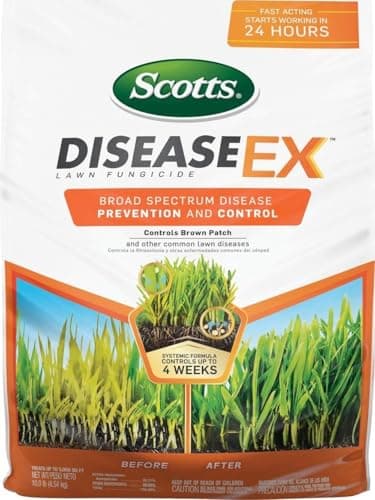
For a homeowner who wants an azoxystrobin option without a commercial license, Scotts DiseaseEx Lawn Fungicide is a granular azoxystrobin product, a ten pound bag at around twenty one dollars, that spreads with a standard rotary spreader. The chemistry is correct. It is not a cure. It is a supporting move behind the drainage, watering, pH, and mowing work, and it only earns its keep if you water it in so it reaches the roots. Apply it and change nothing else and the disease comes back, because the conditions that invited it never left.
What Other Guides Miss
Almost every article on this disease treats diagnosis as the finish line. Confirm the black roots, apply azoxystrobin, improve drainage, done. That is where homeowners actually fail, and the reason is not effort. Take-all recovery is a timing problem wearing a treatment problem's clothes.
The grass has to regrow a root system, and it can only do that during the window when St. Augustine puts energy into roots rather than top growth or heat survival. Feed heavily in that window and the energy goes to the leaves. Water daily and you tell the roots they never need to go deeper. Let it run dry during a heat spike and you burn the shallow roots it just built. Every one of those is a correct action performed at the wrong time of year.
It is also why lawns recover and then relapse the next summer. The homeowner fixed the drainage, got a good fall, saw green in spring, then went right back to the old irrigation timer and the old spring fertilizer habit. The fungus never left the soil. It was waiting for the conditions to return.
So the real work is a calendar, not a product. Which week you back the water off. Which week you feed and how lightly. Which week you raise the mower before the heat arrives. That is what our personalized twelve month care plan builds: it takes your zip code and your grass type and names the exact week to feed and the exact week to pull water back, for your climate instead of a regional average. For a lawn coming back from take-all, that calendar is what keeps it from coming back twice.
Your Recovery Plan, In Order
- Confirm it at the roots. Pull a plug at the edge of a fading patch. Dark, short, brittle roots and stolons that lift easily mean take-all.
- Rule out the mimics. Check for chinch bugs at the green edge, look for leaf lesions, note whether the patch edges are crisp or drifting. If stubby roots are the only symptom, ask about a nematode assay.
- Get a photo diagnosis if you are unsure. Upload a picture to our free AI diagnosis tool before you buy anything. Thirty seconds, no account.
- Cut the water back. Deep and infrequent. Fix any spot that stays soggy after rain. Highest leverage change you will make.
- Raise the mower to three to four inches and keep it there through the recovery.
- Soil test, then adjust pH and nutrition. Follow your extension lab's recommendation. Go light and balanced on nitrogen.
- Relieve compaction and manage thatch so air and water reach the root zone.
- Plan a preventive azoxystrobin application for fall if the lawn has a history of this, and water it in immediately.
- Hold the line for a season and avoid stress events. Repair bare areas only after the conditions are corrected.
- Put next year on a calendar so the watering and feeding habits that caused the outbreak do not quietly return.
Take-all is a slow disease with a slow fix, and that is the hardest part of it. It is also one of the few lawn problems where doing the unglamorous things correctly, for long enough, works almost every time.
Free Lawn Care Tools
Above ground you see irregular yellow, thinning patches with soft edges that drift into healthy turf instead of forming clean circles. The leaf blades themselves carry no spots or lesions, which rules out most other lawn diseases. The real symptom is underground: roots that are dark brown to black, short and brittle, and stolons that lift off the soil with almost no resistance.
No, and the lack of response is one of the clearest diagnostic clues. The roots are too damaged to take up nutrients, so nitrogen and iron produce a flush on the surrounding healthy grass and nothing inside the affected area. Heavy nitrogen actually makes it worse by forcing soft top growth that the damaged root system cannot support. Feed light and balanced while the lawn rebuilds.
Plan on most of a growing season. You are waiting on the grass to regrow an entire root system, and that only happens when conditions stop favoring the fungus. Lawns that fix drainage, cut back watering, correct soil pH, and raise mowing height usually show real improvement over a season, while lawns that only spray a fungicide tend to relapse the following summer.
Azoxystrobin is the active ingredient most often cited for this disease by NC State Extension and UF/IFAS. Because the pathogen lives at the roots, the application must be watered in thoroughly so it moves into the root zone as a drench. Preventive applications in fall are far more useful than a rescue attempt during a summer collapse, and no fungicide will fix a lawn whose growing conditions have not changed.
Chinch bug damage shows up in the hottest, sunniest parts of the lawn, often along driveways, and turns the turf straw brown rather than yellow. Part the grass at the green edge of a damaged area and you can usually find small black and white insects. Chinch bug lawns still have white fibrous roots, while take-all lawns do not. If you cannot tell, a photo diagnosis takes about thirty seconds.
Yes. Alkaline soil is consistently associated with more severe take-all in extension guidance, which is why lowering pH is a standard part of the management plan. Start with a soil test rather than guessing, since the right material and rate depend entirely on your soil. Your state extension office can give you a target range and the amendment that fits your conditions.

Your lawn plan, in your pocket all season
Grass ID, a season plan, soil-timed reminders, and a lawn journal that remembers what you did. Free on iPhone.