Ortho GroundClear Concentrate Mix Ratio: Ounces per Gallon by Jug
 James ThorntonLawn Equipment & Maintenance Expert | 20 Years
Fast Answer: GroundClear Super Weed & Grass Killer Concentrate: 5 fl oz (1/2 cup + 2 tablespoons) per gallon of water for regular weeds, 10 fl oz (1 1/4 cups) per gallon for established or tough weeds. Each gallon covers up to 350 sq ft. GroundClear Year Long Vegetation Killer Concentrate: 24 fl oz (3 cups) per gallon, covering up to 300 sq ft. GroundClear Poison Ivy & Tough Brush Killer Concentrate: 4 fl oz per gallon. All three numbers come from Ortho's current directions. None of them goes on a lawn you want to keep.
GroundClear concentrate mix ratio by jug
Read the front label. Super, Year Long, or Poison Ivy & Tough Brush. Then read across.
| Concentrate | Mix per gallon of water | Kitchen measure | Coverage per gallon of water plus concentrate | Rainproof |
|---|---|---|---|---|
| GroundClear Super Weed & Grass Killer, regular weeds | 5 fl oz | 1/2 cup + 2 tablespoons | 350 sq ft | 15 minutes |
| GroundClear Super Weed & Grass Killer, established or hard-to-kill weeds | 10 fl oz | 1 1/4 cups | 350 sq ft | 15 minutes |
| GroundClear Year Long Vegetation Killer | 24 fl oz | 3 cups | 300 sq ft | 1 hour |
| GroundClear Poison Ivy & Tough Brush Killer | 4 fl oz | 1/2 cup | 100-400 sq ft, depending on brush density; wet leaves, stems, and trunks | 2 hours |
Rates from Ortho's product directions for Super Concentrate, Year Long Concentrate, and Poison Ivy & Tough Brush Concentrate. Formulas get revised, and older jugs still sit on store shelves. If your front label names a different GroundClear, or prints a different number, the jug wins. That includes the B-gon Patio & Landscape concentrate and the refill pouches. This table doesn't cover them.
Read the linked labels for Super Concentrate, Year Long Concentrate, and Poison Ivy & Tough Brush Concentrate. Use the directions on your own container if the formula or label differs. Ready-to-use jugs need no added water.
How much concentrate for each water amount
These rows specify water volume. Leave room in the tank for the concentrate too. One gallon of water plus 24 fl oz of Year Long makes more than one gallon of finished liquid. Use a larger tank or scale both amounts down. Never fill the tank beyond its marked capacity.
| Water to add | Super, regular weeds | Super, tough weeds | Year Long | Poison Ivy & Tough Brush |
|---|---|---|---|---|
| 1/2 gallon | 2.5 fl oz (5 tablespoons) | 5 fl oz | 12 fl oz (1 1/2 cups) | 2 fl oz (4 tablespoons) |
| 1 gallon | 5 fl oz | 10 fl oz | 24 fl oz (3 cups) | 4 fl oz |
| 2 gallons | 10 fl oz | 20 fl oz | 48 fl oz (6 cups) | 8 fl oz |
Mix only what the area needs. The Super label says to rinse the sprayer three times and spray the rinse water on bare soil or gravel. A half tank of leftovers turns that into a chore.
Shop math: how far one 32 oz jug goes
- Super at 5 fl oz per gallon of water: 32 ÷ 5 = 6.4 gallons of water for one 32 fl oz jug. At 350 sq ft per gallon of water, that treats up to 2,240 sq ft.
- Super at 10 fl oz per gallon of water: 32 ÷ 10 = 3.2 gallons of water. At 350 sq ft per gallon of water, that treats up to 1,120 sq ft. That matches Ortho's "treats up to 1120 sq. ft." on the 32 oz jug.
- Year Long at 24 fl oz per gallon of water: 32 ÷ 24 = 1 1/3 gallons of water. At 300 sq ft per gallon of water, that treats up to 400 sq ft.
- Poison Ivy & Tough Brush at 4 fl oz per gallon of water: 32 ÷ 4 = 8 gallons of water. Ortho gives 100 sq ft per gallon for dense brush through 400 sq ft for lighter brush. A 32 fl oz jug therefore treats about 800-3,200 sq ft in one application, depending on density. The separate yearly maximum is 5.3 fl oz of concentrate per 100 sq ft, counting every application. Use the linked label limit; the product web page lists a different figure.
For an illustrative 10-by-40-foot gravel pad, 10 × 40 = 400 sq ft. At the Year Long rate above, that needs 32 fl oz of concentrate plus 1 1/3 gallons of water. Use that calculation only if the site meets the label restrictions, including nearby tree roots. Measure the area first. Trace the strip in our Lawn Size Calculator. It measures any area you outline, driveways included. For these Super directions, divide square feet by 350; for Year Long, divide by 300. That gives gallons of water. Multiply by the product rate to get concentrate. The finished liquid volume also includes the concentrate. Calibrate with plain water and follow the container label for application coverage.
Per-application and per-year limits
More isn't stronger. It's just off-label. The Super concentrate label sets hard caps:
- No more than 10 fl oz of product per 350 sq ft in one application.
- No more than 20 fl oz per 350 sq ft per year. That's two full-strength passes.
- Need a second pass? Wait 28 days.
- No more than two broadcast applications a year.
Use the stricter Year Long label restrictions: one application per year, with no more than 24 fl oz per 300 sq ft per application or per year. Do not repeat it earlier because weeds return. The linked Poison Ivy & Tough Brush label allows no more than 4 fl oz per 100 sq ft per application and 5.3 fl oz per 100 sq ft per year, all applications combined.
- Calibrate with plain water. Ohio State Extension says to use clean water when calibrating a hand sprayer, then adjust your walking pace or pressure if your output is more than 5 percent off the target.
- University of Nevada, Reno Extension on bare-ground herbicides: "The risks of using soil sterilants far outweigh the benefits to homeowners." They can damage trees some distance from where you spray.
- Not sure a residual product fits your yard? Ask your county extension office.
How to mix and spray it
- Pick the right sprayer. Plastic, aluminum, or stainless steel tank sprayer. The Super and Brush labels prohibit backpack sprayers.
- Put on goggles. The Super label strongly recommends eyewear when mixing and applying. Year Long says it can cause substantial but temporary eye injury, and to wear goggles. The brush label also asks for long sleeves, long pants, socks, and shoes.
- Measure with a dedicated cup. Shake the jug gently, measure the concentrate, and add it to the tank with the water. The Super label bans reusing that cup for food.
- Pick the day. Calm air, no rain due for 24 hours, above 60°F. Both Super and Year Long list that temperature.
- Spray the right way for the jug. Super: wet the weed leaves and stop before runoff, and shield plants you're keeping with cardboard. Year Long: spray bare ground or actively growing weeds and let it soak into the ground. Keep runoff away from plants you want. Brush: wet all leaves, stems, and trunks with a coarse, low-pressure spray.
- Leave it alone. The Super label says don't mow, cut, or disturb treated weeds for at least 7 days.
Keep a dedicated sprayer labeled for these herbicides. Do not use it to apply lawn products. The Super and Brush labels prohibit use on or around food or feed crops. Brush also prohibits use where grazing is allowed. Keep pesticide and rinse water out of storm drains, drainage ditches, gutters, and surface water.
What to expect after spraying
Super weeds wilt within hours. Complete kill takes days to 1 to 2 weeks, per the label. Rainproof in 15 minutes.
Year Long starts working right away and is rainproof in 1 hour. It keeps new growth from coming back for up to a year.
Brush killer shows visible results in hours, per Ortho. Full wilting can take 2 to 6 weeks. Poison ivy and blackberry may need a second treatment.
All three labels say keep people and pets out until the spray has dried.
Replanting after GroundClear
This is where the jugs split hard.
Super first. Perennials, trees, and shrubs can go in 1 day after application. Starting a new lawn? Use the 10 fl oz rate. Don't mow for 7 days before or 7 days after spraying. Then wait 7 days after the last application before you rake, till, seed, or lay sod.
Skip Year Long where you intend to plant a lawn, fruits, vegetables, flowers, or other plants. Its label says it can remain active for up to a year, and heavy clay may prevent plant growth for more than a year. A calendar anniversary does not establish that treated soil is ready to plant. Its actives are pelargonic acid and imazapyr.
The brush label gives no replant wait. Check the jug before you plant where you sprayed.
What other guides get wrong
Plenty of guides warn you off the lawn and stop there. Trees take the hit quietly. For Year Long, Ortho says to stay back twice the distance from a tree's trunk to its drip line. Skip slopes. Skip fence lines with plants on the other side. Year Long can prevent plant growth for up to a year, or longer in heavy clay. Keep it away from tree roots. Nevada's warning covers longer-lived sterilants.
Trees near the gravel? Of these three, Super is the one Ortho lists for spot-treating weeds around trees and shrubs. Keep it off their leaves.
The other mistake is the name. GroundClear and WeedClear are one word apart, and the jobs are opposites.
- These GroundClear products are for unwanted vegetation at the sites listed on their labels. Keep them off a lawn you want to preserve.
- WeedClear is Ortho's selective lawn weed killer. Use it only when the exact bottle lists your lawn grass, target weed, and application site. Rates and grass types are in our WeedClear how-to guide.
Weeds in the lawn itself? Put the GroundClear back on the shelf. Not sure that brown patch is even weeds? Run a photo through the free AI lawn diagnosis first. Herbicide won't fix a fungus.
Still deciding between GroundClear and glyphosate for a driveway or a renovation? The chemistry and replant comparison is in Ortho GroundClear vs Roundup.
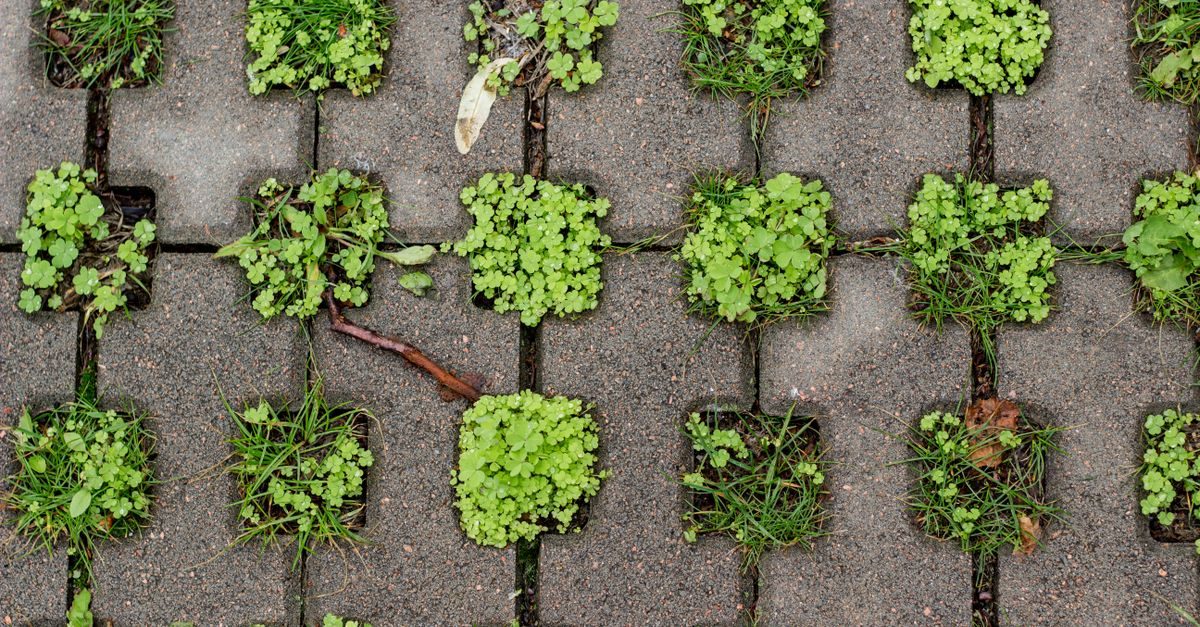
The hero is a cropped stock photograph of plants growing between paving blocks. It does not show a GroundClear trial or an inspected property. The mixing guidance comes from the linked manufacturer directions and labels.
Free Lawn Care Tools
It depends on the jug. GroundClear Super Weed & Grass Killer Concentrate: 5 fl oz per gallon for regular weeds, or 10 fl oz per gallon for established and hard-to-control weeds; each gallon covers up to 350 sq ft. GroundClear Year Long Vegetation Killer Concentrate: 24 fl oz per gallon, covering up to 300 sq ft. GroundClear Poison Ivy & Tough Brush Killer Concentrate: 4 fl oz per gallon. These are Ortho's current directions; the label on your jug wins if it differs.
At 10 fl oz per gallon of water, a 32 fl oz bottle needs 3.2 gallons of water and treats up to 1,120 sq ft. At 5 fl oz per gallon of water, it needs 6.4 gallons of water and treats up to 2,240 sq ft. Finished liquid volume also includes the concentrate. Leave enough room in the sprayer.
Keep these GroundClear products off a lawn you want to preserve. Super has separate directions for killing an old lawn before renovation. Year Long can prevent plant growth for up to a year or longer in heavy clay. For selective weed control, choose a product whose exact label lists your grass and target weed.
With GroundClear Super, the label says to wait 7 days after the last application before you rake, till, or replant with seed or sod. Do not use Year Long where you intend to plant. Its label says it can remain active for up to a year, and heavy clay may prevent plant growth for more than a year. A year on the calendar is not proof that the soil is ready.
No. The Super Concentrate label says not to apply it with a backpack sprayer. Use a plastic, aluminum, or stainless steel tank sprayer.
Photos: Natalia Sevruk / Pexels.
Related Articles
 Weed Control
Ortho GroundClear vs Roundup: Which to Use (and How to Apply GroundClear)
Jul 8, 2026•11 min read Weed Control
How to Use Ortho WeedClear Lawn Weed Killer: Mix Ratio, Timing + What It Kills
Jul 8, 2026•12 min read Weed Control
Pre-Emergent for Bermuda Grass: Best Picks and When to Apply
Nov 26, 2026•5 min read