Barnyardgrass in Lawns: How to Identify and Remove It

Is a coarse, fast-growing grass standing above the rest of your lawn? Check the inside of a leaf junction before calling it barnyardgrass. A broad leaf or purple seed head gives you a clue, but the collar check is more useful.
Fast Answer: Barnyardgrass (Echinochloa crus-galli) is a summer annual grass weed. NC State Extension describes upright growth, moist disturbed sites, and a missing ligule. The ligule is a small membrane or fringe of hairs on the inside where the leaf blade joins its wrapping base.
Inspect that junction on an intact leaf. If the ligule is absent and the remaining features fit, ask your local Extension office to confirm an uncertain plant. Penn State Extension recommends hand pulling or a trowel when only a few confirmed plants are present.
What should you inspect at the leaf junction?
Can you see where a leaf blade bends away from the stem? The sheath is the lower part of that leaf, which wraps around the stem. The collar is the junction between blade and sheath. A ligule projects from the inside of this junction. Penn State's collar photograph shows the area to inspect. Gently pull the blade away from its sheath to expose the inside junction.
- Choose an intact leaf from the coarse plant. Keep track of which stem it belongs to.
- Gently bend the blade away from its sheath. Look at the inside of the junction in good light.
- Check for a thin membrane or a fringe of hairs at that exact position. Use a close phone photograph or magnifier if needed.
- Inspect another intact leaf on the same plant. If the junction is torn or the photograph is blurred, record the result as uncertain.
- Photograph the junction, the whole plant, and any seed head. Include your location and the season when you request confirmation.
Is a membrane or hair fringe clearly present? That conflicts with the absent ligule described for barnyardgrass. If nothing projects from the junction, keep checking the plant's other features. Hair elsewhere on the plant does not establish a hairy ligule.
NC State describes a flattened sheath, sometimes tinged red or purple at its base, and leaves rolled within the bud. Those details support the collar check. They cannot establish the species by themselves.
Do the other features fit barnyardgrass?
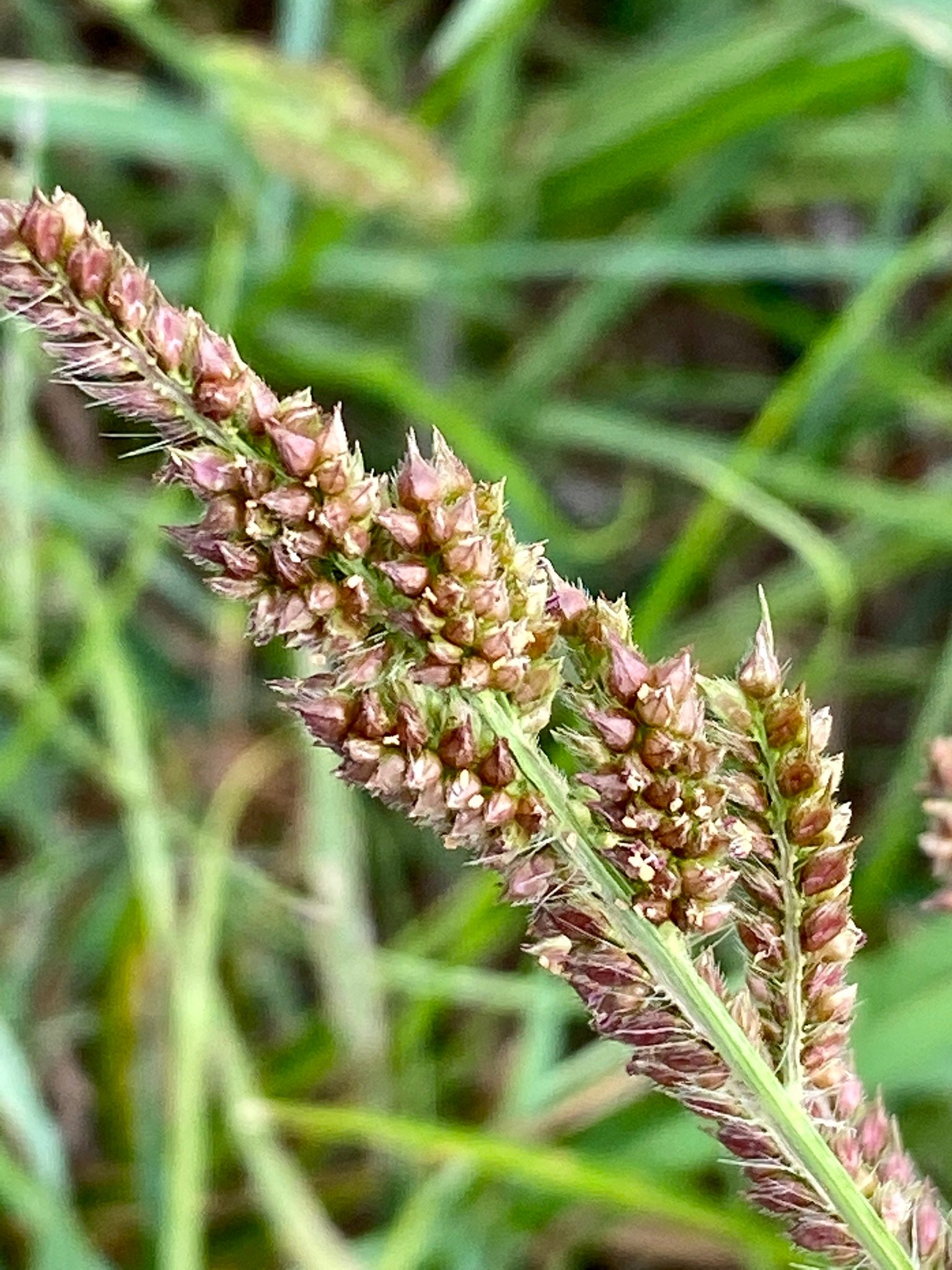
Is the plant coarse and does its flowering head branch? Penn State describes pointed blades, a clear central vein, and a branching, roughly pyramid-shaped seed head. The flowering units may have awns, the bristle-like tips, or lack them. Even one plant can have both types.
The hero photo shows a close-up of a recorded barnyardgrass flowering head. It does not show the collar test or a maintained lawn. Use the photograph to understand the flowering structure, then inspect your own plant.
| Your observation | What it means | What to do |
|---|---|---|
| Intact junction has a clear membrane or hair fringe | Conflicts with the absent ligule of barnyardgrass | Keep the plant unidentified and compare other grasses |
| Ligule absent, coarse leaves, branching seed head | Consistent with barnyardgrass; related species still need consideration | Send the full photo set for confirmation if uncertain |
| Purple color or bristles, but no clear junction view | Incomplete evidence | Take a sharp collar photograph before treatment |
| Torn leaf junction or mixed plants in the sample | Test cannot be read reliably | Repeat with intact leaves from one plant |
Could it be a related grass? University of California IPM describes junglerice (Echinochloa colona), which also lacks a ligule. Its leaves often have purple bands across the blade. Because these bands are variable, their absence alone cannot settle the identification. Send the whole plant, flowering head, and collar view to your local specialist.
If the flowering is spread through otherwise familiar turf, inspect the grass before removing it. Normal lawn grasses also flower. The grass seed head guide covers that separate mowing decision.
How do you remove a few confirmed plants?
Are there only a few plants, or is the weed spread through the lawn? Penn State supports hand removal or a trowel for a small number. The steps below turn that guidance into a careful removal procedure. They are a source-based method, with no field trial or removal guarantee.
- Confirm the plant first. Mark the individual plants so you remove the intended grass.
- If seed heads are present, contain them as you handle the plant. Penn State notes that seed can travel on shoes and mowing equipment.
- Hold the plant near its base and pull it with its roots. Use a trowel to loosen the root area if pulling leaves the plant behind.
- Keep removed plants out of the lawn. Brush plant material from shoes and tools before moving to another area.
- Inspect the opening left behind. Choose a repair method and timing that fit your lawn grass and region.
- Recheck the location for more seedlings. Removing visible plants does not remove seed already in the soil.
If removal leaves bare soil, measure the patch before buying seed. The grass seed calculator can help with quantity once you have selected a grass and its seeding rate. A quantity calculation does not decide the right species or planting season.
Why is it growing in this spot?
Does water linger there after rain or irrigation? NC State places barnyardgrass in moist, disturbed sites and wet turf. Check where sprinkler water lands and where the surface stays wet. A wet spot is a reason to inspect watering and drainage; it is not enough to identify the plant.
Is the surrounding turf thin, or did the weed appear after soil was brought in? Penn State describes seed movement in soil and on equipment. NC State recommends dense, healthy turf maintained with suitable mowing and fertilization. Address the condition you can verify rather than adding fertilizer solely because a weed appeared.
University of California IPM also describes barnyardgrass in moist disturbed places and notes that its features vary between plants. Its California germination season extends from late winter or early spring through summer. Use local conditions when planning prevention.
What other guides misdiagnose
A missing ligule is useful evidence, but a damaged leaf can hide that structure. Check an intact second leaf. A related grass can share the same collar trait, as the junglerice comparison shows.
A shorter cut is not a universal solution. Penn State describes frequent mowing below 3 inches as a way to suppress barnyardgrass growth and seed heads. That weed-control statement does not set a safe mowing height for every lawn species. Use the normal range for your grass. The mowing calculator helps you check that separate requirement.
Extension Guidance: For a widespread infestation, confirm both the weed and the lawn grass with your local Extension office. If a herbicide is considered, check the current product label for barnyardgrass control, residential-lawn use, your turf species, application timing, rates, and reseeding restrictions. Penn State's product tables include turf restrictions and products that cannot be used on lawns. No specific product or rate is recommended here.
Your barnyardgrass diagnosis checklist
- Inspect the inside leaf junction on intact leaves from one plant.
- Document the whole plant and seed head, then confirm an uncertain species.
- Remove a few confirmed plants by hand or trowel.
- Inspect wet or thin areas and repair them for your grass and region.
- Get local guidance for a widespread infestation before choosing chemicals.
You can upload the plant photographs for an AI identification to narrow the possibilities. Keep uncertain species confirmation with Extension. A personalized care plan can organize the lawn's seasonal maintenance after you know its grass and conditions.
Sources: NC State Extension, Barnyardgrass; Penn State Extension, Lawn and Turfgrass Weeds: Barnyardgrass; University of California IPM, Junglerice; University of California IPM, Barnyardgrass.
Display crops vary by screen.
Free Lawn Care Tools
Inspect the inside junction where an intact leaf blade meets its sheath. Barnyardgrass lacks a ligule, the small membrane or hair fringe many grasses have there. NC State describes this feature; use the whole plant and seed head to check the remaining clues.
The result is incomplete on its own. University of California IPM describes junglerice, another Echinochloa species that lacks a ligule and often has purple bands on its leaves. Send clear collar, whole-plant, and seed-head photographs to your local Extension office for an uncertain identification.
Penn State recommends hand pulling or a trowel when only a few confirmed plants are present. Remove the plant with its roots and keep seed heads contained. Recheck the site because seed remaining in soil can produce more plants.
Keep the mowing height suited to your lawn species. Penn State describes cutting below 3 inches as barnyardgrass suppression, but that does not establish a safe height for every turfgrass. Check the grass-specific range before changing the mower.
Confirm the weed and lawn grass before selecting a product. Penn State requires label directions and turf restrictions to be followed, and its tables include products that cannot be used on lawns. Ask local Extension for suitable options, then check the current label for the exact lawn use, timing, rate, and reseeding limits.
Photos: Sandy Wolkenberg / iNaturalist · CC BY 4.0

Beat weeds and brown spots from your phone
Snap a photo, get the fix, and follow a plan timed to your soil and weather. Free on iPhone.