

Nimblewill in Lawns: How to Identify and Remove It

As an Amazon Associate we earn from qualifying purchases.
A pale, wiry patch turns tan while the rest of your cool-season lawn stays green. Nimblewill, a fine perennial grass, may be the cause. It goes dormant early and greens up late, so the patch can look dead beside healthy turf. To identify it, check the creeping stems when they are green. To remove it, lift a small patch with its runners or plan a labeled treatment and reseeding for a larger one.
Fast Answer: Nimblewill is a warm-season perennial grass that forms fine, gray-green patches in cool-season lawns. It turns tan in fall and greens up later than bluegrass and fescue in spring. Its thin stems spread along the soil surface and root at nodes. These traits come from Penn State Extension and Iowa State University Extension.
Lift a few stems and look for the creeping runners. Compare a live plant with the lookalikes below before choosing a control method.
For a small patch, dig out the runners and roots, then repair the bare soil. Larger patches may need a labeled herbicide plan and reseeding. If you like the low-growing native grass, you can leave it.
What does nimblewill look like in a lawn?
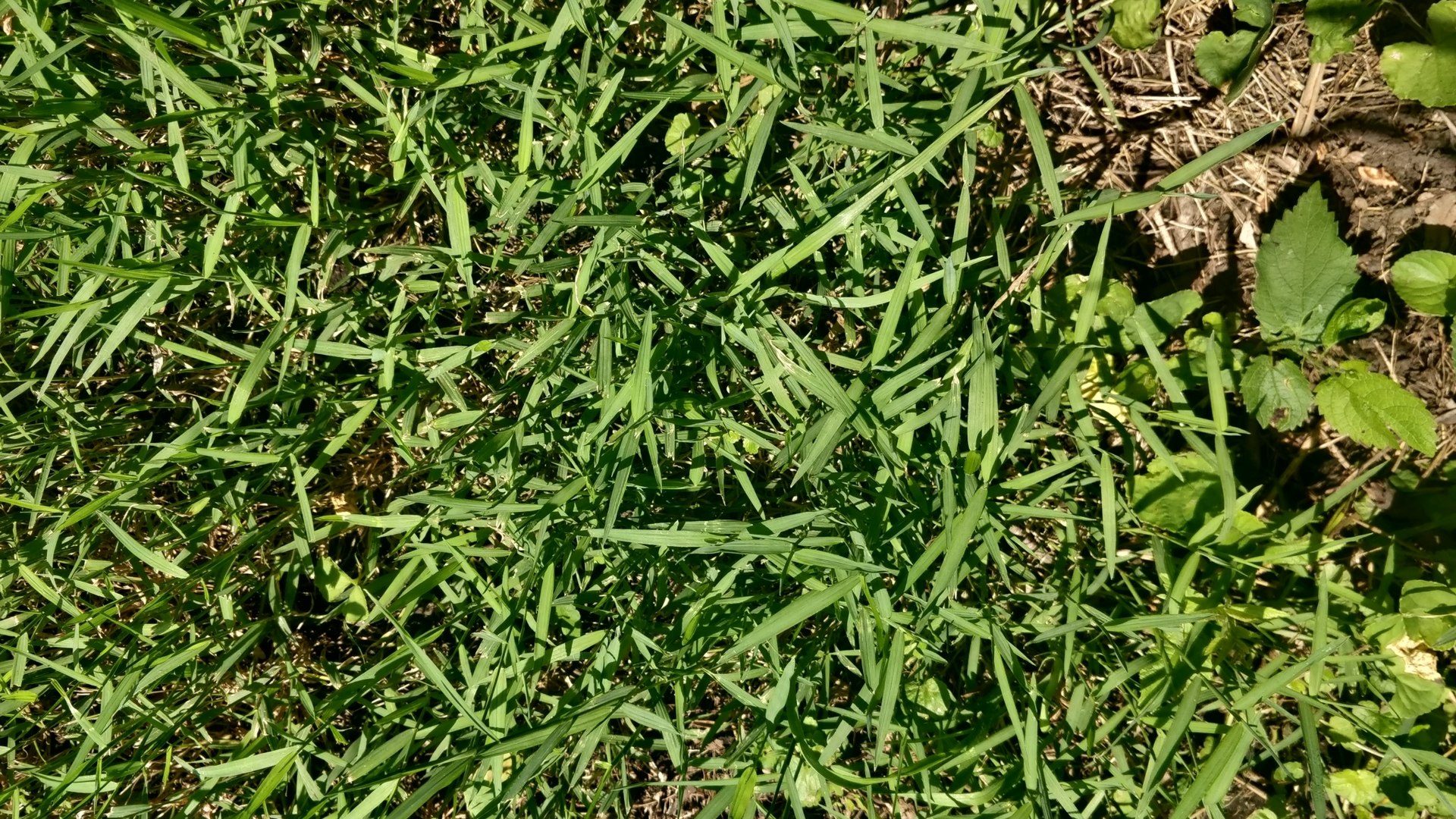
Where does the odd color start? Nimblewill often forms a rounded patch among cool-season grass. While it grows, the patch can look pale or gray-green beside darker turf.
After cooling weather, the nimblewill turns tan earlier. In spring it stays straw colored after nearby bluegrass has greened up. University of Maryland Extension shows both the green plant and the dormant patch.
Lift the edge of a green patch rather than judging it only by color. Do thin, wiry stems run across the surface? Nimblewill produces aboveground runners called stolons. A runner can take root where a node, the joint on a stem, touches soil.
Penn State describes short, pointed leaves that project roughly sideways from the stem. Its small seedheads stand on slender spikes from summer into fall. These are better clues than a single brown photograph.
If the patch is fully dormant, wait for fresh growth before making a confident plant identification. Dead blades alone may be grass killed by drought, disease, or another cause. Mark the edge of the patch now and compare it again when the rest of the lawn starts spring growth. A sample with live stems, runners, and seedheads gives your county extension office more to examine.
Could it be a different grass?
Is there a pale stripe down the middle of each blade? Penn State Extension says Japanese stiltgrass often has that silver stripe and wider leaves; nimblewill does not. The stripe is a useful rule-out when leaves are intact, although one damaged blade is not enough for an identification. Check several stems.
Does the patch creep, but the stems feel softer and more flexible? Penn State compares nimblewill with creeping bentgrass. Bentgrass has a longer membranous ligule, the small flap where the leaf meets its sheath. Nimblewill's ligule is very short.
Bermudagrass is another creeping lookalike. Its ligule is a fringe of hairs, while nimblewill has a short membrane. These details are small. If you cannot see them, take a clear close-up and a wider patch photo to identify the grass from a photo, or send a live sample to your extension office.
The season helps but cannot settle the case by itself. Nimblewill greens up late and goes dormant early in a cool-season lawn, according to Iowa State. Bermudagrass can also change color with the season. The runner, blade, and ligule checks narrow the name before you decide whether to remove anything.
Why did the patch take hold?
Is the desirable turf thin at the patch edge? Iowa State says nimblewill establishes most readily where turf is thin or grows poorly. It often appears in shade in home lawns, yet it can grow in sun too. Do not use shade alone as an identification test.
Instead, check how the existing grass handles the site during the next growing season. Is tree shade keeping bluegrass sparse? Does the area dry out between watering, or does foot traffic wear the turf? A stronger replacement stand needs grass suited to those conditions.
Maryland Extension recommends dense, healthy turf to compete with nimblewill. A shade-tolerant grass choice may help where the current grass cannot fill in.
Nimblewill is native to the eastern United States. Iowa State notes that some homeowners accept its low, mat-forming growth and reduced mowing need. Its early browning and lower foot-traffic tolerance are the trade-offs. Decide whether a mixed lawn bothers you before starting a removal job that leaves bare ground.
How do you remove a small patch?
Can you lift the whole patch with a hand tool? For a small infestation, Maryland Extension recommends digging.
Work past the visible edge, lift the shallow roots, and collect every visible runner. Iowa State warns that left-behind stolons can restart the patch. Put the removed plant material where it cannot root back into the lawn.
Fill and level the hole, then re-establish a grass that fits the site. If the soil is shaded, choose a grass that tolerates the shade rather than repeating a species that stayed thin there. Fall lawn renovation covers seedbed work and establishment for cool-season lawns. Water the new seed as its label and local extension guidance direct.
Check the edge again after new growth appears. A missed runner is easier to remove while the new patch is small. If runners have spread through a large area, digging may strip out more desirable turf than a planned renovation would.
When does an herbicide plan make sense?
First check whether nimblewill is actively green. Iowa State Extension says nonselective herbicide works on growing nimblewill and can require more than one treatment after regrowth. It also kills desirable turf it touches. A tan, dormant patch is a poor target for that method.
Iowa State recommends beginning in early to midsummer where that leaves enough time for late-summer or early-fall reseeding. Watch for regrowth before a second or third application. Check your local planting window first; it may differ from Iowa's.
For a large patch mixed into cool-season grass, Penn State Extension discusses selective products containing mesotrione or topramezone. Penn State says two or three applications over the growing season may be needed while nimblewill is actively growing. One application rarely finishes the job, and treated foliage may turn white.
Maryland Extension notes that mesotrione labels can be difficult for homeowners to use and that a lawn professional is an option. The mesotrione guide explains that ingredient separately.
- Confirm nimblewill before using an herbicide. Follow the label on the exact product for your turf species, site, timing, rate, protective equipment, and reseeding interval.
- Ask your county extension office for local planting dates and a control option that is labeled where you live. Do not copy another region's spray schedule.
- A nonselective treatment kills desirable turf on contact. Keep it away from grass and plants you intend to keep.
After control, repair the opened area. Bare soil lets new weeds establish. Keep the replacement turf dense through suitable mowing, water, and fertilizer decisions based on the grass and soil, as Iowa State recommends. A personalized care plan can turn that choice into a schedule for your grass and ZIP code after you know which grass is present.
Working a case: a tan patch in October
Imagine a 3-foot patch in an otherwise green bluegrass lawn. This is an illustrative case, not a tested lawn. The patch turned tan before the surrounding grass.
In late summer it had wiry, gray-green stems that ran along the soil, and a few runners rooted at the joints. Those observations fit nimblewill. A live sample still matters before treatment.
The owner has two choices. If the patch does not interfere with use, leave it and watch whether it spreads. If uniform turf matters, mark the boundary, confirm the plant while it is green, and plan removal with enough time to reseed. Spraying the brown October patch without checking active growth would miss the timing condition Iowa State gives for herbicide work.
What other guides misdiagnose
A tan patch is often called dead grass. Nimblewill goes dormant and can return in spring, so check live runners before you decide that reseeding alone will solve it.
Another shortcut is to name nimblewill from shade or color alone. Penn State's leaf, runner, and ligule details give better tests. Shade explains why desirable turf may be thin, but nimblewill can also grow in sun.
Control advice also needs a finish line. Removing nimblewill leaves open soil. If the replacement grass cannot grow well in the same shade or wear, the patch stays vulnerable. Choose the replacement and planting window before you remove a large area.
Your nimblewill diagnosis checklist
- Compare the patch with nearby turf in late fall and again during spring green-up.
- When it is green, look for thin runners, rooted joints, short pointed leaves, and slender seedheads.
- Check several blades for a silver stripe, then inspect the ligule if a lookalike remains possible.
- Decide whether the patch needs removal. A small native patch can stay if it suits how you use the lawn.
- For removal, choose digging or a labeled control plan while the plant is actively growing. Plan the replacement turf before opening the soil.
- Repair the bare area and check for regrowth from any remaining runners.
If the checks still point in different directions, upload a clear patch photo and a close view of a stem to identify the grass, or ask your county extension office to inspect a live sample.
Top Picks
- BioAdvanced Fungus Control for LawnsCheck price on Amazon
- Scotts Turf Builder Weed and Feed 3 (5,000 sq. ft.)Check price on Amazon
- PetraTools Liquid Iron for LawnsCheck price on Amazon
As an Amazon Associate we earn from qualifying purchases.
Free Lawn Care Tools
Look for live, wiry runners and leaves during the growing season. Nimblewill turns tan earlier than nearby cool-season turf and greens up later in spring, according to Iowa State University Extension. A tan patch alone does not confirm the plant; examine it when new growth appears.
Yes. Iowa State University Extension describes nimblewill as a warm-season perennial. It spreads by runners and seed, goes dormant when the weather cools, and grows again from surviving tissue in spring.
Digging is an option for a small patch. Lift the roots and every visible runner, because University of Maryland Extension says remaining pieces can regrow. Level and re-establish the bare area with grass that suits the site.
Nimblewill is a grass, so do not assume a broadleaf weed product controls it. Penn State Extension discusses selective grass herbicides containing mesotrione or topramezone and nonselective glyphosate spot treatment. Confirm the product label lists your turf, site, weed, and timing before any application.
Iowa State University Extension says herbicide treatments should target actively growing, green nimblewill. Once a patch is dormant, mark its edge and confirm live growth before planning treatment. Ask your local extension office about the next suitable control and reseeding window.
No. Iowa State University Extension notes that nimblewill is a native grass and some homeowners accept its low, mat-forming growth. Keep it if the seasonal tan color and lower foot-traffic tolerance fit how you use the lawn.
Sources (4)

Beat weeds and brown spots from your phone
Snap a photo, get the fix, and follow a plan timed to your soil and weather. Free on iPhone.
Related Articles
 Problem Solving
Prostrate Knotweed in a Lawn: How to Identify It and Clear a Patch
Sep 24, 2026•3 min read Problem Solving
Ragweed Identification: What It Looks Like and How to Control It
Aug 12, 2026•6 min read Problem Solving
Common Purslane in a Lawn: How to Identify It and What to Check First
Sep 22, 2026•4 min read
