Fall Lawn Care Schedule and Checklist: Month-by-Month Maintenance
 Marcus GreenTurf Management Pro | 18 Years
As an Amazon Associate we earn from qualifying purchases.
Summer is rough on a lawn. Heat, drought, foot traffic, and disease leave most yards thinner, patchier, and more compacted than they were in spring. The good news is that fall is not the wind-down season most people treat it as. For a huge share of lawns it is the single most important repair window of the entire year, and what you do between Labor Day and the first hard freeze sets up how green things look next May.
In early fall, aerate compacted soil and overseed thin or cool-season lawns while the soil is still warm enough for seed to germinate. In mid-fall, feed the lawn with a fall fertilizer so the roots bulk up before winter. In late fall, put down a winterizer on cool-season grass, keep mowing until top growth actually stops, and stay on top of fallen leaves so they never smother the turf.
The catch is that this calendar is not one-size-fits-all. Cool-season lawns treat fall as prime growing season and get the full aerate-overseed-feed program. Warm-season lawns are sliding toward dormancy and need almost the opposite: easing off nitrogen, controlling winter weeds, and lowering the mowing height gradually. Match the plan to your grass type and your region, not to a generic date.
Before you start: know your grass type and your window
Every task below hinges on two things: whether you have cool-season or warm-season grass, and how many growing weeks you have left before a hard freeze. Cool-season grasses (tall fescue, Kentucky bluegrass, perennial ryegrass, fine fescues) hit a second peak growth surge in fall and do their best root building in cooling soil. Warm-season grasses (Bermuda, Zoysia, St. Augustine, centipede) are the opposite: they slow down as nights cool and go dormant after the first frosts.
Soil temperature matters more than air temperature for the seed-and-feed decisions. The easiest way to time overseeding and fertilizing is to watch when your soil settles into the right range rather than watching the calendar. Our soil temperature tool lets you check current and typical soil temps for your area so you are not guessing. If you are unsure what you are even working with, a quick photo diagnosis will name your grass type first.
Fall lawn care schedule at a glance
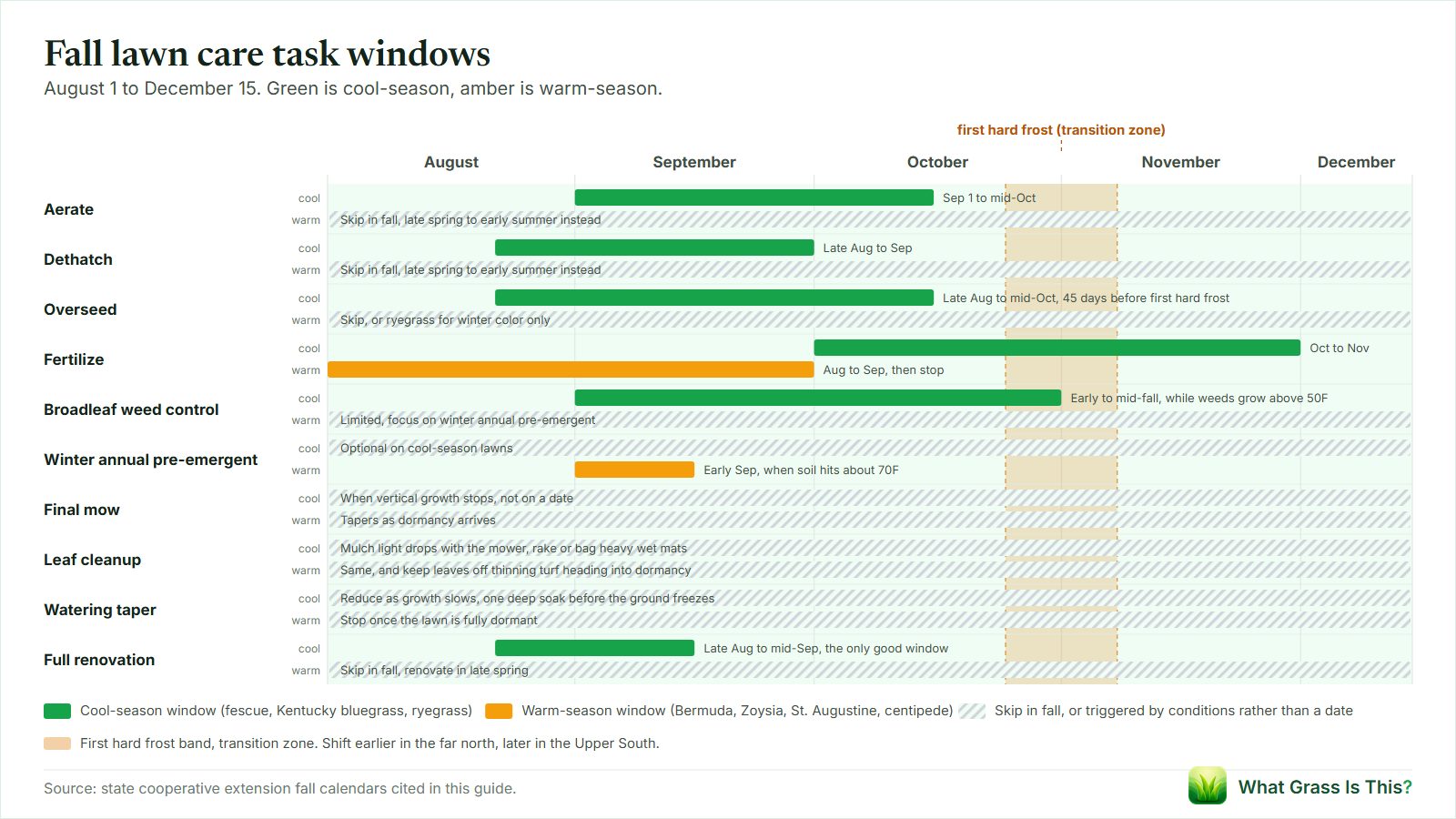
Here is the whole fall program in one view. Find your grass type in the column heading, then work down the task list. Treat the dates as starting points and shift them earlier if you are in the far north, later if you are in the Upper South.
| Task | Cool-season (fescue, KBG, ryegrass) | Warm-season (Bermuda, Zoysia, St. Augustine, centipede) |
|---|---|---|
| Aerate | September through mid-October | Skip in fall, late spring to early summer instead |
| Dethatch | Late August to September | Skip in fall, late spring to early summer instead |
| Overseed | Late August to mid-October, at least 45 days before first hard frost | Skip, or ryegrass for winter color only |
| Fertilize | October to November | August to September, then stop |
| Broadleaf weed control | Early to mid-fall while weeds actively grow above 50F | Limited, focus on winter annual pre-emergent |
| Winter annual pre-emergent | Optional | When soil hits about 70F, early September in most of the South |
| Final mow | When vertical growth stops, not on a date | Tapers as dormancy arrives |
| Leaf cleanup | Mulch light drops with the mower, rake or bag heavy wet mats | Same, and keep leaves off thinning turf heading into dormancy |
| Watering taper | Reduce as growth slows, one deep soak before the ground freezes | Stop once the lawn is fully dormant |
| Full renovation | Late August to mid-September, the only good window | Skip in fall, renovate in late spring |
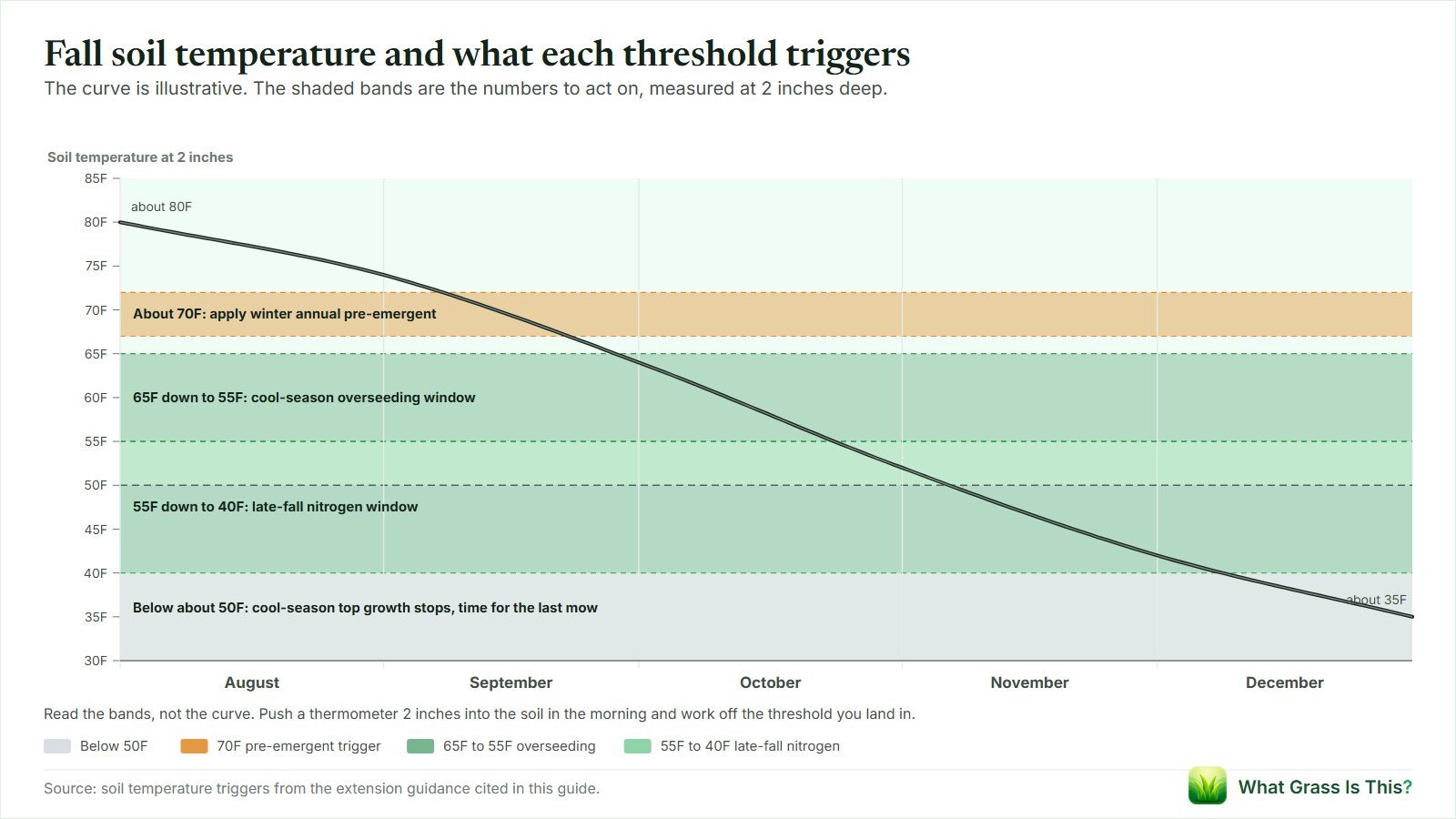
Most of those rows are triggered by soil temperature rather than by a date. Check your current soil temperature and work off these thresholds, all measured at 2 inches deep.
| Trigger | Temperature | Action |
|---|---|---|
| Cool-season seed germination | 55F to 65F soil, 60F to 75F air | Overseed window opens |
| Poa annua germination | Below about 67F for five straight days | Apply pre-emergent at about 70F |
| Late-fall nitrogen window | Soil falling through 40F to 55F | Winterizer after top growth stops |
| Cool-season growth stops | Below about 50F | Last mow |
September: the repair window (aerate, dethatch, overseed)
This is the heavy-lifting month. Soil is still warm from summer, but air temperatures are dropping and rainfall usually picks back up, which is the ideal combination for germinating seed and recovering from summer stress. If the lawn thinned out in patches rather than evenly, check whether grub damage explains the thin patches before you spend a weekend seeding over the real problem.
Cool-season lawns: aerate, dethatch, and overseed
If your cool-season lawn is compacted or thin, early fall is when you fix it. Core aeration pulls plugs of soil out of the ground, relieving the compaction that built up over summer and opening channels for water, air, and nutrients to reach the roots. Figure out how many passes and roughly what it will cost with the aeration calculator before you rent a machine. For the full rundown on reading compaction signs and core versus spike methods, see when to aerate your lawn.
If you have a thick spongy layer of dead material between the green blades and the soil, that thatch needs to come out before you seed, because seed that lands on thatch instead of soil will not root well. Our guide on how to dethatch a lawn covers when it is worth doing and when to leave it alone, and the dethatching calculator will tell you whether your thatch layer is worth removing. Aeration and light dethatching both create the seed-to-soil contact that makes the next step work.
Overseeding right after aeration is the classic fall one-two punch. The aeration holes act as little nurseries for the new seed. Nail your seed rate with the overseeding calculator so you neither waste seed nor sow too thin, and read overseeding best practices for the full method. If the lawn is too far gone to patch and you are starting over, calculate your seed rate for a full reseed instead. Timing is everything here: seed needs soil temperatures in roughly the mid-50s to low 60s to germinate reliably, which you can confirm against the grass seed germination temperature chart. Get the seed down early enough that the young grass has several weeks to mature before the first hard freeze.
Warm-season lawns: hold off on seeding, keep feeding lightly
Warm-season grass owners should not be overseeding with the same species now. Bermuda and Zoysia are heading toward dormancy, and new plugs of the same grass will not establish before cold weather. Early fall is fine for a light feeding while the grass is still actively growing, but the clock is ticking on nitrogen (more on that below). Some warm-season owners overseed with annual or perennial ryegrass for winter color, but that is a cosmetic choice with its own tradeoffs, not a repair task.
October: feed the roots and control weeds
By October the grass you seeded is filling in and the whole lawn is putting energy into roots rather than top growth. This is the most important feeding of the year for cool-season lawns.
Fall fertilizer schedule for cool-season lawns
A fall fertilizer application in mid-fall feeds the root system while the plant is primed to store energy. This is what produces a thick, early-greening lawn the following spring, and it does more for long-term lawn health than any spring feeding. Plan your product and timing with the fertilizer schedule calculator, which maps applications to your grass type across the season.
Mid-fall is also the window for post-emergent broadleaf weed control in cool-season lawns, if you have a dandelion or clover problem. Perennial weeds are pulling resources down into their roots this time of year, which carries herbicide down with them and makes fall applications unusually effective. Hold weed control off any areas you just overseeded until the new grass has been mowed a few times.
Extension programs do put numbers on this. These are pounds of nitrogen per 1,000 square feet for cool-season lawns.
| Timing | Rate (lb N per 1,000 sq ft) | Notes |
|---|---|---|
| Early September | 1.0 | Once daytime highs stay under 90F |
| Early to mid October | 0.75 to 1.0 | The most important feeding of the year |
| Early November, winterizer | 0.5 to 1.0 | After growth stops, while grass is still green |
| Annual total, medium maintenance, clippings returned | 0.5 to 2.0 | Varies with soil organic matter |
| Annual total, high maintenance, clippings removed | 2.5 to 4.0 | Upper end only on sandy, low-organic soils |
Two guardrails go with those numbers. Never exceed 1.0 lb of nitrogen per 1,000 square feet in one application of mostly water-soluble nitrogen, and leave at least four weeks between applications. If your state extension publishes different totals for your soil and season length, theirs win.
Warm-season lawns: stop the nitrogen
This is the single most important warm-season rule of the season: stop applying nitrogen well before dormancy. Late nitrogen pushes tender growth right when the grass should be hardening off, which invites winter injury and disease like spring dead spot. Instead, mid-fall is a good time to apply a pre-emergent for winter annual weeds like Poa annua, and pre-emergent timing for Poa annua is worth reading before you buy a bag, and to consider a potassium-focused feeding that improves cold tolerance without forcing top growth. The exact cutoff date for nitrogen varies by how far south you are, so lean on local guidance here.
- Exact nitrogen rates (commonly expressed as pounds of N per 1,000 square feet per application) and the total seasonal cap for your grass type should come from your state's cooperative extension, not a generic number.
- The precise last-safe date for fall nitrogen on warm-season lawns, and the winterizer timing window for cool-season lawns, depend on your local first-frost date. Your county extension office publishes region-specific calendars.
- Herbicide chemistry and legality vary by state and by what you have recently seeded. Confirm the specific product and rate, especially any pre-emergent or post-emergent near new grass, with local guidance before applying.
- Soil test recommendations (lime, potassium, phosphorus) are worth pulling from your extension's soil lab rather than guessing, since fall is the ideal time to correct pH.
November: winterize, final mow, and leaf cleanup
As growth slows, the tasks shift from building the lawn to protecting it and cleaning up. Do not check out yet: a few late moves make a real difference.
Cool-season lawns: winterizer and the final mow
A winterizer is a late-fall fertilizer, typically higher in potassium, that hardens the grass for winter and stores energy for a fast spring green-up. Timing is the trick: you want it down while the grass is still green and taking up nutrients but has largely stopped growing on top, usually after the last mow. Our guide to the best winterizer fertilizer for northern lawns walks through product choice and timing.
Keep mowing until vertical growth genuinely stops. Do not quit on a date. For the final few cuts, many cool-season owners drop the mowing height slightly (not scalping, just a step down) so the lawn goes into winter a bit shorter, which reduces matting and snow mold risk. Our companion guide on when to stop mowing your lawn covers how to read the grass instead of the calendar.
Warm-season lawns: lower and dormant
Warm-season lawns are going dormant and turning tan, which is normal and healthy, not dead. Gradually lower the mowing height across your last few cuts to clean up the canopy, and raise the deck back up in spring. Skip fertilizer entirely now. If you missed the overseeding window and still want a fix, late fall is when dormant seeding comes into play: sowing seed into cold soil so it sits dormant and germinates the moment spring soil warms.
All lawns: leaf management and watering taper
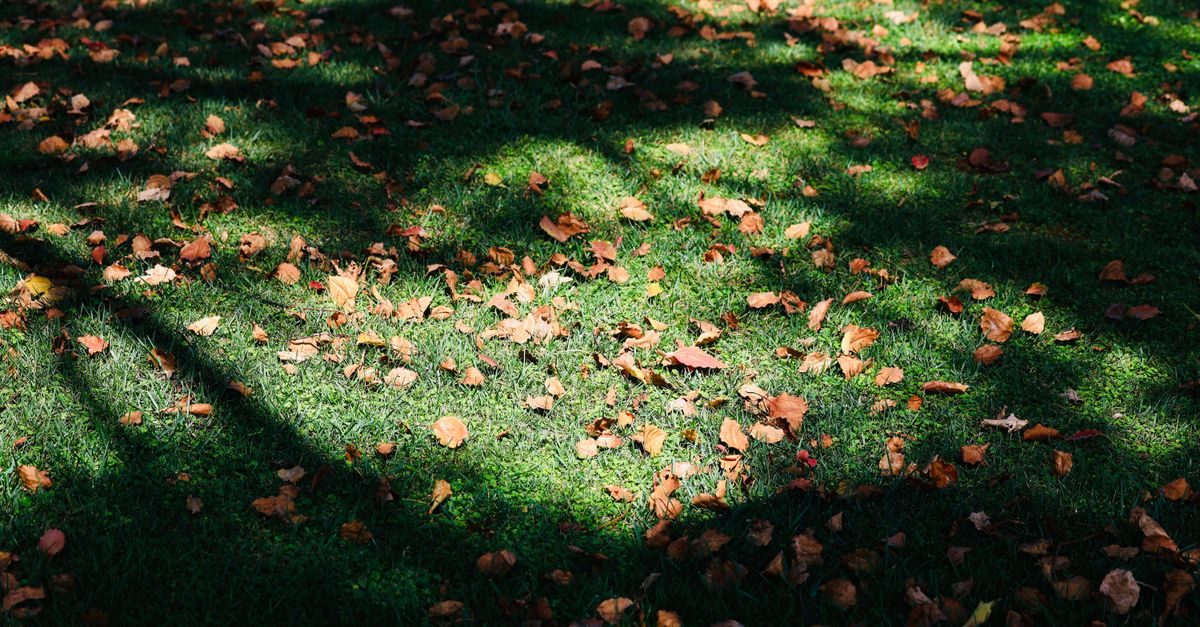
Leaves are the sleeper task of fall. A thick, wet mat of leaves blocks sunlight and traps moisture against the crown of the grass, which is a fast track to disease and dead patches by spring. You do not have to bag every leaf. Mulching a light-to-moderate layer with your mower chops leaves into fine bits that break down and feed the soil. Only heavy drop needs to be raked or collected. The rule is simple: never let a solid blanket of leaves sit on green grass.
Watering also tapers in fall. Cooler air and more rain mean the lawn needs far less supplemental water than it did in July. Keep an eye on rainfall and only water if you hit a dry stretch, especially for newly seeded areas that cannot dry out while germinating. Before the first hard freeze, drain and blow out any in-ground irrigation to prevent burst pipes.
Adjust the schedule for your region
Every date above moves with your first hard freeze. The span between the northern and southern edges of the cool-season zone is roughly six weeks, which is enough to turn a well-timed overseeding into a failed one.
| Region | Typical first hard freeze | Overseed by | Winterizer |
|---|---|---|---|
| Upper Midwest and Northern New England | Early October | Early September | Mid to late October |
| Great Lakes, Mid-Atlantic interior | Mid to late October | Mid September | Early to mid November |
| Transition zone | Early November | Late September | Mid to late November |
| Upper South, warm-season | Mid to late November | Ryegrass only, October | None, stop nitrogen by early September |
What other fall checklists miss
Most fall lawn care checklists you will find online share the same blind spot: they hand you a single calendar as if every lawn in the country runs on the same schedule. It does not work that way, and following a generic list is how people end up feeding a warm-season lawn nitrogen in November or trying to overseed Bermuda in September.
A Bermuda lawn in Georgia and a Kentucky bluegrass lawn in Minnesota have nearly opposite fall programs. The Georgia lawn is easing off nitrogen, laying down a pre-emergent for winter weeds, and gradually lowering its mowing height as it slides into dormancy. The Minnesota lawn is in the busiest, most productive stretch of its year: aerating, overseeding, and taking two heavy feedings to build roots before the ground freezes. Same season, same month, completely different to-do list. The other overlooked variable is your first-frost date, which can swing the timing of every task by four to six weeks between the northern and southern edges of the cool-season zone alone.
This is exactly where a generic article stops being useful and a plan built around your specific lawn takes over. A personalized 12-month care plan tells you the exact week to put down winterizer for your zip code and grass type, instead of a vague "late fall." The free way to start is a photo: snap a picture for an AI diagnosis that identifies your grass and its condition, then builds the schedule around your actual yard.
The fall lawn care checklist
Run down the list that matches your grass. Anything you skip, skip on purpose.
Cool-season lawns
- Confirm your grass type and note your average first hard freeze date.
- Core aerate while the soil is moist, September through mid-October.
- Dethatch only if the spongy layer is thicker than half an inch.
- Overseed straight into the aeration holes, at least 45 days before first hard frost.
- Keep new seed damp until it has been mowed twice.
- Apply 0.75 to 1.0 lb of nitrogen per 1,000 square feet in early to mid October.
- Spot-treat broadleaf weeds while they are still growing, away from new seed.
- Put down winterizer in early November, after top growth stops but while the lawn is still green.
- Mow until vertical growth stops, dropping the height one step for the last few cuts.
- Mulch or clear leaves before they mat down.
- Blow out the irrigation before the first hard freeze.
Warm-season lawns
- Confirm your grass type and the last safe nitrogen date for your latitude.
- Stop nitrogen entirely well ahead of dormancy.
- Apply a winter annual pre-emergent when soil hits about 70F, early September in most of the South.
- Consider a potassium-focused feeding for cold tolerance instead of a nitrogen feeding.
- Skip fall aeration, dethatching, and same-species overseeding.
- Overseed with ryegrass in October only if you want winter color.
- Lower the mowing height gradually across the last few cuts.
- Let dormancy happen, tan is healthy, not dead.
- Dormant-seed in late fall if you missed the establishment window.
- Keep leaves off the turf and taper watering.
Your fall action plan
Here is the whole season boiled down to an order of operations. Adjust the timing to your grass type and region, but the sequence holds.
- Identify your grass and its condition. Cool-season and warm-season lawns diverge from step two onward, so start here. A free photo diagnosis settles it in seconds.
- Early fall, cool-season only: aerate compacted soil, dethatch if needed, and overseed thin areas while soil is still warm. Warm-season lawns skip this.
- Early to mid fall: keep watering new seed until established, and mow at your normal height as the lawn recovers.
- Mid fall, cool-season: apply the big fall feeding and handle broadleaf weeds (away from new seed). Warm-season: stop nitrogen, consider a pre-emergent and a potassium feeding.
- Late fall, cool-season: put down winterizer after growth slows, take a slightly lower final mow. Warm-season: lower the deck gradually, stop feeding, and dormant-seed if you missed the fall window.
- Throughout late fall, all lawns: mulch or clear leaves so nothing smothers the turf, taper watering, and winterize your irrigation before the first hard freeze.
- Keep mowing until growth truly stops, not until a date on the calendar. When the grass stops growing, you are done for the year.
Do fall right and you are not just surviving winter, you are pre-loading next spring. The lawn that gets aerated, fed, and cleaned up in fall is the one that greens up first and thickest in April, while the neglected yard next door is still recovering. If you want the exact dates instead of the general windows, start with a free diagnosis and let the plan handle the calendar for your specific lawn.
Top Picks
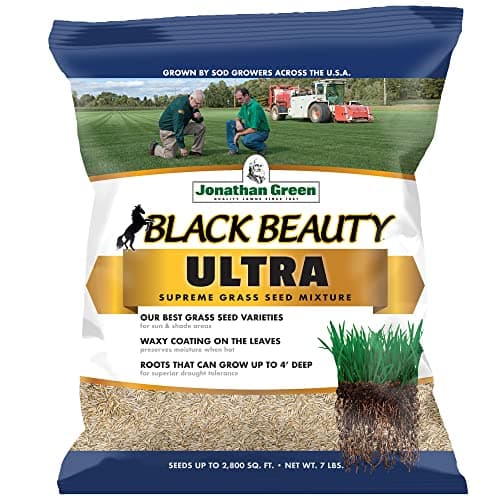
 Jonathan Green Black Beauty Ultra Grass Seed, 7 lbCheck price on Amazon
 The Andersons Professional PGF Complete 16-4-8 Fertilizer with 7% Humic DG 5,000 sq ftCheck price on Amazon
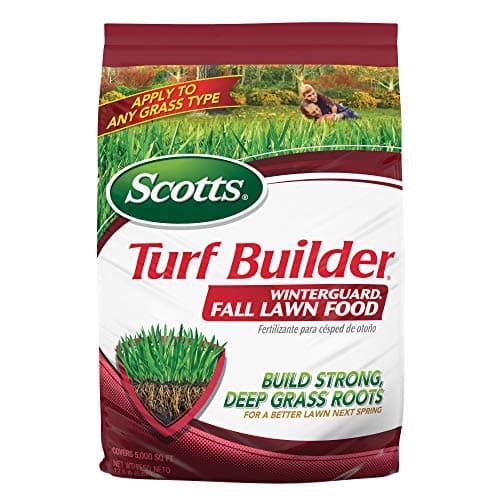
 Scotts Turf Builder WinterGuard Fall Lawn Food, 12.5 lb.Check price on Amazon
As an Amazon Associate we earn from qualifying purchases.
Free Lawn Care Tools
In early fall, aerate compacted soil and overseed thin or cool-season lawns while soil is still warm. In mid-fall, apply a fall fertilizer to feed the roots. In late fall, put down a winterizer on cool-season grass and keep mowing until top growth stops. Rake or mulch leaves throughout so they never smother the turf.
Keep mowing as long as the grass is actively growing. For cool-season lawns that usually means until soil temperatures drop below roughly 50F and vertical growth stops, often late November into December depending on your region. For warm-season lawns, mowing tapers off earlier as the grass slides into dormancy. Do not stop on a calendar date; stop when the grass stops growing.
In the northern half of the country, early October can still work if soil temperatures are in the mid-50s to low 60s and you have several weeks of growing weather before a hard freeze. By late October in cold regions, new seedlings may not mature enough to survive winter, so dormant seeding in late fall is often the smarter play. Warm-season lawns are not overseeded with the same species this late at all.
Cool-season lawns benefit most from fall feeding. Use a balanced fall lawn fertilizer in mid-fall, then a winterizer that is higher in potassium in late fall to harden the grass for winter. Warm-season lawns should generally stop getting nitrogen well before dormancy, since late nitrogen can invite winter injury and disease. Check your local extension office for the exact rates and timing for your grass type.
No, and this is where most generic checklists go wrong. Fall is peak growing and repair season for cool-season grasses like tall fescue and Kentucky bluegrass, so it is the time to aerate, overseed, and feed heavily. Warm-season grasses like Bermuda and Zoysia are winding down toward dormancy in fall, so the priorities shift to easing off nitrogen, controlling winter weeds, and gradually lowering mowing height rather than pushing new growth.
Either works as long as you do not let a thick wet mat sit on the grass, which blocks light and traps moisture that invites disease. Mulching a light-to-moderate leaf layer with your mower returns nutrients to the soil and saves labor. Heavy leaf drop still needs to be raked, bagged, or collected so the turf can breathe going into winter.
Work in three passes. September is the repair pass: aerate, dethatch if needed, and overseed cool-season grass. October is the feeding pass: apply about a pound of nitrogen per 1,000 square feet and treat broadleaf weeds. November is the wind-down pass: winterizer, a slightly lower final mow, leaf cleanup, and irrigation blowout. Warm-season lawns run the opposite order and stop nitrogen instead.
Cool-season lawns need three treatments: an October feeding at 0.75 to 1.0 lb of nitrogen per 1,000 square feet, a post-emergent for broadleaf weeds while they are still growing, and a potassium-heavy winterizer once top growth stops. Warm-season lawns need a winter annual pre-emergent when soil hits about 70F, and no fall nitrogen at all.

Beat weeds and brown spots from your phone
Snap a photo, get the fix, and follow a plan timed to your soil and weather. Free on iPhone.