Scotts 4-Step Program Schedule: When to Apply Steps 1 Through 4
 James ThorntonLawn Equipment & Maintenance Expert | 20 Years
As an Amazon Associate we earn from qualifying purchases.
You bought four bags with big numbers on them, Step 1 through Step 4, and now they are sitting in the garage while you try to figure out when each one actually goes down. The bag says "early spring" and "late spring" like everyone lives in the same zip code. Let me cut through it. The Scotts 4-Step Program is just a feeding calendar with some weed and bug control mixed in, and once you understand what each step is doing, the timing stops being a mystery.
The Scotts 4-Step Program splits a year of lawn feeding into four timed applications. Step 1 (crabgrass preventer plus feed) goes down in early spring before soil hits the crabgrass germination range, Step 2 (weed and feed) follows in late spring when broadleaf weeds are actively growing, Step 3 (summer feed) holds the lawn through heat, and Step 4 (fall feed) builds roots heading into winter.
Space the steps out with about four to six weeks between Steps 1 and 2 and six to eight weeks between the later steps, and never crowd two together. The single biggest mistake is applying by the calendar dates printed on the box instead of by what your soil temperature and weeds are actually doing, which varies a lot between the South and the upper Midwest.
The Scotts 4 Step Program: Steps 1 Through 4 at a Glance
Here is the whole Scotts annual program on one screen. This is the part most people actually need. Read the timing column as a guide, not gospel, because your local weather drives the real dates.
In plain terms, the four bags break down like this: Step 1 is a crabgrass preventer plus a light spring feed, Step 2 is a weed and feed that kills broadleaf weeds like dandelion and clover, Step 3 is a summer feed (some versions add insect control or extra weed protection), and Step 4 is a fall feed that builds roots heading into winter.
The timing runs early spring, late spring, early to mid summer, then fall, with roughly six to eight weeks between steps. The gap between Step 1 and Step 2 is usually a little tighter, around four to six weeks, because spring growth moves fast. The dates printed on the box are a starting point, not a schedule; your soil temperature and your weeds set the real one.
| Step | What it does | When to apply |
|---|---|---|
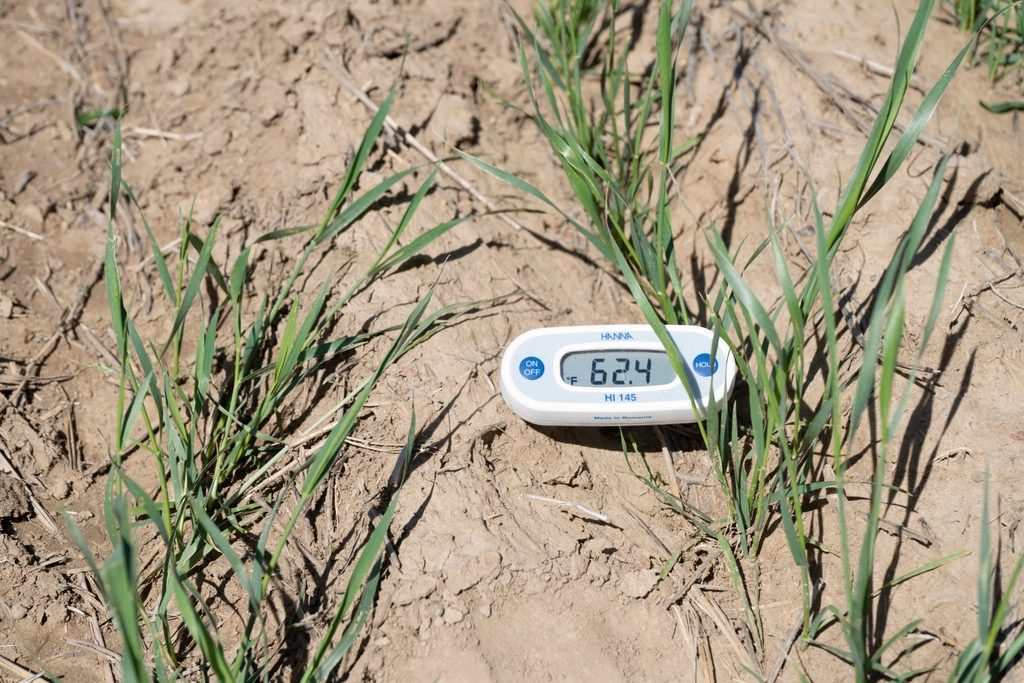
| Step 1 | Crabgrass preventer plus a light spring feed. Forms a pre-emergent barrier that stops crabgrass and other annual weeds before they sprout. | Early spring, roughly February to April depending on your region, before soil temperatures climb into the crabgrass germination range. Roughly when forsythia blooms and before the first few mows. |
| Step 2 | Weed and feed. Kills actively growing broadleaf weeds (dandelion, clover, plantain) by systemic action, getting absorbed through the leaves and moving through the whole plant down to the roots, while feeding the grass. | Late spring, roughly April to June, about four to six weeks after Step 1, once weeds are up and visibly growing. |
| Step 3 | Summer feed, often with insect control or extra weed protection depending on the version you bought. | Early to mid summer, roughly June to August, six to eight weeks after Step 2, before peak heat stress sets in. |
| Step 4 | Fall feed. Pushes nitrogen and root development to harden the lawn off before dormancy and set up next spring's green-up. | Fall, roughly Labor Day to mid October across the North and October into early November in the Deep South, six to eight weeks after Step 3, while the grass is still actively growing but nights are cooling. |
Here is the same program by bag, with the official product name, the analysis, and what is actually doing the work in each one.
| Step | Product | Analysis | Active | Window | Cue |
|---|---|---|---|---|---|
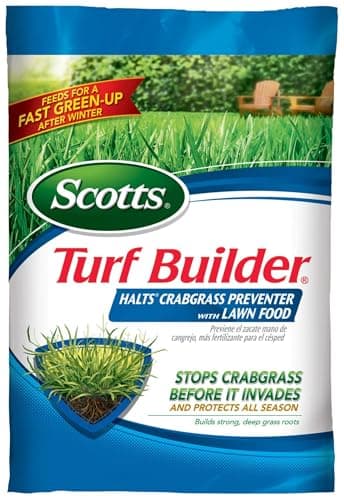
| Step 1 | Scotts STEP 1 Crabgrass Preventer Plus Lawn Food | 28-0-7 | Pendimethalin 1.29% | February to April | Soil in the low-to-mid 50s, before crabgrass germinates, air temps under 80F |
| Step 2 | Scotts STEP 2 Weed Control Plus Lawn Food 2 | 28-0-3 | 2,4-D 1.18%, mecoprop-p 0.59% | April to June, four to six weeks after Step 1 | Damp lawn, no rain expected for 24 hours |
| Step 3 | Scotts STEP 3 Lawn Food with 2% Iron | 32-0-4 | None, 2% iron | June to August | Water in immediately if you are consistently above 90F |
| Step 4 | Scotts STEP 4 Fall Lawn Food | 32-0-12 | None | August to November, Labor Day to mid October for most lawns | Grass still growing, nights cooling |
That table is the program. Everything below is how to apply it without wasting a bag, and where the printed schedule quietly assumes you live somewhere you probably do not.
Not running the four-bag program? If the garage holds plain green-bag Turf Builder Lawn Food, the timing is simpler. Use the Scotts fertilizer schedule for Turf Builder instead. About four feedings. Six to eight weeks apart.
What Each Step Actually Is
Step 1: Crabgrass Preventer Plus Feed
This is a pre-emergent. It does nothing to weeds you can already see. Its entire job is to lay down a chemical barrier in the top layer of soil so crabgrass and other annual weed seeds die as they try to sprout. Miss the window and the barrier goes down after the seeds have already germinated, which is the same as not applying it at all. Timing is everything with Step 1, and the trigger is soil temperature, not the date on a calendar. The Scotts pre-emergent application rate and schedule guide puts the soil temperature numbers and the rates side by side. I walk through the exact application mechanics, watering, and timing in the dedicated Scotts Halts crabgrass preventer instructions, so I will not repeat all of it here.
One technique note: do not aggressively dethatch or aerate right after Step 1. You will punch holes straight through the barrier you just paid to create.
Step 2: Weed and Feed
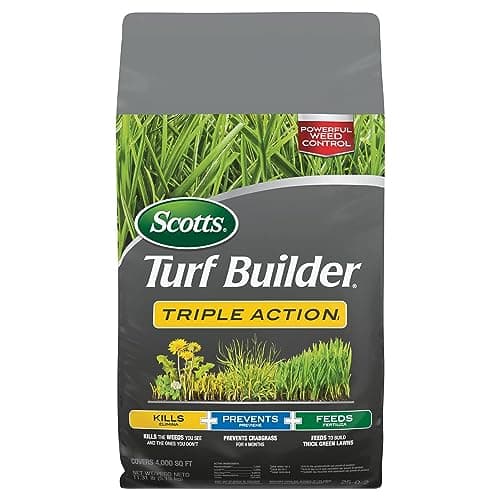
Step 2 is the opposite of Step 1. It is a post-emergent, meaning it targets weeds that are already up and growing. The granules need to stick to weed leaves to work, so this one goes down on a damp lawn (morning dew is perfect) and you hold off mowing for a day or two on either side. The feed portion gives the grass a push during its strongest spring growth. If you are choosing between bags, the Scotts weed and feed application guide compares them, and how often you can apply Scotts weed and feed covers the repeat limits. The Scotts Triple Action version layers a pre-emergent, a post-emergent, and feed into one bag, which is genuinely useful but easy to mistime. The full breakdown lives in the Triple Action application guide.
Step 3: Summer Feed
Step 3 carries the lawn through heat. Depending on which box you grabbed, it is either a straight summer feed or a feed combined with insect control for grubs and surface feeders. This is the step people most often skip or mistime, because summer is exactly when you should be cautious with nitrogen on cool-season grass. More on that in the mistakes section, because it is the most consequential judgment call in the whole program.
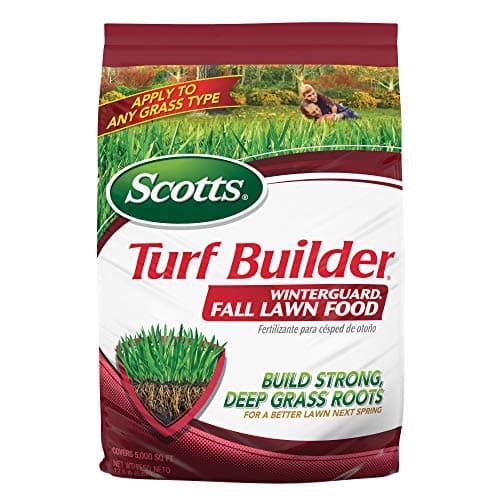
Step 4: Scotts Fall Lawn Food (32-0-12), the bag that matters most
Step 4 is the bag that matters most, and it is the one people get wrong. It is a straight fall feed, 32-0-12, with no weed killer in it. If you want broadleaf weeds gone before winter you need a separate fall weed control pass, because Step 4 will not touch them.
If you only do one feeding all year on a cool-season lawn, fall is when it should happen. Step 4 pushes root development and stores energy for winter, which is what gives you a thick early green-up the following spring without forcing soft top growth. It goes down while the grass is still growing but the nights have started to cool. This is the highest-value bag in the box for most northern lawns.
Does Scotts Step 4 have weed killer?
No. Step 4 is a straight fall fertilizer, a 32-0-12 analysis with no herbicide in the bag at all. It feeds the grass and does nothing else. If dandelion, clover, or plantain are still showing up in October, you need a separate fall broadleaf weed control pass, applied while those weeds are actively growing. Fall is the best time of year to kill them, so run the two passes separately instead of expecting one bag to do both jobs.
Does Step 4 need to be watered in?
Not strictly. Scotts' own guidance is that Step 4 does not require watering in, so you can put it down on a dry lawn and let the next rain handle it. Watering afterward does speed up how quickly the granules break down and how fast you see color, so if you have irrigation, a light pass helps. Just do not water so hard that granules wash off slopes or onto the driveway.
How to apply Scotts Step 4
Apply it while the grass is still growing but the nights have cooled, which for most cool-season lawns means Labor Day through mid October. Set your spreader to the number printed on the bag for your model, fill it on a hard surface rather than out on the grass, walk the perimeter first, then go back and forth across the middle. Sweep stray granules off the driveway and sidewalk when you finish so they do not wash into a storm drain, then knock out the rest of your fall list.
Can I overseed and apply Step 4 in the same fall?
Yes, and the two work well together. Step 4 is a plain fertilizer with no pre-emergent in it, so it will not stop new seed from establishing. Wait until the new grass has been mowed two or three times, then feed it. Steps 1 and 2 are the ones to keep away from fresh seed, because the pendimethalin in Step 1 blocks germination. The fall overseeding guide covers seed rates and timing.
When to apply each step by region
The box prints one calendar for the whole country. Here is what those four windows look like where you actually live.
| Region | Step 1 | Step 2 | Step 3 | Step 4 |
|---|---|---|---|---|
| Deep South | February to early March | April | June | October to early November |
| Transition Zone | Early to mid March | Late April to May | Mid June to July | Late September to October |
| Midwest and Northeast | Late March to mid April | Mid May to early June | July | Labor Day to early October |
| Upper Midwest and Mountain | Mid to late April | Late May to June | July to early August | Late August to late September |
| Pacific Northwest | March | May | July | September to mid October |
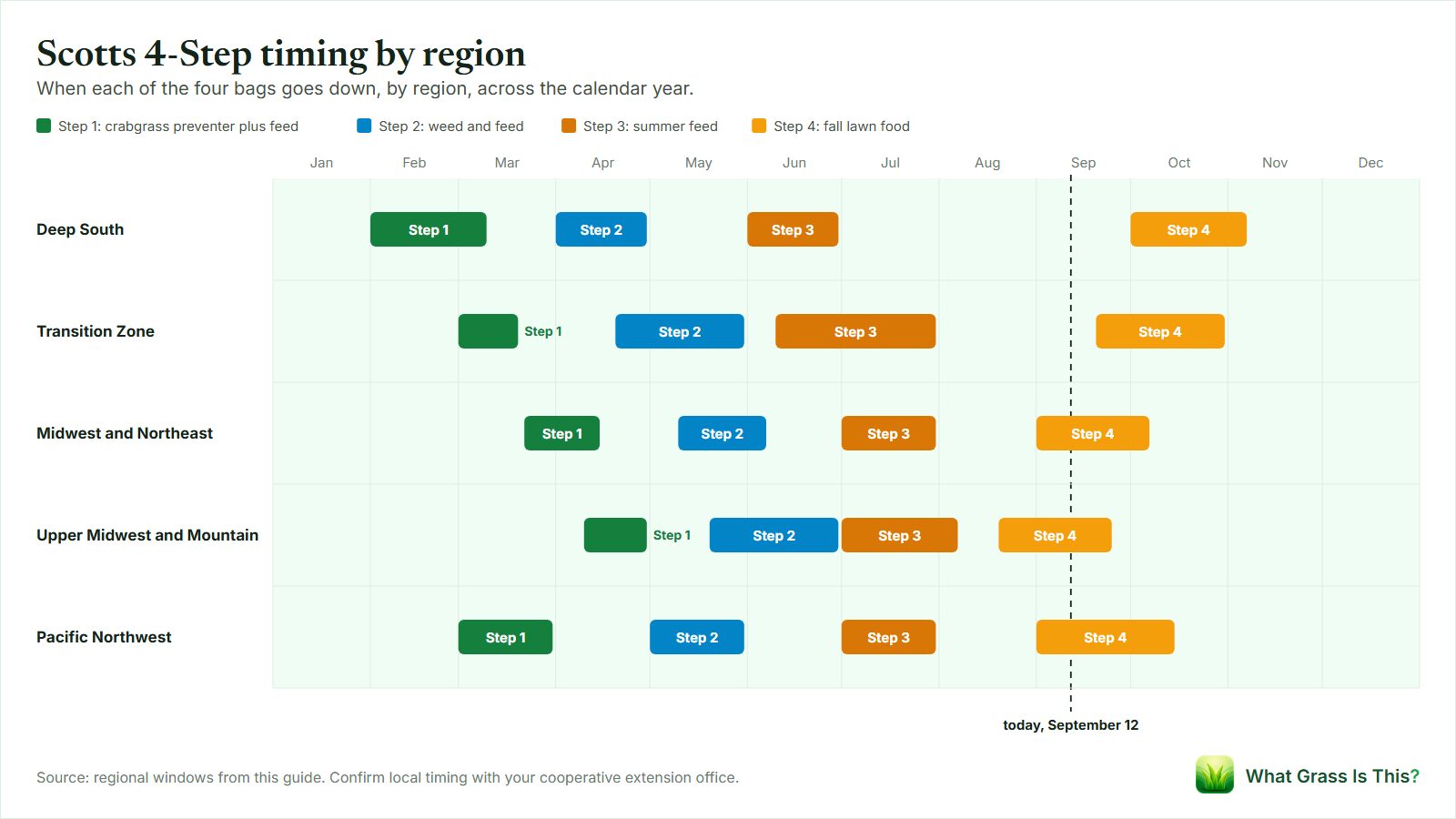
Shift those windows a week or two either way based on the season you are actually having. A cold, late spring pushes Step 1 back and a warm one pulls it forward.
Spacing: How Long Between Each Step
The program is built on intervals, not fixed dates. Scotts spaces the four applications roughly six to eight weeks apart so nitrogen feeds the lawn evenly across the season instead of spiking it. The early-season gap between Step 1 and Step 2 is usually a little tighter, around four to six weeks, because spring growth moves fast.
The rule I give everyone: when in doubt, stretch the gap, do not shrink it. Crowding two feedings close together is how you get fertilizer burn, surge growth that needs constant mowing, and runoff that just washes your money into the storm drain. If you fall behind schedule and the calendar is tight, skip a step rather than double up. A lawn that misses one feeding is fine. A lawn that gets two feedings two weeks apart is stressed.
- Pre-emergents like Step 1 are triggered by soil temperature, commonly cited in the low-to-mid 50s Fahrenheit range as the crabgrass germination threshold. Treat that as a general range and confirm your local timing with your cooperative extension office, since green-up dates shift by hundreds of miles north to south.
- Total annual nitrogen for home lawns is usually discussed in pounds of nitrogen per 1,000 square feet per year, varying by grass type and region. Your extension office publishes the specific target for your turf so you can sanity-check whether four full Scotts steps overshoots it.
- Step spacing of six to eight weeks is a general guideline. Hot, dry, or drought-restricted regions often pull back on summer feeding entirely. Your local extension or water authority can tell you whether Step 3 fits your conditions this year.
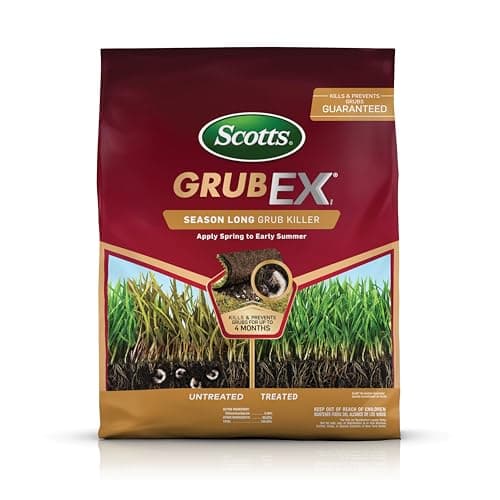
- Grub-control versions of Step 3 are timed to insect life cycles, which differ by region. Do not assume the box date matches your local grub hatch. Extension is the authority on this.
Common Mistakes That Waste a Bag
I have watched people do everything right except the one thing that mattered. Here are the misfires that cost the most.
Applying by the box date instead of conditions. "Early spring" in Georgia and "early spring" in Minnesota are six weeks apart. The box cannot know where you live. Step 1 in particular fails completely if it goes down after the soil has already warmed past the germination threshold.
Putting Step 2 on a dry lawn. Weed-and-feed granules have to cling to weed leaves. On a bone-dry lawn they bounce off and roll into the thatch, feeding the grass but skipping the weeds you bought the product to kill.
Overfeeding cool-season grass in summer. Pushing heavy nitrogen on fescue or bluegrass during a July heat wave invites disease and burn. On cool-season lawns, Step 3 is the step to go light on or skip in a brutal summer, not the one to pile on.
Mowing right after Step 2. Bagging the clippings the day after a weed and feed hauls the product straight off the lawn before it has done its job. Leave it sit.
Buying four steps for a warm-season lawn. The whole program is built around a cool-season calendar. Bermuda, Zoysia, and St. Augustine green up later and want their feeding weighted toward summer, so applying Step 1 through 4 on the printed northern dates can miss the mark badly.
If you are not sure which weeds you actually have or whether your thin patch is a weed problem, a disease, or just drought stress, do not guess and dump a bag on it. Upload a photo for a free AI diagnosis and let it tell you what is active in your lawn right now, so you apply the right step at the right time instead of treating a problem you do not have.
What Other Guides Miss
Most write-ups treat the Scotts 4-Step Program as a fixed, four-purchase commitment, like the four bags are a non-negotiable set. They are not. The program is a marketing convenience, and there is nothing magic about the number four. The real engine underneath is simple: spread a sensible amount of nitrogen across the growing season, time your weed control to whether the weed is up yet, and weight your heaviest feeding toward the season your grass is actually growing hardest.
Once you see it that way, two things become obvious. First, a cool-season lawn often does better with the feeding weighted toward fall, which means Step 4 matters more than Step 3, not the other way around the box implies by numbering. Second, a warm-season lawn's whole calendar is shifted, so blindly following the printed dates is the most common reason people say "I did all four steps and my lawn still looks rough."
The other thing guides skip: you do not have to buy Scotts to run this schedule. The timing logic of pre-emergent in spring, post-emergent when weeds are up, summer maintenance, and a fall root-builder works with any reputable fertilizer. The convenience you are paying Scotts for is having the right product pre-matched to each window. That convenience is real, but it is convenience, not necessity. If you would rather dial in rates to your exact square footage instead of guessing how far a bag goes, run your numbers through the fertilizer calculator first. For the broader spring sequencing across different grass types, the spring lawn fertilizer schedule by grass type covers how the timing shifts north to south.
Where the Generic Schedule Falls Short
Here is the honest limitation of any four-step box program: it cannot account for your zip code, your grass type, your soil test, or the weather this particular year. It hands everyone the same four dates. That is fine as a starting point, and for a lot of lawns it is good enough. But "good enough" still means you are buying four full bags whether or not your lawn needs all four, and applying them on dates that may be weeks off from your local green-up.
This is exactly where a personalized plan earns its keep. A personalized 12-month care plan tells you the exact week to fertilize for your zip and grass type, which step to skip if you are warm-season, and when your local soil temperature actually crosses the crabgrass threshold instead of guessing off forsythia blooms. That is the difference between running a generic calendar and running your lawn's calendar. You can start by getting your lawn diagnosed, then let the plan sequence the feedings around your real conditions.
Your Scotts 4-Step Action Plan
Here is how I would actually run the program this year, in order:
- Confirm your grass type first. Cool-season and warm-season lawns run different calendars. If you are warm-season, do not apply on the box's northern dates. Verify before you buy four bags.
- Watch soil temperature for Step 1, not the calendar. Get the pre-emergent down before the soil warms into the crabgrass germination range. Early is safe, late is wasted.
- Apply Step 2 on a damp lawn once weeds are visibly growing, four to six weeks after Step 1, and skip mowing for a day or two on either side.
- Reassess before Step 3. On a cool-season lawn in a hot summer, go light or skip it. On a warm-season lawn, this is prime feeding season.
- Prioritize Step 4. The fall feed is the highest-value application for most cool-season lawns. Do not skip this one.
- Keep six to eight weeks between steps, and if you fall behind, skip rather than double up.
- Diagnose before you treat anything off-schedule. If a problem shows up between steps, get a free AI diagnosis before reaching for a bag, so you apply the right fix instead of feeding a disease.
Run it that way and the four-step box stops being a mystery and starts being what it is: a convenient default schedule that you adjust to your own lawn. Get the timing right and you will spend less, mow less surge growth, and have a thicker lawn than the person who dumped all four bags on the dates printed on the box.
Top Picks
 Scotts Turf Builder Halts Crabgrass Preventer with Lawn Food, 5,000 sq. ft.Check price on Amazon
 Scotts Turf Builder Triple Action1, 11.31 lb.Check price on Amazon
 Scotts GrubEx1 Season Long Grub Killer, 5,000 sq. ft.Check price on Amazon
As an Amazon Associate we earn from qualifying purchases.
Free Lawn Care Tools
Step 1 is a crabgrass preventer plus feed, Step 2 is a broadleaf weed and feed, Step 3 is a summer feed with insect or weed protection depending on the version, and Step 4 is a fall feed to build roots before winter. That is what the four bag program includes: one application per season, with about four to six weeks between Steps 1 and 2 and six to eight weeks between the later steps, so feeding is spread across the whole growing season instead of dumped all at once.
Yes, if you time it by conditions instead of the dates printed on the box. The logic underneath is sound: spread nitrogen across the growing season, time weed control to whether the weed is up yet, and put a root-building feed down in fall. Where it falls short is that it hands everyone the same four dates, and the calendar is built around cool-season grass. Warm-season lawns like Bermuda, Zoysia, and St. Augustine need shifted, summer-weighted timing, and plenty of lawns do fine with two or three feedings instead of all four. Run it by your soil temperature and grass type and it works well; run it strictly by the box dates and results get hit or miss.
Apply Step 4 in fall, about six to eight weeks after Step 3, while the grass is still actively growing but nights have started to cool. The exact window shifts by region, since green-up and cool-down dates move by weeks between the South and the upper Midwest, so go by your local conditions rather than a printed date. For most cool-season lawns this fall feed is the highest-value application in the whole program because it builds roots and stored energy for next spring's green-up. Do not skip it.
Apply Step 2 in late spring, usually four to six weeks after Step 1, once broadleaf weeds like dandelions and clover are actively growing and visible. The lawn should be slightly damp from dew or light watering so the weed-control granules stick to the leaves. Do not mow for a day or two before and after so the product has time to work.
You can make a second weed-and-feed pass if weeds are still heavy, but only after waiting the full interval on the bag, usually about four weeks, and only if you stay under the product's annual nitrogen limit. Doubling up back to back risks fertilizer burn and wasted product. For stubborn spots, a targeted spot-spray is usually smarter than blanketing the whole lawn a second time.
Scotts spaces the four steps across the growing season, with about four to six weeks between Step 1 and Step 2 and six to eight weeks between the later steps. The exact gap depends on your region and weather, but the goal is even feeding without overlapping nitrogen. Skipping a step is better than crowding two applications close together.
No. The program is a convenient default, but plenty of lawns do fine with two or three feedings, and cool-season grasses generally want their heaviest feeding in fall rather than summer. If your grass type, soil, or climate does not match the generic schedule, a custom plan based on your zip and grass type will use product more efficiently than buying all four bags.
The program is built around a generic cool-season calendar, so warm-season lawns like Bermuda, Zoysia, and St. Augustine often need different timing and a summer-weighted feeding schedule. The steps still feed the grass, but applying them on the box's dates can miss your green-up window. Confirm your grass type first, then adjust the timing to match how your specific turf grows.
It is a reasonable default, not a custom plan. The logic underneath is sound: pre-emergent in spring, weed control once weeds are up, a light summer feed, and a heavy fall feed. The weak points are a single crabgrass pass, no insect control unless you buy a grub version, and one national calendar that ignores your region. Time it by conditions and it works well.
Yes. Scotts' own answer is to start at whatever month you are in and continue at roughly two-month intervals from there. If you are picking it up in September, that means starting with Step 4, the fall feed, and coming back to Step 1 next spring before crabgrass germinates. There is no need to buy the bags you skipped.

Your lawn plan, in your pocket all season
Grass ID, a season plan, soil-timed reminders, and a lawn journal that remembers what you did. Free on iPhone.