


Broadleaf Plantain: How to Get Rid of This Stubborn Lawn Weed
 Sarah MitchellLawn Diagnostics Specialist | 12 Years
As an Amazon Associate we earn from qualifying purchases.
You notice them on the walk out to the mailbox. Flat green rosettes pressed against the ground, wide oval leaves fanned out like a dinner plate, sitting in the strip of lawn beside the path where the grass has always looked a little tired. The mower slides right over the top of them without touching a leaf. Come back three weeks later and slender seed spikes are standing up out of the middle of each one like little rat tails. That is broadleaf plantain, and the reason it keeps returning to that exact strip is not bad luck. In my twelve years diagnosing lawns, plantain is the weed that tells me the most about a yard before I have even knelt down, because it is not really a weed problem. It is a soil report you did not order.
Broadleaf plantain is a low perennial that forms a flat rosette of wide oval leaves with parallel ribs running their length, anchored by a short taproot. It sends up thin, unbranched seed spikes that look like rat tails. Hand-pull it when soil is moist and lift the whole crown, since a rosette that snaps off above the crown simply regrows.
Here is the part that decides whether you ever see it again. Broadleaf plantain is a compaction indicator. It colonizes hard, trafficked, low-oxygen soil where grass roots cannot compete, which is why it clusters along walkways, in play areas, and in the curb strip. Pull every plant and do nothing about the soil and those same spots refill next summer. Core aerate where it clusters, raise your mowing height so the canopy shades the soil, and overseed the thin ground it colonized. Fix the compaction and plantain runs out of places to live.
First, Make Sure It Is Actually Broadleaf Plantain
Confirming the ID matters because the fix is unusual. Most weed guides send you toward a spray. This one sends you toward an aerator, and you do not want to rent one for the wrong diagnosis.
The Three Tells
Parallel ribs in the leaves. This is the most reliable field test. Broadleaf plantain has five to nine prominent veins running the full length of the leaf, roughly parallel, standing up enough that you can feel them with a thumbnail on the underside. Almost every other broadleaf lawn weed has a branching, net-like vein pattern spreading from a central midrib. Parallel ribs on a wide oval leaf is plantain until proven otherwise.
The flat rosette. The leaves radiate from one central growing point at ground level, spreading in a circle that lies nearly flat against the soil. That habit is why the mower never touches it, and why a weed you cut every week seems to grow all summer without ever getting shorter. Leaf stalks are often reddish at the base where they meet the crown.
The rat-tail seed spikes. A mature plant sends up leafless stalks from the center of the rosette, each topped with a narrow cylinder of tiny greenish flowers that turns brown and grainy as it sets seed. That seed gets tracked around on shoes, mower tires, and dog paws, one more reason plantain concentrates along the routes people and equipment take.
Buckhorn Plantain, the Skinny-Leaved Sibling
If your rosette has long, narrow, lance-shaped leaves instead of wide oval ones, you have buckhorn plantain, also called narrowleaf or ribwort plantain. Same family, same conditions, but the leaves stand at an angle rather than lying dead flat and the seed head is a short stubby tuft on a long bare stalk. Treatment is identical for both, so if you cannot tell which you have, do not spiral on it.
What Gets Mistaken for It
The plants that fool people are the other flat rosettes. Young curly dock has long wavy-edged leaves, but its veins branch off a central midrib and it goes vertical much faster. Common mallow spreads low and wide too, but has round, scalloped leaves on trailing stems rather than a tight central rosette. Young dandelion is a rosette as well, but its deeply toothed leaf edge is unmistakable next to plantain's smooth oval. Our identification reference for broadleaf plantain lays these out side by side, and the free photo diagnosis is built for exactly this rosette-versus-rosette call.
Why Plantain Is There: Read the Weed, Not Just the Lawn
Plantain has no special competitive edge over grass. In loose, healthy soil, turf beats it easily. Plantain wins in the places where turf has already lost, for three reasons.
Compaction is the big one. Plantain is a classic compaction indicator weed: it tolerates dense, hard, low-oxygen soil far better than turfgrass does. Grass roots need pore space to push into and air to breathe, and foot traffic, tires, and equipment squeeze that space out of the top few inches. Turf thins in response, and plantain, with its short taproot and dense fibrous roots, does fine in that same ground, so it moves into the vacancy. That is why plantain maps so precisely onto human behavior in a yard.
Thin turf gives it the opening. Plantain seedlings need light on bare soil to establish, and a thick canopy denies them that. Once a rosette establishes it shades out the grass around it and widens the bare patch.
Mowing too low makes it worse. Because plantain grows flat, cutting short does nothing to it but takes leaf area away from the grass, weakening the exact plant you need to win the competition. Scalping a compacted, worn strip is close to a perfect recipe for a plantain colony.
Once you see it this way the strategy writes itself. The plants are the symptom. The soil under them is the cause.
Removing the Plants That Are There Now
Clearing existing rosettes is straightforward. The only thing separating a removal that sticks from one that regrows is whether you got the crown.
Hand-Pulling, Done Right
Plantain is a good hand-pulling candidate, because it does not spread by runners or tubers, so a plant you fully remove is genuinely gone.
Pull when the soil is moist. Go out the morning after a rain, or water deeply and come back a few hours later. In dry, baked ground the roots break off and you get leaves without the plant.
Get the crown, not just the leaves. Everything the plant needs to rebuild lives in the crown, the compressed growing point right at soil level where the leaf stalks converge. Grab a fistful of leaves and yank and they tear off above it, and the plant pushes out a new set within weeks. Instead, work a weeding fork or dandelion tool down alongside the plant, lever the soil loose, then grip low at the base and lift. You want the short pale taproot and its fibrous roots to come up with it.
Fill and seed the hole. Every plant you remove leaves a divot of bare soil in ground that just proved it grows plantain well. Firm soil back in and drop grass seed on it while you are standing there.
Spot Treatment for Heavy Infestations
When plantain is scattered across a large area, hand-pulling stops being realistic and a selective broadleaf herbicide becomes the practical tool. Plantain is a perennial, which shapes the timing: it responds best when the plant is moving resources down into its roots, which for perennial broadleaf weeds generally means fall. A treatment during a hot, dry stretch may burn the top and leave the crown alive to regrow. Which product to use is a real decision, since selectives that are safe on one grass type will damage another. Our herbicide timing tool helps you find the right window for your grass type and location, and the product and rate should come from the source below.
- The broadleaf herbicide chemistries labeled for plantain, their rates, and the safe timing windows vary by state and by turf species, and recommendations are revised periodically. Get the current product and rate from your local cooperative extension office rather than from any blanket online recommendation, including this one.
- Confirm the product is labeled safe for your specific grass before applying. Several common broadleaf selectives carry cautions or restrictions on warm-season turf such as St. Augustine and centipede.
- Before investing in a decompaction program, run a basic soil test. Most extension offices test inexpensively and will tell you whether you have compaction alone or compaction plus a pH or nutrient problem holding the turf back. Ask them how to sample, since depth and mixing affect the result.
- Most extension offices will also confirm a weed identification from a clear photo or a physical sample.
Recommended products
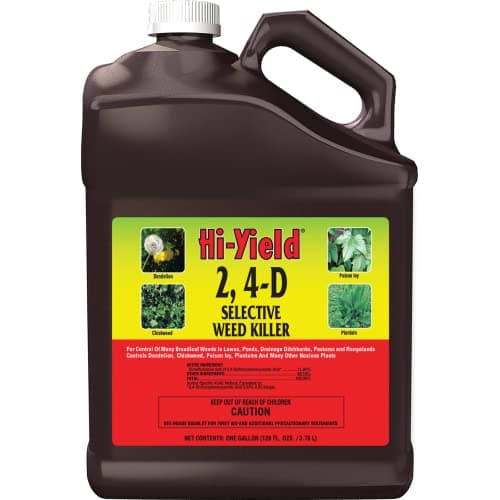
Hi-Yield 2,4-D Amine Selective Herbicide
A selective broadleaf herbicide that takes plantain out without harming cool-season turf, bermuda or zoysia.
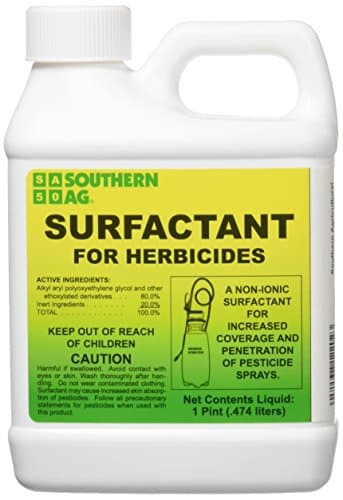
Southern Ag Non-Ionic Surfactant for Herbicides
A spreader-sticker for the thick, ribbed plantain leaf.
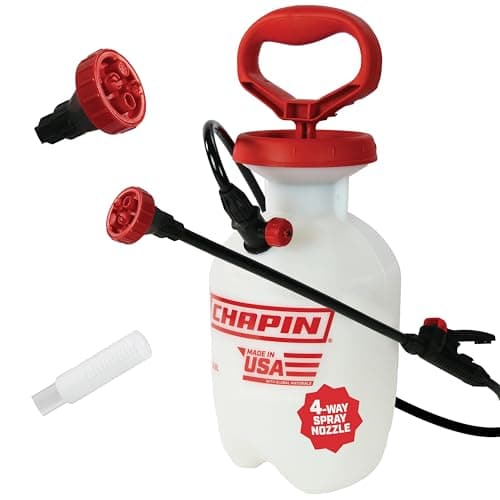
Chapin 20084 1-Gallon Pump Sprayer
A one gallon pump sprayer with a four-in-one nozzle for spot treating rosettes.
Fix the Soil So It Stays Gone
That clears this year's plants. This section decides whether you do it again next year.
Core Aerate Where It Clusters
Core aeration pulls plugs of soil out of the ground and leaves channels behind, relieving compaction and giving grass roots somewhere to expand. It is the most direct answer to the condition that invited plantain in. Concentrate it on the trafficked strips where rosettes are worst rather than treating the lawn uniformly, and time it for your grass type's active growing season, which means fall for cool-season lawns and late spring into early summer for warm-season ones. Our aeration calculator will size the job and tell you when your lawn is in the right window.
Then think about the traffic itself. If a path gets walked every single day, aeration is treating a wound you keep reopening. Sometimes the honest fix is to accept the desire path, put stepping stones or mulch there, and let the turf keep the ground it can hold.
Raise the Mowing Height
Set the deck at the tall end of the range for your grass type and leave it there. Taller grass carries more leaf area, roots deeper, and shades the soil enough to keep plantain seed from getting the light it needs. Since mowing low does nothing to a flat rosette, cutting short costs you everything and costs the weed nothing.
Overseed the Ground It Colonized
Pulling plantain out of a worn strip leaves bare soil, and bare soil in a compacted area does not stay bare long. Overseeding right after aeration is the natural pairing, since the holes give seed excellent soil contact. Keep the seedbed moist through establishment and expect to repeat it in the worst strips. Our overseeding calculator works out the seeding rate and timing for your grass type.
If you would rather not track all of this by hand, a personalized care plan schedules aeration and overseeding for your zip code and grass type, so the decompaction work lands in the window that fixes the underlying problem and compaction weeds stop returning every June.
Is Plantain Edible or Medicinal?
This comes up every time I write about plantain, so here is a straight answer. Broadleaf plantain has a long history of folk and traditional use across many cultures, as a wild green and as a topical remedy, and that history is genuinely interesting. It is not a reason to eat what is growing in your lawn.
I am not a medical professional and nothing here is health advice. What I will say is specific to lawns. Turf routinely receives herbicides, fungicides, and fertilizers, sometimes years back and sometimes applied by a previous owner you never met, and residue is not something you can eyeball. Lawns near streets also collect runoff, and dogs use them. Any foraging conversation belongs with plants from ground whose treatment history you know completely. A maintained lawn is not that.
What Other Guides Miss: Plantain Is a Symptom, Not a Plant Problem
Most plantain articles are organized around removal. Identify it, pull it or spray it, done. That framing guarantees you will be reading another plantain article next summer, because it treats the rosette as the problem when the rosette is the readout.
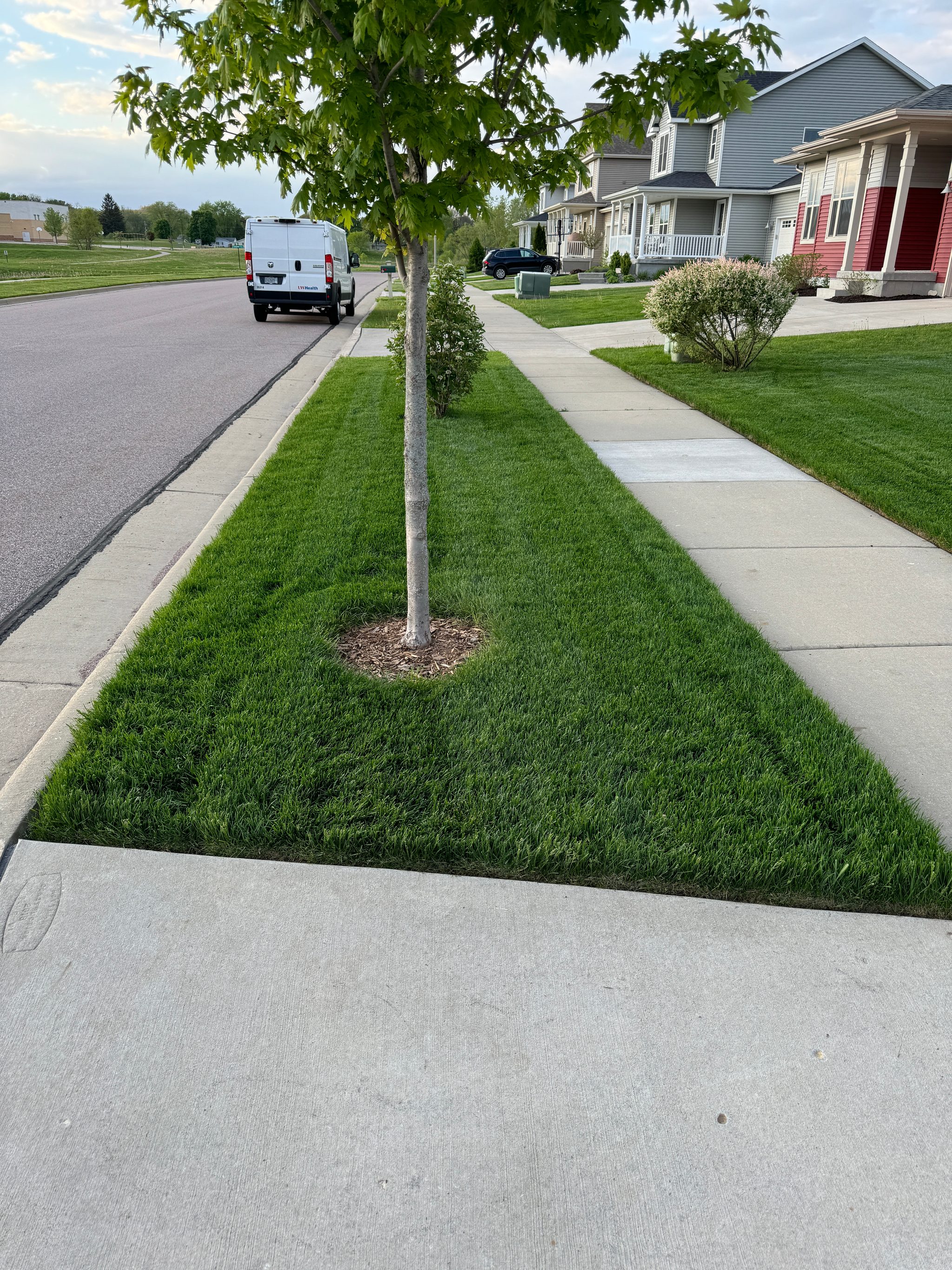
Go outside and look at where yours actually is. I would bet it is along the walkway, in the strip between sidewalk and curb, at the corner where everyone cuts across, under the play set, or in the run the dog wore along the fence. That distribution is not a coincidence and it has little to do with seed dispersal. It is a map of where feet and tires compress the soil, drawn by a plant that tolerates compression better than your grass does. The weed is doing free diagnostic work for you.
Which means killing plantain without decompacting is not a partial fix, it is a guaranteed repeat. The soil condition that made those spots hospitable does not change when the plant dies. You clear the rosettes, get a few clean-looking weeks, and then new seedlings come up in the same footprint, because nothing about why they were there ever changed. People read that as the weed being stubborn. It is not stubborn. It is being correct about the soil.
So invert the usual order. Removal is the quick part. The lasting work is aeration in the trafficked zones, a higher mowing height, overseeding to close the ground you opened up, and where practical, rerouting the traffic. Do those and plantain does not get repelled so much as it runs out of habitat. If you are still not certain the rosettes in your traffic lanes are plantain, run a free photo diagnosis before you rent equipment, because the aeration answer is right for plantain and only sort of right for everything else.
Compaction and thin turf also invite company. Coarse upright grassy clumps in the same worn strips may be foxtail grass, which favors the same disturbed, sunlit ground. Flat mats with milky sap nearby are likely spotted spurge. Finding two or three together is a strong signal that the condition, not any individual weed, needs your attention.
Your Broadleaf Plantain Action Plan
- Confirm the ID. Five to nine parallel ribs on a wide oval leaf, flat rosette, rat-tail seed spikes. Narrow lance-shaped leaves means buckhorn plantain, treated the same way.
- Map where it is growing. Note which spots are walkways, play areas, parking strips, and pet runs. That is your compaction map, and it tells you where the real work goes.
- Pull existing plants when the soil is moist, levering with a weeding fork and lifting the crown, not just the leaves. Fill and seed each divot as you go.
- For heavy infestations, use a selective broadleaf herbicide labeled for your turf, generally in fall, with the product and rate confirmed by your local cooperative extension.
- Core aerate the trafficked zones during your grass type's active growing window, concentrating where plantain clustered.
- Raise the mowing height to the tall end of your grass's range and keep it there.
- Overseed the opened ground right after aeration and keep it moist through establishment.
- Reroute the traffic if you can, so you stop reopening the wound you keep treating.
Top Picks
- T-Zone SE Broadleaf HerbicideCheck price on Amazon
- Ortho WeedClear Lawn Weed Killer Ready-to-SprayCheck price on Amazon
- Outsidepride Maya (Blackjack II) Bermuda Grass Seed (5 lb)Check price on Amazon
As an Amazon Associate we earn from qualifying purchases.
Free Lawn Care Tools
Hold a leaf up and look at the veins. Broadleaf plantain has five to nine prominent ribs running the full length of the leaf, roughly parallel to each other, which you can feel with a thumbnail on the underside. Nearly every other broadleaf lawn weed has a branching, net-like vein pattern instead. Confirm it with the growth habit: wide oval leaves in a flat rosette lying against the soil, with thin rat-tail seed spikes standing up from the center.
Two reasons, and they are both fixable. The first is technique: if you grab the leaves and yank, they tear off above the crown at soil level, and the plant simply pushes out a new set of leaves from the crown you left behind. Lever the soil loose with a weeding fork and lift the whole crown and taproot. The second reason is bigger, which is that plantain colonizes compacted soil, so if you remove plants without relieving the compaction, new seedlings fill the same spots.
Usually, yes. Broadleaf plantain tolerates dense, hard, low-oxygen soil far better than turfgrass does, so it moves into ground where grass roots cannot compete. That is why it clusters along walkways, in the strip between sidewalk and curb, under play equipment, and in parking ruts rather than spreading evenly across a lawn. Where your plantain grows is essentially a map of where feet and tires compress the soil, and core aeration in those zones is the fix.
The leaf shape separates them at a glance. Broadleaf plantain has wide oval leaves lying nearly flat, while buckhorn plantain, also called narrowleaf or ribwort plantain, has long lance-shaped leaves that stand at more of an angle. Their seed heads differ too: broadleaf sends up a long tapering spike, buckhorn a short stubby tuft on a bare stalk. Both are perennials that indicate the same worn, compacted conditions, and you treat them the same way.
Plantain is a perennial, so it responds best to a selective broadleaf herbicide when the plant is moving resources down into its roots, which for perennial broadleaf weeds generally means fall rather than midsummer. Spraying during a hot, dry stretch often burns the top growth and leaves the crown alive to regrow. Because the right product varies by grass type and state, and some broadleaf selectives injure warm-season turf, confirm the specific product and rate with your local cooperative extension office before you buy.
Broadleaf plantain has a long history of folk and traditional use as a wild green and a topical remedy, but that is not a reason to eat what is growing in a maintained lawn. Turf routinely receives herbicides, fungicides, and fertilizers, sometimes applied years earlier or by a previous owner, and residue is not something you can see. Lawns also collect street runoff and pet waste. This is not medical advice, and any foraging belongs with plants from ground whose full treatment history you know.

Beat weeds and brown spots from your phone
Snap a photo, get the fix, and follow a plan timed to your soil and weather. Free on iPhone.
Related Articles
 Problem Solving
Understanding Lawn Care Terminology: A Homeowner’s Guide
Aug 8, 2025•2 min read Problem Solving
How to Get Rid of Thistle in Your Lawn (Why It Keeps Coming Back)
Aug 12, 2026•6 min read Problem Solving
How to Get Rid of Spotted Spurge (Before It Seeds Your Whole Lawn)
Jun 19, 2026•12 min read

