How to Get Rid of Nutsedge (Nut Grass): Kill It for Good
 Sarah MitchellLawn Diagnostics Specialist | 12 Years
As an Amazon Associate we earn from qualifying purchases.
You mow on Saturday, the lawn looks even, and by Wednesday there are spiky, glossy stalks shooting up an inch or two above everything else. You pull them, they come back. You hit the lawn with the weed and feed sitting in the garage, and it does nothing. If that is the loop you are stuck in, you are almost certainly fighting nutsedge, not a grass and not a normal broadleaf weed.
Not sure that is what you have? Snap a photo for a free AI diagnosis and get a clear ID in seconds before you spend a dime on the wrong product.
Nutsedge, also called nut grass or nutgrass, is a sedge, not a grass or a broadleaf weed, which is exactly why ordinary weed and feed and most broadleaf sprays do nothing to it. To get rid of it you have to do two things at once: fix the conditions it loves and use a control product made specifically for sedges. Start by mowing a little higher, watering deep but infrequently, and correcting any soggy or poorly drained spots, because nutsedge thrives in wet, thin turf. Then treat the visible plants with a sedge-specific herbicide, applying when the plants are young and actively growing rather than after they have already set their underground tubers.
The part most people miss is that the plants you see above ground are not the real problem. Nutsedge spreads from underground tubers, often called nutlets, and a single plant can sit on top of dozens of them. Pulling the tops makes you feel productive but usually triggers the tubers to send up even more shoots. Real control means draining the energy out of that tuber bank over a full season or two, which takes repeat treatment and patience, not one heroic weekend of pulling.
Nutsedge or Nut Grass? Same Weed, Different Names
Before we go further, let's clear up the name, because it trips up a lot of shoppers at the garden center. Nutsedge, nut grass, and nutgrass are all the same weed. The nicknames come from the nut-like tubers, the nutlets, that the plant stores underground, and different regions simply call it different things. Plenty of people even search for "nutsedge grass," which makes sense given how it shoots up out of a lawn like an overgrown grass blade.
Here is why the name actually matters: despite the nickname, nut grass is not a true grass at all. It is a sedge, with a solid, triangular stem instead of a grass's flat or rounded, jointed one. That family difference is exactly why the selective grass and broadleaf herbicides sitting in your garage fail on sedges, and while a nonselective product like glyphosate will kill nutsedge, it takes the surrounding lawn down with it, which is why everything in this guide points you toward sedge-specific products instead.
First, Make Sure It Is Actually Nutsedge
In my years diagnosing turf problems, the single most expensive mistake I see is people treating nutsedge as if it were crabgrass or a broadleaf weed. They reach for whatever weed killer is handy, it fails, and they assume they need a stronger version of the same thing. The product was never the problem. The plant family was. So before you buy anything, confirm the ID. And do not let the nicknames confuse you: nut grass, nutgrass, and nutsedge are all the same weed, named for the nut-like tubers it hides underground.
The triangular stem test
The old turf saying is "sedges have edges, rushes are round, grasses have nodes." Nutsedge proves it. Roll a stem between your thumb and finger near the base. A true grass blade is flat or rounded and has joints (nodes) along the stem. A sedge stem is solid and distinctly triangular, with three edges you can feel. If you can feel those three edges, you have a sedge, and almost no ordinary lawn herbicide is built to kill it.
A few other tells confirm it. Nutsedge grows noticeably faster than your turf, so it pokes up above a freshly mowed lawn within days. The leaves are stiff, shiny, and waxy, arranged in sets of three from the base. The color is usually a brighter yellow-green than the surrounding grass, which is why it stands out so much in a photo. If you are staring at your lawn unsure whether those spikes are sedge or just fast-growing grass, that is the perfect moment to snap a photo for a free AI diagnosis instead of guessing.
Yellow nutsedge vs purple nutsedge
The two species you are most likely fighting behave a little differently, and telling them apart helps you set expectations.
- Yellow nutsedge has light yellow-green leaves that taper to a long, fine point, and if it flowers, the seedhead is straw-colored to golden. Its tubers form at the tips of underground stems, usually one tuber per stem, and they have a mild almond-like taste (not that you need to verify it that way). It tends to dominate cooler, more northern regions and shows up first in low, wet areas.
- Purple nutsedge has darker green leaves with a more abruptly pointed tip, and reddish to purple-brown seedheads. It produces chains of tubers strung together underground, which makes it noticeably harder to control than yellow nutsedge. It is more common across the warm, humid South and is widely considered one of the worst weeds in the world for exactly this reason.
Both spread the same way and respond to the same general approach, but if you have purple nutsedge, plan for a longer fight and more repeat treatments. The chained tubers mean the underground bank is bigger and better defended.
Common look-alikes
A couple of plants get mistaken for nutsedge. Annual grassy weeds like crabgrass can grow fast and look coarse, but their stems are flat or round with nodes, not triangular. A coarse, clumping perennial grass like dallisgrass also outruns the mower and gets lumped in with sedge, but it grows from a crown rather than tubers and needs a different control plan. Kyllinga, a close relative of nutsedge, forms low dense mats and also has triangular stems, so the control approach overlaps. And true grasses simply will not have that three-sided stem. When the ID is right, the rest of your plan falls into place, because everything downstream depends on knowing you are dealing with a sedge. If you are torn between several weeds at once, our roundup of common lawn weeds and how to remove them is a good side-by-side reference, and for the flat, milky-sapped summer mat that shares nutsedge's love of thin turf, see our guide on spotted spurge.
Why Nutsedge Spreads So Aggressively
Understanding how nutsedge reproduces is what separates people who actually beat it from people who fight it forever. This weed has a survival strategy built almost entirely underground, and that is the part you have to attack.
The tuber bank is the real plant
Each nutsedge plant you see is connected to a network of underground stems (rhizomes) that produce tubers, the little nutlets the plant is named for. Those tubers are energy storage units, and they are the reproductive engine. A single yellow nutsedge plant left alone for a season can produce hundreds of tubers, and a heavy purple nutsedge infestation can pack thousands of viable tubers into a few square feet of soil. Each tuber can sprout multiple times, even after the original shoot is removed.
This is why hand-pulling backfires. When you yank the top, you almost never get all the tubers, and the disturbance signals the remaining ones to break dormancy and send up new shoots. You can genuinely make a patch worse by weeding it the way you would weed dandelions. The goal is not to remove plants one at a time. It is to drain and exhaust the tuber bank so it stops resupplying the surface.
Wet, thin, compacted turf is an open invitation
Nutsedge loves conditions that stress your desirable grass. Chronically wet soil from overwatering, poor drainage, a leaky irrigation head, or a low spot that puddles after rain is the number one habitat. It also exploits thin or bare turf where it gets unobstructed sunlight, and it tolerates compacted soil better than most lawn grasses. So a nutsedge outbreak is usually telling you something about your lawn's environment, not just announcing a random weed invasion. Fix the environment and you remove the advantage that let nutsedge win in the first place.
How to Actually Control Nutsedge
Effective nutsedge control is a one-two punch: change the conditions that favor it, then use the right chemistry on the plants that remain. Skipping the first half is why so many people spray, spray again, and still lose. Let me walk through it the way I would diagnose it in the field.
Step 1: Cultural control comes first
These are the changes that quietly starve nutsedge while strengthening your turf, and they cost nothing but attention.
- Fix drainage and stop overwatering. This is the highest-leverage move. Water deeply and infrequently so the top inch of soil dries between waterings, rather than light daily sprinkles that keep the surface constantly damp. Track down soggy spots, low areas that puddle, downspouts dumping onto the lawn, or sprinkler heads that overshoot, and correct them. Nutsedge struggles dramatically when its favorite wet habitat dries out.
- Mow a touch higher. Taller turf shades the soil surface, and nutsedge needs sunlight to fuel those tubers. Raising your mowing height within the healthy range for your grass type cuts the light reaching young sedge shoots. Whatever you do, do not scalp the lawn, because short turf is exactly the thin, sunny opening nutsedge wants.
- Thicken the turf. Dense, vigorous grass is the best long-term nutsedge suppressant there is. Address compaction with core aeration, fertilize appropriately for your grass and season, and overseed or sod bare patches so there is no open ground for sedge to colonize.
Do these and you will usually see the nutsedge pressure drop on its own, because you have removed its competitive edge. The chemical step then has far less work to do. This is also the answer for anyone hunting for a natural way to beat nut grass: dry soil and dense turf do more damage to the tuber bank than any home remedy.
How to Kill Nutsedge: Herbicide Treatment and Retreatment Schedule
Here is the rule that saves people the most money and frustration: standard broadleaf weed and feed will not kill nutsedge. Broadleaf herbicides are formulated for broadleaf plants, and crabgrass products are formulated for grasses. Nutsedge is neither, so you need a product specifically labeled for sedge or nutsedge control. The label will say so plainly.
Timing matters as much as product choice. Treat nutsedge when the plants are young and actively growing, ideally before they reach the five-to-six-leaf stage and well before they flower and set new tubers. Hitting it early means the plant is still spending energy reaching upward, so the herbicide gets pulled down into the tubers before the plant has reinforced its underground bank. Late-season sprays on mature plants that have already produced tubers do far less, which is why one well-timed early treatment beats three frantic late ones. Because the tuber bank resupplies the surface, plan on repeat applications across the season and likely into a second year, following the product's labeled interval and maximum number of applications.
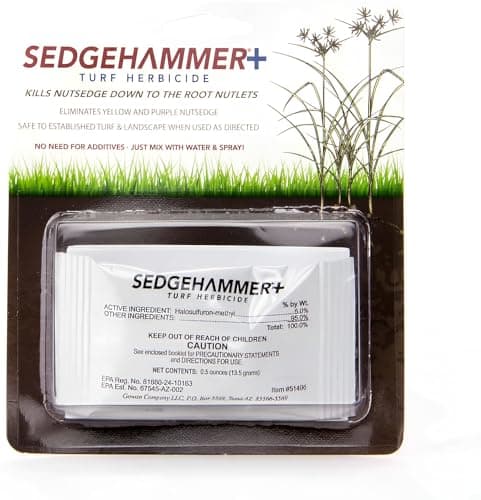
Here is the typical schedule, based on common label guidance (always follow your specific product's label): make the first application in late spring or early summer, when the plants have roughly 3 to 8 leaves and are growing actively. Watch the treated area over the next month. If new shoots emerge, make a repeat application at 4 to 6 weeks; the Sedgehammer label, for example, allows a repeat application for regrowth. For yellow nutsedge, one season of this rhythm usually gets you most of the way. For purple nutsedge, plan on carrying the same schedule into a second season, because its chained tubers hold more reserves.
Getting rid of yellow nutsedge in your lawn (and why purple is harder)
If you are getting rid of yellow nutsedge, the odds are in your favor. Yellow nutsedge builds single tubers at the ends of its underground stems, so each well-timed treatment removes a meaningful slice of the bank, and most lawns see it fade substantially within one committed season. Purple nutsedge is the harder fight. It strings tubers together in chains, so a surviving tuber down the line can resprout the whole run, and it shrugs off some products that handle yellow just fine. That is why the product table below flags yellow and purple efficacy separately, and why purple infestations almost always need a second season of retreatment. Either way, the sequence is identical: dry out the soil, thicken the turf, treat young plants, and repeat on the label interval until the shoots stop coming.
- Match the chemistry to the sedge. University extension programs generally point homeowners toward selective sedge herbicides in chemistry families such as the sulfonylureas (for example halosulfuron) and the active ingredient sulfentrazone for nutsedge in established lawns. Which one is appropriate depends on your grass species and your specific nutsedge, so confirm both against the product label and your local extension office before buying.
- Follow the label rate and interval exactly. Application rates, the number of allowed treatments per season, re-treatment intervals, and which turf species the product is safe on are all printed on the label and vary by product. The label is the law and the agronomy. Do not improvise rates from a blog, including this one.
- Treat young, actively growing plants. Extension guidance consistently emphasizes treating nutsedge early in its growth and before flowering, while it is moving energy and herbicide down to the tubers, rather than after it has matured and set new nutlets.
- Confirm grass tolerance first. Some sedge herbicides are safe on warm-season lawns but not all cool-season grasses, and vice versa. Verify your turf type is listed on the label, and when in doubt, your state or county extension office will give you region-specific, grass-specific direction for free.
For help lining up the right treatment window so you are not spraying mature plants in vain, run your situation through our herbicide timing tool. And before you buy any product by the bottle, it helps to know how much lawn you are actually treating, so size the area first with the lawn size calculator to avoid wildly over- or under-buying. For a broader look at choosing and applying lawn herbicides without wasting product, our guide to the best weed killers and DIY methods covers the fundamentals, and our list of common mistakes people make using weed killers will keep you from undoing your own work.
The Best Nutsedge Killers: Sedgehammer vs Dismiss vs Image
Once the cultural fixes are underway, three products come up again and again in extension recommendations and in my own field work: SedgeHammer (halosulfuron), Dismiss (sulfentrazone), and Image (imazaquin). All three are real sedge herbicides, not repackaged broadleaf killers, but they trade off speed, turf safety, and price very differently. Here is how they compare side by side. Whichever you choose, verify your grass type is on the label and follow the label rate and interval exactly.
| Product | Active ingredient | Kills yellow | Kills purple | Speed | Safe on | Retreat interval |
|---|---|---|---|---|---|---|
| Sedgehammer Plus Turf Solution 13.5grams | Halosulfuron | Yes | Yes | Slow but thorough. Yellowing in 1 to 2 weeks, full kill in 3 to 4 | Most cool-season and warm-season lawns (check label) | Repeat after 4 to 6 weeks if regrowth appears |
| FMC Dismiss Turf Herbicide 6 fl oz | Sulfentrazone | Yes | Suppression, repeat apps needed | Fast. Visible burndown in days | Most warm-season plus several cool-season grasses (check label) | Per label, typically a few weeks between applications |
| Image Herbicides Nutsedge Killer for Southern Lawns Concentrate 24 fl. oz. | Imazaquin | Yes | Yes | Slow. Several weeks to full effect | Southern lawns only: Bermuda, Zoysia, St. Augustine, centipede | Repeat per label if regrowth appears |
The short version: SedgeHammer is the default pick for most lawns because it handles both yellow and purple nutsedge and is gentle on the widest range of turf. Dismiss is the speed pick when you want visible results in days and your grass is on its label. Image is a budget-friendly southern-lawn option, but keep it off cool-season grass entirely.
What about natural or DIY options?
People ask me about vinegar, boiling water, and pulling almost daily, so let me be straight. Household vinegar can burn the tops off young nutsedge shoots, but it does nothing to the tubers underground, so the plant simply regrows, and you have learned the hard way why the tuber bank is the real battle. We dug into the limits of acetic acid on weeds in our piece on whether white vinegar actually kills weeds, and the short version is that it is a topper, not a killer, for a tuber-driven weed like this. Boiling water can work in a sidewalk crack but will scorch your lawn. For a true infestation, cultural changes plus a labeled sedge herbicide remain the only reliably effective route.
What Other Guides Miss
Most nutsedge articles tell you to pull it and spray it, and then they move on. Here is what gets left out, and it is the part that actually determines whether you win.
Pulling nutsedge usually spreads it. This is the counterintuitive truth almost nobody leads with. Because each visible shoot sits on a web of tubers, removing the top rarely removes the tubers, and the soil disturbance wakes up dormant nutlets that then sprout. People diligently hand-weed a small patch all summer and are baffled when it triples in size. If you are going to remove plants by hand at all, do it only when the patch is tiny and brand new, dig deep enough to chase the tubers, and accept that you probably did not get them all.
The tuber bank is the real enemy, and it takes seasons. The plants on the surface are just the visible tip. A meaningful infestation holds a reservoir of tubers in the soil that will keep resupplying shoots for one to three years even under good control. Anyone promising you a single-application, this-weekend fix is selling either the wrong product or false hope. Real nutsedge control is a campaign of well-timed, repeated treatments that gradually exhaust that underground bank, paired with the cultural changes that stop it from refilling. When you measure success in seasons rather than days, you stop getting discouraged and you actually finish the job. If you want a plan that tells you the exact product and the exact week to treat for your specific zip code and grass type, that is precisely what a personalized care plan is built to do, and you can start by getting a free photo diagnosis first.
Your Nutsedge Action Plan
Here is the whole thing condensed into the order I would actually run it.
- Confirm the ID. Feel for the triangular stem and check the color and growth speed. If you are not certain, get a free diagnosis from a photo before spending on any product.
- Fix the water. Stop overwatering, switch to deep and infrequent irrigation, and correct soggy spots, low areas, and drainage problems. This alone weakens nutsedge more than anything else.
- Strengthen the turf. Mow a notch higher, aerate compacted soil, fertilize for your grass and season, and fill in thin or bare areas so sedge has nowhere to colonize.
- Buy the right product. Choose a herbicide specifically labeled for sedge or nutsedge control. Verify your grass type is on the label, and check with your local extension if you are unsure which chemistry fits.
- Treat early and on schedule. Apply to young, actively growing plants before they flower and set tubers, and follow the label's rate and re-treatment interval to the letter.
- Repeat across the season. Expect to treat again as new shoots emerge, and plan for a second year on heavy or purple nutsedge infestations. You are exhausting a tuber bank, not killing one plant.
- Get a tailored plan if you want the shortcut. A personalized care plan names the exact product and the exact week to treat nutsedge for your zip code and grass type, so you are not guessing. Start with a free photo diagnosis and build from there.
Nutsedge feels unbeatable mostly because people fight it with the wrong tools and the wrong timeline. Correct the ID, dry out its habitat, treat young plants with sedge-specific chemistry, and keep at it across the season, and that glossy spike that keeps outrunning your mower will finally lose its underground advantage. Whether you call it nutsedge or nut grass, it loses the same way: dry soil, dense turf, and well-timed sedge chemistry.
Free Lawn Care Tools
Nutsedge is a sedge, not a broadleaf weed or a grass, and standard weed and feed is formulated to kill broadleaf weeds like dandelion and clover. Those active ingredients simply do not affect sedges. To kill nutsedge you need a herbicide specifically labeled for sedge or nutsedge control, applied while the plants are young and actively growing.
Yes. Nut grass, nutgrass, and nutsedge are all names for the same weed, named for the nut-like tubers, or nutlets, it hides underground. Despite the nickname, it is not a true grass at all but a sedge, with a solid triangular stem instead of a flat or rounded, jointed grass stem. That family difference is why selective weed killers made for grassy or broadleaf weeds fail on it, and while nonselective products like glyphosate will kill nutsedge, they kill the lawn around it too, which is why you need a product specifically labeled for sedge or nutsedge control.
Roll a stem between your fingers near the base. Nutsedge has a solid, triangular stem with three distinct edges, while grasses have flat or rounded stems with joints called nodes. Nutsedge also grows faster than your lawn and has stiff, shiny, yellow-green leaves arranged in sets of three, so it pokes above a freshly mowed lawn within days.
Yellow nutsedge has lighter yellow-green leaves with a long tapered tip and golden seedheads, and forms single tubers more common in cooler regions. Purple nutsedge has darker green leaves, reddish to purple-brown seedheads, and forms chains of tubers that make it harder to control. Purple nutsedge is more common in the warm, humid South and usually requires a longer fight.
Usually not, and it can make things worse. Each plant sits on a network of underground tubers, and pulling the top rarely removes them while the soil disturbance triggers dormant tubers to sprout. Hand removal only makes sense on a tiny, brand-new patch where you can dig deep and chase the tubers, and even then you will likely miss some.
Plan on one to three seasons for a meaningful infestation. The visible plants are just the surface, and the soil holds a reservoir of tubers that keeps sending up new shoots. Real control means repeated, well-timed treatments that gradually exhaust that tuber bank, paired with cultural changes like better drainage and thicker turf. Anyone promising a one-weekend fix is overselling.
Vinegar can burn the tops off young nutsedge shoots, but it does nothing to the underground tubers, so the plant simply regrows. It is a topper, not a killer, for a tuber-driven weed like nutsedge. For a real infestation, the reliable route is cultural control plus a herbicide specifically labeled for sedges, applied to young plants before they set new tubers.
Halosulfuron (SedgeHammer) and sulfentrazone (Dismiss) are the two actives university extensions point homeowners to first. SedgeHammer is the default pick because it controls both yellow and purple nutsedge and is labeled for most cool-season and warm-season lawns, while Dismiss works faster on yellow nutsedge. Imazaquin (Image) is a third option for southern lawns like Bermuda, Zoysia, and St. Augustine. Whichever you pick, confirm your grass type is on the label and follow the label rate exactly.
Late spring to early summer, when the plants are young, actively growing, and have roughly 3 to 8 leaves. At that stage the herbicide gets pulled down into the tubers before the plant sets new ones. Spraying mature, flowered plants in late summer does far less. If regrowth appears, most labels allow a repeat application at 4 to 6 weeks, and purple nutsedge usually needs the schedule repeated for a second season.
Take away the wet, thin, sunny conditions it needs. Fix drainage and stop overwatering so the top inch of soil dries between waterings, mow a notch higher to shade the soil, and thicken the turf with aeration and overseeding so there is no open ground. Hand digging only works on tiny brand-new patches if you chase down every tuber, and vinegar or boiling water burn the tops without touching the tubers, so the plant regrows. For an established patch, cultural fixes plus a labeled sedge herbicide are the only reliable route.

Your lawn plan, in your pocket all season
Grass ID, a season plan, soil-timed reminders, and a lawn journal that remembers what you did. Free on iPhone.
Related Articles
 Problem Solving
How to Get Rid of Thistle in Your Lawn (Why It Keeps Coming Back)
Aug 12, 2026•6 min read Problem Solving
Broadleaf Plantain: How to Get Rid of This Stubborn Lawn Weed
Aug 12, 2026•6 min read Problem Solving
How to Get Rid of Spotted Spurge (Before It Seeds Your Whole Lawn)
Jun 19, 2026•12 min read