How to Get Rid of Poa Annua: Best Annual Bluegrass Herbicides & Fall Timing
 Marcus GreenTurf Management Pro | 18 Years
As an Amazon Associate we earn from qualifying purchases.
If you have been fighting the same patches of light, lime-green grass every spring, mowing them and watching them bounce right back covered in seedheads, you are almost certainly dealing with poa annua, also called annual bluegrass. And if you have tried to kill it in spring and felt like nothing worked, you are not crazy. By spring, the most powerful tool you have is already off the table. The real win with annual bluegrass happens in fall, and most homeowners miss the window entirely.
This guide is about control, not identification. If you are not yet sure the weed is poa annua, start with our companion guide on how to identify poa annua (annual bluegrass), which walks through the color, seedhead, leaf-tip, and seasonal tests in detail. Once you have confirmed it, come back here for the plan to actually get rid of it.
Not 100 percent sure it is poa annua, or want to know exactly which week to spray for your zip code? Snap a photo with our free diagnose tool to confirm the weed, then get a personalized control plan with the fall pre-emergent date dialed in for your lawn.
The single most effective way to get rid of poa annua is a fall pre-emergent herbicide applied before the seeds germinate, which happens as soil temperatures consistently drop below 70 degrees Fahrenheit in late summer to early fall. Poa annua is a winter annual, so it sprouts in fall, not spring. Spring pre-emergents aimed at crabgrass are timed for the wrong season and let poa annua right through. Get the fall application down on time and you stop the next generation before it starts.
For the plants already growing, post-emergent options are limited and depend heavily on your grass type, since some products that kill poa annua will also damage cool-season turf. Cultural moves help too: mow a little higher, water deep but infrequently, and fix the wet, compacted, thin spots where poa annua thrives. The honest reality is that annual bluegrass control is a one-to-two-season project built around hitting that fall pre-emergent window, not a single spray.
First, Make Sure It Is Actually Poa Annua
Control only works if you are targeting the right plant, and poa annua gets confused with a few look-alikes that need different handling. The fast field check: poa annua shows up as light, apple-green patches that feel soft and puffy, it pumps out tiny white seedheads even when mowed short, and it peaks in cool weather then fades in summer heat. If your problem grass is coarse, spreads sideways, and thrives in hot summer weather, that is more likely crabgrass or goosegrass, which is a completely different control timeline. A coarse clump that survives winter and regrows in the same spot every year is more likely the perennial dallisgrass, which needs crown-level control rather than the seed-stopping approach poa annua calls for.
I am keeping identification short on purpose because we cover it thoroughly elsewhere. For the full set of tests, including leaf-tip shape, ligules, and how to separate poa annua from Kentucky bluegrass and rough bluegrass, read how to identify poa annua (annual bluegrass). Confirm first, then control.
Why Poa Annua Is So Hard to Kill
Annual bluegrass earns its reputation. Two things make it genuinely stubborn, and understanding both is what turns a frustrating cycle into a plan that actually works.
First, it is a prolific seeder. A single annual bluegrass plant can produce thousands of seeds in one season, and it does it at mowing heights as low as an eighth of an inch. So every spring you see seedheads, the plant is loading the soil with the next year's invasion. That stored-up bank of seed in your soil is the real enemy. You are not fighting the plants you can see so much as the seeds you cannot.
Second, it is a winter annual on a backwards schedule compared to most weeds people worry about. Crabgrass germinates in spring and rages in summer. Poa annua does the opposite. It germinates in late summer and fall, grows quietly through winter, explodes with seedheads in spring, then dies on its own when summer heat arrives. That late-spring dieback fools people into thinking they won. They did not. The plant already dropped its seed, and a fresh crop is waiting for fall.
Here is why those two facts matter together: because poa annua germinates in fall and reseeds every spring, the only way to break the cycle is to stop germination in fall. By spring, the plants are mature, hard to selectively kill without hurting your lawn, and already setting seed. Fall is your leverage point. Spring is damage control at best.
The Highest-Leverage Move: Fall Pre-Emergent Timing
This is the heart of poa annua control, so I want to be precise about it. A pre-emergent herbicide creates a chemical barrier in the top layer of soil that stops seeds from establishing as they germinate. It does nothing to plants that have already sprouted. That means timing is everything. Apply it too late and the seeds are already up. Apply it way too early and the barrier can break down before the germination window even opens.
Poa annua germination kicks off when soil temperatures drop back down into roughly the 70 degree Fahrenheit range, typically in late summer to early fall depending on where you live. Northern lawns often hit that window in late August through September. Transition-zone and southern lawns may not get there until late September into October. The calendar is a rough guide. Soil temperature is the real trigger, which is why you want to track it rather than just picking a date off a chart.
The practical rule: get your fall pre-emergent down a couple of weeks before soil temps settle to that 70 degree mark, so the barrier is in place before the first seeds wake up. Use our soil temperature tracker to watch the trend for your area, and our herbicide timing tool to pin down the application window. If you want the date handed to you for your exact zip code along with confirmation that you are even dealing with poa annua, run the free diagnose tool and you will get a personalized plan instead of a generic chart.
One more timing note that trips people up: pre-emergents do not last forever. A single fall application may lose strength before poa annua's germination window fully closes, since it can sprout in waves over several weeks of cool weather. That is where the general principles of split applications and reapplication intervals come in. We cover the mechanics of soil-temperature thresholds, zip-code timing, and split applications in depth in our pre-emergent timing guide. Read that for the general how-to. Just remember the key difference for poa annua: your target soil temperature is on the way down in fall, not on the way up in spring. For the fall half worked out region by region, with the soil-temperature cues and the overseeding workarounds, see our fall pre-emergent timing guide.
- Ask your local cooperative extension office for their annual bluegrass control fact sheet. It will list the specific pre-emergent active ingredients labeled for poa annua in your state and the application rates, which vary by product and turf type.
- Confirm the soil-temperature germination threshold and typical fall timing window for your region. Extension turf programs publish local soil-temperature data and target dates, and many run real-time soil-temp maps you can check before you spray.
- If you plan to overseed cool-season turf this fall, tell the extension agent. Most pre-emergents also stop your desirable grass seed from establishing, so the timing of pre-emergent and overseeding has to be coordinated, and some products have specific waiting periods.
Best Pre-Emergent Herbicides for Poa Annua (Annual Bluegrass)
Once you know your timing window, the next question is which pre-emergent to put down. Annual bluegrass control comes down to a handful of proven active ingredients. The table below lines up the common ones, an example product for each, the turf they are safe on, and how they fit the fall window. Always read the label for your grass type and rate, and check your local extension for regional resistance notes before you buy.
| Active ingredient | Example product | Safe turf types | Fall timing |
|---|---|---|---|
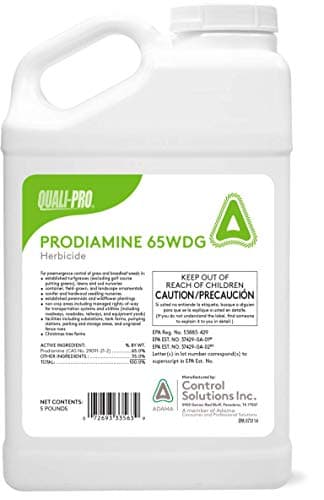
| Prodiamine | Quali-Pro Prodiamine, Pre-Emergent Herbicide, 5 lbs, Yellow Granules (also sold as Barricade) | Most established cool- and warm-season lawns | Apply as soil temps fall toward 70°F; long residual, good for a single fall barrier |
| Dithiopyr | Dimension | Most established cool- and warm-season lawns | Early fall before germination; also catches very young seedlings |
| Pendimethalin | Scotts Halts | Many cool- and warm-season lawns | Early fall before the first seeds sprout |
| Indaziflam | Specticle | Warm-season lawns only (bermuda, zoysia, centipede, St. Augustine) | Early fall at a very low rate; long residual, do not use on cool-season turf |
| Ethofumesate | Prograss | Established cool-season turf and dormant bermuda | Fall, often in split applications |
Prodiamine is the workhorse most homeowners reach for because it is widely available and has a long residual, but any of these will work if it is labeled for your grass. Do not apply a pre-emergent to an area you plan to overseed this fall, since it stops your good grass seed from establishing too.
Controlling Poa Annua That Is Already Growing
Pre-emergent stops next year's crop, but what about the plants already in your lawn right now? This is where expectations need a reset. Post-emergent control of annual bluegrass is genuinely limited, and your options depend almost entirely on what grass you are trying to protect.
In warm-season lawns like bermuda, zoysia, or St. Augustine, you have more room to work, especially while the turf is dormant. Because the desirable grass is brown and inactive in winter, some non-selective and selective treatments can knock back the green poa annua growing through it without harming the sleeping turf. The timing and product selection are very grass-specific, so this is exactly the kind of decision to verify against extension guidance for your species.
In cool-season lawns like fescue, ryegrass, and Kentucky bluegrass, it is much trickier. Poa annua is closely related to Kentucky bluegrass, so products that kill one often injure the other. There are selective post-emergent options, but they are limited, can be temperamental, and frequently require multiple applications. For many cool-season homeowners, the realistic play is to lean hard on the fall pre-emergent and cultural controls, and accept that spring spot-treatment is a supporting move rather than the main event.
Whatever your grass type, do not reach for a generic broadleaf weed killer or a basic weed-and-feed and expect results. Poa annua is a grass, not a broadleaf weed, so those products simply do not touch it. That mismatch is one of the most common reasons people think they have a poa annua product that failed when really they never used the right kind of product at all.
- Get the post-emergent recommendation specific to your turf species before you spray. The product that is safe on dormant bermuda can wreck a fescue lawn. Extension offices publish turf-specific selective herbicide options and the exact active ingredients labeled for poa annua suppression.
- Never guess at rates. Annual bluegrass has well-documented herbicide resistance in some regions, and under-dosing or repeating the wrong chemistry can make resistance worse. Follow the product label and your extension's rate guidance exactly.
- If poa annua keeps coming back despite correct applications, ask your extension about resistance testing and rotating herbicide modes of action.
Post-Emergent Herbicides That Kill Annual Bluegrass
If annual bluegrass is already up and growing, a pre-emergent will not touch it, so you need a post-emergent matched to your turf. This is where grass type decides everything, because a product that is safe on dormant bermuda can wreck a fescue lawn. Treat the options below as label-first starting points and confirm the rate and turf tolerance on the product label before you spray.
| Your grass type | Post-emergent option | Notes |
|---|---|---|
| Cool-season (fescue, ryegrass, Kentucky bluegrass) | Mesotrione (Tenacity Turf Herbicide - 8 ounces (Packaging may vary)) | One of the few selective options; plan on multiple applications with a surfactant, expect temporary white bleaching |
| St. Augustine or centipede | Atrazine or simazine | Labeled for these southern grasses; follow label rates closely |
| Fully dormant bermuda | Glyphosate spot-spray | Non-selective; spot-spray only while the bermuda is fully brown and dormant, since it kills any green tissue it touches |
| Newer selective option | Amicarbazone (Xonerate) | A newer annual bluegrass herbicide; check the label for the turf types it is cleared for |
Whatever you choose, do not expect a single spray to end the problem. Post-emergent control of annual bluegrass is a supporting move behind the fall pre-emergent, and annual bluegrass has documented herbicide resistance in some regions, so rotate modes of action and never guess at rates.
Cultural Controls: Make Your Lawn a Bad Home for Poa Annua
Chemistry stops seeds and plants, but culture is what keeps annual bluegrass from finding an opening in the first place. Poa annua is an opportunist. It moves into wet, compacted, thin, low-mowed turf where your desirable grass is struggling. Take those conditions away and you remove its advantage. Those same wet, thin patches are where the triangular-stemmed nutsedge tends to move in too, so fixing the drainage and density that fix one often shrinks the other.
A few moves that consistently help:
- Mow a little higher. Poa annua loves close mowing and sets seed at heights your good grass cannot survive. Raising your cut lets your turf shade the soil surface, which discourages poa annua seed from germinating. Our timing tools handle the spray schedule, but mowing height is a free, every-week lever.
- Water deep and infrequent, not light and often. Frequent shallow watering keeps the soil surface moist, which is exactly the condition poa annua seeds need to germinate. Deeper, less frequent irrigation lets the surface dry between cycles and favors your deeper-rooted permanent grass.
- Fix drainage and compaction. Those soggy low spots and hard-packed, high-traffic strips are poa annua headquarters. Core aeration relieves compaction, and improving drainage in chronic wet spots removes the moist, cool niche poa annua exploits.
- Thicken your turf. A dense, healthy lawn is the best long-term poa annua control there is. Bare and thin spots are open invitations. Overseed cool-season lawns in fall to fill gaps, but coordinate that timing carefully with any pre-emergent, since the two work against each other.
None of these alone will eliminate an established poa annua problem, but together they shrink the openings poa annua needs and make every chemical application more effective.
When to Escalate
Most home lawns can get annual bluegrass under control with the fall pre-emergent plus cultural fixes over a season or two. But a few situations call for stepping it up. If poa annua makes up a large share of your lawn rather than scattered patches, if it keeps coming back at full strength despite correctly timed and dosed applications, or if you suspect herbicide resistance, it is worth bringing in extra help. Your extension office can advise on resistance testing and rotating herbicide modes of action, and a reputable local lawn-care professional will have access to and licensing for products that are not sold to homeowners. In severe cases where poa annua has crowded out most of the desirable turf, a planned renovation timed around the fall pre-emergent and overseeding schedule may be the cleanest reset.
What Other Guides Miss
Here is the thing that almost every annual bluegrass article gets wrong or buries: they treat it like a spring problem. They tell you to apply pre-emergent in spring, right alongside the crabgrass advice, and they are dead wrong for poa annua.
Spring pre-emergent is the right call for crabgrass, which germinates as soil warms past about 55 degrees Fahrenheit in spring. If you are also fighting crabgrass, our crabgrass control guide covers that spring timing. But poa annua germinates in fall as soil cools, which is the mirror image. A spring pre-emergent applied for crabgrass does almost nothing against poa annua, because by spring the poa annua is already up, mature, and setting seed. The barrier you laid in spring will have largely broken down by the time fall germination actually starts.
So when someone tells you they put down pre-emergent and still got annual bluegrass, this is almost always why. They timed it for crabgrass season and missed the poa annua season completely. Getting rid of poa annua is a fall job. Mark it on your calendar in late summer, not spring, and you will be ahead of nearly everyone fighting this weed.
The second thing guides skip: they sell post-emergent sprays as the main solution. For poa annua, post-emergent is the weaker tool. The seedbank and the fall germination window are where the leverage is. Spend your energy there.
Your Fall-Timed Poa Annua Action Plan
Put it all together and the plan is straightforward. Work it in this order:
- Confirm it is poa annua. Use the field tests in our identification guide, or snap a photo with the diagnose tool to be sure before you spend money on products.
- Track soil temperature in late summer. Watch for soil temps falling toward 70 degrees Fahrenheit using our soil temperature tracker. This is your germination starting gun.
- Apply fall pre-emergent before that window opens. Use the herbicide timing tool to set the date, and follow the split-application and reapplication guidance in our pre-emergent timing guide. Verify the product and rate with your extension office.
- Coordinate overseeding. If you overseed cool-season turf in fall, plan it around the pre-emergent so the two do not cancel each other out.
- Spot-treat in spring if needed. Use a turf-safe selective post-emergent on any plants that slipped through, matched to your grass type and verified with extension guidance.
- Tighten cultural practices year-round. Mow higher, water deep and infrequent, aerate compacted areas, and keep the lawn dense so poa annua has nowhere to move in.
- Repeat the fall pre-emergent next year. Draining the seedbank takes more than one season. Hit the fall window again and the patches keep shrinking.
Annual bluegrass feels unbeatable when you fight it in spring, because spring is when it is winning. Move your battle to fall, time it by soil temperature, and back it up with a thick lawn, and you flip the whole thing in your favor. Want the fall application date and a control plan built for your exact lawn and zip code? Start with a free photo diagnosis and let us handle the timing math for you.
Free Lawn Care Tools
Apply your fall pre-emergent before poa annua seeds germinate, which happens as soil temperatures fall back toward roughly 70 degrees Fahrenheit in late summer to early fall. Northern lawns often hit that window in late August through September, while transition-zone and southern lawns may not reach it until late September into October. Track soil temperature rather than relying on the calendar, and aim to get the barrier down a couple of weeks before that 70 degree mark. Confirm the exact product, rate, and local timing with your cooperative extension office.
Because spring is the wrong season for poa annua. Spring pre-emergents are timed for crabgrass, which germinates as soil warms past about 55 degrees Fahrenheit in spring. Poa annua is a winter annual that germinates in fall as soil cools, so by spring it is already up and setting seed, and any barrier you laid down will have largely broken down before fall germination begins. To actually stop poa annua, you have to apply pre-emergent in fall, not spring.
Yes, but options are limited and depend heavily on your grass type. In warm-season lawns like bermuda or zoysia, some treatments can knock back poa annua while the desirable turf is dormant in winter. In cool-season lawns like fescue and Kentucky bluegrass it is much harder, because poa annua is closely related to bluegrass and many products injure both. Generic broadleaf weed killers and basic weed-and-feed do not work at all, since poa annua is a grass, not a broadleaf weed. Verify a turf-safe selective product and rate with your extension office before spraying.
The visible plants usually do. Poa annua is a winter annual with shallow roots and poor heat tolerance, so it typically yellows and dies when summer temperatures consistently climb into the 80s Fahrenheit. The catch is that it drops thousands of seeds before it dies, and those seeds germinate again the following fall. So summer dieback is not a win. It just resets the cycle. Real control means stopping the next generation with a fall pre-emergent, not waiting for heat to do the job.
Yes. Poa annua tolerates very close mowing and even sets seed at heights your desirable grass cannot survive, so scalping the lawn favors it. Raising your mowing height lets your turf shade the soil surface, which discourages poa annua seed from germinating and helps your permanent grass outcompete it. Mowing higher will not eliminate an established infestation by itself, but combined with deep infrequent watering and a fall pre-emergent it removes a big part of poa annua's advantage.
Plan on one to two full seasons, sometimes more for heavy infestations. The reason is the seedbank: poa annua loads the soil with thousands of seeds, and a single fall pre-emergent application drains only part of that bank. Hitting the fall germination window correctly two years in a row, combined with cultural practices that thicken your lawn, steadily shrinks the patches. It is a campaign, not a single spray. The good news is that once you are consistently timing the fall application, the problem gets noticeably smaller every year.
For prevention, the best herbicide for annual bluegrass is a fall pre-emergent with an active ingredient like prodiamine, dithiopyr, pendimethalin, or indaziflam, applied as soil temperatures fall toward 70 degrees Fahrenheit. For plants already up, your options depend on grass type: mesotrione (Tenacity) is the go-to selective for cool-season lawns, while atrazine or simazine fit St. Augustine and centipede. Always match the product to your turf and follow the label rates, since annual bluegrass has documented herbicide resistance in some regions.
Tenacity can suppress and control poa annua in cool-season lawns, and it is one of the few selective options that is reasonably safe on fescue, ryegrass, and Kentucky bluegrass. It rarely works in a single pass, though. Plan on two or three applications spaced a couple of weeks apart, mixed with a surfactant, and expect a temporary white bleaching on treated plants. It is a supporting tool, not a substitute for the fall pre-emergent that stops next year’s seedlings.

Your lawn plan, in your pocket all season
Grass ID, a season plan, soil-timed reminders, and a lawn journal that remembers what you did. Free on iPhone.
Related Articles
 Pest Control
Fall Pre-Emergent: When to Apply for Poa Annua and Winter Weeds
Sep 12, 2026•11 min read Problem Solving
Understanding Lawn Care Terminology: A Homeowner’s Guide
Aug 8, 2025•2 min read Problem Solving
How to Get Rid of Stickers in Your Yard (Burweed, Sandburs and Goatheads)
Sep 17, 2026•5 min read