Mock Strawberry in a Lawn: How to Identify It and What to Do Next

As an Amazon Associate we earn from qualifying purchases.
Do the strawberry-like berries in your lawn point upward? Are the flowers yellow instead of white? Those two checks separate mock strawberry from a native wild strawberry and help you avoid treating the wrong plant.
Fast Answer: Mock strawberry, also called Indian strawberry, is a low perennial that spreads by runners. University of Minnesota Extension says it has yellow, five-petaled flowers and red fruit that points up. Native wild strawberry has white petals. Confirm both clues before you decide how to manage a patch.
Could the patch be mock strawberry?
Start with the flower. Is it yellow with five petals? University of Minnesota Extension describes that as a mock strawberry clue. A white flower points instead toward native wild strawberry.
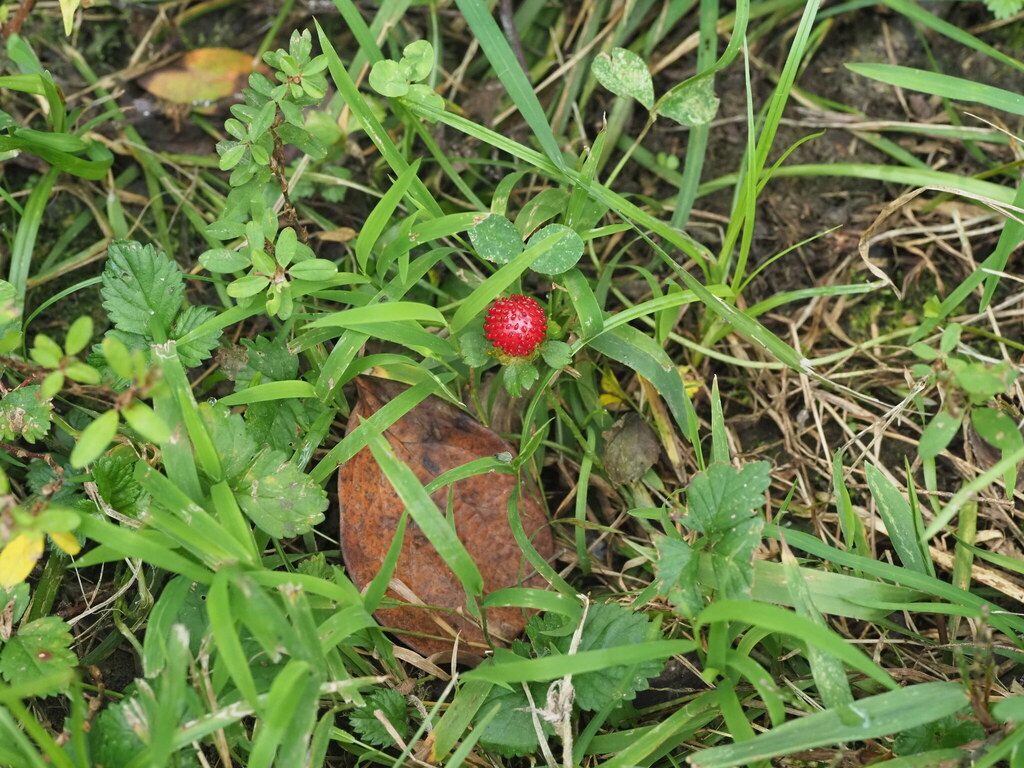
Next, look at the fruit. Does the small red berry sit above the leaves and point upward? That fits mock strawberry. Its fruit is often tempting to use as the only test, but check the flower too because damaged flowers can be missing when fruit appears.
Then follow a runner. Mock strawberry forms low colonies by rooting at nodes along its runners. If the plant makes a connected mat across thin turf, that growth pattern fits.
What does it look like from close range?
- Three dark-green, toothed leaflets on a long leaf stalk.
- A yellow flower with five petals.
- A small red, strawberry-like fruit that faces upward.
- Runners that root and start new plants.
The University of Minnesota Extension profile supports these identification checks. If the fruit points down and the flowers are white, keep the identification open and compare it with wild strawberry.
Why did it move into this spot?
Is the turf sparse, or does this corner stay damp? Mock strawberry can form a dense ground cover in lawns and woods, according to Minnesota Extension. That does not prove one cause for every patch. It does tell you to check whether grass has enough light, suitable mowing, and a chance to fill bare soil.
Use the lawn care schedule only after you confirm the grass type and location. A plan for the wrong turf can make a thin patch worse.
What should you do with a small patch?
Can you lift the runners without disturbing nearby grass? Pulling a small patch is reasonable when soil is moist and the roots release. Remove runners and rooted nodes together. Recheck the area because a missed node can regrow.
For a larger patch, repair the condition that leaves open ground. Mow at the appropriate height for your turf, correct a documented soil problem, and address shade or drainage where possible. A dense stand makes it harder for low, spreading plants to establish.
If you use an herbicide, identify both the weed and the turf first. Use only a current label that lists mock strawberry or the applicable target plant, the lawn site, and your turfgrass. Follow its rate, timing, and restrictions exactly.
Illustrative example: berries beside a shaded walk
A homeowner finds red berries along a shaded sidewalk. The flowers are yellow, the berries point upward, and runners root where they touch soil. Those checks support mock strawberry.
The first action is to remove the small patch while soil is moist, then inspect why the grass is thin beside the walk. If the site cannot support the existing turf, changing the plant without changing the condition will leave another opening.
Mock strawberry checklist
- Check for yellow, five-petaled flowers.
- Check whether the fruit points upward.
- Follow runners to rooted nodes.
- Pull small patches with roots and runners intact.
- Improve turf density before choosing a chemical option.
Still unsure? Send a close photo for identification. Include a flower, fruit, leaf, and the surrounding lawn.
Free Lawn Care Tools
Mock strawberry has yellow flowers and fruit that points upward. Native wild strawberry has white flowers. Check both features before you identify the plant.
It can. University of Minnesota Extension says mock strawberry spreads by runners that root at nodes and can form a low colony.
Hand removal can work for a small patch when you remove rooted runners and nodes. Recheck the area for regrowth.

Your lawn plan, in your pocket all season
Grass ID, a season plan, soil-timed reminders, and a lawn journal that remembers what you did. Free on iPhone.