

Purple Deadnettle in Lawns: How to Identify It and When to Act

Is a patch of fuzzy, purple-topped weeds showing up in the thin parts of your lawn? Purple deadnettle is one likely suspect, and henbit is the other. Check where the top leaves join the stem, then check the calendar. The right step depends on how far into its short life the weed is.
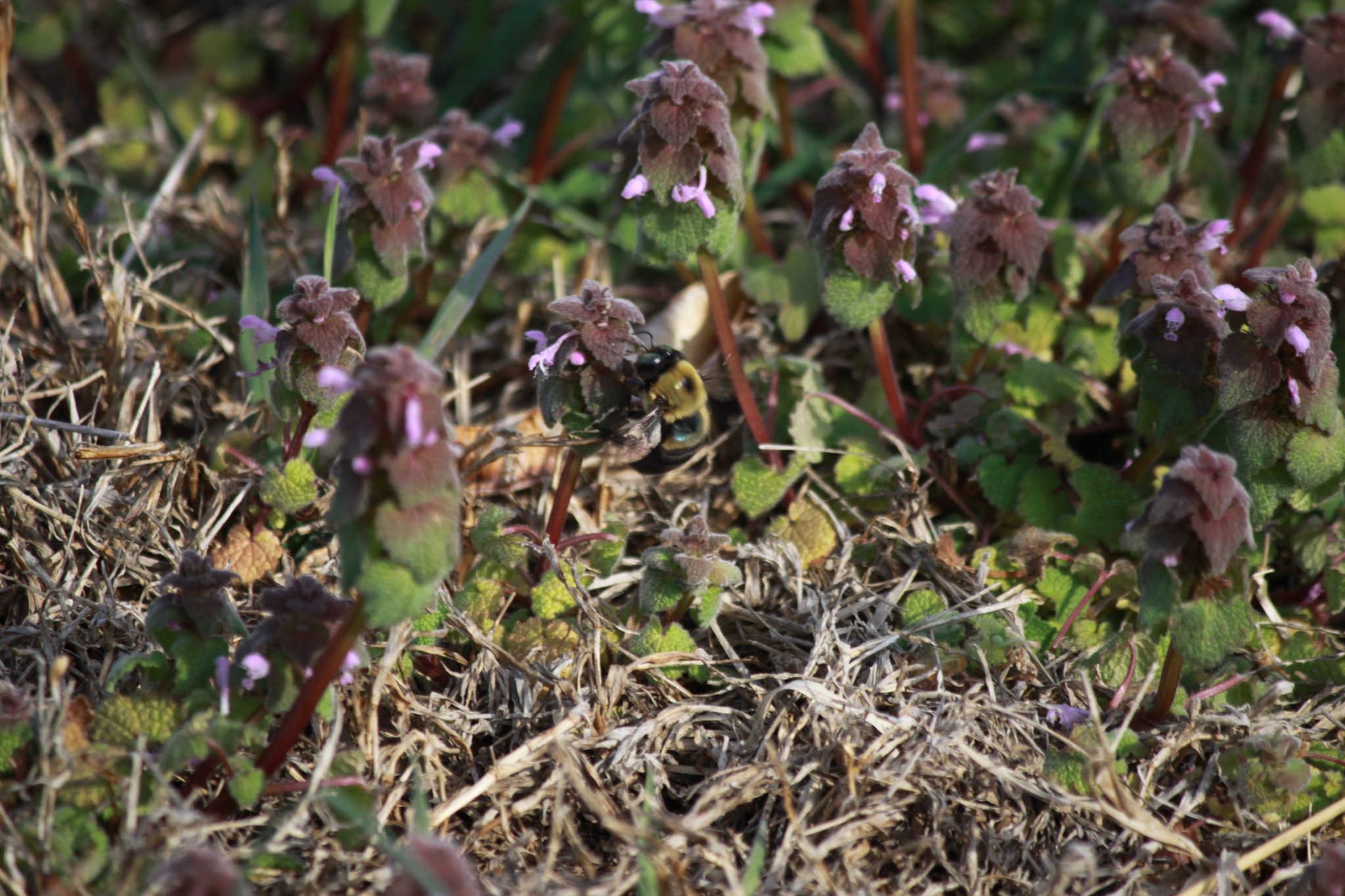
Purple deadnettle (Lamium purpureum) is a winter annual in the mint family. NC State Extension describes a square stem, short stalks on the upper leaves and upper leaves that are distinctly red- or purple-tinged. It sprouts in fall or winter, flowers in spring and dies as early-summer heat arrives.
Identify before you spray. Henbit leaves have no stalks and clasp the stem. For control, act in fall while the plants are small: pull small patches, or use a broadleaf herbicide whose label lists your grass. Clemson Extension also names early spring, before green-up, as a second window. If you seeded this fall, wait. NC State's listings for mesotrione and for sulfentrazone plus prodiamine say to wait until the new grass has been mowed twice; for mesotrione, 4 weeks after germination also counts. Other products set their own new-seeding wait on the label.
How can you recognize purple deadnettle?
Is the stem square? Roll it between your thumb and finger. NC State describes four-sided, square stems on both purple deadnettle and henbit, so a square stem puts you in the mint family but does not settle which one you have.
Are the top leaves crowded and tinted purple? Penn State Extension describes red- or purple-green leaves densely clustered at or near the top of the stem. The leaves are broadly heart-shaped to roughly triangular, with toothed edges and fine hairs that make them look fuzzy. NC State's plant toolbox adds that young leaves at the tip are tinted purple and turn dull green as they mature.
Do the upper leaves sit on short stalks? NC State says the upper leaves have short petioles (the small stalk between leaf and stem) and the lower leaves have long ones. This is the check that separates it from henbit. If you see small, pale pink-purple tubular flowers among the top leaves, Penn State notes they are about half an inch long, with darker streaks and spots.
Is it henbit, creeping Charlie, or purple deadnettle?
Pick one stem and compare its own leaves and flowers. Henbit and purple deadnettle often grow together, so one patch can hold both.
| Possible plant | What to check | What the result means |
|---|---|---|
| Purple deadnettle | Upper leaves on short stalks, crowded and purple-tinged at the top of the stem. | Consistent with purple deadnettle, per NC State. A winter annual, so it dies back by early summer. |
| Henbit | Rounded, scalloped upper leaves with no stalks that clasp the stem. | NC State's plant toolbox separates henbit by its nearly circular, stemless leaves and showier flowers. It has the same winter-annual timing, so the control calendar below still applies. |
| Creeping Charlie (ground ivy) | Stems that creep along the ground and root at the leaf joints; round, scalloped leaves on long stalks; an aromatic smell when you crush a leaf. | NC State describes ground ivy as a perennial. It survives the summer, so it needs a different plan. |
If henbit fits better, the henbit identification page covers it. If the stems root as they creep, go to the creeping Charlie guide. For other purple-flowered plants, start with weeds with purple flowers.
Why does it grow in the thin parts of the lawn?
Where is the patch? NC State says winter annual weeds like this one move quickly into thin turf, especially where the soil stays moist, and that shade can favor them. Clemson points to the same two conditions, too much shade and soil that stays too wet, as common reasons turf thins.
Check the spot before you treat it. Is it under a tree, beside a downspout, or in a low area that holds water? If one of those fits, the weed is pointing at the condition that left the soil open. NC State calls a dense, vigorous turf the best way to reduce winter annual weeds.
What should you do in each season?
When did you first notice it? Purple deadnettle follows a predictable calendar. NC State says it sprouts in fall or winter, stays mostly inactive through the cold, sets seed in spring and dies as late-spring and early-summer heat arrives. Penn State notes it is most noticeable in April, when it flowers. Match what you see to the step that fits:
| What you see | Typical time | Step that fits |
|---|---|---|
| Nothing yet, but last spring the lawn had a purple haze | Late summer to early fall | Preemergence herbicide, timed per Alabama Extension, on established turf only, per Clemson. Use the fall pre-emergent timing guide for your region. |
| Small seedlings with square stems in thin spots | Fall | Hand-pull small patches, or spot-treat with a broadleaf herbicide labeled for your grass. Clemson calls fall, while the weeds are small, the best window. On grass seeded this fall, follow the new-seeding wait on that product's label. For example, NC State's listing for sulfentrazone plus prodiamine says to apply only after a second mowing, once a good root system has formed. |
| Low plants that survived winter | Early spring, before the lawn greens up | Clemson's second window for a postemergence treatment. |
| Purple flowers on upright tips | Mid spring | Pull or mow to remove flower stems before seed forms. Penn State says plants often die back in mid to late spring before broadleaf herbicide applications are made. |
| Brown, collapsing plants | Late spring to early summer | No treatment needed. Repair the bare spots so new weeds have less room. |
These times are general. Your local Extension office can give dates for your area.
What can you do with a confirmed patch?
Is it a few plants you can reach by hand? Alabama Extension lists hand-pulling and spot treatment of emerged weeds. Pull the whole plant, including its fibrous roots. Alabama notes that seeds can remain viable for several years or, in some cases, decades, so expect some plants to return next fall.
Is it flowering already? Penn State recommends frequent mowing in early spring, at typical lawn heights of 2 to 3 inches, to remove the flower stems. Check the right height for your own grass with the mowing height calculator. Do not lower the mower to reach the weed.
Is the infestation large enough to spray? Penn State lists broadleaf herbicides; most combine 2,4-D or MCPA with partners such as dicamba, MCPP, fluroxypyr, triclopyr or carfentrazone, and a few use triclopyr or fluroxypyr without them. Grass tolerance varies by product. NC State, for example, lists sulfentrazone plus prodiamine with different rates for different grasses and says not to use it on St. Augustinegrass. Use only a product whose current label lists your grass, at the printed rate and timing.
- Check that the label lists your lawn grass as tolerant. NC State's listings give different rates for different grasses and exclude some, such as St. Augustinegrass for sulfentrazone plus prodiamine.
- On newly seeded grass, NC State's listing for mesotrione says to wait 4 weeks after germination or until the turf has been mowed twice before a postemergence spray.
- Your county Extension office can confirm the weed and the timing for your area before you spray.
Did you seed this fall? Clemson warns that preemergence herbicides can inhibit the development of new lawns. Postemergence products have limits on new grass too, as the guidance above shows. Check that the label permits use on new seedlings before you apply anything to new grass.
Can you leave it alone? Alabama says the early flowers may provide pollen and nectar for bees and other pollinators, and NC State says the long-lasting flowers provide nectar in winter. If a few plants in a low-traffic area do not bother you, they will die on their own by summer.
What other guides misdiagnose
Is every purple spring weed the same problem? Henbit, purple deadnettle and creeping Charlie often get lumped together as one purple weed with one fix. The first two are winter annuals that die by early summer, per NC State. Creeping Charlie is a perennial that stays. Roll a stem and follow it along the ground before you decide which plan applies.
When do most people notice it? Penn State says purple deadnettle is most conspicuous in April, when it flowers. That is also when many homeowners reach for a spray, yet Clemson says spring is not the best time to control it because the plants are finishing their life cycle. If you first see it in bloom, note the spot and plan for fall.
Your purple deadnettle diagnosis checklist
- Roll one stem between your fingers. Square means a mint-family weed; round means look elsewhere.
- Look at the top leaves. Short stalks and a purple tint point to purple deadnettle; stalkless, clasping leaves point to henbit.
- Follow a stem along the ground. If it roots at the leaf joints, has round leaves on long stalks and smells aromatic when crushed, check creeping Charlie instead.
- Note the location and season. Thin, shaded or wet spots explain why it moved in; the season table tells you which step fits now.
- Before you spray, confirm your lawn grass and read the current product label for that grass, its new-seeding limits and its temperature limits.
Still between two suspects? A photo diagnosis of one clear stem will narrow it, and your county Extension office can confirm it.
This identification method combines the Extension references linked above. It does not report a field inspection, herbicide trial or treatment result.
The photograph is cropped for display.
Free Lawn Care Tools
Look at where the upper leaves join the stem. NC State Extension says purple deadnettle has short leaf stalks on its upper leaves, while henbit leaves lack stalks. Clemson Extension adds that henbit leaves clasp the stem. Purple deadnettle upper leaves are also crowded and often purple-tinged.
No. Penn State Extension describes it as a mint-family plant, not a true nettle, and says it does not sting. Its leaves are covered with fine hairs, which give them a fuzzy look.
Fall, while the plants are young. Clemson Extension says postemergence control works best in fall when the weeds are small, then again in early spring before the lawn greens up. Alabama Extension places preemergence products in late summer to early fall, before the seeds germinate.
Usually not. It is a winter annual, and Penn State Extension notes that plants often die back in mid to late spring before a broadleaf herbicide is applied. Pull or mow small patches to reduce seed, then plan fall control.
Check the label first. Clemson Extension warns that preemergence herbicides can inhibit the development of new lawns, so it advises using them only on well-established turf. Postemergence sprays have limits too: NC State lists waiting until new turf has been mowed twice for some products. If you seeded this fall, choose a product whose label permits use on new seedlings, or wait.
Sources (6)
- NC State TurfFiles: Purple deadnettle
- NC State Plant Toolbox: Lamium purpureum
- Penn State Extension: Lawn and turfgrass weeds, dead nettle
- Clemson HGIC: Purple deadnettle and henbit control in lawns
- Alabama Extension: Henbit and purple deadnettle identification and control
- NC State Plant Toolbox: Glechoma hederacea
Photos: Kathy Richardson / iNaturalist · CC BY 4.0

Beat weeds and brown spots from your phone
Snap a photo, get the fix, and follow a plan timed to your soil and weather. Free on iPhone.
Related Articles
 Problem Solving
Prostrate Knotweed in a Lawn: How to Identify It and Clear a Patch
Sep 24, 2026•3 min read Problem Solving
Common Purslane in a Lawn: How to Identify It and What to Check First
Sep 22, 2026•4 min read Problem Solving
Common Lespedeza in Lawns: Identification and What to Do
Oct 23, 2026•2 min read
