Carpetgrass: How to Identify It and Decide What Your Lawn Needs

As an Amazon Associate we earn from qualifying purchases.
Is the grass in one damp part of the yard wider and lighter than the rest? Does it keep a low mat, then send up seed heads with several short branches? Those clues can point to carpetgrass. The first job is to separate it from centipedegrass and other coarse grasses before you change fertilizer, mowing, or weed control.
Fast Answer: Carpetgrass is a warm-season, creeping perennial grass in the Axonopus group. Mississippi State University Extension describes it as low growing, stolon forming, and tolerant of wet soil. Its seed head has two to five spikes. Let one small area grow long enough to inspect the seed head before you decide it is a weed.
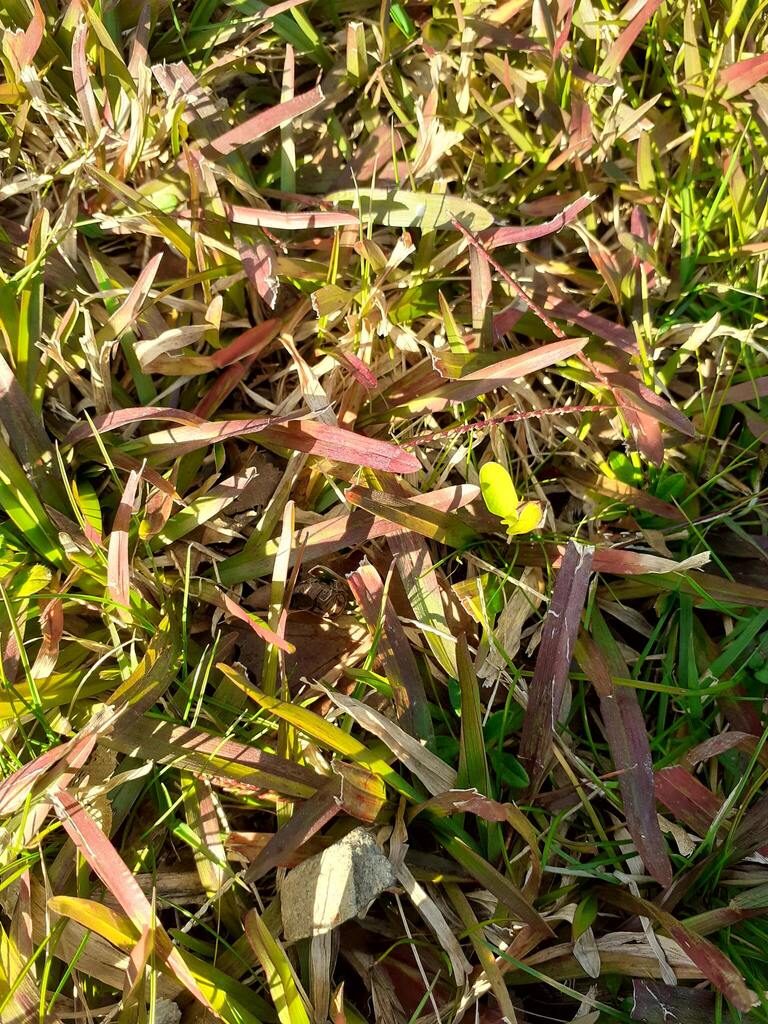
Photo credit: zemlya via iNaturalist, CC BY 4.0.
Could the lawn be carpetgrass?
Start with the site. Is the patch in a low place that stays wet after rain? Carpetgrass tolerates wet soil, according to Mississippi State University Extension. That does not prove the identification, but it tells you where to look more closely.
Next, look for runners at ground level. Carpetgrass spreads with stolons, which are above-ground stems that root at nodes. A low, spreading mat fits that pattern. Digging is usually unnecessary for this check because the runners are near the surface.
Then inspect a leaf tip. A Mississippi State Extension grass-identification handout describes a flat carpetgrass tip and a boat-shaped centipedegrass tip. A phone photo with the blade held against a plain background can make the tip easier to see.
If you still have doubt, wait for a seed head. Mississippi State describes carpetgrass seed heads with two to five spikes. That branching pattern is more reliable than color, which changes with mowing height, moisture, and soil.
Is it carpetgrass or centipedegrass?
Do the leaf tip and seed head agree? Centipedegrass and carpetgrass can share a low-fertility, acidic setting, and both can spread by stolons. They need different labels for some weed-control products, so a close identification matters before any spray is used.
| Check | Carpetgrass | Centipedegrass |
|---|---|---|
| Leaf tip | Flat | Boat shaped |
| Seed head | Two to five spikes | A single spike |
| Growth habit | Low, spreading stolon mat | Low, spreading stolon mat |
| Site clue | Tolerates wet soil | Often grows in acidic, low-fertility soils |
The carpetgrass growth and seed-head points come from Mississippi State University Extension. Its grass-identification handout supports the leaf-tip and centipedegrass comparison. Use the table as a field check, not as a reason to identify a lawn from one blade.
Does the seed head look like a forked Y with two branches? Check the bahiagrass guide too. Bahiagrass can also make a coarse lawn and has a different seed-head pattern.
When can carpetgrass work as the lawn?
Is the area warm enough for a warm-season grass? Common carpetgrass is a native warm-season perennial, according to the USDA Natural Resources Conservation Service. It is more common in the South than in northern cool-season lawns.
Does the soil stay damp and does the lawn need a low-input grass? Mississippi State reports that carpetgrass tolerates wet soil, adapts to low fertility, and does not respond strongly to nitrogen. Those traits can make it a reasonable fit where a high-input, dark-green lawn is not the goal.
Salt is another limit. UF/IFAS classifies carpetgrass as very sensitive to salinity. Do not choose it for a site with saltwater exposure or a known salt problem without local advice and a soil test.
What care does carpetgrass need?
Does the lawn already have an even carpetgrass stand? Start with mowing. Use a current recommendation from your county Extension office for the local mowing height, then avoid cutting so low that the stand thins.
Do not chase darker color with repeated nitrogen applications. Carpetgrass is adapted to low fertility and is not very responsive to nitrogen, according to Mississippi State. A soil test is a better starting point when the lawn is thin, pale, or patchy. It can show whether a nutrient or pH problem needs correction.
Water needs depend on weather, soil, and the amount of sun. Carpetgrass tolerates wet soil, but a wet site can still have drainage problems. If water stands for days, inspect gutters, grading, and compacted soil. Changing fertilizer will not correct a drainage path.
For a broader care plan, use the lawn care schedule after you confirm the grass type and enter your location. Treat its dates as planning help. Watch the lawn and local weather before you act.
What should you check before removing it?
Is carpetgrass only in one patch, or is it the lawn across the whole yard? A single patch in centipedegrass or St. Augustinegrass is a different problem from a mature carpetgrass lawn. Photograph the patch, a leaf tip, a runner, and a seed head before you disturb it.
Which desirable grass grows beside it? This question controls the safe options. Mississippi State's grass-identification handout notes that herbicide choices are limited with carpetgrass. A product can be safe on one warm-season grass and injure another. Use only a current label that lists the target plant, site, and turfgrass species. If the label does not list carpetgrass, do not assume the product is safe.
Would the site support a replacement grass? A wet, low-fertility corner can favor carpetgrass for a reason. Fix drainage or choose the replacement only after you understand why the patch established there. The grass identification guide can help you compare the nearby turf before removal.
- Check the flat leaf tip and a seed head with two to five spikes before identifying carpetgrass.
- Use a soil test when the lawn is thin or discolored.
- Get a local mowing-height recommendation before changing the mower setting.
- Read the current herbicide label. It must list the target, site, and turfgrass species.
What can cause a wrong diagnosis?
Is the answer based only on a broad blade? That is where many identifications go wrong. Centipedegrass, bahiagrass, and carpetgrass can all look coarse from a distance. A leaf tip and seed head give you a more useful check.
Another error is to treat every patch as an invader. Carpetgrass may be the grass that has adapted to the wettest part of the lawn. Removing it without correcting the site can leave bare soil for another weed or for the same grass to return.
Do not borrow a herbicide recommendation from a neighbor with a different lawn. Labels divide warm-season grasses into separate tolerance groups. Match the label to the species you confirmed, then contact your county Extension office if the product choice is unclear.
Working a case: a wet backyard patch
A homeowner sees a pale, wide-bladed patch at the bottom of a sloped backyard. The spot stays wet after hard rain. The homeowner first checks the leaf tip and finds it is flat. After allowing a small edge to grow, the seed head shows several short spikes.
Those clues support carpetgrass. The next step is to decide whether it is actually causing a problem. If the patch is stable and covers a wet corner, the homeowner can focus on mowing and drainage. If it is spreading through a desired centipedegrass lawn, the homeowner should confirm both grasses and ask Extension about current labeled options before treatment.
The rule is simple: identify the grass, then diagnose the site. A product choice comes after both answers are clear.
Carpetgrass checklist
- Check whether the patch is in a persistently wet area.
- Look for above-ground runners that root at nodes.
- Inspect a leaf tip for a flat end.
- Let a small edge grow and look for a seed head with two to five spikes.
- Compare nearby turf before you decide to remove the patch.
- Use a soil test and the current product label before changing fertilizer or weed control.
If the seed head or leaf tip does not fit, keep the identification open. Send a photo for a grass identification and take the result, plus your site notes, to a county Extension office when you need a local recommendation.
Related reading: centipedegrass guide, St. Augustinegrass guide, and types of grass in Florida.
Free Lawn Care Tools
Check more than one clue. Mississippi State University Extension describes carpetgrass as a low-growing, stolon-forming grass with a flat leaf tip and a seed head with two to five spikes. Wet soil is a useful site clue, but it does not identify the grass on its own.
No. Both grasses can spread by stolons and grow in low-fertility settings, but centipedegrass has a boat-shaped leaf tip and a single-spike seed head. Carpetgrass has a flat leaf tip and a seed head with two to five spikes.
No. Mississippi State University Extension says carpetgrass is adapted to low fertility and is not very responsive to nitrogen. Use a soil test to identify a real nutrient or pH problem instead of applying repeated fertilizer for color.
A county Extension office can give the best local mowing-height recommendation for a carpetgrass lawn. Avoid a sudden low cut that thins the stand, and change the mower setting only after you confirm the grass type.
No. Herbicide tolerance varies by turfgrass species. Use a current product label only when it lists the target plant, site, and carpetgrass. Ask your county Extension office when the label does not clearly cover your lawn.

Your lawn plan, in your pocket all season
Grass ID, a season plan, soil-timed reminders, and a lawn journal that remembers what you did. Free on iPhone.