When Does Grass Go Dormant? Temperature Chart by Grass Type
 Marcus GreenTurf Management Pro | 18 Years
As an Amazon Associate we earn from qualifying purchases.
You walk out one morning and half the yard has gone the color of a paper bag. The neighbor two doors down still has a green strip, and you start running the math in your head: did I underwater, did I burn it with fertilizer, is it dead? Most of the time the honest answer is none of the above. Your grass is doing exactly what its biology tells it to do at this time of year. The trick is knowing whether the browning is on schedule for your grass type, or whether it showed up early and means something is actually wrong.
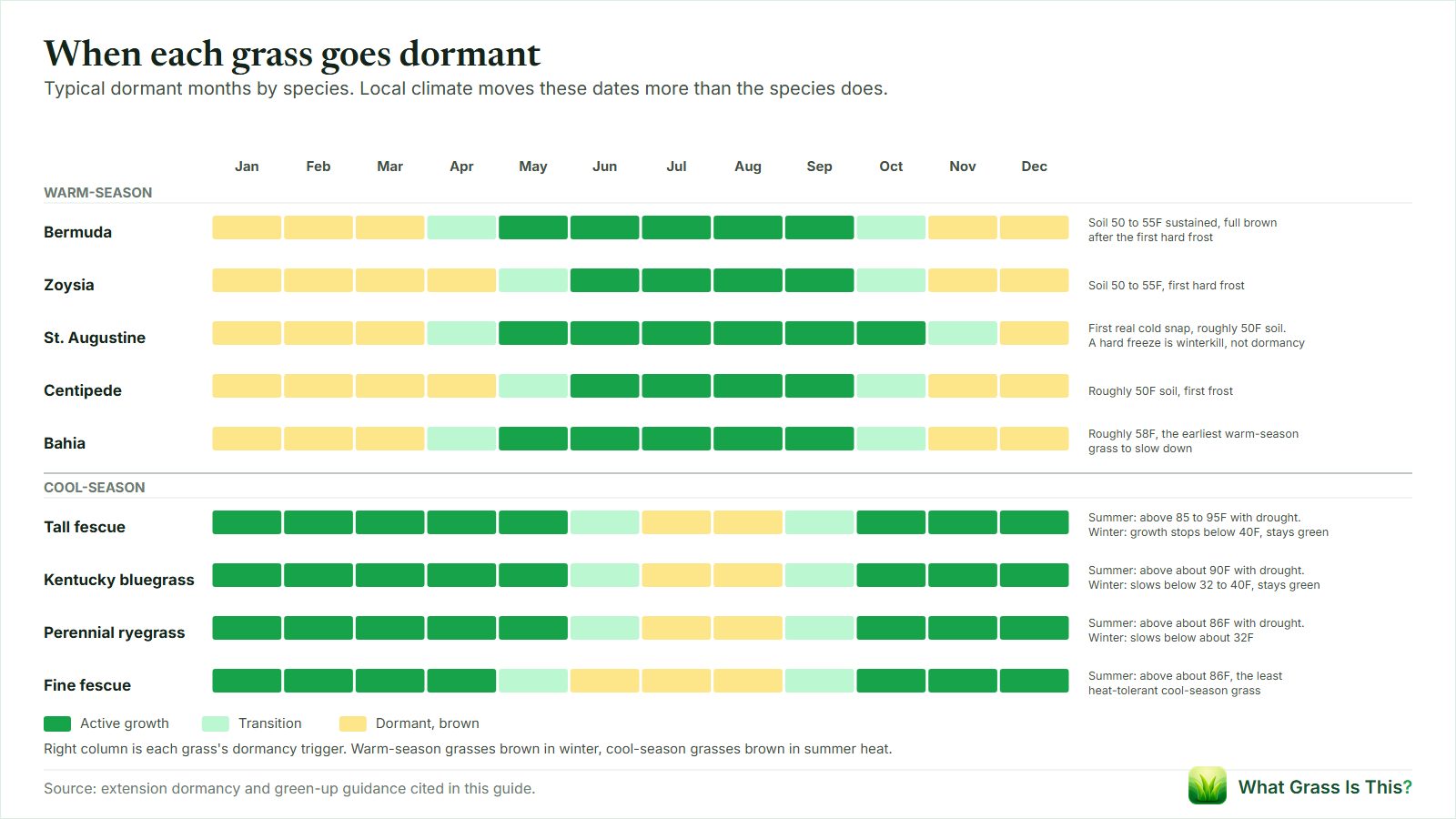
Warm-season grasses like bermuda, zoysia, St. Augustine, and centipede go dormant in the cold. They typically slow down after the first hard cool snap in fall, brown out through winter, and green back up in spring once soil temperatures climb. So when those lawns turn tan from late fall into early spring, that is usually the calendar working as designed.
Cool-season grasses like tall fescue and Kentucky bluegrass run the opposite playbook. They stay green through cold weather and instead can go dormant in the heat of mid to late summer, brown until the temperatures and rain return in fall, then recover. Same word, dormancy, but a very different season. Which pattern your lawn follows depends entirely on which grass you have.
Here is the short version for the nine grasses most lawns are made of. The months are typical ranges, and your local climate can move them by a couple of weeks in either direction.
| Grass | Dormancy trigger | Typical dormant months | Green-up trigger |
|---|---|---|---|
| Bermuda | Soil 50 to 55F sustained, full brown after the first hard frost | Nov to Mar in the upper South, Dec to Feb on the Gulf, semi-dormant only in zones 9 to 10 | Nights above 60F for several days, soil 65F at 4 inches |
| Zoysia | Soil 50 to 55F, first hard frost | Nov to Apr, greens up 2 to 3 weeks behind bermuda | Soil 65F at 4 inches |
| St. Augustine | First real cold snap, roughly 50F soil. A hard freeze causes winterkill rather than dormancy | Dec to Mar, may not fully brown in zones 9 to 10 | Soil 65F at 4 inches |
| Centipede | Roughly 50F soil, first frost | Nov to Apr, often the first warm-season grass to green up in the coastal Carolinas | Soil 65F at 4 inches |
| Bahia | Roughly 58F, the earliest warm-season grass to slow down | Nov to Mar | Soil 65F at 4 inches |
| Tall fescue | Winter: top growth stops below about 40F and it stays green. Summer: above 85 to 95F with drought | Summer browning Jul to Aug in the transition zone, green through winter | Rain and temperatures back under 80F |
| Kentucky bluegrass | Winter: slows below about 32 to 40F and stays green. Summer: above about 90F with drought | Summer browning Jul to Aug | Cooler weather and rain in September |
| Perennial ryegrass | Winter: slows below about 32F. Summer: above about 86F with drought | Summer browning Jul to Aug | September rain |
| Fine fescue | Winter: slows below about 37F. Summer: above about 86F, the least heat-tolerant cool-season grass | Summer browning Jun to Aug | September rain |
What dormancy actually is
Dormancy is your lawn hitting pause, not dying. When conditions get too cold or too hot for active growth, grass pulls energy down into its crowns, roots, and rhizomes, lets the blades brown out, and waits. The plant is still alive underground. It is conserving resources until the weather swings back into the range it likes. That is why a dormant lawn can look completely dead for weeks or months and then flush green again as if nothing happened. Some people call it hibernating, and the comparison is close enough: growth stops, the plant lives off stored reserves, and it wakes when conditions return.
The reason the same word covers such different seasons is that warm-season and cool-season grasses evolved for opposite climates. Warm-season grasses thrive in summer heat and shut down in cold. Cool-season grasses thrive in mild spring and fall and can shut down in extreme summer heat. Knowing which family your grass belongs to is the whole game, so if you are not certain, our grass comparison tool can help you sort warm-season from cool-season at a glance.
The dormancy calendar by grass type
Here is the per-grass-type breakdown. Treat the timing windows as common ranges, not promises, because your local climate moves these dates around more than the grass species does. The triggers below are temperature-driven, and the numbers in the table are the typical thresholds each grass responds to.
Does Bermuda grass go dormant in winter?
Yes. Bermuda goes dormant once soil temperatures hold around 50 to 55F and the first hard frost arrives, usually late October into November across most of its range. It stays straw-tan through winter and greens up when soil hits about 65F at four inches. In zones 9 and 10 it may only go semi-dormant.
Bermuda is a warm-season grass, so it goes dormant in the cold. It usually starts slowing once nights turn consistently cool in fall and browns out fully after the first hard frost or freeze. Most bermuda lawns sit dormant through winter and start breaking dormancy in spring once soil warms into a range that wakes the roots back up. People often ask what temperature bermuda goes dormant at: the honest answer is that growth grinds down as soil temperatures fall through the cool range and frost finishes the job, but the precise number depends on your microclimate. For the green-up side of the cycle, when bermuda comes back out of dormancy, we have a region-by-region walkthrough in when bermuda grass turns green by region and a deeper look at speeding it up in bermuda grass spring green-up.
Does zoysia grass go dormant in winter?
Yes. Zoysia is warm-season, so it browns after the first hard cold, holds a straw color through winter, and greens up in spring. Zoysia is typically the slowest warm-season grass to green up, often trailing bermuda by two to three weeks, which is why people assume it died over winter.
Yes, zoysia goes dormant in winter, and it is one of the most common questions people ask about this grass. Zoysia is warm-season, so it follows the same cold-dormancy pattern as bermuda: it slows in fall, turns a straw-tan color after hard cold arrives, and stays dormant through winter before greening up in spring. Zoysia is often slower to green up in spring than bermuda and can hold its tan color a little longer on the back end of winter, which throws people off into thinking it died over the cold months. It rarely did. For the full picture on this grass, see our complete zoysia grass guide.
Does St. Augustine grass go dormant in summer?
No. Summer is St. Augustine's growing season. It goes dormant in cold, usually after the first real cold snap in fall, and in its warmest range it may barely brown at all. Summer browning on St. Augustine means drought, chinch bugs, or disease, not dormancy, so investigate rather than wait.
St. Augustine is a warm-season grass common in the hot, humid South, and it goes dormant in cold weather. In its warmest growing regions it may barely brown at all in a mild winter, but in cooler parts of its range it goes tan after the first real cold and recovers in spring. St. Augustine is more cold-sensitive than bermuda or zoysia, so a hard freeze can do more than push it dormant; it can cause real winterkill in spots. That sensitivity is exactly why telling dormancy from damage matters so much for this grass. Our St. Augustine grass guide covers its care cycle in detail.
Does centipede grass go dormant in winter?
Yes. Centipede browns once soil drops to roughly 50F and the first frost lands, and it usually sits dormant from November into April. In the coastal Carolinas it is often the first warm-season grass back, greening up when soil reaches about 65F at four inches. Patchy green-up is worth a closer look.
Centipede is warm-season and goes dormant in the cold, but it deserves a special warning. Centipede browns out in winter like its warm-season cousins, but it is notoriously touchy about being pushed, fed, or stressed at the wrong time, and it is prone to a problem sometimes called centipede decline that can look like slow or patchy spring green-up. So with centipede, dormancy that drags on or recovers unevenly is worth a closer look rather than a shrug. The centipede grass guide explains why this low-maintenance grass still has a short list of ways to get it wrong.
Does bahia grass go dormant in winter?
Yes, and it is the earliest warm-season grass to slow down, easing off at around 58F rather than waiting for a frost. Bahia typically stays dormant from November through March and greens up once soil reaches about 65F at four inches. Its deep roots let it ride out stress that browns other lawns.
Bahia is another warm-season grass, common in the Deep South and Gulf Coast on lower-input lawns. It follows the warm-season script: it slows and browns as cold sets in, sits dormant through winter, and greens up in spring as soil warms. Bahia tends to be tough and deep-rooted, so it can ride out stress that would brown other lawns, but in the cold it still goes dormant like the rest of the warm-season family.
Does fescue go dormant in winter?
Not really. Tall fescue stays green through winter and only suspends top growth once temperatures sit below roughly 40F. Roots keep working underneath. Fescue's real dormancy is a summer one, triggered by sustained heat above about 85 to 90F combined with drought, which is the opposite season from warm-season grasses.
Tall fescue flips the script. It is a cool-season grass, so it stays green through cold weather, including light winters, and instead can go dormant in the heat of summer. When mid to late summer brings sustained high temperatures and dry spells, tall fescue can brown out and coast until cooler, wetter fall weather brings it back. It also slows in the depths of a hard winter, but its signature dormancy is the summer kind. So if your fescue browns in July and August, that is often heat dormancy doing its job, not a watering failure, though the two can overlap. We cover this pattern in detail in our companion post on summer lawn dormancy in cool-season grass.
Does Kentucky bluegrass go dormant?
Yes, but in summer far more than in winter. Bluegrass stays green through cold and only slows once temperatures sit below about 32 to 40F. Its real dormancy comes from heat above roughly 90F paired with drought, which browns it out through July and August. Cooler weather and September rain bring it back.
Kentucky bluegrass is also cool-season and follows the same heat-dormancy pattern as tall fescue, often more dramatically. It is one of the quicker cool-season grasses to go dormant in a summer heat wave, browning out to protect itself and then recovering when temperatures drop in fall. Bluegrass has strong rhizomes, which is part of why it can recover and fill back in after a dormant summer stretch. Like fescue, it stays green through most of winter and saves its dormancy for the hottest part of the year.
Does ryegrass go dormant?
Yes. Perennial ryegrass slows below about 32F in winter but stays green, and its true dormancy is a summer one, triggered by heat above roughly 86F with drought that browns it from July into August. September rain revives it. Annual ryegrass is different: it fades out for good once summer heat arrives.
Ryegrass is cool-season as well. Perennial ryegrass can go summer-dormant under heat and drought stress, similar to fescue and bluegrass, then green back up in fall. Annual ryegrass is a different story: it is often used as a temporary winter overseed on dormant warm-season lawns in the South, and it tends to fade out as summer heat arrives rather than going dormant and returning. So if you overseeded bermuda with ryegrass for winter color, that green you see in January is the ryegrass, and it will hand the lawn back to the bermuda come summer. If keeping color on a dormant lawn appeals to you, our guide to overseeding with ryegrass for winter walks through the seed rates and timing.
Does fine fescue go dormant?
Yes, and it is the quickest cool-season grass to do it. Fine fescue is the least heat-tolerant of the group, so it browns once temperatures hold above about 86F, often from June through August rather than waiting for the worst of the heat. In winter it stays green and only slows below roughly 37F. September rain brings it back.
That low heat tolerance is why fine fescue shows up mostly in shade mixes and cooler northern lawns. In a sunny transition-zone yard it will be the first patch to go tan, and it will hold that color longer than the tall fescue growing next to it.
Does grass go dormant in the summer?
Cool-season grasses can. Tall fescue, Kentucky bluegrass, and ryegrass slip into drought dormancy when heat holds above roughly 85 to 90F with no rain, and they brown until fall. Warm-season grasses do not. Bermuda, zoysia, and St. Augustine are at peak growth in summer heat, so summer browning on those lawns is a problem, not a season. Our companion post on summer lawn dormancy in cool-season grass covers how long a cool-season lawn can safely stay brown and when to step in.
Regional variation moves every one of these dates
Notice that every window above is fuzzy on purpose. The single biggest factor in when your grass goes dormant and breaks dormancy is not the species, it is where you live. A bermuda lawn in north Texas may be dormant for four or five months, while the same grass on the Gulf Coast might only brown for a few weeks in a mild winter. A fescue lawn in the upper Midwest may sail through summer with barely a hint of heat dormancy, while the same seed in the transition zone browns out reliably every August.
Elevation, soil type, sun exposure, and how much you water all shift the timing too. A shaded, north-facing slope holds dormancy longer in spring. A heavily irrigated lawn can delay summer dormancy in cool-season grass almost indefinitely, while an unwatered one browns on the first hot dry week. This is exactly the kind of timing a generic calendar cannot nail for your specific yard.
If you want the dates pinned to your actual address instead of a national average, this is where the product earns its keep. A personalized 12-month care plan tells you the exact weeks your grass type goes dormant and breaks dormancy for your zip code, so you stop watering and mowing on the wrong schedule and stop panicking over browning that was always coming. Start with a free photo diagnosis and it will read your grass type and current condition before building the calendar around it.
- Soil temperature, not the date on the calendar, is the real trigger for warm-season green-up and dormancy. Track it with our soil temperature tool rather than guessing from air temperature.
- The table above gives the typical soil and air temperature thresholds where each grass enters and exits dormancy. Cultivar, elevation, and sun exposure shift those dates by a couple of weeks in either direction, so read them as typical ranges tied to your conditions.
- For dates calibrated to your county, including average first and last frost and local green-up windows, your state cooperative extension office is the authority. They publish region-specific turf calendars that beat any national average.
Recommended products
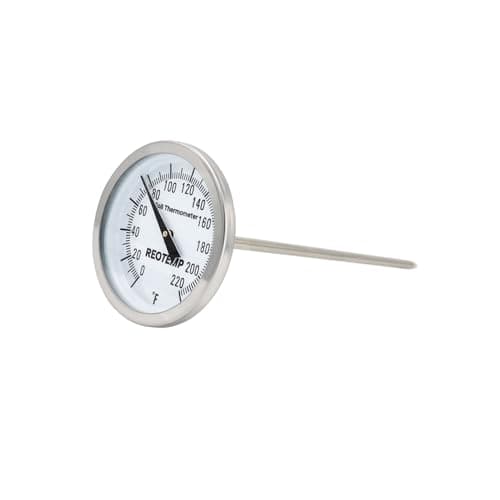
REOTEMP Waterproof Soil Thermometer, 5 inch Stem
A soil thermometer that reads temperature at root depth instead of in the air.
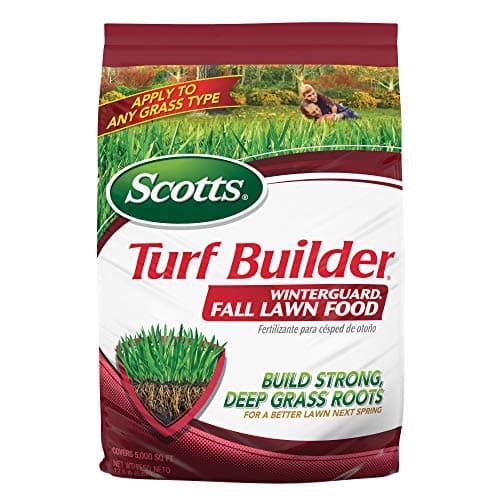
Scotts Turf Builder WinterGuard Fall Lawn Food
A late-season feeding for cool-season lawns heading into winter.
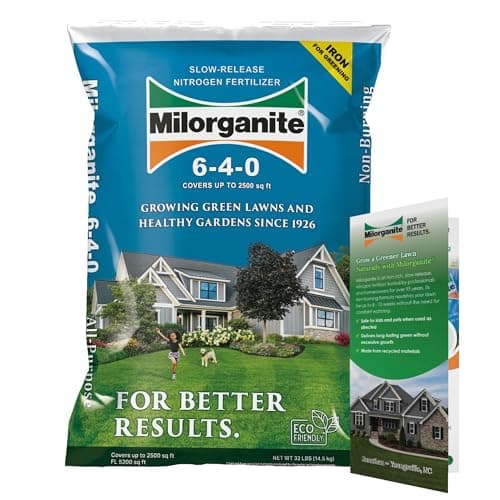
Milorganite 6-4-0 (32 lb)
A slow-release organic nitrogen that suits warm-season and cool-season lawns alike.
How to tell on-schedule dormancy from a real problem
This is the part most people get wrong, because dormancy and damage can look identical from a distance. A few signals help you tell them apart. Dormancy is usually uniform: the whole lawn, or large even areas, browns together as the season turns. Damage tends to be patchy, irregular, or sharply outlined, like fertilizer streaks, pet spots, fungus rings, or grub-eaten sections that lift up like loose carpet.
Timing is the other tell. If a warm-season lawn browns in fall and winter, that is on schedule, and it is also your signal to put the mower away, which we walk through in when to stop mowing your lawn. If it browns in the middle of a warm, well-watered summer, something is wrong. If a cool-season lawn browns in a hot dry August, that is likely heat dormancy. If it browns in mild spring weather, look for disease, pests, or a care mistake. The tug test helps too: dormant grass crowns stay firmly anchored and the base near the soil often holds a faint green tinge, while dead grass pulls out easily with no resistance.
When you genuinely cannot tell, do not guess and do not start dumping water or fertilizer on a lawn that may just be resting, because feeding or overwatering dormant grass can do more harm than good. Our full walkthrough on whether your grass is dead or dormant covers the tests step by step. Or skip the detective work: snap a photo for a free AI diagnosis and let it compare the pattern, color, and season against what your grass type should be doing right now.
What other guides miss
Most dormancy articles treat dormancy as one thing. It is not. There are two completely different dormancy modes, and confusing them is how people end up watering a lawn that does not want water or writing off grass that is about to come back on its own.
Cold dormancy, the kind warm-season grasses enter in winter, is a deep, scheduled shutdown driven by falling temperatures and frost. It lasts months, it is predictable, and there is essentially nothing to do but wait for spring. Watering and feeding during it are mostly wasted at best.
Drought or heat dormancy, the kind cool-season grasses can slip into in summer, is a faster, more reversible protective response to heat and dry conditions. A cool-season lawn can pop in and out of light heat dormancy across a single summer depending on rainfall. The danger here is the opposite of winter: a lawn that stays dormant and bone-dry for too many weeks in extreme heat can cross from dormant into actually dying, so during a long heat-drought stretch a deep watering every couple of weeks can keep the crowns alive even while the blades stay brown. That is the nuance a one-size-fits-all dormancy article flattens, and it is exactly the kind of grass-type-and-season-specific call a personalized plan is built to make for you.
Your dormancy game plan
- Identify your grass family first. Warm-season grasses go dormant in cold; cool-season grasses can go dormant in summer heat. Everything else follows from this. Use the grass comparison tool if you are unsure.
- Match the browning to the season. Warm-season brown in fall and winter is normal. Cool-season brown in a hot dry summer is normal. Off-season browning is your cue to investigate.
- Track soil temperature, not the calendar, for green-up. Warm-season grasses wake by soil warmth in spring; the soil temperature tool beats guessing by date.
- When in doubt, do the tug test and check for patchiness before you reach for water or fertilizer on a possibly dormant lawn.
- Get your local dates from your state extension office, and let a personalized plan pin the exact dormancy and green-up weeks to your zip so you stop reacting and start scheduling.
- Line the rest of fall up behind it with our fall lawn care schedule and checklist, so feeding, seeding, and the last mow land before dormancy sets in.
Brown does not have to mean dead, and it usually does not. Once you know which dormancy your grass runs and roughly when, the seasonal color swing stops being a scare and turns into a calendar you can plan around. That calendar also tells you when to act: a thin cool-season lawn heading into winter is a candidate for dormant seeding, sowing seed on the cold ground so it germinates at the first spring warmth.
Free Lawn Care Tools
Yes. Zoysia is a warm-season grass, so it goes dormant in cold weather. It slows in fall, turns a straw-tan color after hard cold sets in, and stays dormant through winter before greening up in spring. Zoysia often greens up a bit slower than bermuda, which leads people to think it died over winter when it usually did not.
Bermuda growth grinds down as soil and air temperatures drop through the cool range in fall, and the first hard frost or freeze typically pushes it fully dormant. The exact temperature varies by microclimate, cultivar, and source, so treat any single number as a rough range. Soil temperature is a better trigger to watch than the calendar date, and your local extension office can give county-specific figures.
St. Augustine goes dormant in cold weather, usually after the first real cold snap in fall, and recovers in spring. In its warmest growing regions it may barely brown in a mild winter, while in cooler parts of its range it browns more noticeably. Because St. Augustine is more cold-sensitive than bermuda or zoysia, a hard freeze can cause actual winterkill in spots rather than simple dormancy.
Tall fescue is a cool-season grass, so its signature dormancy is in summer, not winter. Sustained heat and dry spells in mid to late summer can brown it out until cooler, wetter fall weather brings it back. It stays green through most of winter and only slows in the depths of a hard cold stretch, which is the opposite pattern from warm-season grasses.
Centipede is a warm-season grass that browns out and goes dormant in winter cold, then greens up in spring. It is touchier than other warm-season grasses, though, and is prone to a problem called centipede decline that can mimic slow or patchy spring green-up. So with centipede, dormancy that drags on or recovers unevenly is worth a closer look rather than assuming it is just resting.
Kentucky bluegrass is cool-season and tends to go dormant in summer heat, often more readily than tall fescue. It browns out to protect itself during a heat wave and recovers when fall temperatures drop. Its strong rhizomes help it fill back in after a dormant summer stretch, and like other cool-season grasses it stays green through most of winter.
Cool-season grasses can. Tall fescue, Kentucky bluegrass, ryegrass, and fine fescue slip into drought dormancy when heat holds above roughly 85 to 90F with no rain, and they stay brown until fall rain returns. Warm-season grasses do not. Bermuda, zoysia, and St. Augustine are at peak growth in summer heat, so summer browning on those lawns points to drought, chinch bugs, or disease rather than a season.
Warm-season grasses like bermuda and zoysia go dormant once soil temperatures hold around 50 to 55F and the first hard frost arrives, and they green up when soil reaches about 65F at four inches. Cool-season grasses run the reverse. Tall fescue slows below about 40F but stays green, then browns in summer once heat passes roughly 85 to 95F with drought.

Your lawn plan, in your pocket all season
Grass ID, a season plan, soil-timed reminders, and a lawn journal that remembers what you did. Free on iPhone.