
About carpetgrass
Common carpetgrass (Axonopus fissifolius) is a warm-season, stoloniferous turfgrass. It spreads with above-ground stems and forms a low, coarse-textured lawn when moisture and soil acidity suit it.
Its strongest fit is a wet, acidic site in the warm Southern climate. It needs less fertility than many turfgrasses, but low input does not mean no diagnosis. Drainage, mowing, and correct identification still control the result.
What to expect
- Growth habit: Creeping stolons that root at nodes
- Texture: Coarse leaves with a light-to-medium green color
- Soil fit: Moist, acidic soil with no prolonged standing water
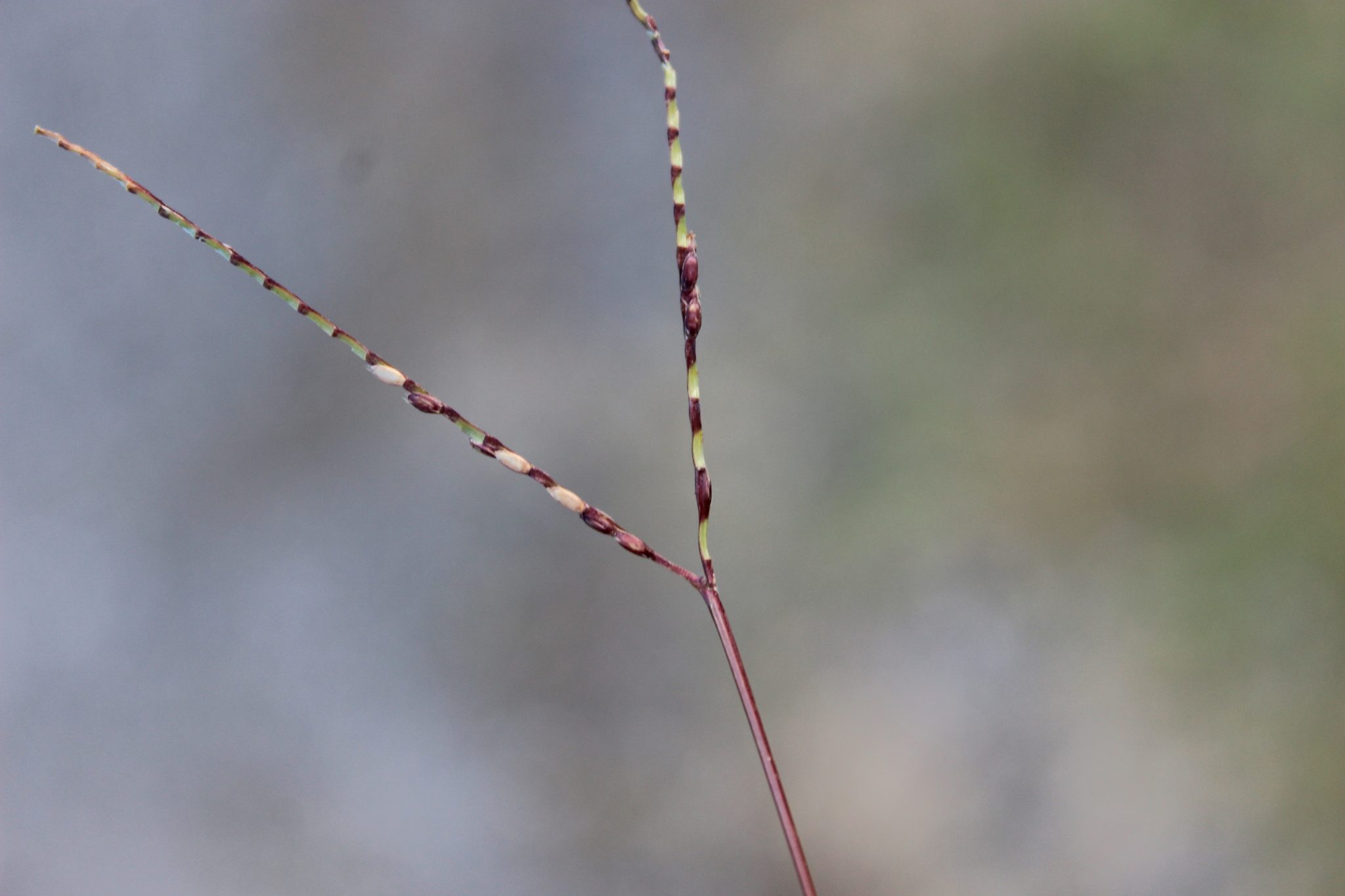
- Seedheads: Slender spikes that often form a V shape, sometimes with a third spike
- Input level: Low fertility and rainfall-driven watering when weather is normal
How to identify carpetgrass
Is the turf coarse, light green, and creeping across a moist site? Start with the growth structure, then confirm the leaf and seedhead clues.
Check the runner
Look along the edge of the lawn or gently open the canopy. Carpetgrass has above-ground stolons. Leaves attach in an alternate pattern along the stolon, rather than appearing in opposite pairs.
Check the seedhead
A mature seedhead has several slender spikes. Two upper spikes often form a V, and a third spike may appear below them. A seedhead can be hidden by mowing, so its absence does not rule out carpetgrass.
Use more than color
Color changes with light, moisture, and fertility. Confirm the stolon, leaf arrangement, coarse texture, and seedhead together. If the collar or plant base is hidden, request a close photo before assigning a species.
Do not use this profile to identify every plant called carpetgrass. This guide covers common carpetgrass, Axonopus fissifolius.
Common carpetgrass
This profile covers common carpetgrass, Axonopus fissifolius. Keep the species name attached to the identification because common names can cover more than one plant.
Broadleaf carpetgrass (Axonopus compressus) is outside this profile. Do not transfer these identification or care limits to it.
For a lawn decision, confirm the plant from several visible features. A coarse blade, alternate leaves on a stolon, and the characteristic multi-spike seedhead provide stronger evidence together than a color match alone.
If a scan does not show the runner, collar, or seedhead, keep the result conditional and request the missing detail.
Best climate and site
Carpetgrass suits warm, humid Southern sites where rainfall and soil moisture support active summer growth. It is especially useful where a finer turfgrass would struggle with wet, acidic soil.
Match the site
- Good fit: Moist, acidic soil with warm-season growing conditions
- Watch closely: Areas that stay saturated or collect runoff
- Wrong assumption: More water is not always better. Standing water signals a drainage problem
Use the site conditions and plant features together. A wet location alone does not identify carpetgrass.
Soil and pH
Start with a soil test before adding lime or another amendment. Common carpetgrass performs in acidic soil, so raising pH without test evidence can move the site away from its best fit.
Check the soil
- Test pH and the nutrients that guide fertilizer decisions
- Look for compaction where water sits or runs off instead of moving into the soil
- Correct drainage and grade problems before adding seed or plugs
- Do not treat a pale or thin area as a fertilizer problem until moisture and roots have been checked
Fertilizer program
Common carpetgrass is adapted to low fertility. If the lawn is growing evenly and the soil test does not show a need, skip routine feeding.
The LSU AgCenter's Louisiana Home Lawn Series: Carpetgrass allows up to 1 pound of nitrogen per 1,000 square feet per year. This guide uses a more conservative ceiling of 0.5 pound of nitrogen per 1,000 square feet per application. Follow the soil test and local rules.
Do not use a fertilizer product as a substitute for checking drainage, pH, mowing height, or disease symptoms. Product recommendations are intentionally omitted for this guide.
Seasonal care calendar
Carpetgrass follows a simple warm-season cycle. It begins active growth as temperatures rise, needs regular mowing during the growing season, and slows as the season ends.
- Spring: Confirm green-up and correct drainage or compaction before active growth increases
- Summer: Mow at the recommended height, watch seedheads, and use rainfall as the water guide
- Fall: Reduce mowing as growth slows and remove leaves that block the canopy
- Winter: Avoid fertilizer and limit traffic on wet or dormant turf
Mowing carpetgrass
The LSU AgCenter's Carpetgrass for Lawns recommends mowing at 2 inches and removing no more than one-third of the leaf blade. This guide keeps the mowing range at 1 to 2 inches as growth changes.
Seedheads can appear quickly when the lawn is not mowed often. Mow as needed to keep the surface even, but do not lower the height to chase a single flush of seedheads.
If the lawn scalps
Check the mower setting and mowing interval. A sudden low cut removes too much leaf area and can expose uneven stolons. Raise the setting and return to the one-third rule.
Watering with rainfall as the guide
Rainfall may cover normal water needs in a wet Southern climate. Do not add irrigation on a calendar schedule when the soil is already moist.
During drought, irrigate when the turf shows visible water stress and rainfall is not meeting demand. Water in a way that does not leave the site saturated. Standing water is a drainage warning, not a watering target.
Check the lawn and the soil before changing the schedule. Yellowing in a wet area can indicate poor drainage or root stress rather than a need for more water.
Establishing carpetgrass
Establish common carpetgrass from seed or plugs during active warm-season growth. Prepare a clean, firm site and correct drainage before planting.
- Remove competing vegetation and surface debris
- Use a soil test to guide pH and nutrient changes
- Place seed or plugs according to the planting material label
- Keep the establishment area evenly moist without creating standing water
- Begin mowing after the new turf is rooted and can tolerate the cut
Do not judge establishment from color alone. Check whether new plants are rooted and spreading through stolons.
Weed control and identification
Confirm the plant before treating a mixed stand. A coarse grass in wet soil can resemble carpetgrass, but a visual guess does not establish the species or the correct treatment.
Check first
- Photograph the whole patch and a close view of the collar, stolon, and seedhead
- Compare leaf arrangement and runner structure with the carpetgrass profile
- Check whether the plant is part of the turf or an isolated clump
Use only a product whose current label lists the target weed, Carpetgrass as the host turf, the site, and the intended use. Product recommendations are intentionally omitted because treatment depends on the verified plant and local label.
Pests and disease
Carpetgrass usually has few major pest problems, but brown patch, leaf spot, and white grubs can occur. Similar symptoms can also come from saturated soil, drought, scalping, or traffic.
Work from the symptom
- Brown patches in wet weather: Check drainage, mowing, and leaf wetness before selecting a treatment
- Leaf spots: Inspect individual blades and compare new symptoms over time
- Loose or thinning turf: Check roots and stolon contact, then look for insects or compaction
If the cause is unclear, submit a representative sample to a local extension service. Do not apply a chemical product from a symptom name alone.
Aeration and thatch
Aerate only when compaction limits infiltration or root growth. Schedule the work during active warm-season growth so the turf can recover.
Test the area first. If water sits because of grade or drainage, aeration alone will not solve the problem. Avoid working saturated soil because traffic can increase compaction.
Carpetgrass spreads with stolons, so protect the runners during cultivation. Remove only the thatch or debris that blocks soil contact and healthy growth.