Best Battery Lawn Mower for 2026: Tested Picks by Yard Size
 James ThorntonLawn Equipment & Maintenance Expert | 20 Years
As an Amazon Associate we earn from qualifying purchases.
The best battery lawn mower is not a single model, it is whichever one matches your yard size, grass type, and how much power you actually need. Cordless mowers have quietly gotten good enough to replace gas for most homeowners, but the lineup is crowded and the marketing leans hard on voltage numbers that do not tell you much on their own.
This guide cuts through that. We line up the battery mowers most people cross-shop for 2026, sort them by the yard they actually fit, and give you a simple way to match watt-hours to your square footage so you neither overspend nor buy something that bogs down in thick grass.
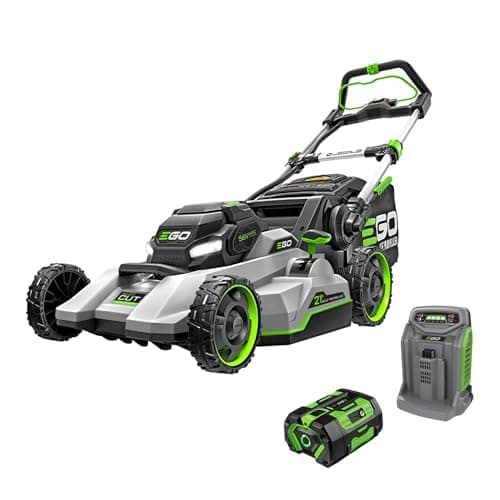
For most medium to large lawns, the EGO POWER+ Select Cut LM2135SP is the best all-around battery lawn mower, thanks to a strong 56V platform and a 7.5Ah pack that handles thick, damp turf in one pass. For smaller, flatter yards where value matters most, the Greenworks 40V 21-inch Self-Propelled Mower does the job for a few hundred dollars less. If you already own Ryobi 40V tools, stay in that ecosystem. To choose, measure your lawn in square feet, match it to the mower's realistic (not advertised) coverage, and add a 20 to 30 percent buffer for tall or wet grass.
- Compare watt-hours (volts x amp-hours), not voltage alone. A 56V 7.5Ah pack (~420Wh) has far more real cutting energy than a 40V 4.0Ah pack (~160Wh), regardless of the number on the sticker.
- Match the mower to your lawn size: under ~5,000 sq ft, a value 40V mower is plenty; past ~8,000 sq ft you want a high-capacity 56V or 60V system, or a second battery.
- EGO leads on raw power and warranty (5-year tool), Greenworks leads on price, and Ryobi wins if you already own its 40V batteries.
- Discount advertised runtime by 20 to 30 percent for real-world thick or damp grass, self-propel use, and slopes.
- Battery mowers are quieter (often near 75 dB vs 95+ dB for gas) and skip the oil, fuel, and spring tune-ups entirely.
What actually makes a battery mower good
Before the picks, three specs decide whether a cordless mower will satisfy you or frustrate you. Get these right and the brand almost sorts itself out.
Watt-hours, not voltage
Voltage is a marketing headline. The number that predicts how long you can mow is watt-hours: volts multiplied by amp-hours. A 56V mower with a 7.5Ah battery carries about 420Wh of energy; a 40V mower with a 4.0Ah pack carries about 160Wh. That gap, not the 56-versus-40 difference, is why one mower finishes a big yard and another taps out halfway.
Higher voltage does help the motor hold blade speed in tall or wet grass without bogging. But a small high-voltage pack can still run out before a large lower-voltage one. Compare watt-hours first, then use voltage as a tie-breaker for tough conditions.
Deck size and cut quality
Deck width sets how many passes your yard takes. 20 to 21 inches suits most suburban lots; 22 inches speeds up open, rectangular yards over roughly 6,000 to 7,000 square feet. Just as important is the deck design and blade system: a well-shaped deck with good airflow lifts grass upright and mulches or bags it cleanly, while a cheap flat deck clumps in thick turf.
Self-propel and real runtime
Self-propel is worth it on anything but a small flat lawn, but running it near full speed can shave 15 to 25 percent off your runtime. Treat every advertised runtime as an "up to" figure and plan for about 70 to 80 percent of it in real grass. If your lawn sits right at the edge of a battery's realistic coverage, size up the pack or pick a dual-battery system.
The best battery lawn mowers for 2026
Here are the walk-behind battery mowers worth your money this year, each matched to the buyer it fits best. Prices move, so treat the figures below as ballpark bands rather than fixed numbers.
Best overall: EGO POWER+ Select Cut LM2135SP (56V)
The EGO POWER+ Select Cut Self-Propelled Mower (LM2135SP) is the mower most homeowners should buy if budget allows. The 56V platform and included 7.5Ah battery power through thick, overdue, or slightly damp grass that stalls weaker mowers, and the Select Cut multi-blade system genuinely improves mulching. The variable-speed Touch Drive self-propel is smooth and easy to feather on slopes. EGO also backs it with a 5-year tool warranty, the longest of the mainstream cordless brands. It is best for medium to large lawns and anyone planning to buy into EGO's 56V trimmers, blowers, and chainsaws down the line.
Best value: Greenworks 40V 21-inch Self-Propelled
The Greenworks 40V 21-inch Self-Propelled Mower delivers most of the cordless-mowing experience for a few hundred dollars less. It is lighter, easy to handle, and finishes small to medium lawns on a charge with weekly mowing. You give up some brute torque in thick warm-season turf and the tool warranty is shorter (3 years on the standard line), but for a flat lot under about 6,000 square feet it is hard to beat on price. It is the smart pick when you want cordless convenience without paying the premium.
Best for Ryobi owners: Ryobi RY40LM10-Y Smart Trek (40V)
If your garage already has Ryobi 40V batteries, the Ryobi RY40LM10-Y 21-inch Smart Trek Self-Propelled Mower is the obvious choice. Smart Trek matches drive speed to your walking pace, and staying in one battery ecosystem saves real money over time. Ryobi's 40V line is capable for typical suburban lawns, though like Greenworks 40V it is happier on regular weekly cuts than on hacking through 8 inches of overgrowth. Buy this if you are already invested in Ryobi tools; if you are starting fresh, weigh it against the EGO and Greenworks above.
The head-to-head
Here is how the three stack up. Specs are manufacturer-rated, so read runtime as an "up to" figure that real grass and self-propel use will pull down.
| Mower | Platform | Included battery | Best for | Typical price band |
|---|---|---|---|---|
| EGO POWER+ Select Cut LM2135SP | 56V ARC Lithium | 7.5Ah (~420Wh) | Medium-large, thick or damp turf, one-pass mowing | ~$700-800 |
| Greenworks 40V 21-inch Self-Propelled | 40V | 5.0Ah (~200Wh) | Small-medium flat lawns, best value | ~$380-450 |
| Ryobi RY40LM10-Y Smart Trek | 40V | 6.0Ah (~240Wh) | Existing Ryobi 40V owners | ~$650-700 |
Two notes for the edges of the market. For a tiny, flat lawn where you mow at least weekly, a manual reel mower like the American Lawn Mower Company 1204-14 Push Reel Mower is nearly free to run and needs no charging. At the other extreme, a half-acre or more moves you into battery riding mowers and zero-turns, which we cover in the Riding Mower and Zero-Turn Buying Guide.
Match the mower to your lawn size
Yard size is the single best predictor of which mower you need. Measure it first. If you are guessing, use our lawn size calculator to get a real square footage from your address, then match it below.
| Lawn size | Pick | Why |
|---|---|---|
| Under ~5,000 sq ft (small city or suburban lot) | Greenworks 40V (or Ryobi 40V if you own the batteries) | Finishes on one charge, lighter and cheaper. A 56V mower is more than the yard needs. |
| 5,000-8,000 sq ft (medium lawn) | EGO 56V, or Greenworks 60V on flatter, thinner turf | Thick grass and one-pass mowing favor EGO's power; value shoppers on flat lawns can go Greenworks. |
| 8,000-20,000 sq ft (large, ~1/4 to 1/2 acre) | EGO 56V high-capacity or dual-battery 60V, plus a spare pack | High-output systems only; plan on two batteries or splitting the mow. |
| Over ~1/2 acre | Battery riding mower or zero-turn | Walk-behind runtime and mowing time stop making sense past this point. |
Grass type shifts this too. Thick warm-season lawns like Bermuda, Zoysia, and St. Augustine load the motor harder than thin cool-season fescue, so a mower that breezes through 6,000 square feet of fescue can struggle at 4,000 square feet of dense Zoysia if you mow low. When in doubt, size up. To dial in your cutting height by grass type, the mowing height calculator gives a target range.
- Purdue Turfgrass Science guidance: removing more than one-third of the grass blade height in a single mowing stresses the plant and can weaken turf over time, so a more powerful mower does not mean you should cut lower or less often.
Are battery mowers worth it over gas?
For most homeowners in 2026, yes. Battery mowers start instantly, produce no fumes, need no oil changes or carburetor cleaning, and run far quieter, often around 75 dB versus 95 dB or more for a gas push mower, which matters if you mow early or in a tight neighborhood. The trade-offs are runtime limits on very large lawns and the upfront cost of batteries. If your yard is under about a half acre and you keep a charged spare pack for the big spring cuts, gas has few remaining advantages. For a fuller breakdown, see our comparison of EGO vs Greenworks mowers and the wider best lawn mowers roundup.
Common mistakes when buying a battery mower
- Buying on voltage alone. Two mowers can both say 60V while one holds twice the watt-hours. Always check the amp-hours of the included battery.
- Trusting advertised runtime. Real thick or damp grass, self-propel, and slopes pull it down. Plan for 70 to 80 percent of the claim.
- Undersizing the battery. A mower that needs two charges every week is a chore. Size for your whole yard plus a buffer, or budget for a spare pack.
- Ignoring the ecosystem. Your mower's battery platform usually becomes your trimmer, blower, and edger platform too. Pick the one whose full tool lineup you want.
- Storing batteries wrong. Leaving packs fully charged in a hot garage over winter accelerates capacity loss. Store lithium packs around 40 to 60 percent charge in a cool, dry spot.
Best Battery Lawn Mower: Frequently Asked Questions
What is the best battery lawn mower overall?
For most medium to large lawns, the EGO POWER+ Select Cut LM2135SP is the best all-around battery mower, because its 56V platform and 7.5Ah battery handle thick and damp grass in one pass and it carries the longest tool warranty of the mainstream brands. For smaller, flatter yards, the Greenworks 40V self-propelled is the better value. The right answer depends on your yard size more than on any single "best" label.
How long do battery lawn mowers last on one charge?
Most mid-size cordless mowers with a 5.0 to 7.5Ah battery run roughly 40 to 60 minutes in normal conditions, enough for a lawn up to about 1/4 acre. Expect less in tall, thick, or damp grass and when running self-propel at full speed. A realistic planning figure is 70 to 80 percent of the advertised runtime.
Are battery lawn mowers powerful enough for thick grass?
The better 56V and 60V mowers are. Higher-voltage models with load-sensing motors hold blade speed through thick, tall, or slightly wet turf that would bog a budget 40V unit. If you have dense warm-season grass or you sometimes let the lawn get overdue, choose a high-capacity 56V or 60V mower rather than an entry-level pick.
How many years does a mower battery last?
Expect roughly 3 to 5 seasons from a primary lithium pack with normal care before you notice meaningful capacity loss. Longevity depends far more on habits than brand: avoid running packs to zero, storing them fully charged in heat, or charging them when they are near freezing.
Conclusion
The best battery lawn mower for you is the one sized to your yard, not the one with the biggest number on the box. Measure your square footage, compare watt-hours, and add a buffer for thick or damp grass. For most medium to large lawns the EGO Select Cut is the safe, powerful default; for smaller flat yards the Greenworks 40V saves real money; and Ryobi owners should stay in their ecosystem. Once your mower arrives, keep it cutting cleanly with our guide to sharpening lawn mower blades, and if a hands-off option tempts you, see whether robotic mowers are worth it.
Top Picks

As an Amazon Associate we earn from qualifying purchases.
Free Lawn Care Tools

Beat weeds and brown spots from your phone
Snap a photo, get the fix, and follow a plan timed to your soil and weather. Free on iPhone.