Best Fertilizer for Bermuda Grass in Oklahoma (2026)
 Marcus GreenTurf Management Pro | 18 Years
As an Amazon Associate we earn from qualifying purchases.
Bermuda grass in Oklahoma can look dense, dark, and athletic in summer, but fertilizer timing is what separates elite turf from weedy, stressed, or burned lawns. The best fertilizer for Bermuda grass in Oklahoma is not one universal bag - it depends on soil test results, irrigation, lawn traffic, soil texture, and whether the lawn is in dry western Oklahoma, clay-heavy central Oklahoma, or higher-rainfall eastern Oklahoma.
In 2026, the winning program is simple: feed Bermuda only after active green-up, favor nitrogen-forward fertilizer with potassium, avoid unnecessary phosphorus, and reduce nitrogen before dormancy. This guide covers fertilizer ratios, Oklahoma timing, drought rules, product-selection tips, and the mistakes that cause poor color, weeds, and lawn damage.
The best fertilizer for Bermuda grass in Oklahoma in 2026 is usually a slow-release, nitrogen-forward fertilizer with potassium, such as 20-0-10 or 24-0-11, applied after the lawn is 50-75% green and has been mowed once or twice. Confirm the right ratio with a soil test before buying.
Do not fertilize brown dormant Bermuda, drought-stressed turf, or late-fall grass heading into winter. Start in late April or May, feed mainly in June through August, and stop heavy nitrogen by late summer or early fall.
- Bermuda grass in Oklahoma should usually receive its first fertilizer after 50-75% spring green-up and 1-2 mowings.
- Established Bermuda lawns commonly perform best with 2-4 lbs of nitrogen per 1,000 sq ft during the growing season.
- High-performance irrigated Bermuda may use 4-5 lbs of nitrogen per 1,000 sq ft, but only with frequent mowing and reliable water.
- Our Grass Database recommends 3.5 lbs of nitrogen per 1,000 sq ft annually for Bermudagrass under a standard high-maintenance program.
- According to our watering data, Bermudagrass needs 1 inch per week in summer to support active growth and fertilizer response.
This guide covers Oklahoma-specific timing, soil, and product notes. For the full national picture, NPK ratios, and the complete product comparison, see our main best fertilizer for Bermuda grass guide.
East vs West Oklahoma: The I-35 Line That Decides Your Fertilizer
Oklahoma bermuda advice splits at roughly Interstate 35. OSU notes that soils turn acidic where rainfall tops about 30 inches a year, so east of I-35 you get acidic red clay that may need lime, while west of I-35 soils are alkaline and calcareous. That one fact changes your bag: western Oklahoma lawns that yellow in summer are often fighting iron chlorosis, where high pH locks up iron, and the fix is a chelated iron or iron-sulfate spray, not more nitrogen.
OSU puts bermuda at 4 to 6 pounds of actual nitrogen per 1,000 square feet over the season, with about 5 pounds across five applications being a typical program: about 1 pound per feeding, spread from spring green-up through early fall rather than pinned to fixed calendar dates. The local cutoff is firm: OSU says the last nitrogen application of the year on warm-season grass goes down no later than September 15, so you do not push tender growth into dormancy.
Water is the other Oklahoma reality. Under summer heat and the watering rules many Oklahoma cities enforce (Tulsa, for example, runs a two-day-a-week schedule and Oklahoma City and Norman use odd/even schedules by address, though the exact rules change by city and drought stage, so check yours), heavy nitrogen backfires. OSU's drought guidance is to hold off on quick-release nitrogen in hot, dry spells and lean on potassium, because nitrogen you cannot water in just drives thirsty top growth and thatch.
Oklahoma Bermuda Fertilizer Calendar (OSU)
| When | Feed? | Rate & product | Why here |
|---|---|---|---|
| May 1 | Yes | ~1 lb N, spring complete N-P-K | OSU moderate program; enhances rooting |
| July 1 | Yes | ~1 lb N (straight nitrogen) | Peak growth |
| September 1 | Yes (last feed) | ~1 lb N | Total 3-5 lb N/yr |
| September 15 | STOP nitrogen | Nothing | Hard cutoff for winter hardiness |
| Under drought / watering limits | Cap N | No more than 1 lb quick N; use K | Do not feed N you cannot water in |
| West-OK yellowing | Iron, not N | Chelated iron | Alkaline soils west of I-35 |
What Bermuda Grass Needs in Oklahoma Before You Choose a Fertilizer
Bermuda grass needs warm soil, active growth, adequate water, and soil-test-based nutrients before fertilizer can work correctly in Oklahoma. Fertilizer cannot wake dormant Bermuda, fix compacted clay by itself, or overcome drought stress when irrigation is limited.
Recommended products
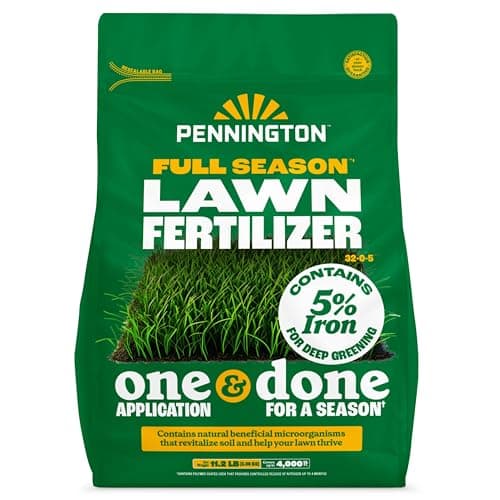
Pennington Full Season Lawn Fertilizer 32-0-5
High-nitrogen fertilizer with iron for fast green-up on warm-season lawns.

Outsidepride Maya (Blackjack II) Bermuda Grass Seed (5 lb)
Named, fine-textured improved bermuda cultivar for dense, carpet-like, dark-green full-sun turf; 5 lb full-lawn bag.
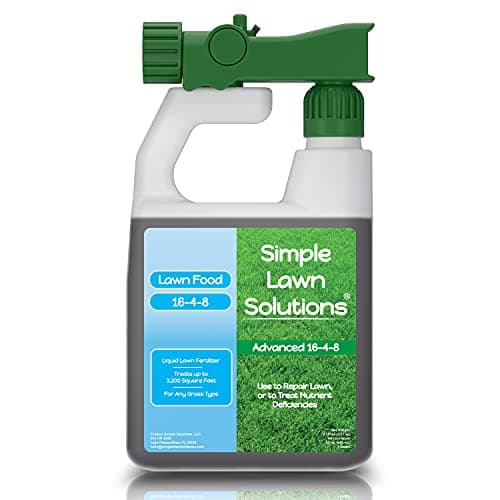
Simple Lawn Solutions Advanced 16-4-8 Liquid Fertilizer
Concentrated liquid fertilizer with balanced 16-4-8 NPK for quick green-up through any hose-end sprayer.
Bermuda is a warm-season grass with peak growth from May through September. Our Grass Database shows Bermudagrass has a high maintenance level, very high traffic tolerance, high drought tolerance, and a recommended mowing height of 1-2 inches, which explains why it responds so strongly to a disciplined fertility program.
Why Bermuda Grass Is Fertilizer-Hungry but Timing-Sensitive
Bermuda grass is fertilizer-hungry because nitrogen drives color, lateral spread, traffic recovery, and mowing density during warm weather. When applied at the right time, nitrogen helps Bermuda fill thin areas and compete with summer weeds.
The problem is timing. Early spring nitrogen often feeds winter weeds and cool-season weeds before Bermuda is ready to use it. Late fall nitrogen can encourage tender growth before dormancy. Heavy nitrogen during drought increases water demand and can scorch turf that is already under stress.
Oklahoma Soil Realities: Clay, Sandy Soil, pH, and Nutrient Lockup
Oklahoma soil conditions change fertilizer performance because clay, sand, rainfall, and pH affect how nutrients move and how roots absorb them. Central Oklahoma lawns often deal with compacted clay, poor drainage, and high pH. Western Oklahoma lawns are more drought-prone and may have sandy soils with lower nutrient-holding capacity. Eastern Oklahoma lawns receive more rainfall, so nutrients can leach faster.
Sandy soils usually need smaller, more frequent applications because fertilizer moves through them more easily. Clay soils hold nutrients longer, but compaction and runoff can keep fertilizer from reaching the root zone. High-pH soil can also limit iron availability, so Bermuda may look pale even when nitrogen is adequate. In that case, iron can improve color without forcing excessive top growth.
Start With a Soil Test Before Buying the “Best” Fertilizer
A soil test is the most reliable way to choose the best fertilizer for Bermuda grass in Oklahoma because it separates actual nutrient needs from guesswork. Test every 2-3 years for stable lawns, and test annually for problem lawns with poor color, weak growth, or recurring thinning.
Oklahoma State University Extension soil testing is a useful option for homeowners who want local interpretation. Look for soil pH, phosphorus, potassium, organic matter, and salinity or sodium concerns where applicable. Pull 10-15 soil cores, sample 3-4 inches deep, mix the cores in a clean bucket, remove thatch and debris, and submit one representative sample.
- Purdue Turfgrass Science guidance: phosphorus is rarely needed on established lawns unless a soil test shows a deficiency.
That phosphorus point matters for established Bermuda. Starter fertilizer can be useful for new seed or sod only when the soil test shows phosphorus is needed. Otherwise, a low-phosphorus or zero-phosphorus fertilizer is usually the better choice.
Best Fertilizer for Bermuda Grass in Oklahoma in 2026
The best fertilizer for Bermuda grass in Oklahoma in 2026 is a nitrogen-forward product with enough potassium for heat, traffic, and drought stress, selected after reviewing soil test results. Most established Bermuda lawns do not need high phosphorus, but they do need consistent nitrogen during active growth.
For many Oklahoma lawns, the best approach is a slow-release granular fertilizer for the base program, then iron or light liquid feeding only when the turf is actively growing. Professional crews approach this differently - the homeowner version is to feed less often, use controlled-release nitrogen, and avoid pushing growth faster than the mower and irrigation can support.
Best Fertilizer Ratio for Established Bermuda Grass
Established Oklahoma Bermuda usually performs best with nitrogen-forward fertilizer ratios such as 16-4-8, 20-0-10, 24-0-11, 30-0-10, or 34-0-0 when phosphorus and potassium are already adequate. The first number, nitrogen, drives green color and growth. Phosphorus supports establishment and rooting when needed. Potassium improves stress tolerance, drought resilience, and winter conditioning.
Use low-phosphorus or zero-phosphorus fertilizer unless the soil test says otherwise. Potassium becomes more important on high-traffic lawns, drought-prone lawns, sandy western Oklahoma sites, and lawns that struggled during the previous summer.
Quick Answer: Best Fertilizer Types by Lawn Situation
The right Bermuda grass fertilizer in Oklahoma depends on the lawn’s current limitation, not just the N-P-K number on the front of the bag. Use this table to match the fertilizer type to the situation.
| Lawn Situation | Best Fertilizer Type | Why It Fits |
|---|---|---|
| Established irrigated Bermuda | Slow-release nitrogen with potassium, such as 24-0-11 or 20-0-10 | Feeds evenly through heat and supports density |
| Quick green-up during active growth | Fast-release nitrogen plus iron | Improves color quickly, but needs careful watering |
| Drought-prone lawn | Moderate nitrogen with potassium, such as 15-0-15 or 20-0-10 | Supports stress tolerance without excessive growth |
| Sandy western Oklahoma soil | Controlled-release nitrogen in smaller doses | Reduces nutrient loss and surge growth |
| New Bermuda seed or sod | Starter fertilizer only if soil test shows phosphorus need | Targets establishment without overapplying phosphorus |
| High-pH pale Bermuda | Nitrogen plus iron or supplemental iron | Improves color when iron availability is limited |
Avoid winterizer products high in nitrogen for Bermuda going dormant. Cool-season winterizer logic does not transfer cleanly to warm-season Oklahoma Bermuda.
Granular vs Liquid Fertilizer for Bermuda Grass
Granular fertilizer is the best choice for most Oklahoma Bermuda lawns because it is easier to apply evenly, better suited to slow-release feeding, and more forgiving in summer heat. It must be watered in according to the label, especially on hot days.
Liquid fertilizer is useful for spoon-feeding, quick color correction, and advanced programs, but it has a higher burn risk if applied too strong or during heat stress. A hybrid program works well for serious Bermuda lawns: granular slow-release fertilizer as the base, with liquid iron or micronutrients for color when needed. Calibrate the spreader or sprayer before applying any Bermuda grass fertilizer in 2026.
What to Look for on the Fertilizer Label in 2026
A good Bermuda fertilizer label should clearly show the N-P-K ratio, slow-release nitrogen percentage, iron content, potassium source, coverage area, and application rate per 1,000 sq ft. Compare products by pounds of actual nitrogen, not bag weight.
For example, a 20-0-10 fertilizer contains 20% nitrogen. To apply 1 lb of nitrogen per 1,000 sq ft, divide 1 by 0.20, which equals 5 lbs of product per 1,000 sq ft. If the label rate differs, follow the label, but use this calculation to understand what the product is actually delivering.
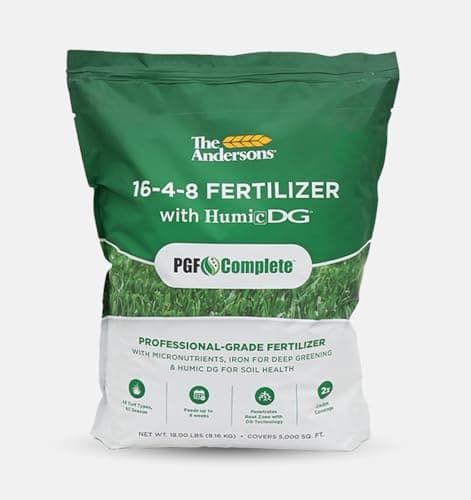
For a high-nitrogen granular option that fits actively growing Bermuda, Pennington Full Season Lawn Fertilizer 32-0-5 is best for homeowners who want strong summer color on established warm-season turf. For a liquid feeding option, Simple Lawn Solutions Advanced 16-4-8 Liquid Fertilizer fits advanced users who want quick response through a hose-end sprayer and can apply light, even rates.
Oklahoma Bermuda Fertilizer Schedule: When to Fertilize Bermuda in Oklahoma
The best Oklahoma Bermuda fertilizer schedule starts after green-up, not on the first warm weekend. Bermuda should be actively growing before nitrogen is applied, because early fertilizer is more likely to feed weeds than dormant turf.
The timing data we track puts Bermudagrass first fertilizer at soil temperatures near 65°F, with peak growth from May through September and dormancy from November through March. That supports a late-spring through late-summer fertilizer program rather than a March feeding program.
The Simple 2026 Oklahoma Bermuda Fertilizer Calendar
A practical statewide Oklahoma Bermuda fertilizer schedule begins with patience in spring, steady feeding in summer, and restraint in fall. Regional weather still matters, so use green-up and growth rate as the final confirmation.
| Timing | Fertilizer Action | Oklahoma Notes |
|---|---|---|
| March to early April | Do not fertilize yet | Focus on pre-emergent timing, mower prep, and soil testing |
| Late April to May | First fertilizer after 50-75% green-up | Wait until Bermuda has been mowed 1-2 times |
| June | Main growing-season feeding | Use slow-release nitrogen if heat is building |
| July | Optional light feeding | Only fertilize irrigated, actively growing turf |
| August | Final main feeding | Favor nitrogen with potassium support |
| September | Optional light potassium-focused application | Avoid heavy nitrogen, especially in northern Oklahoma |
| October through February | No nitrogen fertilizer | Bermuda is entering or in dormancy |
First Spring Fertilizer Timing: Don’t Rush Green-Up
The first spring fertilizer for Bermuda in Oklahoma should go down only after the lawn is mostly green and has been mowed at least once or twice. Soil temperatures should be consistently warm, not just briefly warm during a spring spike.
If the lawn is still mostly brown, wait. Early nitrogen commonly feeds henbit, chickweed, annual bluegrass, and other cool-season weeds while Bermuda roots remain sluggish. Track soil temperature trends and visual green-up instead of relying on a fixed calendar date.
Summer Feeding: How Often to Fertilize Bermuda in Oklahoma
Most common Oklahoma Bermuda lawns need 2-4 lbs of nitrogen per 1,000 sq ft during the growing season, while high-performance irrigated lawns may use 4-5 lbs. Low-input or drought-limited lawns should stay closer to 1-2 lbs.
Our Grass Database recommends 3.5 lbs of nitrogen per 1,000 sq ft annually for Bermudagrass, with a seasonal split of 20% in spring, 80% in summer, and 0% in fall and winter. With slow-release granular fertilizer, feed every 6-8 weeks. With light liquid spoon-feeding, advanced users may feed every 2-4 weeks, but only when turf is watered and actively growing.
- NC State TurfFiles guidance: slow-release nitrogen sources feed turf more evenly and reduce surge growth compared with quick-release products.
Higher nitrogen requires more mowing. If the lawn cannot be mowed often enough to avoid scalping, reduce the fertilizer rate rather than forcing growth.
Late Summer and Fall Fertilizer Strategy
Late-summer Bermuda fertilizer in Oklahoma should shift toward stress conditioning instead of maximum growth. Potassium support, moderate nitrogen, and careful timing help the lawn enter dormancy without excessive tender growth.
The last meaningful nitrogen application is usually late August to early September, depending on weather and location. Northern Oklahoma lawns should stop earlier than southern Oklahoma lawns because cold weather arrives sooner. Related planning topics include Bermuda Grass Fall Care and How to Prepare Bermuda Grass for Winter.
Fertilizing Bermuda During Drought, Heat, and Water Restrictions
Drought Bermuda fertilizer decisions in Oklahoma should begin with turf condition, not the calendar. Heavy nitrogen should be skipped when Bermuda is drought-stressed, off-color from lack of water, or barely growing.
Bermuda is drought tolerant, but drought tolerance does not mean it can use fertilizer without water. According to our watering data, Bermudagrass needs 1 inch per week in summer to support active growth. If that water is not available from rain or irrigation, fertilizer response will be limited and burn risk rises.
Drought Bermuda Fertilizer Rules for Oklahoma Lawns
The core drought rule is simple: do not heavily fertilize drought-stressed Bermuda. Drought-stressed turf often shows a bluish-gray cast, folded leaves, footprints that remain visible, thin crispy patches, straw-like color, or little to no growth.
Nitrogen forces growth the plant cannot support without water. This increases water demand, raises burn risk, and can make thin turf thinner. If the grass is brown because it is dormant from drought, fertilizer is not the fix. Water and renewed growth must come first.
Best Fertilizer Approach During Hot, Dry Periods
The best fertilizer approach during hot, dry Oklahoma weather is to skip nitrogen on unirrigated dormant turf and use only light, slow-release feeding on irrigated, actively growing turf. Avoid applications during extreme afternoon heat.
If the lawn is not irrigated, wait for rainfall and visible growth before fertilizing. If the lawn is irrigated, use light rates, water in properly, and consider potassium if the soil test indicates a need. Iron can improve color without forcing as much top growth. Advanced spoon-feeding should stay around 0.1-0.25 lb nitrogen per 1,000 sq ft only when the lawn is watered and growing.
Watering Fertilizer In Without Wasting It
Fertilizer should be applied to dry foliage and watered in with about 0.25 inches of irrigation unless the product label gives different instructions. This moves nutrients off the blades and into the soil while reducing burn risk.
Do not apply fertilizer before heavy rain, especially on compacted clay soils that shed water quickly. Sweep granules off sidewalks, driveways, and curbs so they do not wash into storm drains. Related planning topics include How Often to Water Bermuda Grass and How to Fix Compacted Lawn Soil.
Step-by-Step Fertilizer Application Plan for Oklahoma Bermuda
A correct fertilizer application plan for Oklahoma Bermuda measures the lawn, calculates actual product rate, applies evenly, waters in, and evaluates the turf response. Most fertilizer problems come from guessing square footage or applying unevenly.
This is where homeowners can borrow from professional turf management without buying professional equipment. The key most homeowners miss is that accuracy matters more than brand loyalty.

Step 1: Measure the Lawn and Calculate the Product Rate
Measure the fertilized lawn area before opening the bag. Multiply length by width for each lawn section, subtract driveways, beds, patios, and structures, then divide total square feet by 1,000.
If a 6,000 sq ft lawn uses a product applied at 4 lbs per 1,000 sq ft, the total product needed is 24 lbs. Guessing often leads to overapplication, striping, burn, or wasted fertilizer.
Step 2: Choose the Right Fertilizer for the Current Season
The right fertilizer changes by season because Bermuda growth rate changes through the year. Spring fertilizer should be slow-release nitrogen after active green-up. Summer fertilizer should balance nitrogen with potassium. Drought fertilizer should be skipped or applied very lightly only if irrigation is reliable.
Late-summer fertilizer should include potassium support where needed, and dormant-season Bermuda should receive no nitrogen. For broader product comparisons, Best Fertilizers for Lawns and Organic vs Synthetic Fertilizers are useful related topics to evaluate release speed and nutrient sources.
Step 3: Apply Evenly With the Right Equipment
Even fertilizer coverage requires the right spreader or sprayer and a steady application pattern. Use a broadcast spreader for medium or large lawns, and use a drop spreader for tight strips near beds and hardscapes.
For granular products, apply half the rate in one direction and the other half perpendicular to reduce streaking. For liquids, calibrate walking speed and spray volume before treating the lawn. Avoid windy days, overlap stripes, and heat-stressed turf. Testing spreader output on a driveway or tarp helps prevent full-lawn mistakes.
Step 4: Water In and Monitor the Lawn Response
After fertilizer application, water according to the label and keep pets and kids off the grass until the lawn has been watered in and the surface is dry. Most Bermuda fertilizer responses appear within 5-14 days, depending on product type, temperature, moisture, and turf health.
Good response shows as improved color, increased density, and more lateral growth. Problems show as streaking, burned tips, patchy green-up, or excessive surge growth. If the response is uneven, check spreader overlap, irrigation coverage, and soil compaction before applying more fertilizer.
Advanced Optimization: Building a High-Performance Bermuda Fertility Program
A high-performance Bermuda fertility program uses nitrogen timing, potassium, iron, mowing, and irrigation together instead of treating fertilizer as a stand-alone fix. Bermuda can handle aggressive summer feeding only when the rest of the maintenance program supports it.
Based on our regional dataset, Bermudagrass roots can reach 72 inches under favorable conditions, but shallow watering, compacted soil, and poor timing reduce real-world rooting. Fertility works best when mowing and irrigation are consistent.
Nitrogen Strategy: Fast Release vs Slow Release
Fast-release nitrogen produces quick color but increases burn risk and surge growth, especially during Oklahoma heat. It works best in small doses during active growth, not as a heavy rescue treatment.
Slow-release nitrogen feeds more steadily and is better for most homeowners. For routine summer applications, look for products with 30-50% slow-release nitrogen when available. This reduces growth spikes and helps maintain color between mowings.
Potassium, Iron, and Micronutrients for Oklahoma Conditions
Potassium supports drought tolerance, traffic recovery, and stress resistance, which makes it valuable for Oklahoma Bermuda lawns under summer pressure. It is especially useful in sandy soils and sports-style lawns with heavy use.
Iron improves green color without pushing excessive blade growth. That is useful in high-pH Oklahoma soils where Bermuda may look pale despite adequate nitrogen. Micronutrients should be added only when soil or tissue testing indicates a need. Repeated micronutrient applications without testing can waste money and complicate soil chemistry.
Fertilizer and Weed Control: What to Coordinate
Fertilizer helps Bermuda suppress weeds by improving density, but weed-control timing must come first in spring. Pre-emergent applications usually belong before spring fertilization because crabgrass and summer annual weeds germinate before Bermuda is fully ready for nitrogen.
Weed-and-feed products are often poorly timed for Bermuda in Oklahoma because the herbicide window and the fertilizer window do not always match. Better related planning topics include Best Pre-Emergent for Bermuda Grass, Bermuda Grass Weed Control Calendar, and How to Kill Crabgrass in Bermuda.
Fertilizer and Mowing Height Work Together
Bermuda fertilizer performance depends on mowing height because more nitrogen creates more growth that must be cut correctly. Our mowing data shows the optimal height for Bermudagrass is 1.0-2.0 inches, with 1.0 inch listed as the minimum mow height.
Common Bermuda usually performs well at 1-2 inches. Hybrid Bermuda can be maintained around 0.5-1.5 inches when the mower and surface quality allow it. Never remove more than one-third of the blade at one mowing. If fertilizer creates growth faster than the mowing schedule can handle, reduce nitrogen.
Common Mistakes to Avoid
The most common Bermuda fertilizer mistakes in Oklahoma are early spring feeding, drought-stress fertilization, soil-test skipping, and careless application around hardscapes, pets, and kids. Many generic guides miss Oklahoma’s weather swings and regional soil differences.
What other guides often miss is the confirmation step. A calendar date alone is not enough. Use green-up percentage, mowing history, soil test results, irrigation status, and visible growth before deciding to fertilize.
Mistake 1: Fertilizing Before Bermuda Is Fully Awake
Fertilizing before Bermuda is fully awake wastes nutrients and often feeds weeds. This mistake is common because a few warm March days can make the lawn look ready even when roots are not actively growing.
The better approach is to wait for 50-75% green-up and at least one or two mowings. If brown dormant turf still dominates the yard, delay the first fertilizer.
Mistake 2: Applying Nitrogen During Drought-Stress
Applying nitrogen during drought stress increases water demand and burn risk. This usually happens when homeowners try to green up a brown lawn during heat or water restrictions.
Confirm active growth before fertilizing. If footprints remain visible, leaves are folded, or the lawn has stopped growing, irrigate first if allowed. Then apply only a light rate once recovery is visible.
Mistake 3: Choosing Fertilizer Without a Soil Test
Choosing fertilizer without a soil test can lead to unnecessary phosphorus, low potassium, or missed pH problems. Pale Bermuda does not always mean nitrogen deficiency.
If the lawn stays pale after proper nitrogen and watering, check soil pH and iron availability. How to Test Your Lawn's Soil and How to Improve Soil pH for Grass are useful related topics before adding more nitrogen.
Mistake 4: Misapplying Products Around Pets, Kids, and Hardscapes
Misapplication causes safety, burn, and runoff problems. Common errors include letting pets onto treated grass before watering and drying, leaving granules on sidewalks, applying before storms, and overlapping spreader passes.
Follow the product label, water in correctly, sweep hard surfaces, and store fertilizer securely. If using compost as part of a fertility plan, Composting for a Healthier Lawn is a related topic worth pairing with soil testing, not replacing it.
Conclusion
The best fertilizer for Bermuda grass in Oklahoma in 2026 is usually a nitrogen-forward, slow-release fertilizer with potassium, chosen from soil test results and applied only while Bermuda is actively growing. For most lawns, that means first feeding after green-up in late April or May, main feeding through summer, reduced nitrogen by late summer or early fall, and no nitrogen during dormancy.
Build the Oklahoma Bermuda fertilizer schedule around soil testing, irrigation reality, drought conditions, mowing capacity, and regional soil differences. Measure the lawn, calculate actual nitrogen, and choose a fertilizer with the right N-P-K ratio, slow-release nitrogen, potassium support, and clear application rate per 1,000 sq ft.
For the next step, look for a 2026 Bermuda grass fertilizer with low or zero phosphorus unless your soil test says otherwise, potassium for stress support, and enough slow-release nitrogen to feed evenly through Oklahoma heat.
Top Picks

As an Amazon Associate we earn from qualifying purchases.
Free Lawn Care Tools
Fertilize Bermuda grass in Oklahoma after it reaches 50-75% green-up and has been mowed once or twice. For most lawns, that means late April or May for the first feeding, with the main fertilizer window running through August.
Most established Oklahoma Bermuda lawns do best with a nitrogen-forward fertilizer that includes potassium, such as 20-0-10, 24-0-11, or 30-0-10. Use low-phosphorus or zero-phosphorus fertilizer unless a soil test shows phosphorus is needed.
Common Oklahoma Bermuda lawns usually need 2-4 lbs of nitrogen per 1,000 sq ft during the growing season. High-performance irrigated lawns may use 4-5 lbs, while drought-limited lawns should stay closer to 1-2 lbs.
Do not heavily fertilize drought-stressed Bermuda. If the lawn is not irrigated and has stopped growing, skip nitrogen until rainfall returns and active growth resumes.
Pale Bermuda can be caused by nitrogen deficiency, high soil pH, poor iron availability, compaction, or drought stress. Confirm with a soil test before adding more nitrogen, especially in high-pH Oklahoma soils.
Bermuda fertilizer usually shows visible color or growth response within 5-14 days when the grass is actively growing and watered correctly. Slow-release products respond more gradually than fast-release nitrogen.
Photos: Clayton800 / Pixabay, thiago japyassu / Pexels, Lisa from Pexels / Pexels

Beat weeds and brown spots from your phone
Snap a photo, get the fix, and follow a plan timed to your soil and weather. Free on iPhone.