Best Fertilizer for St. Augustine Grass in Florida (2026 Top Picks)
 Marcus GreenTurf Management Pro | 18 Years
As an Amazon Associate we earn from qualifying purchases.
If you live in Florida and you are growing St. Augustine grass, you are basically running the most demanding warm-season lawn in the most demanding warm-season climate in the country. That is not a complaint, it is just the reality. St. Augustine is the dominant lawn grass from Pensacola to the Keys for good reason, but it is a hungry, thirsty, pest-prone grass, and Florida amplifies every one of those traits. The sun runs hot for ten months, the rain comes in tropical buckets, the soil is mostly sand, and a good chunk of the state has fertilizer ordinances that tell you flat out when you are not allowed to feed your lawn at all.
I have watched plenty of homeowners do everything "right" by national-guide standards and still end up with a yellow, thinning, chinch-bug-eaten lawn by August. Almost always the problem is that they treated their Florida lawn like a Georgia lawn or a Texas lawn. The fertilizer was fine. The timing, the phosphorus, and the summer nitrogen were the problem. Florida St. Augustine is its own animal, and the fertilizer plan has to respect that.
This guide is built specifically for Florida conditions in 2026: what NPK numbers to look for, which products actually fit the bill, how to schedule feedings around the summer blackout that covers much of the state, and how to fix the yellowing without just dumping more nitrogen on the lawn (which is a great way to invite gray leaf spot). If you are not totally sure your grass is even St. Augustine, run a quick check with our free grass identifier before you buy anything, because the wrong fertilizer plan on the wrong grass wastes both money and a season.
Why Florida St. Augustine Is Different
Three things make Florida a special case, and they all push your fertilizer plan in the same direction: smaller, more frequent, slow-release feedings instead of a few heavy ones.
First, the soil. Most of Florida is sand, sometimes almost pure sand near the coast. Sand drains beautifully and holds nutrients terribly. A heavy dose of fast-release nitrogen on Florida sand mostly washes past the roots and into the aquifer (or the nearest waterway), which is exactly the problem the state's ordinances are trying to solve. Slow-release nitrogen meters itself out over weeks, so the grass actually catches it. Second, the growing season is brutally long. South Florida barely goes dormant, so a lawn there can keep feeding into November when a North Carolina lawn shut down in September. Third, and this is the big one, many Florida counties enforce a summer fertilizer blackout. If you load up on nitrogen the wrong week, you can be technically breaking a local ordinance and also feeding a disease at the same time.
For most Florida yards, a quality slow-release granular is the backbone of the program, with an iron product on hand for color and a liquid for spot feeding. Here are three that cover the vast majority of Florida St. Augustine lawns.
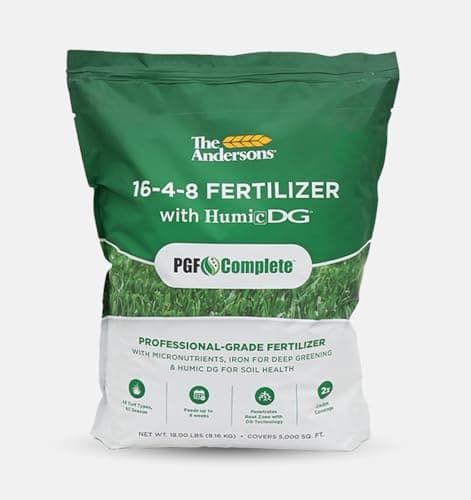
- The Andersons Professional PGF Complete 16-4-8 Fertilizer with 7% Humic DG for your main slow-release feedings (our editor's pick).
- Milorganite All-Purpose Slow-Release Nitrogen 6-4-0 Fertilizer for a gentle, iron-rich organic feeding that will not surge growth.
- Southern Ag Chelated Liquid Iron for the high-pH yellowing that plagues coastal and limestone-soil lawns.
NPK Targets for Florida St. Augustine
St. Augustine wants nitrogen, and a lot of it. UF/IFAS sets the annual target by region: 2 to 4 lbs of nitrogen per 1,000 sq ft in North Florida, 2 to 5 lbs in Central Florida, and 4 to 6 lbs in South Florida, where the grass grows nearly year-round. The key word is "per year," because that total gets split into several light feedings, not delivered in one or two heavy hits.
For the NPK ratio, you want nitrogen as the dominant number, modest potassium, and very little phosphorus. A 16-4-8 or 15-5-10 analysis is the sweet spot. Why the low phosphorus? Two reasons. Florida soils are often already adequate in phosphorus, and the state restricts how much P you can apply to turf unless a soil test shows a genuine deficiency. So unless you have a soil test calling for it, choose a low-P or zero-P product and stay on the right side of the rules.
Potassium matters more in Florida than people give it credit for. It helps with stress, root strength, and disease tolerance, all of which St. Augustine needs in a hot, humid, pest-heavy climate. That 8 or 10 in the third slot of a 16-4-8 or 15-5-10 is doing real work. The one number you do not chase with more fertilizer is color. Florida St. Augustine yellows from iron deficiency far more often than from nitrogen deficiency, and that is a separate fix (more on that below). Pushing nitrogen to green up a yellow lawn in July is one of the most common, and most damaging, mistakes Florida homeowners make.
Top Fertilizers for Florida St. Augustine (2026)
Every product below fits the Florida profile: nitrogen-forward, low or zero phosphorus, and either slow-release or iron-based so you are not surging growth during disease season. The table sorts them by job, and a short note on each follows.
| Product | N-P-K | Type | Best For | Buy |
|---|---|---|---|---|
| The Andersons Professional PGF Complete 16-4-8 Fertilizer with 7% Humic DG | 16-4-8 | Slow-release granular | Main season-long feedings (editor's pick) | Amazon |
| Milorganite All-Purpose Slow-Release Nitrogen 6-4-0 Fertilizer | 6-4-0 | Organic slow-release | Gentle feeding plus iron, no growth surge | Amazon |
| Dark Matter 21-0-0 Ammonium Sulfate Fertilizer | 21-0-0 | Quick N plus iron | Fast spring green-up, zero phosphorus | Amazon |
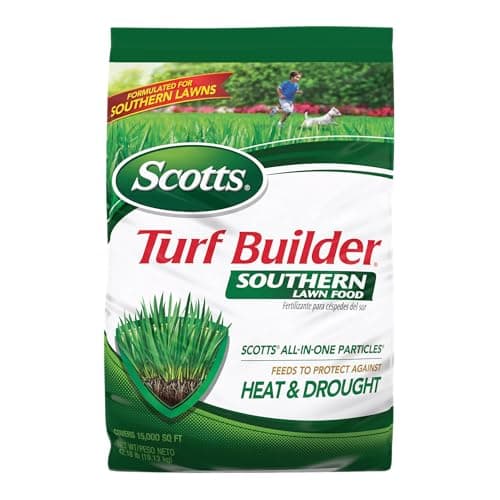
| Scotts Southern Turf Builder Lawn Fertilizer | Southern blend | Granular | The easy big-box pickup | Amazon |
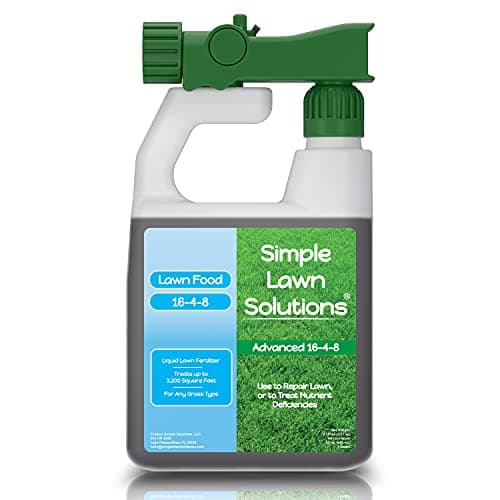
| Advanced 16-4-8 Balanced NPK Liquid Lawn Food | 16-4-8 | Liquid | Spot feeding and quick uptake | Amazon |
| Simple Lawn Solutions Superior 15-0-15 Liquid Fertilizer | 15-0-15 | Liquid | Phosphorus-free feeding under county P rules | Amazon |
| Southern Ag Chelated Liquid Iron | Chelated iron | Liquid supplement | High-pH yellowing (iron chlorosis) | Amazon |
| Ironite II by Pennington Mineral Lawn Supplement 1-0-0 | 1-0-0 | Granular iron | Color without pushing growth | Amazon |
| Espoma Organic All Season Lawn Food | Organic blend | Organic granular | Slow, gentle organic program | Amazon |
| Pennington Full Season Lawn Fertilizer 32-0-5 | 32-0-5 | Granular | Budget pick, zero phosphorus | Amazon |
The Andersons PGF Complete 16-4-8 (editor's pick)
This is the one I reach for first on Florida St. Augustine. The 16-4-8 ratio is textbook for the species, the dispersing granule (DG) technology breaks down into a fine particle that feeds evenly and resists the wash-through problem on sandy soil, and the 7 percent humic content helps the sand actually hold onto nutrients a little longer. The slow-release nitrogen means you are feeding the grass, not the aquifer, which is exactly what Florida sand demands. Use this for your two to four main feedings a year and you have built a solid backbone.
Milorganite 6-4-0
Milorganite is the gentle workhorse. The 6-4-0 is low-octane on purpose, it is slow-release organic nitrogen plus about 2.5 percent iron, so it greens the lawn through color (the iron) rather than a growth surge (the nitrogen). That makes it close to ideal for late spring and early fall in Florida, when you want a healthier, greener lawn without feeding gray leaf spot. The catch is the 4 in the phosphorus slot, so on a P-restricted Florida lawn, treat Milorganite as a supplemental feeding rather than your every-cycle staple unless a soil test clears the phosphorus.
Dark Matter 21-0-0 Ammonium Sulfate plus iron
When the lawn is sluggish coming out of a North Florida winter and you want a fast, clean green-up, ammonium sulfate is the tool. The 21-0-0 delivers quick nitrogen with zero phosphorus (perfect for Florida rules), and the included iron deepens the color fast. Ammonium sulfate is acidifying, which is a quiet bonus on Florida's high-pH coastal and limestone soils because lower pH helps the grass pull iron on its own. Go light, water it in, and do not use it in the dead heat of summer where quick nitrogen invites disease.
Scotts Southern Turf Builder
If you would rather grab a bag on the way home than wait on a shipment, the Scotts Southern blend is the convenient default. It is formulated for southern grasses including St. Augustine and is about as foolproof as a granular gets. It is not the most precisely tuned product for Florida sand, but it works, it is everywhere, and for a homeowner who just wants a reliable feeding it gets the job done.
Advanced 16-4-8 Liquid
A liquid 16-4-8 is your precision tool. Liquids take up fast and are perfect for spot feeding a thin or recovering area, evening out a patchy lawn between granular cycles, or giving a quick boost without committing to a full broadcast. On sandy Florida soil, treat liquids as supplemental rather than your only nitrogen source, because what goes in fast can leach out fast.
Simple Lawn Solutions Superior 15-0-15
Is 15-0-15 good for St. Augustine? In Florida, it is close to purpose-built. The zero in the middle keeps you compliant with the state phosphorus rule without a soil test on file, and the matching potassium number is doing real stress-tolerance work in a climate that piles heat, humidity, and chinch bugs onto the lawn at once. Use it for the shoulder feedings right before the June 1 blackout and right after it lifts in October, when you want balanced nutrition without pushing tender growth into disease season.
Southern Ag Chelated Liquid Iron and Ironite II 1-0-0
These two solve the yellow-lawn problem the right way. The Southern Ag chelated liquid iron is the fast fix you spray when the lawn pales in the heat, and the chelated form stays available even in high-pH soil where ordinary iron locks up. Ironite II 1-0-0 is the granular version for a steadier hand, with essentially no nitrogen so it deepens color without pushing a flush of growth. In a state where iron chlorosis is more common than nitrogen deficiency, having one of these on the shelf saves you from the temptation to over-fertilize.
Espoma Organic All Season and Pennington 32-0-5
Two bookends. The Espoma Organic All Season Lawn Food is for the homeowner who wants a slow, soil-building organic program and is patient with results, which suits Florida fine because gentle and frequent is the right rhythm anyway. The Pennington Full Season 32-0-5 is the budget pick: a high-nitrogen, zero-phosphorus granular that covers a lot of square footage per dollar and keeps you compliant with Florida's phosphorus rules. Just respect the high nitrogen number and apply it lightly so you are not dumping a season's worth of N in one pass.
Application Schedule by Florida Region (2026)
Florida is not one climate, it is at least three when it comes to lawns. The single most important rule statewide: check your county and city fertilizer ordinance before you build a schedule. More than 36 counties and roughly 98 municipalities, including Orange, Hillsborough, Manatee, Polk, and Brevard, enforce a summer blackout that bans nitrogen and phosphorus from June 1 through September 30. Potassium, magnesium, manganese, and iron remain legal all summer, which is exactly how Florida lawns hold color through the blackout. The schedules below assume a typical blackout window, but your local rule is the final word. Want to time the first feeding precisely? The grass wakes up when soil temperatures climb into the mid-60s, and you can check yours with our soil temperature tool rather than guessing by the calendar.
North Florida and the Panhandle (Jacksonville, Tallahassee, Pensacola)
This region has a true winter. The grass goes dormant, often browns out, and should not be fed until it is actively growing again, usually mid-March to early April once soil temperatures are reliably in the mid-60s. Feed once at green-up (a quick-release plus iron like the Dark Matter 21-0-0 works well here), then a slow-release 16-4-8 in late April or May. Pause nitrogen during the summer blackout if your county enforces one. Resume with one feeding in early fall (late September or October) and a final light, potassium-leaning feeding in late October to harden the grass for winter. Stop feeding nitrogen at least a month before your average first frost. Roughly three to four feedings total, landing near 3 lbs of nitrogen for the year.
Central Florida (Orlando, Tampa, Lakeland)
The transition zone of the state. Winters are mild and dormancy is short, so the season runs longer than up north. Start feeding in March once growth resumes, with a slow-release 16-4-8 as the backbone. Get one or two feedings in before the summer blackout, observe the blackout if it applies in your county (the Tampa Bay area counties are strict about this), and lean on iron rather than nitrogen for color through the hottest weeks. Pick the program back up in early fall and feed into October or even November. Plan on four to five feedings spaced roughly every 6 to 8 weeks outside the blackout, targeting 4 lbs of nitrogen for the year.
South Florida (Miami, Naples, Fort Myers)
Here the grass barely sleeps. St. Augustine in South Florida grows nearly year-round, which means more total feedings and the most disciplined attention to the summer blackout, because this is also where disease and chinch-bug pressure peak. Begin the year with a slow-release 16-4-8 in February or March, work in feedings every 6 to 8 weeks, and strictly honor the June-through-September blackout where it applies (Miami-Dade and the coastal counties enforce it). During the blackout, color comes from chelated iron, never nitrogen. After September, resume and you can feed lightly into the winter since the grass keeps growing. This region can comfortably use the upper end of the range, 4 to 6 lbs of nitrogen for the year, spread across five or more light feedings. The high-pH limestone soils common down here also make iron supplementation close to mandatory.
Cultivar Notes: Floratam Is Not the Only St. Augustine
Most Florida lawns are Floratam, which wants a 3.5 to 4 inch mowing height and the standard feeding program above. CitraBlue, the newer UF release, runs shorter at 2 to 3 inches and carries better shade and disease tolerance, so it looks good on slightly less nitrogen. Palmetto sits in between at 3 to 4 inches, and dwarf types like Seville stay at 2 to 2.5 inches. The fertilizer plan barely changes between them, but the mowing height does, and scalping a dwarf cultivar or crew-cutting Floratam stresses the lawn more than any fertilizer mistake will.
Common Florida St. Augustine Problems
Problem: Yellowing in summer (iron chlorosis)
The most common Florida St. Augustine complaint, and the most commonly misdiagnosed. On high-pH coastal and limestone soils, the grass cannot pull enough iron even when iron is present in the soil, so it pales to a sickly yellow-green between the veins. The instinct is to throw nitrogen at it. Do not. More nitrogen in summer green-ups for a week and then sets you up for disease. The fix is iron: a chelated liquid like Southern Ag for a fast response, or a granular like Ironite II for a steadier hand. You get the color back without the growth surge, and an acidifying product like ammonium sulfate over time can lower pH enough that the grass pulls its own iron.
Problem: Chinch bugs chewing out the sunny spots
Chinch bugs are the number-one pest of Floratam, the dominant Florida cultivar, and they love hot, dry, sunny patches, often right along sidewalks and driveways. The damage looks like irregular yellow-to-brown patches that you might mistake for drought or disease. Here is the fertilizer connection: over-fertilized, lush, nitrogen-pushed turf is exactly what chinch bugs feast on. Keeping nitrogen moderate and using slow-release products makes the lawn less of a buffet. Scout the sunny edges in summer (part the grass and look for the small black-and-white bugs), and treat with an appropriate insecticide if you find them. No amount of fertilizer cures a chinch-bug infestation.
Problem: Gray leaf spot in the summer heat
Gray leaf spot is a fungal disease that flares in exactly the conditions Florida serves up all summer: heat, humidity, and a lush, fast-growing lawn. The single biggest driver you control is summer nitrogen. Excess nitrogen during the hot, wet months feeds the disease as surely as it feeds the grass, producing tender new growth the fungus loves. This is the agronomic reason behind the summer blackout, beyond just nutrient runoff. Hold the nitrogen through summer, use iron for color instead, water in the early morning so blades dry fast, and the disease has far less to work with.
Problem: Take-all root rot thinning the lawn
Take-all root rot is a stealthier summer disease that attacks the roots and stolons, leaving the lawn thin, weak, and slow to recover, often in irregular yellowing patches that do not bounce back with watering. Stressed, over- or under-fertilized turf on high-pH soil is most vulnerable. The management overlaps neatly with everything else here: keep nitrogen moderate and slow-release, lower soil pH over time with acidifying products like ammonium sulfate, avoid overwatering, and do not scalp the grass. A healthy, properly fed root system is the best defense, which is one more reason the light-and-frequent Florida approach pays off.
Problem: Nutrients washing straight through the sand
Florida's sandy soil is a colander for nutrients. A heavy dose of fast-release fertilizer largely leaches past the root zone within a couple of rains, wasting your money and contributing to the runoff the ordinances target. The solution is built into every recommendation above: choose slow-release nitrogen, feed lighter and more often instead of heavy and rarely, and add organic matter (the humic content in PGF Complete, or an organic product like Espoma or Milorganite) to help the sand hold onto what you apply.
Application Tips for Florida Conditions
A few habits separate a great Florida lawn from a frustrating one:
- Check your local ordinance first, every year. Rules change, and the summer blackout window varies by county and city. A quick search for your county's fertilizer ordinance saves you a fine and a diseased lawn.
- Go light and frequent. Florida rule 5E-1.003 caps a single application at 1 lb of nitrogen per 1,000 sq ft, with no more than 0.7 lb from quick-release sources; 2 lbs is allowed only when at least 65 percent of the nitrogen is controlled-release. On Florida sand, lean toward 0.5 lb per pass anyway. On Florida sand, two half-doses beat one full dose every time.
- Water it in, but do not flood it. A quarter inch of water after a granular feeding moves nutrients into the root zone. Dumping an inch of water (or fertilizing right before a downpour) just sends it through the sand.
- Use iron for color, nitrogen for growth. If the lawn is yellow but growing fine, that is an iron call, not a nitrogen call. This single distinction prevents most summer disease problems.
- Feed by soil temperature, not the calendar. Wait until the grass is actively growing in spring, and stop nitrogen well before dormancy up north. Our soil temperature tool takes the guesswork out.
- Mow high and keep the blade sharp. St. Augustine wants to be cut tall (3.5 to 4 inches). A taller, well-fed lawn shades out weeds and resists chinch bugs and disease better than a scalped one.
- Calibrate your spreader. Guessing the spread rate is how lawns get striped, burned, or underfed. Match the setting on the bag to your spreader, and do a test pass.
Conclusion
Florida St. Augustine is demanding, but it is not complicated once you accept that the Florida rules are different. Pick a nitrogen-forward, low-phosphorus, slow-release fertilizer like the PGF Complete 16-4-8, aim for 3 to 5 lbs of nitrogen a year split into light and frequent feedings, keep iron on the shelf for the summer yellows, and respect your county's summer blackout. Do those four things and you sidestep the chinch bugs, the gray leaf spot, and the runoff that trip up most homeowners. For the deeper agronomy that applies to St. Augustine anywhere in the country, including buying guides and ratio breakdowns, see our national Best Fertilizer for St. Augustine Grass (2026 Guide), and for the full care picture (mowing heights, varieties, watering) start with our St. Augustine grass care guide. And if you are still not 100 percent sure you are even working with St. Augustine, take ten seconds with our free grass identifier before you spend a dollar on fertilizer.
Free Lawn Care Tools
Start feeding once the grass is actively growing in spring, which is usually February or March in South Florida and mid-March to April in North Florida and the Panhandle once soil temperatures reach the mid-60s. Feed lightly every 6 to 8 weeks during active growth, then pause nitrogen during your county's summer blackout (often June through September). Resume in early fall and stop nitrogen well before winter dormancy in the northern part of the state.
Look for a nitrogen-forward, low- or zero-phosphorus, slow-release product such as 16-4-8 or 15-5-10. Florida soils are usually already adequate in phosphorus and the state restricts how much you can apply to turf, so avoid high-P blends unless a soil test calls for it. The potassium (the third number) matters for stress and disease tolerance in Florida's heat, so do not skip it.
In Florida, summer yellowing is usually iron chlorosis from high-pH coastal or limestone soils, not a nitrogen shortage. Adding more nitrogen makes it worse by feeding gray leaf spot disease. Use a chelated iron product like Southern Ag for a fast fix or a granular iron supplement like Ironite II for color, since iron greens the lawn without forcing a growth surge.
Be very careful. Many weed-and-feed products contain herbicides that can damage St. Augustine, and applying nitrogen during a summer blackout can violate local ordinances and feed disease. If you need to address weeds, it is usually safer to treat the weeds and feed the lawn separately so you can control the timing and the herbicide choice. Always confirm the product label says it is safe for St. Augustine.
Many Florida counties and cities, especially coastal ones, enforce a summer blackout that bans applying nitrogen and phosphorus fertilizer roughly from June through September. The exact dates and rules vary by location, so check your specific county and city ordinance every year before you build a schedule. The ban exists to reduce nutrient runoff into waterways and it also happens to reduce summer lawn disease.
Hold off on regular fertilizer until the new sod has rooted, usually about three to four weeks after installation, then begin with a light slow-release feeding rather than a heavy dose. Water the new sod frequently while it establishes, but feed gently so you do not push tender growth that invites disease or burns the young roots. Skip any application that would fall inside your county's summer blackout window.
Yes, especially in Florida. 15-0-15 skips phosphorus, which Florida soils rarely need and rule 5E-1.003 restricts, and pairs nitrogen with equal potassium for root strength and stress tolerance. It is a strong choice for the feedings just before the June 1 blackout and just after it lifts in October.

Your lawn plan, in your pocket all season
Grass ID, a season plan, soil-timed reminders, and a lawn journal that remembers what you did. Free on iPhone.